
Pre Calculus Equations: 9 Things Nobody Tells You 🔢✨
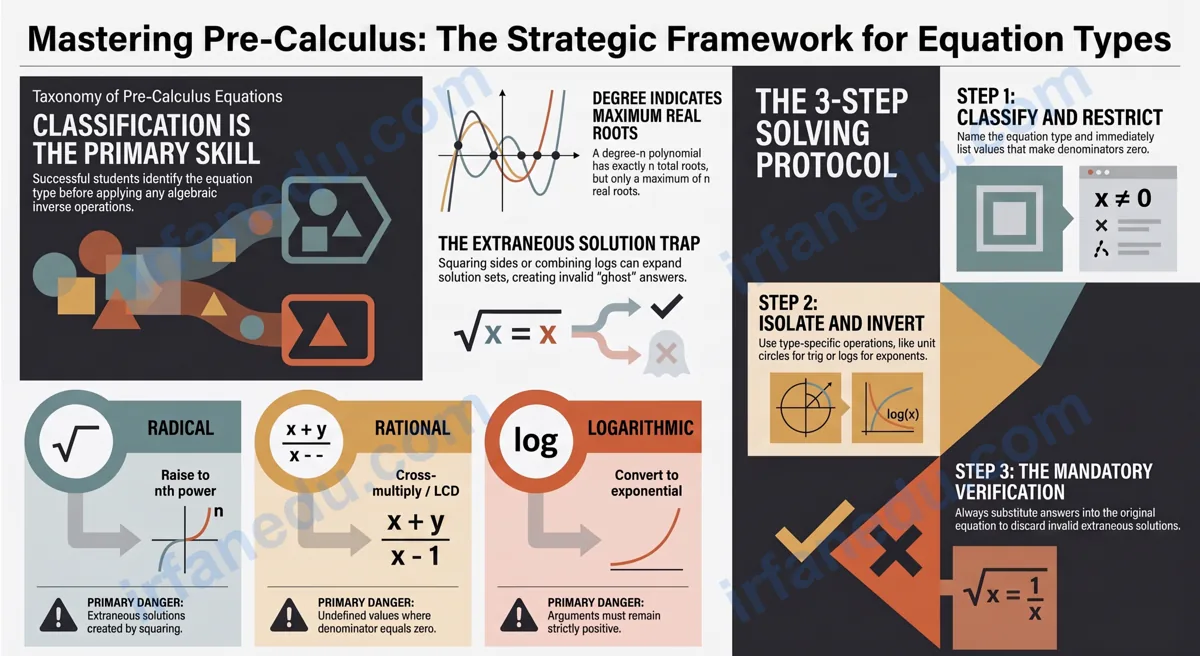
Most students hit precalculus and feel like someone quietly changed the rules. Algebra made sense. Now suddenly there are logarithms, unit circles, and equations that spit out infinitely many solutions. The problem is not that precalculus is impossibly hard — it is that most guides list the equation types without telling you the non-obvious traps inside each one.
In my 15+ years of teaching math, I have watched students lose points not because they could not do the algebra, but because they did not know which type of equation they were looking at or when to check for extraneous solutions. This guide fixes that.
Pre calculus equations are the nine core equation types — polynomial, rational, radical, exponential, logarithmic, trigonometric, absolute value, piecewise, and parametric — that students must solve fluently before entering calculus. Each type has a specific solving strategy, a specific domain restriction to watch for, and a specific way it connects to its graph.
- 🎯 Identify all nine pre calculus equation types by sight
- 🔑 Apply the correct inverse operation for each type
- ⚠️ Spot and eliminate extraneous solutions every time
- 📝 Use the free printable worksheet to practice all nine types
- 🏆 Walk into your precalculus exam with genuine confidence
Pre calculus equations are algebraic and transcendental equations — including polynomial, rational, radical, exponential, logarithmic, and trigonometric forms — that students solve before entering calculus. Mastering them requires knowing which inverse operation to apply first, how to check for extraneous solutions, and how each equation type connects to its graph. There are nine core types in a standard precalculus course.
12 problems covering all 9 pre calculus equation types — with a full answer key. Print it, solve it, check it.
⚡ TL;DR – Quick Summary
- 🔢 There are 9 core pre calculus equation types you must master
- 🔍 Equation-type recognition is the #1 skill — identify before you solve
- ⚠️ Extraneous solutions appear in radical, rational, and logarithmic equations — always check
- 📐 Trig equations produce multiple solutions — use the unit circle, not a calculator
- 📊 Exponential and log equations are inverses of each other — know both directions
- 📝 Use the free worksheet below to practice all 9 types in one session
| Equation Type | Key Feature | Inverse Operation | Watch Out For |
|---|---|---|---|
| Polynomial | Variable raised to whole-number powers | Factor / Quadratic formula | Multiple roots |
| Rational | Variable in denominator | Cross-multiply / LCD | Undefined values (denominator = 0) |
| Radical | Variable under a root | Raise both sides to nth power | Extraneous solutions |
| Exponential | Variable in exponent | Take logarithm of both sides | Base must be positive, not 1 |
| Logarithmic | log or ln of variable | Convert to exponential form | Argument must be positive |
| Trigonometric | sin, cos, tan of variable | Inverse trig + unit circle | Infinitely many solutions |
| Absolute Value | |expression| = value | Split into two cases | Negative right-hand side (no solution) |
| Piecewise | Different rules for different domains | Solve each piece separately | Boundary point validity |
| Parametric | x and y both depend on parameter t | Eliminate parameter t | Restricted domain of t |
🧮 What Are Pre Calculus Equations, Exactly?
Pre calculus equations are mathematical statements that set two expressions equal to each other, where the expressions involve functions studied in the precalculus curriculum. Solving them means finding every value of the variable that makes the statement true.
The word “precalculus” is a curriculum label, not a mathematical category. It groups together the equation types that students need to handle fluently before calculus introduces limits, derivatives, and integrals. According to Khan Academy’s Precalculus curriculum, the course builds directly on algebra and prepares students for calculus by deepening their understanding of functions and their equations.
The key insight that most textbooks bury: every pre calculus equation type is defined by the function it involves. A polynomial equation involves a polynomial function. A logarithmic equation involves a logarithmic function. Know the function, know the equation type, know the strategy.
In my experience teaching precalculus, the students who struggle most are not bad at algebra — they are bad at classification. They see an equation and immediately start moving symbols around without asking “what kind of equation is this?” That one habit change — classify first, solve second — raises scores faster than any amount of extra practice.
🔟 9 Things Nobody Tells You About Pre Calc Equations
These are the nine non-obvious truths I wish every student heard on day one of precalculus. Each one addresses a specific equation type and the hidden trap inside it.
🔢 Polynomial Equations: “Degree = Number of Roots” Is Only Half True
The Fundamental Theorem of Algebra says a degree-n polynomial has exactly n roots counting complex roots and multiplicity. Most guides stop there. What they skip: a degree-4 polynomial can have 0, 2, or 4 real roots. The degree tells you the maximum number of real roots, not the guaranteed number.
Solve: x⁴ + 4 = 0
x⁴ = -4 — this has no real solutions because x⁴ is always ≥ 0. All four roots are complex. A student who expects “4 real roots because degree 4” will waste time searching for them.
➗ Rational Equations: The Denominator Is a Domain Restriction, Not Just a Number
When you solve a rational equation, you must state the values that make the denominator zero before you start solving. These are excluded from the solution set. If your final answer equals one of those excluded values, it is extraneous — throw it out.
Solve: (x – 1)/(x + 2) = 3
Restriction: x ≠ -2
Cross-multiply: x – 1 = 3(x + 2) → x – 1 = 3x + 6 → -2x = 7 → x = -7/2
Check: -7/2 ≠ -2 ✓ and (-7/2 – 1)/(-7/2 + 2) = (-9/2)/(-3/2) = 3 ✓
√ Radical Equations: Squaring Both Sides Creates Solutions That Were Never There
When you square both sides to remove a square root, you may introduce extraneous solutions. This is not a mistake — it is a mathematical consequence of squaring. The fix is simple: always substitute your answer back into the original equation, not the squared version.
Solve: sqrt(x + 5) = 4
Square both sides: x + 5 = 16 → x = 11
Check: sqrt(11 + 5) = sqrt(16) = 4 ✓ Valid solution.
Now try: sqrt(x + 5) = -4. Squaring gives x = 11 again — but sqrt(16) = 4, not -4. Extraneous!
📈 Exponential Equations: You Have Two Strategies, and Most Students Only Know One
Strategy 1: rewrite both sides with the same base (works when both sides are powers of the same number). Strategy 2: take the logarithm of both sides (works always). Most students only learn Strategy 2. But Strategy 1 is faster and cleaner when it applies.
Solve: 3^(2x – 1) = 27
Rewrite: 27 = 3³, so 3^(2x – 1) = 3³
Same base → exponents equal: 2x – 1 = 3 → 2x = 4 → x = 2 ✓
Solve: 2^x = 7
Take log of both sides: x·ln(2) = ln(7) → x = ln(7)/ln(2) ≈ 2.807
📉 Logarithmic Equations: The Domain Restriction Is the Trap Nobody Warns You About
The argument of any logarithm must be strictly positive. This is not optional. When you solve a logarithmic equation and get a numerical answer, you must verify that the answer makes every log argument positive. If it does not, the solution is extraneous.
Solve: log(x) + log(x – 3) = 1
Combine: log(x(x-3)) = 1 → x(x-3) = 10 → x² – 3x – 10 = 0 → (x-5)(x+2) = 0
Solutions: x = 5 or x = -2
Check x = -2: log(-2) is undefined. Extraneous! ✗
Check x = 5: log(5) + log(2) = log(10) = 1 ✓ Valid.
🌊 Trigonometric Equations: “One Answer” Is Almost Always Wrong
When you solve sin(x) = 1/2, your calculator gives you one answer. But there are infinitely many. On a restricted interval like [0, 2π), there are typically two. Most students write one answer and lose half the marks. The unit circle shows you both.
         π/2 (top)
          |
  sin=1/2 at π/6 (30°)  ←── Quadrant I
  sin=1/2 at 5π/6 (150°) ←── Quadrant II

          Unit Circle
     Q II  |  Q I
     ------+------
     Q III | Q IV

  sin is POSITIVE in Q I and Q II
  So: x = π/6  AND  x = 5π/6  (for 0 ≤ x < 2π)
| | Absolute Value Equations: A Negative Right-Hand Side Means Zero Solutions
|expression| = negative number has no solution, because absolute value is always ≥ 0. This is obvious once you hear it — but students who rush will split it into two cases and solve both, producing two wrong answers. Check the right-hand side first.
Solve: |2x - 3| = 7
Case 1: 2x - 3 = 7 → 2x = 10 → x = 5
Case 2: 2x - 3 = -7 → 2x = -4 → x = -2
Both valid. Check: |2(5)-3| = |7| = 7 ✓ and |2(-2)-3| = |-7| = 7 ✓
📊 Piecewise Equations: You Must Verify the Solution Lives in the Right Domain
A piecewise function uses different formulas for different intervals. When you solve a piecewise equation, you solve each piece separately — but you must check that the solution falls inside the domain interval for that piece. A solution from the wrong piece is invalid.
Solve f(x) = 5, where f(x) = {2x + 1 if x < 2; x² - 1 if x ≥ 2}
Piece 1 (x < 2): 2x + 1 = 5 → x = 2. But x = 2 is NOT in x < 2. Invalid.
Piece 2 (x ≥ 2): x² - 1 = 5 → x² = 6 → x = sqrt(6) ≈ 2.449. Is sqrt(6) ≥ 2? Yes. ✓
🎯 Parametric Equations: Eliminating the Parameter Changes the Domain
When you eliminate the parameter t to get a Cartesian equation, you often get a curve that extends further than the original parametric path. The Cartesian equation is correct algebraically, but you must restrict its domain to match the original range of t. Skipping this step means your graph shows more curve than actually exists.
x = t², y = t, for t ∈ [0, 3]
Eliminate t: t = y, so x = y²
Cartesian form: x = y² — a parabola. But the original only covers t ∈ [0, 3], so y ∈ [0, 3] and x ∈ [0, 9]. Restrict accordingly.
🪜 How to Solve Pre Calculus Equations: A 5-Step Framework
This five-step framework works for every equation type. I teach it to every student on day one, and it eliminates the most common errors immediately.
- Classify the equation type. Look at the equation and name it: polynomial, rational, radical, exponential, logarithmic, trigonometric, absolute value, piecewise, or parametric. Do not skip this step.
- State any domain restrictions. Write down values that would make a denominator zero, a log argument non-positive, or a square root negative. These are excluded from the solution set before you start.
- Isolate the variable expression. Use inverse operations to get the variable expression alone on one side of the equation.
- Apply the type-specific inverse operation. Factor for polynomials. Convert to exponential form for logs. Use the unit circle for trig. Split into cases for absolute value.
- Check every solution in the original equation. Substitute back. Discard any extraneous solutions. Write your final answer set.
| Feature | Exponential Equation | Logarithmic Equation |
|---|---|---|
| Form | b^x = c | log_b(x) = c |
| Variable location | In the exponent | Inside the log argument |
| Inverse operation | Take log of both sides | Convert to b^c = x |
| Domain restriction | b > 0, b ≠ 1 | Argument must be > 0 |
| Extraneous solutions? | Rarely | Yes — always check |
| Number of solutions | Usually one | Usually one (after checking) |
🚫 Common Mistakes in Pre Calculus Equations (Wrong vs. Right)
These are the five mistakes I see most often on student work. Each one has a clear fix.
Wrong: sqrt(2x - 1) = -3 → square both sides → 2x - 1 = 9 → x = 5 ✓ (student writes this as the answer)
Right: Check: sqrt(2(5)-1) = sqrt(9) = 3 ≠ -3. Extraneous! No real solution.
Wrong: sin(x) = 1/2 → x = π/6 only
Right: x = π/6 AND x = 5π/6 (for 0 ≤ x < 2π), because sin is positive in both Q I and Q II.
Wrong: (x² - 4)/(x - 2) = 0 → cancel (x-2) → x + 2 = 0 → x = -2 only
Right: Factor numerator: (x-2)(x+2)/(x-2) = 0. Note x ≠ 2 (denominator restriction). Cancel carefully: x + 2 = 0 → x = -2. Valid. x = 2 is excluded.
Wrong: log(x + 3) = log(x) + log(3)
Right: log(a + b) has no simplification. Only log(a·b) = log(a) + log(b).
Wrong: Solve each piece, keep all answers
Right: Solve each piece, then verify each answer falls in that piece's domain interval. Discard those that do not.
Most precalculus guides treat extraneous solutions as a minor footnote: "remember to check your answer." But in my experience, the deeper issue is that students do not understand why they appear — and that misunderstanding causes them to check inconsistently.
Here is the real reason: certain solving operations are not reversible. Squaring both sides is the classic example. The equation sqrt(x) = -2 has no solution. But if you square both sides, you get x = 4 — a perfectly valid number that satisfies x = 4 but NOT the original equation. You have solved a different, broader equation (one that includes both sqrt(x) = 2 and sqrt(x) = -2).
The same logic applies to logarithmic equations: combining logs via the product rule expands the domain of the equation you are solving. The same applies to clearing denominators in rational equations.
The fix that actually works: instead of just "checking at the end," teach yourself to ask before each operation — "does this operation expand the solution set?" If yes, flag it, and plan to verify. This turns checking from a chore into a deliberate, understood step. Students who understand why extraneous solutions appear check every single time, automatically.
📝 On-Page Practice Worksheet: Pre Calculus Equations
These 12 problems cover all nine equation types, ordered from easier to harder. Solve each one on paper, then reveal the answer key below. For a print-ready version with space to show your work, download the PDF above.
How to use this worksheet: Work through each problem without looking at the answer key. Show every step. After finishing, open the answer key and check each one. For any you got wrong, re-read the relevant section above before trying again.
- Solve: 2x^2 - 8 = 0
- Solve: x^2 - 5x + 6 = 0
- Solve: (x - 1)/(x + 2) = 3
- Solve: sqrt(x + 5) = 4
- Solve: 2^x = 32
- Solve: log2(x) = 4
- Solve: |2x - 3| = 7
- Solve: sin(x) = 1/2 for 0 <= x < 2*pi
- Solve: 3^(2x - 1) = 27
- Solve: log(x) + log(x - 3) = 1
- Solve: (x^2 - 4)/(x - 2) = 0
- Solve: 2*sin^2(x) - sin(x) - 1 = 0 for 0 <= x < 2*pi
✅ Show Answer Key
- x = 2 or x = -2
- x = 2 or x = 3
- x = -7/2
- x = 11
- x = 5
- x = 16
- x = 5 or x = -2
- x = pi/6 or x = 5*pi/6
- x = 2
- x = 5 (x = -2 is extraneous — log(-2) is undefined)
- x = -2 (x = 2 is excluded because denominator = 0)
- x = 3*pi/2, x = pi/6, x = 5*pi/6
Download the free PDF worksheet — same 12 problems, formatted for printing, with a separate answer key section at the end.
🧠 Quick Quiz: Test Your Pre Calculus Equations Knowledge
Q1. You solve sqrt(3x + 1) = -5 and get x = 8. What should you do?
Q