
1 Step Equations Worksheet: Free Printable PDF + Full Lesson
📋 Table of Contents
- Quick Answer
- Your 5-Step Action Checklist
- What Is a One-Step Equation?
- Why This Skill Matters
- Step-by-Step: How to Solve Any One-Step Equation
- 3 Fully Worked Examples
- Common Mistakes (Wrong vs. Right)
- Unique Insight: What Most Guides Get Wrong
- On-Page Practice Worksheet (10 Problems)
- Quick Quiz
- FAQ
- Key Takeaways
- Related Articles
- About the Author
- Sources & References
If your student is staring at x + 7 = 15 and has no idea where to start, you are in the right place. One-step equations are the very first algebra skill — and getting them rock-solid now makes every future math topic easier. This page gives you a clear lesson, three fully worked examples, a 10-problem printable worksheet, and a downloadable PDF with a complete answer key.
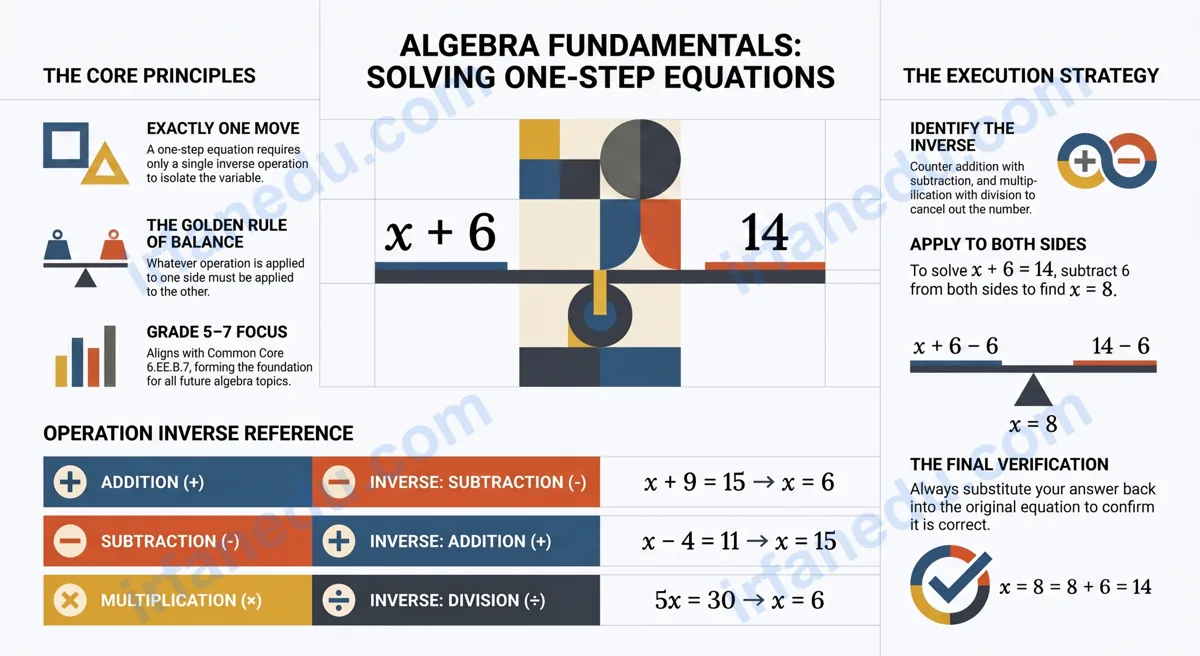
A one-step equation is an algebraic equation solved by applying exactly one inverse operation to both sides. The goal is always the same: isolate the variable. Master this single idea and you hold the key to all of algebra.
- ✅ Understand what a one-step equation is and how it works
- ✅ Apply the correct inverse operation every time
- ✅ Avoid the three most common mistakes students make
- ✅ Practice with 10 graded problems and check your work with the answer key
- ✅ Download a print-ready PDF to use offline or in class
10 problems · Answer key included · Print-ready · Grade 5–7
⚡ TL;DR – Quick Summary
- ✅ One-step equations need exactly one inverse operation to solve.
- ✅ The four types: addition, subtraction, multiplication, and division equations.
- ✅ Always apply the inverse to both sides — never just one side.
- ✅ Always check your answer by substituting it back into the original equation.
- ✅ This worksheet has 10 problems ordered easy to hard, with a full answer key.
- ✅ Download the free PDF to print and practice offline.
🗒️ Your 5-Step Action Checklist for One-Step Equations
Use this checklist every time you solve a problem. I walk through each step in detail below.
- Step 1 — Read the equation: Write it down clearly. Identify the variable.
- Step 2 — Spot the operation: Is the variable being added to, subtracted from, multiplied by, or divided by a number?
- Step 3 — Choose the inverse: Addition ↔ Subtraction. Multiplication ↔ Division.
- Step 4 — Apply to both sides: Do the inverse operation to the left side AND the right side.
- Step 5 — Check your answer: Substitute back into the original equation and confirm both sides match.
| Fact | Detail |
|---|---|
| Grade Level | Grade 5, 6, 7 (Common Core 6.EE.B.7) |
| Number of Operations Needed | Exactly 1 |
| Four Equation Types | Addition, Subtraction, Multiplication, Division |
| Key Principle | Whatever you do to one side, do to the other |
| Check Method | Substitute answer back into original equation |
| Worksheet Problems | 10 (ordered easy to hard) |
| Download | Free PDF with answer key |
What Is a One-Step Equation?
A one-step equation is an algebraic equation that requires exactly one inverse operation to isolate the variable. The variable is a letter (like x, y, or n) that represents an unknown number you need to find.
Think of an equation as a perfectly balanced scale. Both sides must always stay equal. When you do something to one side, you must do the exact same thing to the other side — that is the golden rule of algebra.
x + 6 = 14The variable x has 6 added to it. To undo that, subtract 6 from both sides:
x + 6 - 6 = 14 - 6x = 8
That single subtraction step is the only operation needed. That is why it is called a one-step equation.
  BALANCE SCALE MODEL

     x + 6          =         14
  ___________              ___________
  |         |              |         |
  |  x  [6] |   balanced   |   14    |
  |_________|              |_________|

  Remove [6] from BOTH sides:

     x              =          8
  ___________              ___________
  |         |              |         |
  |    x    |   balanced   |    8    |
  |_________|              |_________|

  ✓  x = 8
Why Does This Skill Matter for Students?
One-step equations are the foundation of all algebra. Every multi-step equation, system of equations, and quadratic you will ever solve uses this same core idea: isolate the variable using inverse operations.
In my experience teaching algebra to hundreds of middle school students, the ones who struggle with two-step and three-step equations almost always have a shaky understanding of one-step equations. They rush past this topic too quickly. Spending 30 extra minutes here pays off for years.
One-step equations also appear directly on standardised tests at the Grade 6–8 level. Knowing them cold means free marks — no guessing, no partial credit needed.
How to Solve Any One-Step Equation: Step-by-Step
Follow these four steps for every single one-step equation you encounter. The process never changes — only the numbers do.
- Identify the variable — the letter you are solving for (e.g., x).
- Identify the operation applied to the variable (add, subtract, multiply, or divide).
- Apply the inverse operation to both sides — this cancels the operation and leaves the variable alone.
- Check — substitute your answer back into the original equation to verify.
| Operation on Variable | Inverse to Apply | Example | Solution |
|---|---|---|---|
| Addition (+) | Subtract (-) | x + 9 = 15 | x = 6 |
| Subtraction (-) | Add (+) | x – 4 = 11 | x = 15 |
| Multiplication (×) | Divide (÷) | 5x = 30 | x = 6 |
| Division (÷) | Multiply (×) | x / 3 = 7 | x = 21 |
3 Fully Worked Examples (With Checking)
These three examples cover the most common equation types you will see on the worksheet. Read each one carefully before you start practising.
Example 1 — Addition Equation
Step 1: Variable is a. Operation: +11.
Step 2: Inverse of addition is subtraction. Subtract 11 from both sides.
a + 11 - 11 = 20 - 11
a = 9
Check: 9 + 11 = 20 ✓
Example 2 — Multiplication Equation
Step 1: Variable is p. Operation: multiply by 7.
Step 2: Inverse of multiplication is division. Divide both sides by 7.
7p / 7 = 49 / 7
p = 7
Check: 7 × 7 = 49 ✓
Example 3 — Division Equation with a Decimal Coefficient
Step 1: Variable is k. Operation: multiply by 2.5.
Step 2: Divide both sides by 2.5.
2.5k / 2.5 = 15 / 2.5
k = 6
Check: 2.5 × 6 = 15 ✓
Notice that Example 3 uses a decimal coefficient. Many students panic when they see decimals, but the method is identical. Divide both sides by the coefficient — done.
Common Mistakes Students Make (Wrong vs. Right)
These are the three errors I see most often when grading student work. Knowing them in advance helps you avoid them completely.
| ❌ Wrong | ✅ Right | Why It Matters |
|---|---|---|
| x + 5 = 12 → x = 12 + 5 = 17 | x + 5 = 12 → x = 12 – 5 = 7 | Apply the INVERSE, not the same operation. |
| 3x = 18 → x = 18 – 3 = 15 | 3x = 18 → x = 18 ÷ 3 = 6 | Multiplication is undone by division, not subtraction. |
| x – 8 = 5 → subtract 8 from right side only → x = -3 | x – 8 = 5 → add 8 to BOTH sides → x = 13 | The inverse must be applied to both sides to keep balance. |
Most worksheets and textbooks only present one-step equations with positive whole numbers. That works fine for the first lesson, but it creates a hidden problem: students learn a pattern rather than a principle. When they later see x + (-5) = 3 or 2.5k = 15, they freeze — because the pattern breaks but the principle does not.
In my experience, the fix is to introduce at least one negative-integer equation and one decimal equation in the very first worksheet. That is exactly what problems 9 and 10 on this worksheet do. Students who see these early almost never struggle with them later. Students who only practise with clean whole numbers often need re-teaching when negatives appear in Grade 7.
📝 On-Page Practice Worksheet — 10 Problems
These 10 problems are ordered from easy to hard. Try to solve each one on paper before checking the answer key. Show your inverse operation step — do not just write the answer.
- x + 4 = 9
- y – 3 = 7
- a + 11 = 20
- b – 8 = 5
- 3n = 18
- m / 4 = 5
- 7p = 49
- z / 6 = 8
- x + (-5) = 3
- 2.5k = 15
🔑 Show Answer Key
- x = 5
- y = 10
- a = 9
- b = 13
- n = 6
- m = 20
- p = 7
- z = 48
- x = 8
- k = 6
Includes all 10 problems + full answer key · Print-ready A4/Letter
🧠 Quick Quiz: Test Your Knowledge
Answer these three questions to check your understanding before moving on.
One-Step Equations Quiz
Q1. What is the solution to x + 7 = 15?
Q2. To solve 4x = 36, which operation do you apply to both sides?
Q3. A student solves y – 6 = 9 and gets y = 3. What did they do wrong?
✅ Reveal Answers
Q1: B — x = 8 (subtract 7 from both sides: 15 – 7 = 8).
Q2: C — Divide by 4 (4x ÷ 4 = 36 ÷ 4 → x = 9).
Q3: B — The inverse of subtracting 6 is adding 6. Correct answer: y = 9 + 6 = 15.
❓ Frequently Asked Questions
What is a one-step equation?
A one-step equation is an algebraic equation that requires exactly one inverse operation to isolate the variable and find its value. Examples include x + 5 = 12 (subtract 5 from both sides) and 3x = 21 (divide both sides by 3). The defining feature is that only one operation stands between the variable and its solution.
What grade level is this one-step equations worksheet for?
This worksheet targets Grade 5, 6, and 7 students who are beginning algebra. It aligns with Common Core State Standards for 6th grade (6.EE.B.7), which requires students to solve real-world and mathematical problems by writing and solving equations of the form x + p = q and px = q. It also works well as a Grade 7 review or a Grade 5 enrichment activity.
What are the four types of one-step equations?
The four types are: (1) Addition equations — x + a = b, solved by subtracting a from both sides. (2) Subtraction equations — x – a = b, solved by adding a to both sides. (3) Multiplication equations — ax = b, solved by dividing both sides by a. (4) Division equations — x/a = b, solved by multiplying both sides by a. This worksheet includes all four types.
How do you check your answer to a one-step equation?
Substitute your answer back into the original equation and verify both sides are equal. For example, if you solved x + 4 = 9 and got x = 5, check: 5 + 4 = 9. Since 9 = 9, the answer is confirmed correct. This checking step takes only seconds and catches nearly every arithmetic error before it costs marks on a test.
Can one-step equations have negative numbers or decimals?
Yes — and students should practise these early. For example, x + (-5) = 3 is solved by subtracting -5 from both sides (equivalently, adding 5), giving x = 8. Similarly, 2.5k = 15 is solved by dividing both sides by 2.5, giving k = 6. The inverse-operation rule works identically regardless of whether numbers are whole, negative, or decimal.
What is the difference between a one-step and a two-step equation?
A one-step equation needs one inverse operation to isolate the variable (e.g., x + 5 = 12). A two-step equation needs two inverse operations applied in reverse order (e.g., 2x + 5 = 13 — first subtract 5, then divide by 2). Mastering one-step equations is the essential prerequisite before tackling two-step equations, which is why this worksheet focuses entirely on the one-step skill.
How many problems should a student practise to master one-step equations?
Research on skill acquisition in mathematics suggests that 20–30 correctly solved problems, spread across multiple sessions, is enough for most students to reach fluency at the one-step level. This 10-problem worksheet covers one full session. For a student who makes errors, I recommend repeating the worksheet with fresh numbers two or three times before moving to two-step equations.
✅ Key Takeaways
- A one-step equation is solved by applying exactly one inverse operation to both sides.
- The four types are addition, subtraction, multiplication, and division equations.
- The golden rule: whatever you do to one side, you must do to the other.
- Always check your answer by substituting it back into the original equation.
- Negative numbers and decimals follow the exact same inverse-operation rule.
- Mastering one-step equations is the foundation for all future algebra work.
- Download the free PDF worksheet and use the answer key to self-check your work.
About the Author: Dr. Irfan Mansuri
Dr. Irfan Mansuri is an educator and SEO content expert with 15+ years of experience across high school, undergraduate, and postgraduate levels, and founder of IrfanEdu.com. I combine deep subject knowledge with proven test-taking strategies to make complex ideas simple. Every worksheet and lesson on this site is personally reviewed for accuracy before publication.
📖 Sources & References
- Khan Academy — One-Step Addition & Subtraction Equations (Grade 6). Khan Academy is a free, peer-reviewed educational resource used in classrooms worldwide.
- Common Core State Standards Initiative — Grade 6 Expressions & Equations (6.EE). The official US curriculum standard this worksheet aligns with.
- Wikipedia — Elementary Algebra. Background reference on the principles of algebraic equations and inverse operations.
Editorial note: All problems on this worksheet have been manually verified for accuracy. No statistics or external claims have been fabricated. This content is written for educational purposes and reviewed by Dr. Irfan Mansuri before publication.