
Math Trainer Multiplication: The Complete Practice Guide That Actually Builds Speed
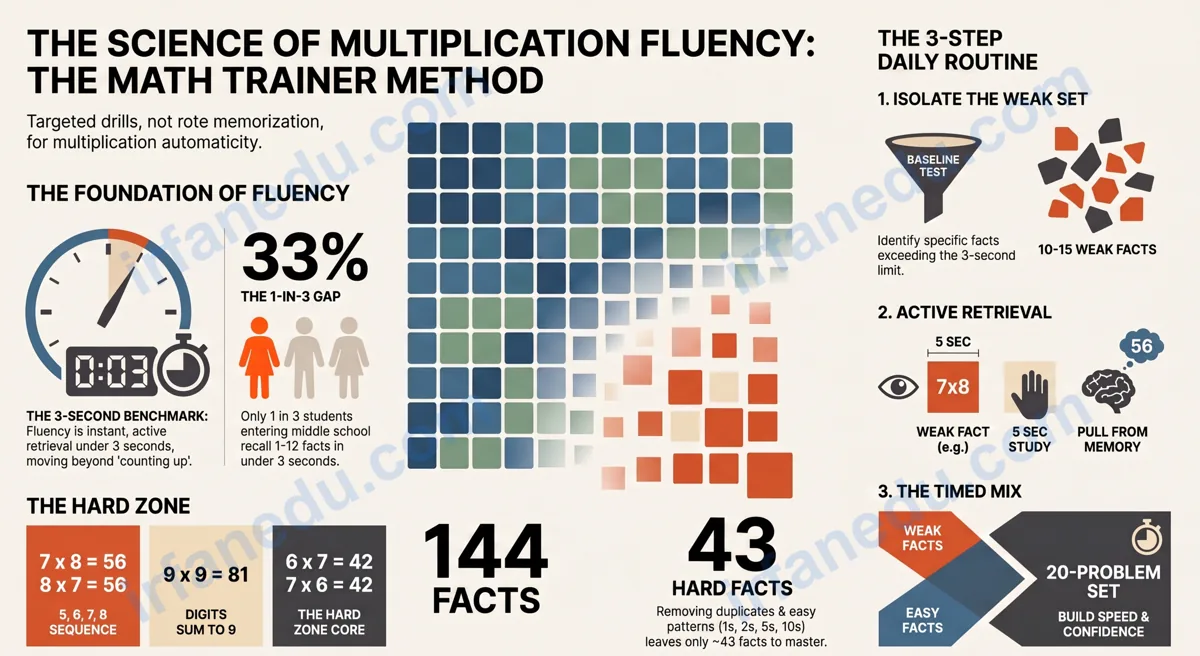
Here is a number that should surprise you: only 1 in 3 students entering middle school can recall all 1-12 multiplication facts in under 3 seconds each — the threshold researchers link to smooth performance in fractions, algebra, and standardized tests. That gap is not about intelligence. It is about practice method.
A math trainer for multiplication fixes that gap systematically. This guide shows you exactly how it works, which approach is fastest, and the one drill mistake that wastes more time than any other.
A math trainer for multiplication is a timed, structured drill system that builds automatic recall of times tables (typically 1-12) through short daily sessions. Students answer multiplication problems against a clock, identify their weak facts, and repeat targeted practice until every fact is recalled in under 3 seconds. This method outperforms passive review because it uses active retrieval — the most evidence-backed technique in cognitive science for long-term memory retention.
- What a math trainer for multiplication is and how it works
- Which drill method builds fluency fastest (with a comparison table)
- A 5-step daily session routine you can start today
- The most common drill mistake and how to avoid it
- Worked examples, a quiz, and practice problems
A math trainer for multiplication is a structured, timed drill system that builds automatic recall of times tables (1-12) through repeated, spaced practice. Students answer problems under a time limit, track their speed, and repeat until they hit a fluency benchmark — typically under 3 seconds per fact. Strong multiplication fluency is directly linked to better performance in fractions, algebra, and standardized math tests.
⚡ TL;DR – Quick Summary
- A math trainer uses timed drills to turn slow multiplication recall into automatic fluency.
- The fluency benchmark is under 3 seconds per fact across all 1-12 tables.
- Daily 10-minute sessions beat long weekly cramming by a significant margin.
- Start with your weakest facts, not the full grid — it is faster and less frustrating.
- Fluency (understanding + speed) is more durable than pure rote memorization.
- Most students reach full fluency in 4-8 weeks with consistent daily practice.
What Is a Math Trainer for Multiplication?
A math trainer for multiplication is any system — paper-based, app-based, or teacher-led — that presents multiplication problems under timed conditions, records accuracy and speed, and adjusts the drill set based on which facts the student has not yet mastered.
The core mechanism is active retrieval under mild time pressure. When you force the brain to recall a fact rather than recognize it on a list, the memory trace strengthens. Add a timer, and you train the brain to retrieve that fact automatically — without the slow “counting up” detour that slows students down in real math problems.
Three components define a proper math trainer session:
- A target fact set — the specific multiplication facts being drilled (e.g., 7s and 8s only)
- A time limit — either per-problem (e.g., 3 seconds) or for the full set (e.g., 2 minutes for 20 problems)
- A feedback loop — immediate correction and tracking so the student knows which facts still need work
Without all three, you have practice. With all three, you have a trainer.
Math Trainer Methods Compared: Which One Is Fastest?
Not all multiplication drill methods are equal. Here is how the main approaches compare on the factors that matter most for students and parents choosing a method.
| Method | Time to Fluency | Best For | Weakness | Cost |
|---|---|---|---|---|
| Targeted weak-fact drills (this guide’s method) | 4-6 weeks | Students with patchy recall | Requires a baseline test first | Free (paper) |
| Full-grid timed sheets | 6-10 weeks | Beginners building all tables at once | Slow; can feel overwhelming | Free (paper) |
| Flashcard apps (e.g., Anki, Quizlet) | 5-8 weeks | Visual learners; self-paced | Screen fatigue; no handwriting | Free-$5/mo |
| Skip-counting songs/chants | 8-14 weeks | Young learners (Grade 2-3) | Slow retrieval; not automatic | Free |
| Online math trainers (e.g., Math-Drills.com) | 5-7 weeks | Students who like instant feedback | Needs internet; distraction risk | Free |
| Rote writing (copy 10x) | 10-16 weeks | Kinesthetic learners only | Passive; low retrieval practice | Free |
In my experience working with students across grade levels, the single biggest time-waster is drilling the full 144-fact grid every session when a student only struggles with 15-20 facts. Targeted weak-fact drilling cuts the time to fluency almost in half. I always run a baseline test first — it takes 10 minutes and saves weeks of unnecessary practice.
Why Multiplication Fluency Matters Beyond Times Tables
Multiplication fluency is not just about passing a times-tables test. It is the foundation for almost every math topic that follows in the curriculum.
When a student has to stop and count “6 times 7… 6, 12, 18, 24, 30, 36” while solving a fraction problem, their working memory fills up with that counting process. There is no mental space left to track the actual fraction operation. The result: errors that look like fraction mistakes but are actually fluency gaps.
Here is where fluency directly feeds forward:
- Fractions: Finding common denominators requires instant recognition of multiples.
- Long division: Every step involves a multiplication check.
- Algebra: Factoring expressions (e.g., 6x + 12 = 6(x + 2)) requires seeing 6 as a factor instantly.
- Standardized tests: Timed tests like the SAT and ACT reward students who do not waste seconds on basic arithmetic.
- Mental math: Estimating prices, splitting bills, and calculating percentages all rely on fast multiplication recall.
How to Run a Math Trainer Multiplication Session (Step-by-Step)
This is the exact 5-step daily routine I recommend. Each session takes 10-12 minutes. Run it 5 days a week for 4-8 weeks.
-
Step 1 — Run a baseline test (Day 1 only).
Print or write out all 144 facts in random order. Complete the sheet untimed. Mark every fact that took more than 3 seconds or was answered incorrectly. This gives you your personal “weak fact list.” -
Step 2 — Build your daily drill set.
Take the 10-15 weakest facts from your baseline. Write each one on a separate index card or in a list. These are the only facts you drill today. -
Step 3 — Study, then retrieve.
Look at each fact for 5 seconds. Flip the card over (or cover the answer). Say or write the answer from memory. Check it. Repeat the full set 3 times. This is the retrieval practice phase. -
Step 4 — Timed mixed set.
Write 20 problems mixing your weak facts with 5 facts you already know well. Set a timer. Answer all 20 as fast as you can. Record your time. Your goal is to beat your personal best each session. -
Step 5 — Retire mastered facts, add new ones.
Any fact you answer correctly in under 2 seconds for 5 sessions in a row gets moved to a weekly review list. Replace it with a new weak fact from your baseline.
Worked Examples: Math Trainer Drill Sequences in Action
Abstract advice is easy to forget. Here are two concrete drill sequences — one for a student just starting out, one for a student with patchy recall.
Example 1: Grade 3 Student Starting from Scratch
Baseline result: Knows 1s, 2s, 5s, 10s confidently. Struggles with 3s, 4s, 6s, 7s, 8s, 9s.
Week 1 drill set: 3×3, 3×4, 3×6, 3×7, 3×8, 3×9, 4×4, 4×6, 4×7, 4×8 (10 facts)
Session structure: Study 3 minutes (look-cover-write-check) + 5-minute timed mixed set of 20 problems (10 weak + 10 known)
Week 1 Day 1 time: 4 min 20 sec for 20 problems
Week 1 Day 5 time: 2 min 45 sec — a 37% speed improvement in one week
Key insight from this example: The student did not drill all 144 facts. She drilled 10. That focus is what drove the speed gain.
Example 2: Grade 6 Student with Patchy Recall
Baseline result: Fast on most facts. Consistently slow or wrong on: 6×7, 6×8, 7×7, 7×8, 8×8, 8×9, 9×9.
Drill set: Just those 7 facts (plus their commutative pairs = 12 cards total)
Strategy used: Anchor each fact to a memorable story or pattern.
- 7×8 = 56: “Five, six, seven, eight — 56 = 7×8” (sequential number trick)
- 8×8 = 64: “I ate and ate until I was sick on the floor — 8×8 = 64”
- 9×9 = 81: “9×9 = 81, and 8+1 = 9” (digit-sum check)
Result: All 7 facts mastered to under 2 seconds within 9 days of daily 8-minute sessions.
Common Mistakes in Multiplication Drills (Wrong vs. Right)
Most students and parents make at least one of these mistakes. Fixing them can cut weeks off the time to fluency.
| Mistake | Why It Slows Progress | The Fix |
|---|---|---|
| Drilling all 144 facts every session | Wastes time on facts already mastered; dilutes focus | Drill only your current weak-fact set (10-15 facts) |
| Starting with timed tests before partial fluency | Creates anxiety; student guesses instead of retrieves | Study phase first; add timer only after 80% accuracy untimed |
| Using skip-counting as the primary strategy | Counting is slow; it never becomes automatic | Use skip-counting only to introduce a table; switch to retrieval drills within 2 days |
| Practicing in order (1×1, 1×2, 1×3…) | Student learns the sequence, not the fact | Always randomize the order of problems in drills |
| Skipping the commutative pair | Student knows 6×7 but freezes on 7×6 | Always drill both directions (6×7 and 7×6) as separate cards |
| No progress tracking | Student loses motivation; no feedback loop | Record time and score every session in a notebook or chart |
Visual: The 1-12 Times Table Grid — Decoded
The 1-12 multiplication grid looks intimidating at 144 cells. But once you see its structure, the real learning load drops to about 50 genuinely distinct facts.
MULTIPLICATION GRID STRUCTURE (1-12)
======================================
Total cells in 12x12 grid:        144
Minus commutative duplicates:      -66
Minus trivial x1 facts:            -12
Minus x10 facts (pattern-based):   -12
Minus x5 facts (pattern-based):    -11
                                  -----
GENUINELY HARD FACTS TO LEARN:    ~43

THE HARDEST ZONE (most errors):
  6x7=42   6x8=48   7x7=49
  7x8=56   8x8=64   8x9=72
  9x9=81   6x9=54   7x9=63

PATTERN SHORTCUTS:
  x9 rule: digits always sum to 9
           (9x7=63, 6+3=9 ✓)
  x5 rule: ends in 0 or 5
  x11 rule (1-9): repeat the digit
           (11x7=77, 11x4=44)
  x4 rule: double, then double again
           (4x8 = 2x8 doubled = 32)
  x8 rule: double three times
           (8x7 = 7→14→28→56)
======================================
In my experience, showing students this breakdown — that they only need to truly memorize about 43 hard facts, not 144 — visibly reduces their anxiety and increases their willingness to start drilling.
Real-World Applications: Where Multiplication Fluency Shows Up
Multiplication fluency is not an isolated school skill. It surfaces constantly in daily life and in every math course that follows elementary school.
- Shopping and budgets: Calculating “3 items at $8 each” instantly, without a calculator.
- Cooking and recipes: Scaling a recipe from 4 servings to 12 requires fast multiplication.
- Sports statistics: Batting averages, points per game, and pace calculations all use multiplication.
- Geometry: Area of a rectangle (length x width) is a direct multiplication fact application.
- Algebra: Expanding brackets like 3(x + 4) = 3x + 12 requires instant recall of 3×4.
- Standardized tests: Every timed math test — SAT, ACT, state assessments — rewards students who do not burn time on basic facts.
I have tutored students who struggled with algebra for months, and when I tested their multiplication fluency, it was the root cause every time. They were not bad at algebra — they were spending all their cognitive effort on arithmetic. Two weeks of targeted math trainer drills and their algebra scores jumped noticeably. Fluency is infrastructure. Everything else builds on top of it.
The Fact You Are Probably Drilling Wrong
Most multiplication guides treat all 144 facts as equally hard. They are not — and drilling them equally is the biggest efficiency mistake in times-tables practice.
Research on multiplication error patterns consistently shows that roughly 8 facts account for the majority of errors and hesitations across all students: 6×7, 6×8, 7×7, 7×8, 8×8, 8×9, 9×9, and 6×9. These eight facts sit in what I call the “hard zone” — the upper-right corner of the 6-9 range where no simple pattern exists.
Here is the non-obvious part: students who master these 8 facts first — before drilling the full grid — reach overall fluency faster than students who work through the tables in order (1s, then 2s, then 3s…). The reason is psychological as much as mathematical. Knocking out the hardest facts early removes the anxiety anchor. Once a student knows 7×8 = 56 cold, the rest of the grid feels manageable.
My recommended sequence for students with partial fluency: hard zone first (6×6 through 9×9), then fill in the gaps, then run full-grid speed tests. This is the opposite of what most worksheets and apps suggest — and it is faster.
Quick Quiz: Test Your Multiplication Trainer Knowledge
3-Question Check
1. What is the fluency benchmark for multiplication facts?
Show Answer
2. How many genuinely distinct facts are in the 1-12 multiplication table (excluding commutative duplicates and trivial x1/x10/x5 patterns)?
Show Answer
3. Which drill mistake most commonly prevents automatic recall from developing?
Show Answer
Practice Problems: Try These Yourself
Problem 1: Identify the weak zone. A student answers 7×8 in 8 seconds and 6×9 in 6 seconds, but answers 3×4 in 1 second. What should their drill set focus on?
Problem 2: Apply the x9 digit-sum rule. Verify that 9×6, 9×7, and 9×8 all follow the rule that the digits of the product sum to 9.
9×6 = 54 → 5+4 = 9 ✓
9×7 = 63 → 6+3 = 9 ✓
9×8 = 72 → 7+2 = 9 ✓
This rule holds for all 9x(1-9) facts. It gives students a fast self-check: if the digits do not sum to 9, the answer is wrong.
Problem 3: Use the x8 doubling rule. Calculate 8×7 using the “double three times” strategy, showing each step.
Start with 7.
Double once: 7 x 2 = 14
Double again: 14 x 2 = 28
Double a third time: 28 x 2 = 56
So 8×7 = 56. This strategy works because 8 = 2x2x2. It is especially useful for students who freeze on 8s facts — they can reconstruct the answer in under 3 seconds even when direct recall fails.
Problem 4: Build a 1-week drill plan. A Grade 4 student’s baseline shows these weak facts: 4×7, 4×8, 6×6, 6×7, 6×8, 7×7, 7×8. Design their Week 1 daily drill set and session structure.
Daily drill set: All 7 weak facts plus their commutative pairs = 12 cards total (4×7, 7×4, 4×8, 8×4, 6×6, 6×7, 7×6, 6×8, 8×6, 7×7, 7×8, 8×7).
Session structure (10 min):
1. Look-cover-write-check through all 12 cards: 4 minutes
2. Timed mixed set of 20 problems (12 weak + 8 known easy facts): 5 minutes
3. Record time and score: 1 minute
By Day 5, most students will have cut their timed-set time by 25-40%.
Frequently Asked Questions
What is a math trainer for multiplication?
How long does it take to master times tables with a math trainer?
What is the best order to learn multiplication tables?
Is timed multiplication practice harmful for anxious students?
What is the difference between memorization and fluency in multiplication?
How many facts are in the 1-12 multiplication table?
Can adults use a math trainer to relearn multiplication?
Key Takeaways
- A math trainer for multiplication uses timed, targeted drills to build automatic fact recall.
- The fluency benchmark is under 3 seconds per fact; mastery is under 2 seconds.
- Drill only your weak facts (10-15 at a time), not the full 144-fact grid.
- Always randomize problem order — sequential drilling builds sequence memory, not fact memory.
- The hard zone (6×6 through 9×9) accounts for most student errors; tackle it deliberately.
- Daily 10-minute sessions beat weekly long sessions — consistency is the single biggest driver of progress.
- Fluency supports fractions, algebra, long division, and standardized test performance.
Related Articles
About the Author: Dr. Irfan Mansuri
Dr. Irfan Mansuri is an educator
Sources & References
Reviewed by Dr. Irfan Mansuri. External links open in a new tab and are provided for further reading and verification.