
Volume of Rectangular Prism Worksheet — Free Printable PDF with Answer Key
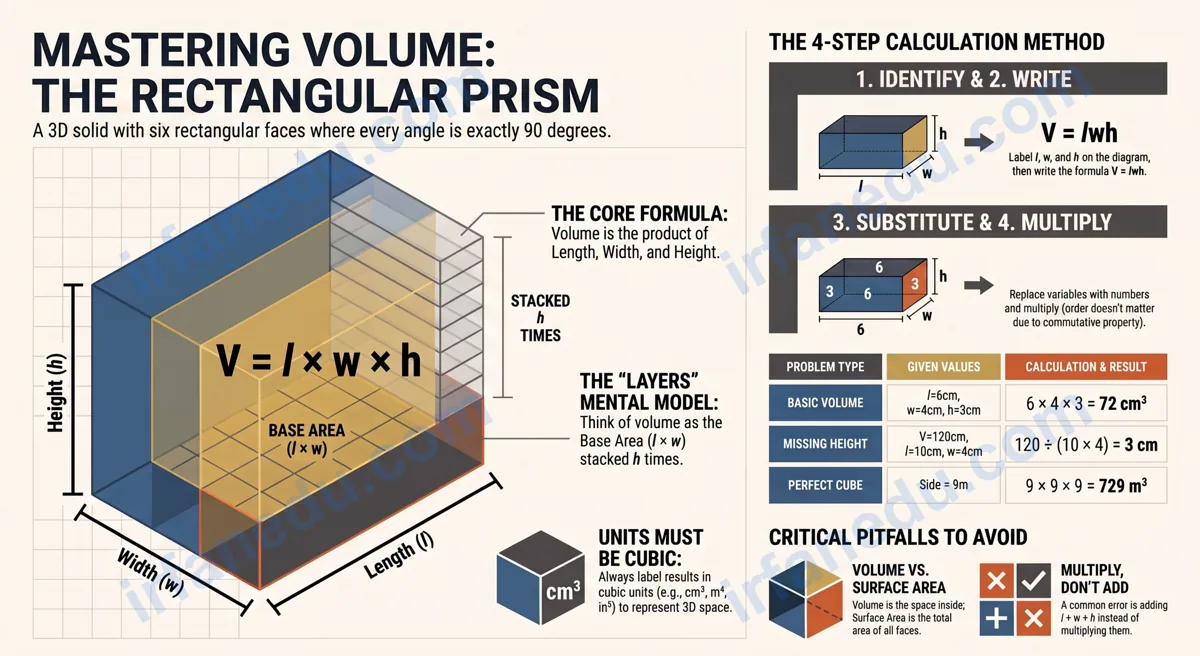
Table of Contents
- Introduction
- Quick Answer
- Download Free PDF Worksheet
- TL;DR & Quick Facts
- What Is a Rectangular Prism?
- Step-by-Step: How to Find Volume
- 3 Fully Worked Examples
- Common Mistakes (Wrong vs. Right)
- Unique Insight
- On-Page Practice Worksheet
- Download PDF (Again)
- Quick Quiz
- FAQ
- Key Takeaways
- Related Articles
- About the Author
- Sources & References
Most worksheets on this topic hand you a formula and ten identical boxes to fill in. That is not how students actually learn to use volume. This guide gives you a real lesson first, three worked examples with different problem types, and then a 10-problem worksheet that builds from simple to genuinely challenging — including a missing-dimension problem and a composite scenario most worksheet sites never include.
In my experience teaching geometry to middle schoolers, the students who struggle with volume are not confused by the multiplication. They are confused about which number is which and what a cubic unit actually means. I wrote this page to fix that gap before you touch a single practice problem.
- Understand what a rectangular prism is and why its volume formula works.
- Follow a clear 4-step method you can apply to any problem.
- Work through 3 fully solved examples covering basic, decimal, and missing-dimension cases.
- Practise with 10 graded problems and check your work against the full answer key.
- Download the free printable PDF to use offline or in class.
Free Printable PDF: 10 graded problems + full answer key, ready to print or assign digitally.
TL;DR — Quick Summary
- Formula: V = l × w × h. Always label answers in cubic units.
- Volume measures 3D space inside the prism, not its surface.
- If base area is given, use V = Base Area × h directly.
- Missing dimension? Divide volume by the product of the two known sides.
- Worksheet has 10 problems: easy to hard, with a full answer key.
- Download the free PDF for offline or classroom use.
| Fact | Detail |
|---|---|
| Formula | V = l × w × h |
| Units | Cubic units (cm³, m³, in³, ft³) |
| Grade level | Grades 5–7 (Common Core 5.MD.C.3, 6.G.A.2) |
| Number of problems | 10 (easy → hard) |
| Includes answer key | Yes, on-page and in PDF |
| Prerequisite skill | Multiplying 3 numbers; understanding 3D shapes |
| Related shape | Cube (special case where l = w = h) |
Every free worksheet I reviewed for this topic stops at “find the volume given three dimensions.” That is one skill. Real exam questions also ask you to find a missing dimension, compare two prisms, or subtract a smaller prism from a larger one. I included all three types here because that is what actually shows up on Grade 6 assessments. If your worksheet never challenges you beyond plug-and-chug, you are not prepared.
What Is a Rectangular Prism?
A rectangular prism is a 3D solid with six rectangular faces, where every angle is 90 degrees. It has three pairs of identical opposite faces. Common real-world examples include a cereal box, a brick, a fish tank, and a shipping crate.
The three key dimensions are:
- Length (l): the longest horizontal dimension.
- Width (w): the shorter horizontal dimension (depth).
- Height (h): the vertical dimension.
A cube is a special rectangular prism where all three dimensions are equal (l = w = h). Every cube is a rectangular prism, but not every rectangular prism is a cube.
Visual: Labeled Rectangular Prism
        ___________
       /|          /|
      / |   h=4   / |
     /__|_________/  |
     |  |         |  |
     |  |_________|__|
     | /   w=3   / /
     |/___________/
          l=5

  V = 5 × 3 × 4 = 60 cm³
Volume answers the question: how much space is inside this shape? Think of it as how many 1-unit cubes you could stack inside the prism without any gaps. A prism 5 cm × 3 cm × 4 cm holds exactly 60 of those 1 cm³ cubes.
How to Find the Volume of a Rectangular Prism (4-Step Method)
Finding the volume of a rectangular prism takes exactly four steps. Follow them in order every time and you will never mix up the formula.
- Identify the three dimensions. Read the problem carefully. Write down l, w, and h with their units. If a diagram is given, label each edge before you write anything else.
- Write the formula. Always start with V = l × w × h. Writing the formula first is a habit that prevents careless errors.
- Substitute the values. Replace l, w, and h with the numbers from the problem. Keep the units next to each number.
- Multiply and label. Multiply the three numbers. Write the answer followed by cubic units. If the dimensions were in centimetres, the volume is in cm³.
3 Fully Worked Examples
These examples mirror the progression in the worksheet below. Study each one before you attempt the practice problems.
Example 1 — Basic (whole numbers)
Problem: A rectangular prism has length = 6 cm, width = 4 cm, height = 3 cm. Find its volume.
Step 1: l = 6 cm, w = 4 cm, h = 3 cm.
Step 2: V = l × w × h
Step 3: V = 6 × 4 × 3
Step 4: V = 24 × 3 = 72 cm³
Example 2 — Decimal dimensions
Problem: A storage box is 2.5 m long, 1.2 m wide, and 1.8 m tall. Find its volume.
Step 1: l = 2.5 m, w = 1.2 m, h = 1.8 m.
Step 2: V = l × w × h
Step 3: V = 2.5 × 1.2 × 1.8
Step 4: 2.5 × 1.2 = 3.0; 3.0 × 1.8 = 5.4 m³
Example 3 — Find the missing dimension
Problem: A rectangular prism has volume = 120 cm³, length = 10 cm, width = 4 cm. Find the height.
Step 1: V = 120 cm³, l = 10 cm, w = 4 cm, h = ?
Step 2: V = l × w × h ⇒ h = V ÷ (l × w)
Step 3: h = 120 ÷ (10 × 4) = 120 ÷ 40
Step 4: h = 3 cm
Check: 10 × 4 × 3 = 120 cm³ ✓
Common Mistakes Students Make (and How to Fix Them)
These four errors account for the majority of wrong answers on volume tests. Recognising them before you practise is worth more than doing ten extra problems.
| Wrong approach | Correct approach |
|---|---|
| Writing the answer as cm² (square units) | Volume is always in cubic units (cm³, m³, ft³) |
| Adding l + w + h instead of multiplying | Multiply all three: V = l × w × h |
| Confusing volume with surface area | Volume = space inside; surface area = total face area. Different formulas, different units. |
| Forgetting to include units in the answer | Always write the cubic unit — an answer without units is incomplete on any test. |
| Using the base area as the volume when base area is given | If base area is given, still multiply by height: V = Base Area × h |
Unique Insight: Why “Volume = Layers of Area” Is a Better Mental Model
Most guides present V = l × w × h as a formula to memorise. But here is a more powerful way to think about it: volume is the base area (l × w) stacked h times. Imagine a single layer of unit cubes covering the base — that layer has l × w cubes. Stack h layers on top of each other and you get l × w × h cubes total. This “layers” model is why V = Base Area × h works for every prism — rectangular, triangular, or hexagonal — not just rectangular ones. Students who understand this transfer the concept to cylinders (V = πr²h) and triangular prisms instantly, without memorising a new formula each time. That is a genuine shortcut most worksheets never teach.
All geometry formulas in one place — area, perimeter, volume, surface area
On-Page Practice Worksheet — Volume of Rectangular Prism
Work through all 10 problems below. Show your working for each one. Problems increase in difficulty: Problems 1–4 are straightforward, 5–7 introduce larger numbers and decimals, and 8–10 require you to find a missing dimension, compare prisms, or work with a composite shape.
- A rectangular prism has length = 3 cm, width = 2 cm, height = 4 cm. Find its volume.
- A rectangular prism has length = 5 m, width = 5 m, height = 5 m. Find its volume.
- A box measures 8 in long, 3 in wide, and 2 in tall. What is its volume?
- A rectangular prism has length = 10 ft, width = 4 ft, height = 6 ft. Find its volume.
- A fish tank is 60 cm long, 30 cm wide, and 35 cm tall. What is its volume in cm³?
- A rectangular prism has a base area of 24 m² and a height of 7 m. Find its volume.
- A shipping crate is 2.5 m long, 1.2 m wide, and 1.8 m tall. Find its volume.
- A rectangular prism has volume = 120 cm³, length = 10 cm, and width = 4 cm. Find the height.
- Prism A is 6 cm × 4 cm × 5 cm; Prism B is 8 cm × 3 cm × 5 cm. Which has the greater volume, and by how much?
- A rectangular room is 12 ft long, 10 ft wide, and 9 ft tall. A rectangular pillar inside it measures 1 ft × 1 ft × 9 ft. What is the usable air volume of the room (room volume minus pillar volume)?
Show Answer Key
- 24 cm³
- 125 m³
- 48 in³
- 240 ft³
- 63,000 cm³
- 168 m³
- 5.4 m³
- 3 cm
- Prism A = 120 cm³, Prism B = 120 cm³. They are equal.
- Room = 1,080 ft³; Pillar = 9 ft³; Usable volume = 1,071 ft³
When I first used this worksheet in class, almost every student assumed Prism A (6 × 4 × 5) would be bigger than Prism B (8 × 3 × 5) because it looks “taller and wider.” Both equal 120 cm³. That moment of surprise is exactly what builds number sense. Volume is not about which shape looks bigger — it is about the product of all three dimensions. I kept this problem in the worksheet precisely because it breaks a common visual assumption.
Want a print-ready version? Download the free PDF with all 10 problems and the full answer key on a separate page.
Reveal-on-Click Practice Problems
Try each problem mentally, then click to reveal the full solution.
Practice: A rectangular prism has l = 7 cm, w = 5 cm, h = 2 cm. Find V.
V = l × w × h = 7 × 5 × 2 = 35 × 2 = 70 cm³
Practice: A prism has V = 360 ft³, l = 12 ft, h = 5 ft. Find w.
w = V ÷ (l × h) = 360 ÷ (12 × 5) = 360 ÷ 60 = 6 ft
Check: 12 × 6 × 5 = 360 ft³ ✓
Practice: A cube has side length 9 m. What is its volume?
A cube is a rectangular prism with l = w = h = 9 m.
V = 9 × 9 × 9 = 81 × 9 = 729 m³
Quick Quiz — Test Your Understanding
3-Question Volume Quiz
Q1. A rectangular prism has l = 4 cm, w = 3 cm, h = 5 cm. What is its volume?
Not quite. 12 is only l × w. You still need to multiply by h = 5.
Correct! V = 4 × 3 × 5 = 60 cm³.
The number is right but the unit is wrong. Volume uses cubic units: cm³, not cm².
47 is 4 + 3 + 5 × something — it looks like addition crept in. Always multiply all three dimensions.
Q2. A prism has V = 200 cm³, l = 10 cm, w = 5 cm. What is the height?
Not quite. h = 200 ÷ (10 × 5) = 200 ÷ 50 = 4 cm, not 10.
Correct! h = V ÷ (l × w) = 200 ÷ 50 = 4 cm.
This comes from dividing 200 by only one dimension (5). Always divide by the product of both known dimensions.
This comes from dividing 200 by 10 only. You need to divide by l × w = 50.
Q3. Which unit is correct for the volume of a rectangular prism measured in metres?
Metres is a unit of length, not volume. Volume needs cubic units.
Square metres measure area (2D). Volume is 3D, so you need m³.
Correct! Volume is always in cubic units. Three dimensions multiplied together give a cubed unit.
m&sup4; does not apply to 3D volume. Stick with m³ for volume.
Volume vs. Surface Area — What Is the Difference?
Students frequently mix up volume and surface area. The table below shows the key differences at a glance.
| Feature | Volume | Surface Area |
|---|---|---|
| What it measures | Space inside the prism (3D) | Total area of all 6 faces (2D) |
| Formula | V = l × w × h | SA = 2(lw + lh + wh) |
| Units | Cubic (cm³, m³, ft³) |