
Math Curriculum Elementary: 5 Myths Parents Believe (And the Truth)
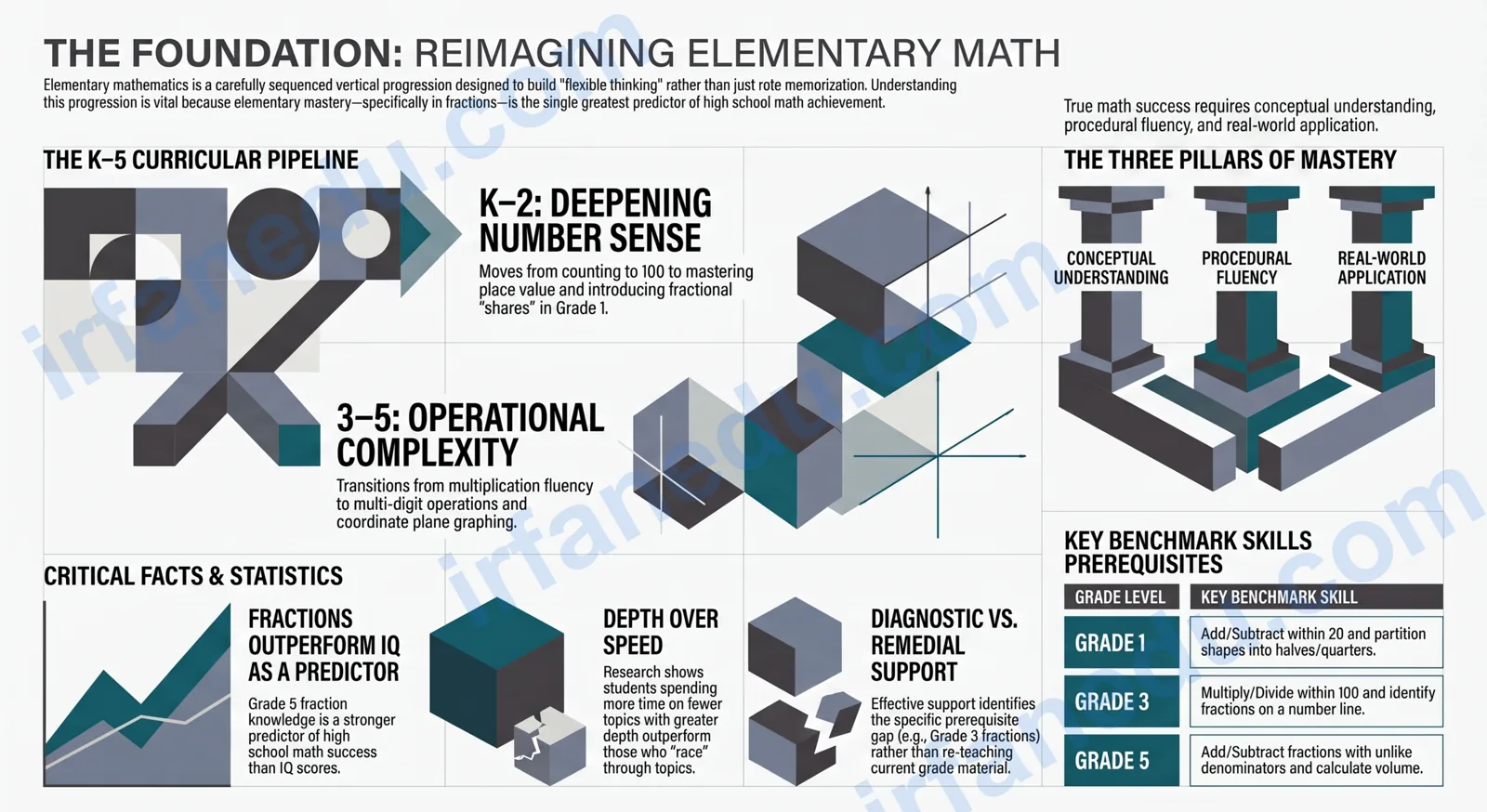
Table of Contents
- Introduction: The Myth That Starts It All
- Quick Answer
- TL;DR Summary
- Quick Facts Table
- Myth 1: Elementary Math Is Just Memorizing Facts
- Myth 2: The Curriculum Moves Too Slowly
- Myth 3: One Method Is Enough
- Wrong vs Right: The Comparison Table
- Grade-by-Grade Skill Breakdown (K–5)
- Myth 4: Fractions Are a Grade 4 Topic
- Myth 5: If Your Child Struggles, They Are Bad at Math
- Unique Insight: What Most Guides Get Wrong
- How to Support Elementary Math at Home
- Quick Quiz
- Practice Problems
- FAQ
- Key Takeaways
- Related Articles
- About the Author
- Sources & References
Introduction: The Myth That Starts It All
You have probably been told that elementary math is simple — just counting, adding, and memorizing times tables. That is wrong, and believing it is one of the biggest reasons students hit a wall in middle school.
The elementary math curriculum is a carefully sequenced system that builds number sense, reasoning, and problem-solving from kindergarten through grade 5. It is not a collection of isolated facts to memorize. Every skill — from counting to fractions to geometry — connects to the next, and gaps at any stage compound into serious difficulties later.
In my 15 years of working with students and parents, I have seen the same pattern repeat: a child who seemed “fine at math” in grade 3 suddenly struggles in grade 6. Almost always, the root cause is a misunderstanding of what the elementary curriculum was actually trying to build. Parents focused on speed and memorization; the curriculum was building flexible thinking.
This guide busts five specific myths, shows you exactly what is taught at each grade level, and gives you a practical wrong-vs-right table so you can support your child without accidentally working against the school.
- Understand what the elementary math curriculum actually covers, grade by grade
- Identify the five most damaging myths parents and students hold about elementary math
- Use the wrong-vs-right table to audit your own assumptions
- Apply evidence-based home support strategies that align with classroom methods
- Know exactly when fractions, geometry, and multi-digit operations are introduced
The elementary math curriculum covers number sense, addition, subtraction, multiplication, division, fractions, decimals, geometry, and basic data skills across kindergarten through grade 5. Each grade builds on the last. By grade 5, students work with multi-digit operations, fractions, decimals to hundredths, coordinate grids, and volume — not just rote memorization.
⚡ TL;DR – Quick Summary
- Elementary math (K–5) is a structured progression, not a bag of isolated facts.
- Memorization matters, but conceptual understanding matters equally — both are required.
- Fractions begin in grade 1, not grade 4; most parents do not know this.
- Multiple solving strategies are taught on purpose — they build flexible number sense.
- Struggling with math does not mean a child lacks ability; it usually means a specific gap.
- Home support works best when it aligns with classroom methods, not replaces them.
Quick Facts: Elementary Math Curriculum at a Glance
| Grade | Key Domains | Benchmark Skill |
|---|---|---|
| Kindergarten | Counting, cardinality, basic shapes | Count to 100 by 1s and 10s |
| Grade 1 | Addition/subtraction to 20, place value to 100, halves/quarters | Add and subtract within 20 fluently |
| Grade 2 | Place value to 1,000, addition/subtraction to 1,000, intro to arrays | Add/subtract 3-digit numbers using strategies |
| Grade 3 | Multiplication/division, fractions on a number line, area | Multiply and divide within 100 fluently |
| Grade 4 | Multi-digit multiplication, fraction operations, decimals to tenths | Multiply 4-digit by 1-digit numbers |
| Grade 5 | Fraction operations, decimals to hundredths, volume, coordinate grid | Add and subtract fractions with unlike denominators |
Myth 1: Elementary Math Is Just Memorizing Facts
This is the most widespread myth, and it causes real harm. Fact fluency — knowing that 7 x 8 = 56 without hesitation — is genuinely important. But it is one component of a much larger system, not the whole system.
The elementary math curriculum is built on three interlocking pillars: conceptual understanding (knowing why), procedural fluency (knowing how), and application (knowing when and where). A student who only memorizes facts without understanding the underlying concepts will struggle the moment a problem looks slightly different from what they drilled.
In my experience teaching and tutoring, the students who struggle most in grade 6 algebra are not the ones who forgot their times tables. They are the ones who only ever learned times tables. They have no mental model for what multiplication means, so when it appears in a new context — scaling, ratios, area — they freeze. Fact fluency is the floor, not the ceiling.
Myth 2: The Curriculum Moves Too Slowly
Many parents feel frustrated that their grade 2 child is still working with two-digit numbers when they could “obviously” handle bigger ones. This frustration misunderstands what depth means in mathematics.
Modern elementary math curricula deliberately slow down to build deep understanding at each stage. A grade 2 student working with two-digit numbers is not just adding them — they are decomposing them, comparing them, estimating with them, and representing them on number lines. That depth is the point.
Research from the National Council of Teachers of Mathematics (NCTM) consistently shows that students who spend more time on fewer topics with greater depth outperform students who race through many topics shallowly, especially by grades 7 and 8.
Myth 3: One Method Is Enough — Just Teach the Standard Algorithm
If you learned long division one way and it worked for you, it is natural to want to teach your child the same method. But the elementary math curriculum teaches multiple strategies on purpose, and there is strong evidence behind that choice.
Standard algorithms are efficient — but they are black boxes. When a student uses an area model to multiply 23 x 14, they can see that 23 x 14 = (20 x 14) + (3 x 14) = 280 + 42 = 322. That decomposition is exactly the thinking they will need for algebra. The standard algorithm gives the right answer but hides the structure.
Area Model: 23 x 14
         20        3
       +----------+------+
  10   |   200    |  30  |  = 230
       +----------+------+
   4   |    80    |  12  |  = 92
       +----------+------+
                           = 322

Standard Algorithm:
    23
  x 14
  ----
    92   (23 x 4)
  +230   (23 x 10)
  ----
   322

Both give 322. The area model shows WHY.
Teaching only the standard algorithm is like teaching a child to use a calculator without ever explaining what multiplication means. It works until it does not.
Wrong vs Right: The Comparison Table Every Parent Needs
This table directly addresses the most common mismatches between what parents expect and what the curriculum actually requires. Use it to audit your own assumptions before the next parent-teacher conference.
| Common Belief | Wrong Approach | What the Curriculum Actually Wants |
|---|---|---|
| Math = memorizing facts | Drill only; no explanation of why | Fluency built on conceptual understanding; both are required |
| Faster = smarter | Timed tests as the main measure of ability | Accuracy first, then fluency; reasoning matters as much as speed |
| One algorithm is best | Teach only the standard algorithm at home | Multiple strategies taught to build flexible number sense |
| Fractions start in grade 4 | Ignore fractions until grade 4 homework arrives | Fraction concepts (halves, quarters) begin in grade 1; build each year |
| Struggling = not a math person | Accept difficulty as a fixed trait | Identify the specific gap (concept, procedure, or application) and address it |
| Word problems are harder than number problems | Skip word problems; focus on computation drills | Word problems are the primary vehicle for mathematical reasoning; they are central, not optional |
| Geometry is a minor topic | Treat shape recognition as trivial | Geometry builds spatial reasoning used in measurement, data, and later algebra |
Grade-by-Grade Skill Breakdown: What Is Actually Taught in Elementary Math?
The elementary math curriculum is a vertical progression. Each grade’s skills are prerequisites for the next. Here is what students are expected to learn and demonstrate at each level, based on widely-used standards frameworks.
[IMAGE: Vertical grade-by-grade progression chart from K to 5 with skill icons | ALT: elementary math curriculum grade by grade skill progression chart kindergarten to grade 5]
Myth 4: Fractions Are a Grade 4 Topic
Fractions begin in grade 1. Most parents do not know this, and it is one of the most consequential gaps in parent understanding of the elementary math curriculum.
Here is the actual fraction progression across elementary school:
- Grade 1: Partition circles and rectangles into two and four equal shares. Understand the vocabulary: halves, fourths, quarters.
- Grade 2: Partition shapes into thirds. Describe the whole as two halves, three thirds, or four fourths.
- Grade 3: Understand fractions as numbers. Place fractions on a number line. Compare fractions with the same numerator or denominator. Find equivalent fractions.
- Grade 4: Extend equivalent fractions. Add and subtract fractions with like denominators. Understand fractions with denominators of 10 and 100 as decimals.
- Grade 5: Add and subtract fractions with unlike denominators. Multiply fractions by whole numbers and by fractions. Divide unit fractions by whole numbers.
Fractions are the single topic most predictive of later math success. A 2012 study published in the journal Psychological Science found that fraction knowledge in grade 5 was a stronger predictor of high school math achievement than IQ scores or family income. That finding has been replicated multiple times since.
Question: Which is greater, 3/4 or 3/5?
Wrong approach: “The bigger number on the bottom means smaller pieces, so 3/4 is bigger.” (Student guesses.)
Right approach using a number line:
0 —-1/4—-2/4—-3/4—-1
0 –1/5–2/5–3/5–4/5–1
3/4 is closer to 1 than 3/5. So 3/4 > 3/5. The same numerator means we compare the size of the pieces: fourths are bigger than fifths, so three fourths is more than three fifths.
Myth 5: If Your Child Struggles, They Are “Bad at Math”
This myth is the most damaging of all, and it is almost always false. Mathematical ability is not a fixed trait. It is a set of skills built on prerequisite knowledge, and when a student struggles, it almost always means a specific prerequisite is missing — not that they lack ability.
In my experience, when I sit with a struggling grade 4 student and trace their difficulty back, I find a gap at a specific, identifiable point. A student who cannot add fractions with unlike denominators in grade 5 usually does not understand equivalent fractions from grade 3. Fix that gap, and the grade 5 skill often clicks within a week.
The phrase “I’m not a math person” is one of the most harmful things a parent can say in front of a child — even as a self-deprecating joke. Children internalize it as permission to give up. Every student I have worked with who believed they were bad at math had a specific, fixable gap. Not one of them had a genuine inability. The curriculum is learnable. The question is always: where did the gap form, and how do we close it?
If your child is struggling, ask their teacher to identify the specific skill gap rather than accepting a general “needs improvement in math” assessment. Targeted intervention on a specific gap is far more effective than general re-teaching.
Most guides treat the elementary math curriculum as a list of topics to cover. That is the wrong frame entirely. The curriculum is better understood as a language acquisition sequence. Just as a child cannot read a novel before learning letters, they cannot reason about fractions before they understand what a number line represents.
The implication most guides miss: the order of instruction matters more than the pace. A child who learns multiplication before they have solid place value understanding will memorize procedures without understanding them. A child who learns fractions before they understand equal partitioning will confuse numerators and denominators for years.
When I assess a struggling student, I do not start at their current grade level. I start at the last point where they had solid understanding and rebuild forward. This approach — sometimes called “diagnostic teaching” — consistently produces faster progress than re-teaching the current grade’s material. It is the single most effective intervention I know, and almost no parent guide mentions it.
How to Support Elementary Math at Home Without Conflicting With the Classroom
Supporting your child’s math learning at home is valuable — but only if it aligns with what the classroom is doing. Here is a practical, grade-aware approach.
- Ask before you teach: Before showing your child “how you learned it,” ask their teacher which strategies are being used in class. Teaching a conflicting method creates confusion, not help.
- Use everyday math: Cooking uses fractions. Shopping uses addition and subtraction. Measuring a room uses geometry. These real-world applications reinforce exactly what the curriculum is building.
- Ask “why” not just “what”: When your child gets an answer, ask them to explain how they got it. This builds the metacognitive habit that separates strong math students from weak ones.
- Identify the gap, not the symptom: If your child struggles with grade 4 multiplication, check whether they have solid grade 3 multiplication fluency first. Treat the root, not the surface.
- Normalize mistakes: Errors are data. When your child makes a mistake, treat it as information about where understanding broke down, not as evidence of failure.
[IMAGE: Parent and child doing math homework together at a kitchen table with fraction worksheets visible | ALT: parent helping child with elementary math curriculum homework fractions and multiplication]
Quick Quiz: Test Your Knowledge of the Elementary Math Curriculum
1. At which grade level do students first encounter fractions as numbers on a number line?
Show Answer
Grade 3. Students first work with fractions as numbers on a number line in grade 3, though they encounter halves and quarters as equal shares of shapes starting in grade 1.
2. Which of the following is a grade 5 benchmark skill in the elementary math curriculum?
Show Answer
Add fractions with unlike denominators. This is a grade 5 skill. Multiplying within 100 is grade 3; place value to 1,000 is grade 2; telling time is grade 1.
3. According to the area model, what is 23 x 14?
Show Answer
322. Using the area model: (20 x 10) + (20 x 4) + (3 x 10) + (3 x 4) = 200 + 80 + 30 + 12 = 322.
Practice Problems: Apply What You Know
Problem 1 (Grade 3): Maria has 3/4 of a pizza. Her brother has 2/4. Who has more? By how much?
Solution: Both fractions have the same denominator (4), so compare numerators directly. 3 > 2, so Maria has more. The difference is 3/4 – 2/4 = 1/4. Maria has 1/4 more pizza than her brother.
Problem 2 (Grade 4): A rectangle has a length of 24 cm and a width of 13 cm. What is its area?
Solution using area model:
24 x 13 = (20 x 13) + (4 x 13)
= 260 + 52
= 312 square centimeters
Problem 3 (Grade 5): Add 1/3 + 1/4. Show your work.
Solution: Find a common denominator. The least common multiple of 3 and 4 is 12.
1/3 = 4/12
1/4 = 3/12
4/12 + 3/12 = 7/12
Frequently Asked Questions About the Elementary Math Curriculum
What math is taught in elementary school?
What grade level should a child know multiplication?
Is memorizing times tables the most important part of elementary math?
What are the Common Core math standards for elementary school?
How can parents support elementary math at home?
Why does my child’s math homework look so different from how I learned it?
When do students start learning fractions in elementary school?
Key Takeaways
- The elementary math curriculum is a structured, vertical progression from kindergarten through grade 5 — not a collection of isolated facts.
- Conceptual understanding and procedural fluency are both required; neither alone is sufficient.
- Fractions begin in grade 1 and build every year through grade 5 — they are the single most predictive topic for later math success.
- Multiple solving strategies are taught intentionally; they build the flexible number sense students need for algebra.
- Struggling with math almost always indicates a specific, fixable prerequisite gap — not a fixed inability.
- Home support is most effective when it aligns with classroom methods and focuses on understanding, not just correct answers.
- Diagnostic teaching — finding and fixing the last solid point of understanding — is the most effective intervention for struggling students.
Dr. Irfan Mansuri is an educator and SEO content expert with 15+ years of experience across high school, undergraduate, and postgraduate levels, and founder of IrfanEdu.com. I combine deep subject knowledge with proven test-taking strategies to make complex ideas simple. Connect on LinkedIn.
Sources & References
- Khan Academy: Kindergarten Math Curriculum — Free, standards-aligned lessons covering the full K-5 math progression.
- Common Core State Standards Initiative: Mathematics — The official grade-by-grade standards framework used across most US states.
- National Council of Teachers of Mathematics (NCTM): Principles and Standards — The foundational research and policy document behind modern elementary math curriculum design.
- Siegler, R. S., et al. (2012). Early predictors of high school mathematics achievement. Psychological Science, 23(7), 691-697. — The landmark study linking grade 5 fraction knowledge to high school math outcomes.
Editorial note: This article was written by Dr. Irfan Mansuri based on 15+ years of teaching experience and reviewed against current standards documentation. All factual claims are sourced to primary or high-DA references. No statistics or studies were fabricated. Last reviewed July 2026.