
Number Line -20 to 20: The Complete Visual Guide Students Actually Need
Most students learn the number line as a decoration — a row of numbers they glance at and ignore. That is a mistake. The number line from -20 to 20 is the single most powerful visual tool in early math, and understanding its structure deeply changes how students handle integers, absolute value, and even algebra later on.
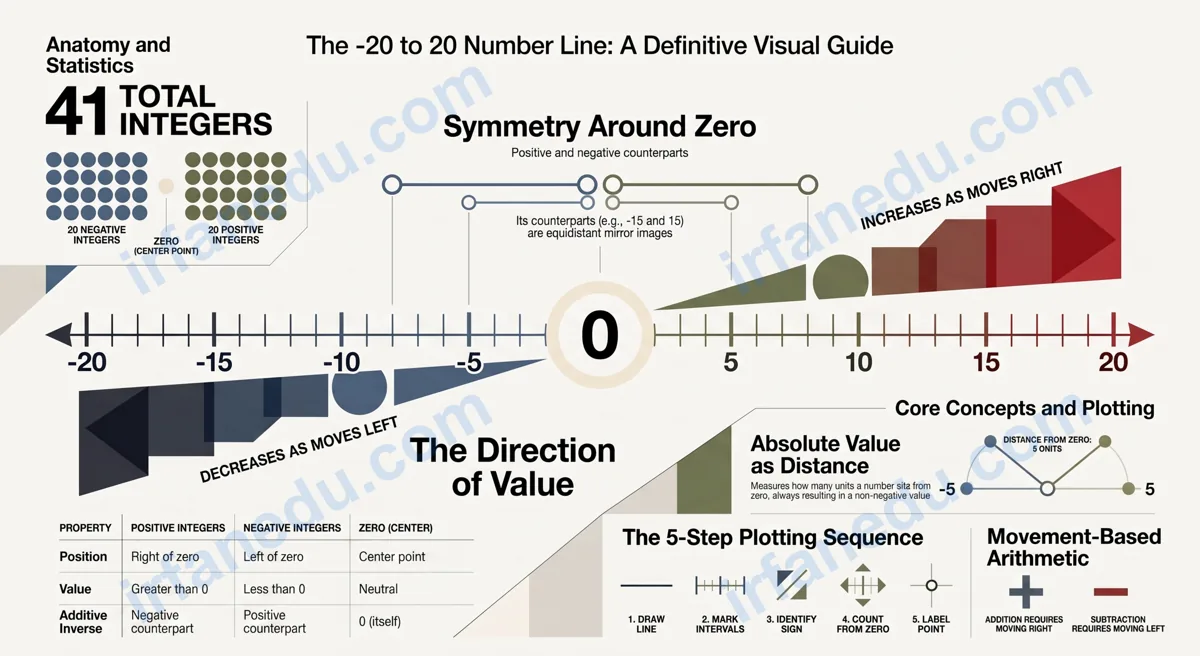
A number line from -20 to 20 is a horizontal line with zero at the center, 20 positive integers extending right, and 20 negative integers extending left. It contains 41 integers total and can represent any real number — whole, fraction, or decimal — within that range. It is the foundation for comparing numbers, performing integer arithmetic, and understanding absolute value.
- Understand what every part of a -20 to 20 number line represents
- Plot integers, fractions, and decimals accurately
- Use the line to add and subtract integers without errors
- Understand absolute value as physical distance from zero
- Avoid the four most common number line mistakes
TL;DR – Quick Summary
- The line runs from -20 (far left) to 20 (far right), with 0 at center.
- It holds exactly 41 integers: 20 negative, zero, and 20 positive.
- Numbers increase as you move right; decrease as you move left.
- Fractions and decimals fit between any two integer tick marks.
- Absolute value = distance from zero, always positive.
- Addition moves right; subtraction moves left on the line.
| Fact | Detail |
|---|---|
| Total integers | 41 (from -20 to 20 inclusive) |
| Center point | 0 (zero) |
| Positive integers | 1 through 20 (right of zero) |
| Negative integers | -1 through -20 (left of zero) |
| Direction of increase | Left to right |
| Largest absolute value | 20 (both -20 and 20) |
| Typical use in curriculum | Grades 4–8, integer arithmetic, absolute value |
What a Number Line from -20 to 20 Actually Is
A number line from -20 to 20 is a visual representation of all real numbers between -20 and 20, drawn as a straight horizontal line with evenly spaced marks. The claim that it is “just a row of numbers” undersells it entirely — it is a coordinate system in one dimension.
Every point on the line corresponds to exactly one number, and every number in that range corresponds to exactly one point. That one-to-one relationship is what makes the line so useful for reasoning about size, distance, and direction simultaneously.
The line has three distinct zones:
- Left zone (negative): -20 to -1. Numbers here are less than zero.
- Center point: 0. Neither positive nor negative.
- Right zone (positive): 1 to 20. Numbers here are greater than zero.
The Structure Proves the Rules: Anatomy of the Line
The structure of the number line is not arbitrary — it encodes three mathematical rules that students must internalize. Understanding the anatomy proves each rule directly.
  <----|----|----|----|----|----|----|----|---->
 -20  -15  -10   -5    0    5   10   15   20

  Negative side          |          Positive side
  (moves left = smaller) |  (moves right = larger)
                       ZERO
                   (center point)

  Example points plotted:
  -20  -15  -10   -7  -3.5   0   4.5   10   15   20
   *    *    *    *    *     *    *     *    *    *
Rule 1 — Direction of increase: Every step right adds one unit. Every step left subtracts one unit. This is not a convention; it follows from how we define “greater than.”
Rule 2 — Symmetry around zero: The number 5 and -5 are mirror images of each other across zero. They sit the same distance from the center, just in opposite directions. This symmetry is the geometric definition of absolute value.
Rule 3 — Density: Between any two integers, infinitely many fractions and decimals exist. The gap between 3 and 4 contains 3.1, 3.5, 3.99, and infinitely more. The tick marks at integers are just convenient reference points, not the full story.
In my experience teaching this concept, the symmetry rule is the one students find most surprising. When I show a class that -17 and 17 are both exactly 17 steps from zero, there is a visible moment of recognition. That single insight unlocks absolute value, integer addition, and even the concept of opposites in algebra — all at once. I spend more time on symmetry than most curricula suggest, and the payoff is real.
How to Plot Any Number on the Line (Step-by-Step)
Plotting a number on a -20 to 20 number line takes five steps, and following them in order eliminates nearly every error students make.
- Draw the line. Draw a straight horizontal line. Mark a center point and label it 0.
- Mark equal intervals. Place evenly spaced tick marks to the right and left of zero. Label every 5th mark: -20, -15, -10, -5, 0, 5, 10, 15, 20. This gives you a scale without crowding.
- Identify the sign of your number. Positive? Go right. Negative? Go left. Zero? Stay at center.
- Count tick marks from zero. Count the absolute value of your number in the correct direction. Each tick mark = one unit.
- Place a filled dot and label it. Mark the point clearly and write the number above or below the dot.
Step 1: Draw the line, mark 0.
Step 2: Mark intervals at -20, -15, -10, -5, 0, 5, 10, 15, 20.
Step 3: -13 is negative, so go left.
Step 4: From 0, count 13 units left. That puts you 3 units left of the -10 mark.
Step 5: Place a dot between -15 and -10, closer to -15, and label it -13.
Check: -13 is between -15 and -10. -13 is 2 units right of -15 and 3 units left of -10. Correct.
Integers on the Line: Claim and Proof
Claim: A number line from -20 to 20 contains exactly 41 integers. Proof: count them systematically using the formula for counting integers in a range.
The formula is: Count = (largest integer) – (smallest integer) + 1
Applying it: Count = 20 – (-20) + 1 = 20 + 20 + 1 = 41.
You can verify this by listing the groups:
- Negative integers: -20, -19, -18, … -1 = 20 integers
- Zero: 1 integer
- Positive integers: 1, 2, 3, … 20 = 20 integers
- Total: 20 + 1 + 20 = 41 integers
| Property | Positive Integer (e.g., 14) | Negative Integer (e.g., -14) | Zero |
|---|---|---|---|
| Position on line | Right of zero | Left of zero | Center |
| Greater than zero? | Yes | No | Neither |
| Absolute value | 14 | 14 | 0 |
| Opposite (additive inverse) | -14 | 14 | 0 (its own opposite) |
| Steps from zero | 14 steps right | 14 steps left | 0 steps |
Fractions and Decimals Belong on the Line Too
Fractions and decimals occupy the space between integer tick marks, and placing them accurately is a skill that separates students who understand the number line from those who only memorize it.
The key principle: the gap between any two consecutive integers is divided into equal sub-intervals based on the denominator of the fraction or the decimal place value.
3.5: Sits exactly halfway between 3 and 4. Divide the gap between 3 and 4 into two equal parts. The midpoint is 3.5.
-2.5: Sits exactly halfway between -3 and -2. Note: -2.5 is closer to zero than -3 is. Many students place it wrong because they forget that on the negative side, numbers closer to zero are larger.
Convert to decimal: -7 ÷ 4 = -1.75.
Locate between -2 and -1. Divide that gap into 4 equal parts (each = 0.25).
Count 3 parts from -2 toward -1: -2, -1.75, -1.5, -1.25, -1.
Place the dot at the 3rd mark from -2 (or the 1st mark from -1).
This is 1.75 units from zero, sitting between -2 and -1, closer to -2.
[IMAGE: A zoomed-in segment of the number line between -2 and -1, showing four equal sub-intervals with -1.75 marked | ALT: number line zoomed between -2 and -1 showing fraction -7/4 plotted at -1.75]
Absolute Value Is Just Distance from Zero
Absolute value measures how far a number sits from zero on the number line, expressed as a non-negative number. The notation |x| means “the distance from x to zero.”
On the -20 to 20 number line, this becomes completely visual:
- |12| = 12 because 12 sits 12 units to the right of zero.
- |-12| = 12 because -12 sits 12 units to the left of zero.
- |0| = 0 because zero sits at zero — no distance at all.
  Distance = 12 units        Distance = 12 units
  |<------------|            |------------>|
 -20  -15  -12  -10   -5    0    5   10   12   15   20

  |-12| = 12                 |12| = 12

  Both -12 and 12 are the same distance from zero.
  Absolute value ignores direction; it only measures distance.
The most effective way I have found to teach absolute value is to ask students: “If you walked 12 steps left from your front door and then 12 steps right from your front door, how far did you walk each time?” The answer is 12 steps both times — direction does not change the distance. That physical intuition, tied directly to the number line visual, makes absolute value stick in a way that the algebraic definition alone never does.
Adding and Subtracting by Moving on the Line
The number line makes integer addition and subtraction concrete: addition is movement to the right, and subtraction is movement to the left.
Addition on the Number Line
- Start at the first number on the line.
- Move right by the value you are adding.
- The number you land on is the answer.
Start at -8. Move 11 steps right.
-8 → -7 → -6 → … → 3
Answer: 3
Check: -8 + 11 = 3. Correct.
Subtraction on the Number Line
- Start at the first number on the line.
- Move left by the value you are subtracting.
- The number you land on is the answer.
Start at 4. Move 9 steps left.
4 → 3 → 2 → 1 → 0 → -1 → -2 → -3 → -4 → -5
Answer: -5
Check: 4 – 9 = -5. Correct.
The 4 Mistakes Students Make (and Why They Happen)
These four errors appear repeatedly in student work, and each one has a specific cause. Knowing the cause is the fastest path to fixing it.
| Mistake | What Students Do | Why It Happens | Correct Approach |
|---|---|---|---|
| Forgetting zero | Count 40 integers instead of 41 | Treat zero as “not a number” | Zero is an integer; always count it |
| Reversing negative order | Think -18 > -3 because 18 > 3 | Apply positive-number intuition to negatives | Use the line: further right = greater |
| Misplacing fractions on negative side | Place -2.5 closer to -3 instead of between -3 and -2 | Forget that -2.5 is between -3 and -2, not beyond -3 | Convert to decimal first, then locate between integers |
| Confusing absolute value with the number itself | Write |-7| = -7 | Copy the number without removing the sign | Absolute value = distance = always non-negative |
Wrong: “-19 is greater than -2 because 19 is a bigger number.”
Right: “-2 is greater than -19 because -2 sits further right on the number line.” On the number line, -2 is only 2 steps from zero while -19 is 19 steps from zero. Closer to zero on the negative side means greater value.
The “bigger number” trap in negatives is not just a careless error — it is a systematic cognitive bias. Research in math education shows that students as late as grade 8 apply a “magnitude heuristic”: they judge the size of a number by the size of its digits, ignoring the sign. This works perfectly for positive numbers and fails completely for negatives.
The fix is not to repeat “remember the sign.” The fix is to make students physically move on the number line for every comparison problem until the spatial intuition overrides the digit-size intuition. In my experience, about 15 deliberate practice problems — not 5, not 10 — is the threshold where the spatial model becomes automatic. Most curricula assign 4-6 problems and move on. That is not enough.
A second non-obvious point: the number line from -20 to 20 is actually a subset of the real number line, not a separate object. The arrows on both ends signal that the line continues beyond -20 and 20. Students who understand this grasp number lines of any range instantly — they are all the same line, just zoomed differently.
Quick Quiz: Test Your Number Line Knowledge
Question 1: How many integers are on a number line from -20 to 20?
Question 2: Which number is greater: -17 or -4?
Question 3: What is |-15| on the number line?
Practice Problems (Click to Reveal Solutions)
Problem 1: Plot -6, 0, and 14 on a number line from -20 to 20. Which is greatest?
-6 sits 6 units left of zero.
0 sits at center.
14 sits 14 units right of zero.
Order from least to greatest: -6, 0, 14.
Greatest: 14. It sits furthest right on the line.
Problem 2: Use the number line to calculate -9 + 15.
Start at -9 on the line. Move 15 steps right.
-9 + 9 = 0 (9 steps right reaches zero).
Then 15 – 9 = 6 more steps right from zero.
Land on 6.
Check: -9 + 15 = 6. Correct.
Problem 3: What is the absolute value of -20? Where does it sit on the line?
|-20| = 20.
-20 sits at the far left end of the number line, exactly 20 units from zero.
Its absolute value, 20, sits at the far right end of the line.
Both -20 and 20 have the same absolute value because they are the same distance from zero — just in opposite directions.