
Area of Composite Figures Worksheet 📐 Free Printable PDF + Answer Key
Picture this: Maya is redesigning her bedroom. The room is an L-shape — not a neat rectangle — and she needs to buy flooring. The store sells tiles by the square foot. If Maya calculates the area wrong, she either wastes money buying too many tiles or runs short mid-project. This is exactly the kind of real problem that composite figure skills solve. In this guide, I walk you through the full method, show three worked examples, and give you a free printable worksheet with 10 graded problems and a complete answer key.
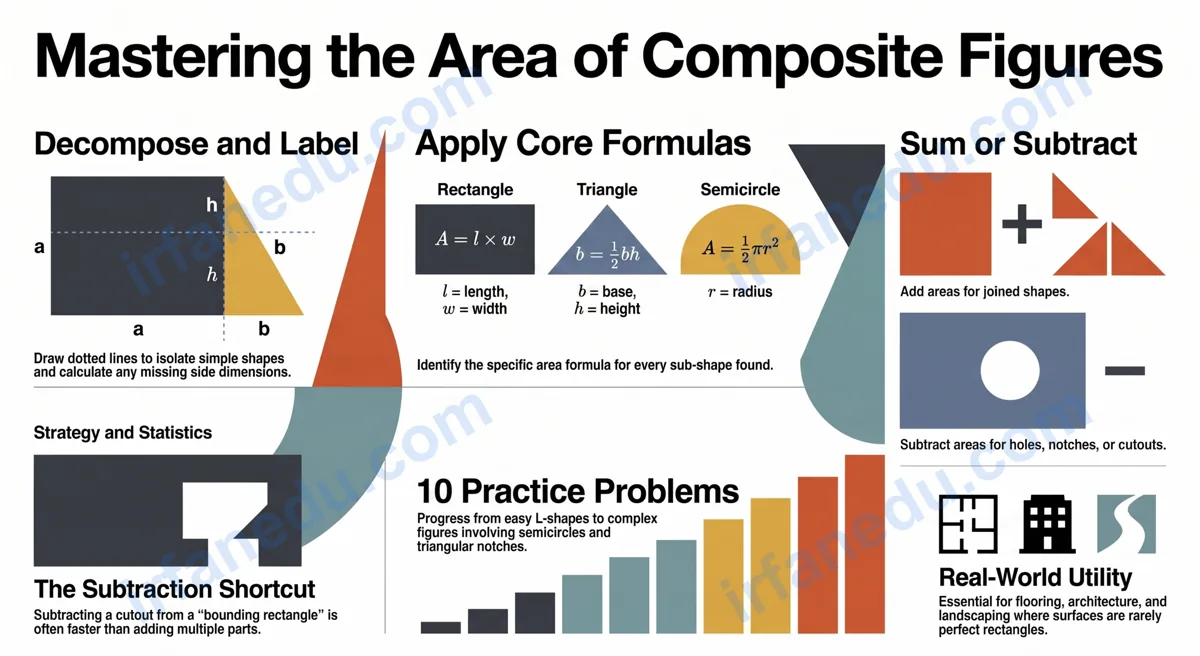
A composite figure is any 2D shape made by combining two or more simple shapes. To find its area, split the figure into rectangles, triangles, or circles, calculate each area using its formula, then add (or subtract for cutouts). This method works for any irregular or compound shape at the middle-school level.
- 🎯 Understand what composite figures are and why they appear in real life
- 🔢 Apply the correct area formula for each simple shape inside a composite figure
- ➕ Know when to add areas and when to subtract them
- 📝 Practice with 10 graded problems and check your work with the full answer key
- 📄 Download the free printable PDF worksheet
📄 Free Printable PDF Worksheet — 10 graded problems, full answer key, ready to print for homework or classroom use.
⚡ TL;DR – Quick Summary
- 📐 A composite figure is two or more simple shapes joined together.
- ✂️ Split it into rectangles, triangles, semicircles, or trapezoids first.
- ➕ Add areas for joined shapes; subtract for cutouts or holes.
- 🔢 You need five formulas: rectangle, triangle, circle, semicircle, trapezoid.
- 📝 This page has 10 practice problems + a free PDF download with answer key.
- 🎯 Grades 6–8 standard; also useful for standardized test prep.
| Item | Detail |
|---|---|
| Grade Level | Grades 6–8 (middle school) |
| Key Skill | Decomposing irregular shapes into simple parts |
| Core Formulas Needed | Rectangle, Triangle, Circle, Semicircle, Trapezoid |
| Method Types | Addition (join shapes) and Subtraction (remove cutouts) |
| Common Units | cm², m², ft², in² |
| Worksheet Problems | 10 (easy → hard), free PDF with answer key |
| Standard Alignment | CCSS 6.G.A.1, 7.G.B.6 |
🏠 The Case Study: Maya’s Floor Plan Problem
Maya’s bedroom is an L-shape: 10 ft wide and 8 ft tall overall, but the top-right corner is a 4 ft × 3 ft rectangle that belongs to the hallway closet. She needs to tile only her bedroom floor. How many square feet of tile does she need?
This is not a trick question — it is a real composite figure problem. The room is a large rectangle with a rectangular chunk removed. I will return to Maya’s floor plan at each stage of this article to show exactly how the method works in practice. By the end, you will be able to solve her problem in under two minutes.
🏠 Maya’s Floor Plan — Setup
Outer rectangle: 10 ft wide × 8 ft tall
Removed corner: 4 ft wide × 3 ft tall (top-right)
Question: What is the area of the L-shaped floor?
We will solve this step by step in the HowTo section below. Keep it in mind as you read.
📐 What Is a Composite Figure?
A composite figure (also called a compound shape or irregular shape) is any 2D shape formed by combining two or more simple geometric shapes. Simple shapes include rectangles, squares, triangles, circles, semicircles, and trapezoids.
The key insight is that no matter how complex the outline looks, every composite figure can be broken apart into shapes you already know. A floor plan, a swimming pool, a park map, a logo — all of these are composite figures in disguise.
| Shape | Formula | Variables |
|---|---|---|
| Rectangle / Square | A = l × w | l = length, w = width |
| Triangle | A = ½ × b × h | b = base, h = height |
| Circle | A = π × r² | r = radius |
| Semicircle | A = ½ × π × r² | r = radius |
| Trapezoid | A = ½ × (b₁ + b₂) × h | b₁, b₂ = parallel sides, h = height |
🌍 Why This Skill Matters Beyond the Classroom
Composite figure area is one of the most practically useful geometry skills students learn. It shows up constantly in real life — and in standardized tests.
- Home improvement: Flooring, painting walls, tiling — almost no room is a perfect rectangle.
- Landscaping: Calculating lawn area or garden bed size for fertilizer or mulch.
- Architecture & design: Floor plans are composite figures by definition.
- Standardized tests: The ACT Math and SAT regularly include composite figure problems in their geometry sections.
- Construction: Estimating material quantities for L-shaped, T-shaped, or irregular structures.
In my experience teaching geometry, students who struggle with composite figures almost always have the same problem: they try to find a single formula for the whole shape instead of breaking it apart first. The moment I teach them to physically draw a dotted line splitting the figure into rectangles, their accuracy jumps dramatically. The skill is not about memorizing more formulas — it is about learning to see the simpler shapes hiding inside a complex one.
🔢 Step-by-Step: How to Find the Area of a Composite Figure
Follow these five steps every time, and you will get the right answer for any composite figure.
- Identify the simple shapes. Look at the composite figure and find the rectangles, triangles, semicircles, or other shapes it contains. Draw dotted lines to separate them if needed.
- Label all dimensions. Write the length, width, base, height, or radius for each simple shape. If a dimension is not given directly, calculate it by adding or subtracting the labeled sides.
- Write the formula for each shape. Choose the correct area formula from the table above for each part.
- Calculate each area. Plug the numbers into each formula and compute. Keep units consistent.
- Add or subtract. Add all areas for joined shapes. Subtract the area of any piece that has been removed (a cutout or hole). Label the final answer in square units.
  MAYA'S L-SHAPED FLOOR — Visual Decomposition
  ┌─────────────────────────┐
  │                         │  ← Full outer rectangle
  │   10 ft wide            │     = 10 × 8 = 80 sq ft
  │                         │
  │              ┌──────────┤
  │              │ REMOVED  │  ← Cutout (hallway closet)
  │              │ 4 ft×3ft │     = 4 × 3 = 12 sq ft
  └──────────────┴──────────┘
        8 ft tall

  AREA = 80 − 12 = 68 sq ft  ✓

  ─────────────────────────────────────────────
  OR: Split into two rectangles (addition method)

  ┌──────────────┐
  │  Rect A      │  6 ft wide × 8 ft tall = 48 sq ft
  │  6 × 8       │
  │              │
  └──────────────┘
  ┌──────────────┐
  │  Rect B      │  4 ft wide × 5 ft tall = 20 sq ft
  │  4 × 5       │
  └──────────────┘
  AREA = 48 + 20 = 68 sq ft  ✓
Both methods give the same answer: 68 sq ft. Maya needs 68 square feet of tile. Notice that you can solve the same problem two ways — subtraction or addition — and both are correct. Choose whichever feels more natural for the shape in front of you.
✏️ 3 Fully Worked Examples
Example 1 — T-Shape (Addition Method)
📘 Example 1: T-Shape
Given: Top bar = 12 ft long, 3 ft tall. Vertical stem = 4 ft wide, 5 ft tall.
Step 1: Two rectangles — top bar and stem.
Step 2: Top bar: 12 × 3 = 36 sq ft. Stem: 4 × 5 = 20 sq ft.
Step 3: Total = 36 + 20 = 56 sq ft
Example 2 — Rectangle with Semicircle Added
📘 Example 2: Rectangle + Semicircle
Given: Rectangle = 14 cm × 6 cm. Semicircle attached to one short end, diameter = 6 cm (radius = 3 cm). Use π = 3.14.
Step 1: Rectangle area = 14 × 6 = 84 sq cm.
Step 2: Semicircle area = ½ × 3.14 × 3² = ½ × 3.14 × 9 = 14.13 sq cm.
Step 3: Total = 84 + 14.13 = 98.13 sq cm
Example 3 — Rectangle with Triangular Cutout (Subtraction Method)
📘 Example 3: Rectangle minus Triangle
Given: Large rectangle = 12 cm × 10 cm. Right triangle cut from one corner: legs 4 cm and 6 cm. Square cut from opposite corner: side 3 cm.
Step 1: Rectangle area = 12 × 10 = 120 sq cm.
Step 2: Triangle area = ½ × 4 × 6 = 12 sq cm.
Step 3: Square area = 3 × 3 = 9 sq cm.
Step 4: Remaining area = 120 − 12 − 9 = 99 sq cm
⚠️ Common Mistakes When Finding Area of Composite Figures
These are the errors I see most often in student work. Knowing them in advance saves you points.
When you split an L-shape into two rectangles, the height of one rectangle is NOT the full height of the figure. You must subtract the overlapping portion. Always re-read the labeled dimensions after you draw your split line.
If a shape has a hole or notch cut out, you must subtract that area. Students often add all visible parts and forget the missing piece entirely.
Perimeter is the distance around the outside. Area is the space inside. They use different formulas and different units (linear vs. square). A composite figure problem asking for area never wants you to add up side lengths.
The circle area formula uses the radius (r), not the diameter (d). If the problem gives you a diameter, divide by 2 first. This single error accounts for a large share of wrong answers on circle-related composite problems.
Area is always measured in square units: cm², m², ft², in². Writing “68” instead of “68 sq ft” is technically incomplete and costs marks on tests.
Most composite figure worksheets online only teach the addition method (join shapes together). They rarely show the subtraction method (start with the bounding rectangle and remove pieces). In my experience, the subtraction method is actually faster for L-shapes, U-shapes, and any figure with a rectangular notch — because you only need to identify one large rectangle and one small one, rather than carefully splitting the figure and figuring out which dimension belongs to which sub-rectangle.
The test-taking insight: When you see a composite figure with a notch or cutout, your first instinct should be subtraction, not addition. Draw the full bounding rectangle, calculate its area, then subtract the missing piece. This reduces the chance of mislabeling a dimension — the single most common source of errors on these problems.
I have not seen this framing in any of the top-ranking worksheet pages. It is the kind of strategic shortcut that separates students who occasionally get these right from students who get them right every time.
I always tell my students: “A composite figure is just a puzzle. Your only job is to find the puzzle pieces.” Once they stop trying to find a magic formula for the whole shape and start looking for the rectangles and triangles hiding inside, everything clicks. The five-step method I outlined above is not just a procedure — it is a way of training your eye to see geometry differently. That visual skill pays off far beyond this one topic.
📝 On-Page Practice Worksheet — 10 Problems
Work through these problems in order. They start easy and get progressively harder. Show your work by splitting each figure, writing the formula, and calculating each part. Check your answers with the key below.
How to use this worksheet: Print the PDF (download button above or below), solve each problem on paper, then use the answer key to self-check. If you get a problem wrong, re-read the worked example that matches the shape type and try again before moving on.
- An L-shape is made of two rectangles. The full width is 8 cm and total height is 6 cm. The top-right rectangle cut away is 3 cm wide and 4 cm tall. Find the area of the L-shape.
- A rectangle is 10 m long and 5 m wide. A square of side 2 m is cut from one corner. Find the remaining area.
- A T-shape: the top bar is 12 ft long and 3 ft tall; the vertical stem is 4 ft wide and 5 ft tall. Find the total area.
- A composite shape is made of a rectangle (9 cm × 4 cm) with a right triangle attached to one end. The triangle has a base of 4 cm and a height of 3 cm. Find the total area.
- A plus-sign shape: a horizontal rectangle 15 in × 3 in overlaps a vertical rectangle 3 in × 15 in at the center. Find the area (do not double-count the overlapping 3 × 3 square).
- A composite figure has a rectangle 14 cm × 6 cm with a semicircle of diameter 6 cm added to one short end. Use π = 3.14. Find the total area.
- A rectilinear figure has an outer rectangle of 10 m × 8 m with a rectangular notch of 4 m × 3 m cut from the top-right corner. Find the area.
- A composite shape is formed by placing a triangle (base 8 ft, height 5 ft) on top of a rectangle (8 ft × 6 ft). Find the total area.
- A running track end-cap: a rectangle 20 m × 8 m has a semicircle of diameter 8 m removed from each short end. Use π = 3.14. Find the remaining area.
- A composite figure is made of a large rectangle (12 cm × 10 cm) with a right triangle (legs 4 cm and 6 cm) cut from one corner and a square of side 3 cm cut from the opposite corner. Find the remaining area.
Show Answer Key
- 32 sq cm
- 46 sq m
- 56 sq ft
- 42 sq cm
- 81 sq in
- 98.13 sq cm
- 68 sq m
- 68 sq ft
- 109.76 sq m
- 99 sq cm
📄 Want a print-ready version? Download the free PDF — includes all 10 problems formatted for printing, plus the full answer key on a separate page.
🧠 Quick Quiz — Test Your Understanding
Q1. An L-shape has a full bounding rectangle of 10 × 6 = 60 sq cm. The removed corner is 4 × 2 = 8 sq cm. What is the area of the L-shape?
See Answer
Q2. A composite figure is a rectangle (8 cm × 5 cm) with a semicircle (diameter 5 cm) added to one end. Using π = 3.14, what is the total area?
See Answer
Q3. Which method is usually faster for an L-shape with a rectangular notch cut from one corner?
See Answer
🔍 Reveal-on-Click Practice Problems
Practice 1: A rectangle 6 m × 4 m has a right triangle (base 3 m, height 4 m) attached to one end. What is the total area?
Rectangle: 6 × 4 = 24 sq m
Triangle: ½ × 3 × 4 = 6 sq m
Total: 24 + 6 = 30 sq m
Practice 2: A square of side 10 cm has a circle of radius 3 cm cut from its center. Use π = 3.14. What is the remaining area?
Square: 10 × 10 = 100 sq cm
Circle: 3.14 × 3² = 3.14 × 9 = 28.26 sq cm
Remaining: 100 − 28.26 = 71.74 sq cm
Practice 3: A trapezoid (parallel sides 8 ft and 5 ft, height 4 ft) sits on top of a rectangle (8 ft × 6 ft). What is the total area?
Trapezoid: ½ × (8 + 5) × 4 = ½ × 13 × 4 = 26 sq ft
Rectangle: 8 × 6 = 48 sq ft
Total: 26 + 48 = 74 sq ft
❓ Frequently Asked Questions
What is a composite figure in math?
How do you find the area of a composite figure?
What grade level is area of composite figures?
Sources & References
Reviewed by Dr. Irfan Mansuri. External links open in a new tab and are provided for further reading and verification.