
🔢 7 Things Nobody Tells You About the Empty Number Line (And Why It Matters)
📋 Table of Contents
- Introduction: Why This Tool Gets Underestimated
- Quick Answer
- TL;DR – Quick Summary
- Thing #1 — What an Empty Number Line Actually Is
- Thing #2 — Empty vs Regular Number Line (They Are Not the Same)
- Thing #3 — How to Use It for Addition (Step-by-Step)
- Thing #4 — The Subtraction Trick Most Teachers Skip
- Thing #5 — 4 Common Mistakes (Wrong vs Right)
- Thing #6 — Using It for Fractions & Decimals
- Thing #7 — Real-World Uses & Why Number Sense Lasts a Lifetime
- 💡 Unique Insight
- Quick Quiz
- Practice Problems
- FAQ
- Key Takeaways
- Related Articles
- About the Author
- Sources & References
Most math worksheets give students a number line that is already filled in — evenly spaced tick marks from 0 to 20, or 0 to 100. That looks helpful. But in my experience teaching elementary and middle school math, that pre-filled line is quietly doing the thinking for the student. The empty number line flips that completely.
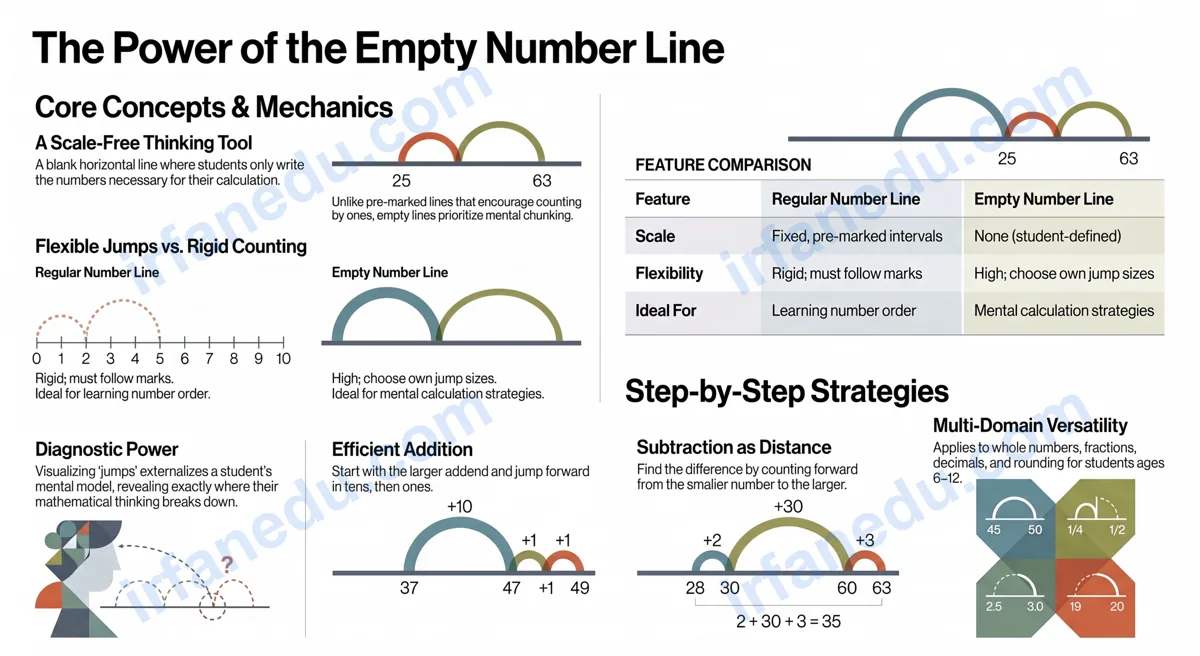
An empty number line is a blank horizontal line with no pre-marked numbers. Students write only the numbers they need, then draw curved arrows — called “jumps” — to show each step of a calculation. It is the single most flexible mental math tool in the elementary curriculum, and it builds the number sense that underpins algebra, fractions, and beyond.
- 🎯 Understand exactly what an empty number line is (and is not)
- 📐 Use it confidently for addition, subtraction, fractions, and decimals
- 🚫 Avoid the four most common mistakes students make
- 💡 Discover the non-obvious insight that makes this tool so powerful
- 🧠 Help your child or student build lasting number sense
An empty number line is a blank horizontal line with no pre-marked numbers or intervals. Students place only the numbers they need, then draw curved jumps to show addition or subtraction steps. It builds mental math flexibility by letting learners choose their own jump strategy rather than counting fixed tick marks one by one. Used in grades 1–6 for arithmetic, fractions, and decimals.
⚡ TL;DR – Quick Summary
- ✅ An empty number line has no pre-marked numbers — students add only what they need.
- ✅ It teaches flexible thinking, not just a fixed counting algorithm.
- ✅ For addition: start at the larger number, jump in tens then ones.
- ✅ For subtraction: count forward from the smaller number to find the difference.
- ✅ Works for fractions and decimals too — not just whole numbers.
- ✅ The biggest mistake: making jumps that are too small (counting by ones).
| Fact | Detail |
|---|---|
| 📛 Also called | Open number line, blank number line |
| 🎓 Grade range | Grades 1–6 (ages 6–12) |
| 🧮 Used for | Addition, subtraction, fractions, decimals, rounding |
| 🏫 Curriculum | Common Core Math (US), also used in UK, Australia, Netherlands |
| 🔑 Core skill built | Number sense and mental math flexibility |
| ⏱ Typical intro age | Age 6–7 (Grade 1–2) |
| 📈 Extends to | Negative numbers, fractions, decimals in Grades 4–6 |
🔢 Thing #1 — What an Empty Number Line Actually Is
An empty number line is a horizontal line with no numbers, no tick marks, and no scale. That is the entire definition. Students write a starting number at one end, then draw curved arrows (jumps) to move along the line as they calculate.
The jumps are not drawn to scale. A jump of 10 and a jump of 3 can look the same size on the paper — and that is intentional. The line is a thinking tool, not a measuring tool. This distinction matters enormously, and most introductory worksheets never explain it.
The concept was developed by Dutch mathematics educators in the 1980s as part of the Realistic Mathematics Education (RME) framework, later adopted into the US Common Core standards. The idea was simple: give students a tool that mirrors how expert mathematicians actually think — in chunks and relationships, not in individual unit counts.
  Empty Number Line (Addition: 47 + 35)

  Start at 47. Jump +10, +10, +10 (three tens = 30), then +5 (five ones).

  47        57        67        77     82
  |-------->|-------->|-------->|----->|
     +10       +10       +10      +5

  Answer: 82
Notice that the line has no markings between 47 and 57. The student decides the jump size. That freedom is the whole point.
📏 Thing #2 — Empty vs Regular Number Line (They Are Not the Same)
A regular number line has evenly spaced, pre-marked intervals — every integer from 0 to 20, for example. An empty number line has none of that. The difference sounds small but changes how a student thinks completely.
| Feature | Regular Number Line | Empty Number Line |
|---|---|---|
| Pre-marked numbers | ✔ Yes (fixed scale) | ✘ None |
| Student chooses jump size | ✘ No (must follow marks) | ✔ Yes (full flexibility) |
| Encourages counting by ones | ✔ Often yes | ✘ Discourages it |
| Works for large numbers | ✘ Impractical past ~20 | ✔ Works for any number |
| Builds mental math | ✘ Limited | ✔ Strong |
| Works for fractions/decimals | Possible but rigid | ✔ Very naturally |
| Best for | Introducing number order | Mental calculation strategies |
In my experience, the biggest mistake parents make is printing a pre-numbered number line for homework help. It feels supportive, but it actually teaches the child to count by ones — the exact habit the empty number line is designed to break. Hand your child a blank piece of paper and a pencil instead. That blank line is more powerful than any printed worksheet.
➕ Thing #3 — How to Use It for Addition (Step-by-Step)
Using an empty number line for addition takes five steps. The key rule: always start with the larger number and jump in the biggest chunks you can.
- Draw a horizontal line. No numbers yet — just a plain line across your paper.
- Write the larger addend at the left. For 47 + 35, write 47 at the start.
- Jump in tens first. Draw a curved arrow forward for each group of ten. For 35, that is three jumps of 10. Label each arrow “+10”. Land at 57, then 67, then 77.
- Jump in ones next. Draw smaller curved arrows for the remaining 5 ones. Label each “+1” — or, better, draw one arrow labeled “+5” to land at 82.
- Read the answer. The number where your last arrow lands is the sum: 82.
Start at 63. Jump +10, +10 (two tens = 20) to reach 83. Then jump +8 (eight ones) to reach 91.
 63         73         83      91
 |--------->|--------->|------>|
     +10        +10       +8

 Answer: 91
Smarter version: instead of +8 ones, jump +7 to reach 90 (a “friendly” number), then +1 to reach 91. Same answer, easier mental math.
➖ Thing #4 — The Subtraction Trick Most Teachers Skip
Most students try to subtract on a number line by jumping backward — and that works, but it is harder to draw and easier to lose track. The smarter method is to jump forward from the smaller number to the larger one and count the total distance.
This method is called “finding the difference by counting up” and it mirrors how cashiers make change. It is faster, less error-prone, and builds a deeper understanding of subtraction as distance between two numbers.
Instead of jumping back from 82, start at 47 and jump forward to 82.
 47    50         60         70         80  82
 |---->|--------->|--------->|--------->|-->|
   +3      +10        +10        +10     +2

 Total jumps: 3 + 10 + 10 + 10 + 2 = 35

 Answer: 82 − 47 = 35
The “bridge to 50” jump (+3) is the key move — it turns a messy calculation into clean tens.
I have tutored hundreds of students who struggled with subtraction because they were taught only the “take away” model — physically removing objects. The empty number line introduces subtraction as a distance, which is a completely different and more powerful mental model. When students later encounter subtraction of negative numbers or algebraic expressions, the distance model is the one that actually makes sense. Teaching it early with the empty number line is one of the highest-leverage moves in elementary math education.
🚫 Thing #5 — 4 Common Mistakes (Wrong vs Right)
These four mistakes account for the vast majority of errors I see on empty number line work. Each one has a simple fix.
Jumping by ones for every step (e.g., +1, +1, +1 … 35 times for 47 + 35). This defeats the purpose of the tool and is just slow counting with extra steps.
Jump in tens first, then ones. Aim for the fewest arrows possible. Three jumps of 10 and one jump of 5 is far better than 35 jumps of 1.
Starting with the smaller number for addition (e.g., starting at 28 instead of 63 for 63 + 28). This means more jumps and more chances for error.
Always start with the larger addend. Addition is commutative — 63 + 28 = 28 + 63 — so always put the bigger number first to minimize jumps.
Forgetting to label each arrow. Students draw jumps but skip the “+10” or “+5” labels, then cannot check their work or add up the jumps at the end.
Label every single arrow with its jump size. This is not optional — it is how you verify the answer and show your thinking.
Drawing jumps to scale (making a jump of 10 look ten times bigger than a jump of 1). This wastes time and misses the point — the line is a thinking tool, not a ruler.
Jumps do not need to be proportional. A jump of 10 and a jump of 3 can look the same size. What matters is the label, not the length of the arrow.
🍕 Thing #6 — Using It for Fractions & Decimals
The empty number line is not just for whole numbers. From Grade 3 onward, it becomes a powerful tool for placing fractions and decimals — and for understanding why 1/2 is bigger than 1/4 without needing a pie chart.
Fractions on the Empty Number Line
Mark 0 on the left and 1 on the right. Now ask: where does 1/2 go? Exactly in the middle. Where does 1/4 go? Halfway between 0 and 1/2. This spatial reasoning builds fraction sense faster than any worksheet of equivalent fraction problems.
  0          1/4        1/2        3/4         1
  |-----------|-----------|-----------|-----------|
              ↑           ↑           ↑
           halfway     halfway     halfway
          between    between     between
          0 & 1/2    1/4 & 3/4   1/2 & 1
Decimals on the Empty Number Line
Mark 0 and 1. Place 0.5 in the middle. Then 0.25 and 0.75 at the quarter points. This directly connects decimals to fractions — 0.5 = 1/2, 0.25 = 1/4 — in a visual way that abstract notation never achieves.
Mark 0 and 1. Place 0.5 in the middle. 0.7 is to the right of 0.5, closer to 1 than to 0.5. It sits 70% of the way from 0 to 1.
  0         0.5    0.7       1
  |---------|------|---------|
                  ↑
              Mark here
🌍 Thing #7 — Real-World Uses & Why Number Sense Lasts a Lifetime
The empty number line is not a school-only tool. The mental process it teaches — breaking a calculation into manageable chunks and tracking your position — is exactly what adults do when they calculate mentally every day.
- 💰 Making change: A cashier who counts up from $3.47 to $5.00 is using the empty number line mentally.
- ⏱ Time calculations: “My meeting starts at 10:45 and ends at 12:20 — how long is that?” Jump from 10:45 to 11:00 (+15 min), then to 12:00 (+60 min), then to 12:20 (+20 min). Total: 95 minutes.
- 📏 Measurement: Estimating distances, lengths, and weights all use the same “where does this number sit between two anchors?” thinking.
- 📊 Data interpretation: Reading a graph axis requires placing values on a mental number line — a skill that transfers directly from this tool.
In my experience, students who master the empty number line in grades 2–3 are significantly more comfortable with algebra in grades 6–7, because they already think of numbers as positions on a line — which is exactly what a coordinate system is.
Almost every guide to the empty number line frames it as a calculation tool. That is too narrow. The real power is that it externalizes a student’s mental model of number relationships. When a child draws their jumps, you can see exactly how they think about numbers — whether they decompose into tens and ones, whether they bridge through friendly numbers, whether they understand subtraction as distance. A wrong answer on a standard worksheet tells you nothing about why the student went wrong. A wrong answer on an empty number line shows you the exact moment their thinking broke down. That diagnostic power is why experienced teachers use it not just for practice but for assessment. If you are a parent helping with homework, do not just check whether the answer is right — look at the jump strategy. That is where the real math is happening.
🧠 Quick Quiz: Test Your Understanding
Q1. You are solving 54 + 37 on an empty number line. What should your first jump be?
See Answer
Q2. For subtraction 73 − 46, which method is faster on an empty number line?
See Answer
Q3. On an empty number line from 0 to 1, where does 3/4 sit?
See Answer
✏️ Practice Problems (Reveal-on-Click)
Problem 1: Solve 68 + 45 using an empty number line
Strategy: Start at 68. Jump +10, +10, +10, +10 (four tens = 40) to reach 108. Then jump +5 to reach 113.
 68        78        88        98       108    113
 |-------->|-------->|-------->|-------->|----->|
    +10       +10       +10       +10      +5

 Answer: 113
Problem 2: Solve 91 − 54 using the counting-up method
Strategy: Start at 54. Jump to 60 (+6), then +10, +10, +10 to reach 90, then +1 to reach 91.
 54    60         70         80         90  91
 |---->|--------->|--------->|--------->|-->|
   +6      +10        +10        +10     +1

 Total: 6 + 10 + 10 + 10 + 1 = 37

 Answer: 91 − 54 = 37
Problem 3: Place 2/3 on an empty number line from 0 to 1
Strategy: Divide the line into three equal parts. Mark 1/3 and 2/3. 2/3 is approximately 0.667 — to the right of 1/2 (0.5) but to the left of 3/4 (0.75).
  0       1/3      1/2    2/3      1
  |--------|--------|------|--------|
                          ↑
                      Mark 2/3 here
                    (between 1/2 and 1,
                     closer to 1/2)