
Number Line Addition: Step-by-Step Guide with Examples
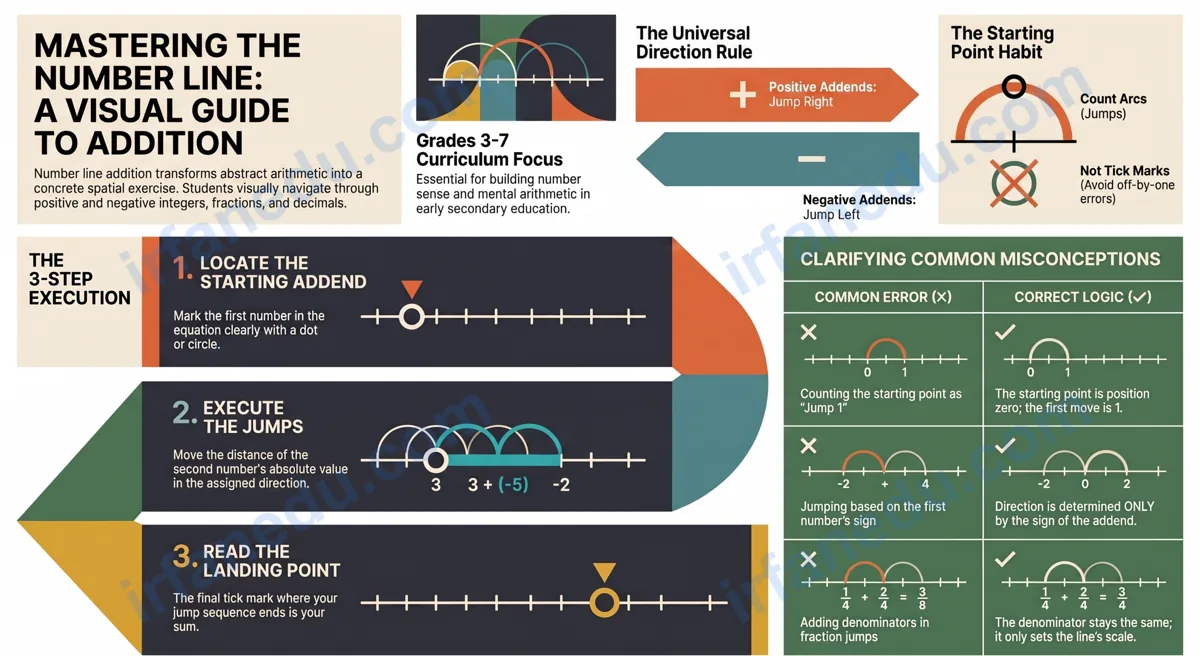
Start with a real calculation: -3 + 5. Place your finger on -3. Jump five spaces to the right. You land on 2. That is number line addition — and it takes about four seconds once you know the rule. The hard part for most students is not the jumping; it is knowing which direction to jump and why. This guide fixes that completely.
Number line addition is a visual method for finding the sum of two numbers by starting at the first number on a number line and jumping right (for a positive addend) or left (for a negative addend). The landing point is the answer. It works for whole numbers, integers, and fractions.
- Understand the left-right direction rule for positive and negative addends
- Solve whole-number, negative-integer, and fraction addition on a number line
- Avoid the three most common direction errors students make
- Know when the number line method is more useful than the standard algorithm
The direction of your jump — not the size — is what most students get wrong. Positive addend = right. Negative addend = left. Master that one rule and every number line addition problem becomes straightforward.
Number line addition means starting at the first number on a number line, then jumping right (positive direction) or left (negative direction) by the value of the second number. Where you land is the sum. For example, -3 + 5: start at -3, jump 5 spaces right, land on 2. The rule is simple — positive addend means right, negative addend means left.
TL;DR – Quick Summary
- Start at the first number; jump right for positive, left for negative addends.
- The size of the jump equals the absolute value of the second number.
- Adding a negative always moves you left, making the result smaller.
- For fractions, divide each unit into equal parts matching the denominator.
- Two negative addends both jump left — the sum is always more negative.
- The number line is a thinking tool, not just a drawing exercise.
| Fact | Detail |
|---|---|
| Method name | Number line addition |
| Also called | Integer addition on a number line, jumping on a number line |
| Positive addend direction | Right (increasing values) |
| Negative addend direction | Left (decreasing values) |
| Works for | Whole numbers, integers, fractions, decimals |
| Typical grade level | Grades 3-7 (US Common Core) |
| Key skill it builds | Number sense and mental arithmetic |
What Is Number Line Addition?
Number line addition is a visual strategy for adding two numbers by representing the operation as physical movement along a scaled horizontal line. The number line itself is a straight line with zero at the center, positive numbers extending to the right, and negative numbers extending to the left.
Each number corresponds to a specific point on the line. Addition becomes a two-step action: place a marker at the first number, then slide it in the direction and distance defined by the second number. The final position is the answer.
This method is not just for beginners. In my experience teaching middle school math, I have seen students who struggle with abstract integer rules immediately grasp them the moment they draw the jumps. The visual makes the abstract concrete.
[IMAGE: A labeled number line from -10 to +10 with tick marks and zero centered | ALT: number line from negative ten to positive ten with labeled integers]
Always write the number line before you calculate. Even a rough sketch on scratch paper reduces direction errors by giving your brain a spatial anchor. Students who skip the drawing step make far more sign errors than those who draw it out.
How Does Number Line Addition Work? (5-Step Method)
Number line addition follows five clear steps every time, regardless of whether the numbers are positive, negative, or fractional.
- Draw your number line. Mark a horizontal line with evenly spaced tick marks. Place zero in the center. Label positive integers to the right and negative integers to the left.
- Locate the first addend. Find the first number in your addition problem and mark it clearly as your starting point. Circle it or draw a dot.
- Identify the direction. Look at the second addend. If it is positive (or has no sign), you will move right. If it is negative, you will move left.
- Count the jumps. Jump the number of spaces equal to the absolute value of the second addend. Each tick mark is one unit. Count carefully and mark each jump with a small arc.
- Read the answer. The tick mark where your final jump lands is the sum. Write the equation with the answer.
- Draw a number line from 0 to 10.
- Start at 4.
- The second addend is +3, so move right.
- Jump 3 spaces to the right: 4 → 5 → 6 → 7.
- Answer: 4 + 3 = 7
Adding Whole Numbers on a Number Line
Adding whole numbers on a number line is the foundation of the method. Both addends are positive, so every jump goes to the right.
  Start                          Land
    |                              |
    v                              v
----+----+----+----+----+----+----+----+----+----
   -1    0    1    2    3    4    5    6    7    8

    [2]---(+1)---(+2)---(+3)---(+4)---(+5)---(+6)--->[8]

    Start at 2. Jump 6 spaces right. Land on 8.
    Answer: 2 + 6 = 8
The key habit to build here is counting the jumps, not the tick marks. Students often count the starting point as “1” instead of “0,” which shifts every answer by one. The starting point is your position, not your first jump.
- Draw a number line from 0 to 15.
- Start at 7.
- Second addend is +5, so move right.
- Jump 5 spaces: 7 → 8 → 9 → 10 → 11 → 12.
- Answer: 7 + 5 = 12
In my experience, teachers sometimes rush straight to negative integers because that is where the curriculum pressure is. I always spend at least one full session on whole-number jumps first. The physical habit of counting arcs — not tick marks — must be automatic before you introduce direction changes. Skipping this step is the single biggest reason students make off-by-one errors with negatives later.
How Do You Add Negative Numbers on a Number Line?
Adding a negative number means jumping to the left, because negative numbers decrease in value. The absolute value of the negative addend tells you how many spaces to jump.
  Start                    Land
    |                        |
    v                        v
----+----+----+----+----+----+----+----
   -5   -4   -3   -2   -1    0    1    2

    [-3]---(+1)---(+2)---(+3)---(+4)---(+5)--->[2]

    Start at -3. Jump 5 spaces RIGHT (addend is +5).
    Answer: -3 + 5 = 2
- Draw a number line from -5 to 6.
- Start at 4.
- Second addend is -6, so move LEFT.
- Jump 6 spaces left: 4 → 3 → 2 → 1 → 0 → -1 → -2.
- Answer: 4 + (-6) = -2
Notice that you start at a positive number but land on a negative number. This is exactly the kind of result that confuses students who rely only on rules without a visual. The number line makes it obvious: you simply ran out of positive space and crossed zero.
Many students see a negative sign and automatically jump left from the starting point, even when the starting number is already negative. The rule is about the addend’s sign, not the starting number’s sign. Always check: what sign does the second number carry? That sign determines your direction.
How Do You Add Two Negative Numbers on a Number Line?
When both addends are negative, both jumps go left, and the result is always more negative than either addend on its own.
         Land              Start
          |                  |
          v                  v
----+----+----+----+----+----+----+----
   -7   -6   -5   -4   -3   -2   -1    0

    [-2]<--(-1)<--(-2)<--(-3)<--(-4)---[-6]

    Start at -2. Jump 4 spaces LEFT (addend is -4).
    Answer: -2 + (-4) = -6
- Draw a number line from -10 to 0.
- Start at -5.
- Second addend is -3, so move LEFT.
- Jump 3 spaces left: -5 → -6 → -7 → -8.
- Answer: -5 + (-3) = -8
A useful mental check: when both addends are negative, the answer’s absolute value equals the sum of the two absolute values. So |-5| + |-3| = 5 + 3 = 8, and the sign is negative, giving -8. The number line confirms this visually.
Can You Add Fractions on a Number Line?
Yes, and the method is nearly identical to integer addition. The only extra step is dividing each unit interval into equal parts that match the denominator.
- Draw a number line from 0 to 2 (or whatever range fits your fractions).
- Divide each unit interval into equal parts equal to the denominator. For fourths, each unit gets 4 marks.
- Label the fractions: 1/4, 2/4, 3/4, 1, 5/4, and so on.
- Start at the first fraction and jump right by the number of parts equal to the numerator of the second fraction.
- Read the landing fraction as your answer.
- Number line from 0 to 1, divided into 4 equal parts.
- Start at 1/4 (the first tick mark after 0).
- Second addend is 2/4 (positive), so jump right 2 parts.
- 1/4 → 2/4 → 3/4.
- Answer: 1/4 + 2/4 = 3/4
- Number line from 0 to 2, divided into 5 equal parts per unit.
- Start at 3/5.
- Jump right 4 parts: 3/5 → 4/5 → 5/5 (=1) → 6/5 → 7/5.
- Answer: 3/5 + 4/5 = 7/5 = 1 and 2/5
Most fraction mistakes happen because students treat numerators and denominators as separate whole numbers and add them both. When I make a student draw 3/5 + 4/5 on a number line, they see immediately that they are jumping along a single scale — the denominator sets the scale, the numerator counts the jumps. That visual kills the “add the denominators” error faster than any rule I could recite.
What Are the Most Common Number Line Addition Mistakes?
Three errors account for the vast majority of wrong answers in number line addition. Knowing them in advance lets you avoid them entirely.
| Wrong Approach | Correct Approach |
|---|---|
| Counting the starting point as jump #1 (off-by-one error) | The starting point is position zero. Your first jump takes you to position 1. |
| Jumping left whenever you see a negative starting number | Direction depends on the addend’s sign, not the starting number’s sign. |
| Adding denominators when adding fractions (e.g., 1/3 + 1/3 = 2/6) | The denominator sets the scale. Only the numerator (jump count) changes: 1/3 + 1/3 = 2/3. |
| Drawing a number line that is too small and running off the edge | Estimate the answer first (rough mental math), then draw a line that comfortably fits both the start and the expected answer. |
Number Line vs. Standard Algorithm: When Should You Use Each?
The number line is a thinking tool, not a calculation shortcut. Knowing when to use it — and when to switch to the standard algorithm — is a sign of mathematical maturity.
| Situation | Number Line Method | Standard Algorithm |
|---|---|---|
| Learning integer concepts for the first time | Best choice. Builds intuition visually. | Too abstract without prior understanding. |
| Adding small integers (-10 to +10) | Quick and reliable. | Equally fast once memorized. |
| Adding large numbers (e.g., 347 + 589) | Impractical — line too long. | Best choice. Efficient column addition. |
| Understanding why a rule works | Best choice. Shows the logic spatially. | Procedural — does not explain the why. |
| Adding fractions with the same denominator | Good for concept-building. | Faster once the concept is clear. |
| Mental arithmetic check | Useful as a mental image. | Faster for practiced students. |
Where Is Number Line Addition Used in Real Life?
Number line thinking appears in everyday situations far more often than most students realize. Recognizing these connections makes the math feel purposeful.
- Temperature changes: If it is -4°C and the temperature rises 7 degrees, you start at -4 and jump 7 right to reach +3°C.
- Bank account balances: A balance of -$20 (overdrawn) plus a $35 deposit: start at -20, jump 35 right, land at +$15.
- Elevation: A submarine at -150 meters rises 80 meters: -150 + 80 = -70 meters.
- Sports scoring: A football team on the -5-yard line gains 12 yards: -5 + 12 = +7 yards (past the line of scrimmage).
- Time zones: Adding or subtracting hours when calculating time differences across zones is fundamentally number line addition.
Most number line guides treat the method as a drawing exercise — “draw the line, draw the arrows, write the answer.” That misses the deeper point. The number line is a mental model, not just a paper tool. Research in math cognition (including work from the University of Western Ontario on the mental number line) shows that humans naturally represent numbers spatially from birth. When you practice number line addition, you are not learning a drawing technique — you are training your brain’s built-in spatial number sense. Students who internalize the left-right direction rule eventually stop drawing and start solving integer problems mentally, because the number line lives in their head. The goal is always to make the drawing unnecessary. That is the exit ramp most textbooks never show you.
Quick Quiz: Test Your Number Line Addition
1. Starting at -4 and adding +7, where do you land?
2. Which direction do you jump when adding -5 to any number?
3. What is -3 + (-5) on a number line?
Practice Problems (Reveal-on-Click)
Problem 1: What is 6 + (-9)?
Start at 6. The addend is -9, so jump 9 spaces left.
6 → 5 → 4 → 3 → 2 → 1 → 0 → -1 → -2 → -3
Answer: 6 + (-9) = -3
Problem 2: What is -7 + 4?
Start at -7. The addend is +4, so jump 4 spaces right.
-7 → -6 → -5 → -4 → -3
Answer: -7 + 4 = -3
Problem 3: What is 2/6 + 3/6?
Draw a number line from 0 to 1, divided into 6 equal parts.
Start at 2/6. Jump 3 parts right: 2/6 → 3/6 → 4/6 → 5/6.
Answer: 2/6 + 3/6 = 5/6
Problem 4: What is -8 + (-3)?
Sources & References
Reviewed by Dr. Irfan Mansuri. External links open in a new tab and are provided for further reading and verification.