
Circumference & Area of a Circle Worksheet 📐 (Free PDF + Answer Key)
📋 Table of Contents
- Introduction
- Quick Answer
- Download Free PDF Worksheet
- TL;DR & Quick Facts
- What Are Circumference and Area?
- Step-by-Step: How to Solve Circle Problems
- Worked Examples (Good vs Bad)
- Common Mistakes — Wrong vs Right
- 💡 Unique Insight
- On-Page Practice Worksheet
- Download PDF (Again)
- Interactive Quiz
- FAQ
- Key Takeaways
- Related Articles
- About the Author
- Sources & References
Circumference and area of a circle are two of the most tested geometry skills in middle school math. Circumference measures the distance around a circle (C = 2πr), while area measures the space inside it (A = πr²). Master both formulas with this free printable worksheet, step-by-step lesson, and full answer key.
Most circle worksheets online give you a list of problems and nothing else. That is not enough. In my experience teaching geometry to hundreds of students, the single biggest barrier is not the arithmetic — it is confusing which formula to use and when to halve the diameter. This guide fixes both problems before you touch a single practice problem.
By the end of this page you will be able to:
- State the circumference formula (C = 2πr or C = πd) and the area formula (A = πr²) from memory.
- Convert between radius and diameter without hesitation.
- Solve reverse problems (find radius from area or circumference).
- Complete all 10 worksheet problems confidently and check your work with the answer key.
📄 Free Printable PDF Worksheet — 10 problems (easy to hard), full answer key included. Print it, practise, then self-check.
⚡ TL;DR – Quick Summary
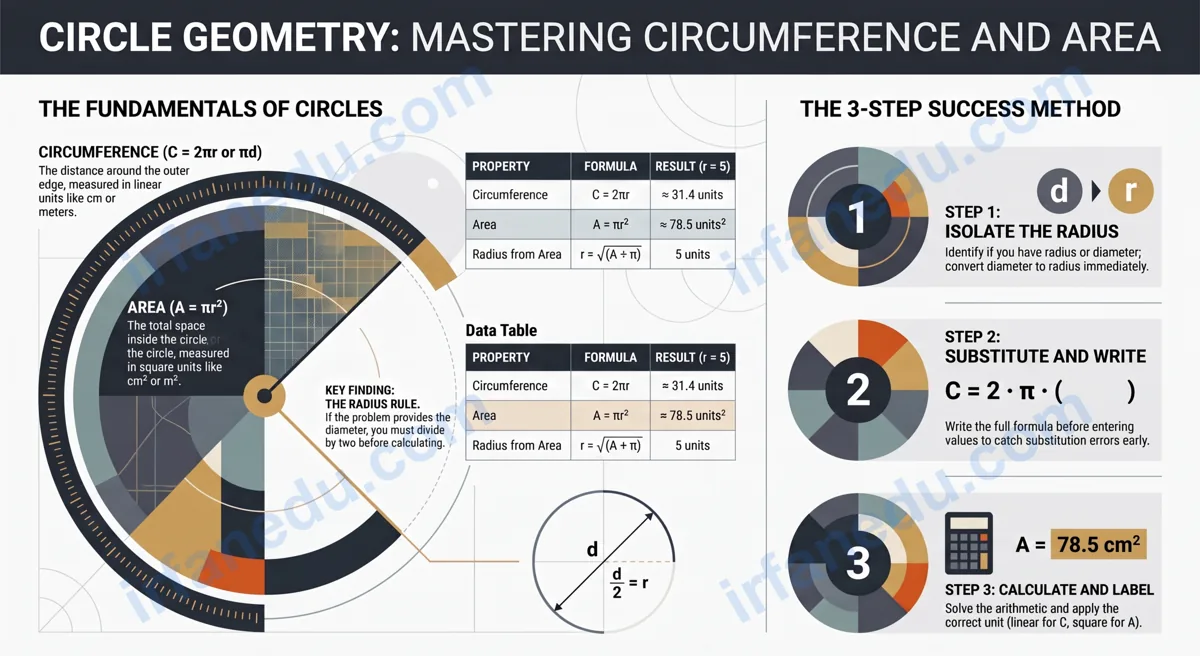
- 🔴 Circumference = distance around the circle: C = 2πr or C = πd
- 🔴 Area = space inside the circle: A = πr²
- 🔴 Always use the radius; if given diameter, divide by 2 first.
- 🔴 Use π ≈ 3.14 unless your teacher says otherwise.
- 🔴 Circumference is in units (cm, m); area is in square units (cm², m²).
- 🔴 Reverse problems: r = C/(2π) or r = sqrt(A/π).
📊 Quick Facts Table
| Property | Formula | Units | Example (r = 5 cm) |
|---|---|---|---|
| Circumference | C = 2πr = πd | cm, m, in, ft | C ≈ 31.4 cm |
| Area | A = πr² | cm², m², in², ft² | A ≈ 78.5 cm² |
| Diameter | d = 2r | same as r | d = 10 cm |
| Radius from C | r = C ÷ (2π) | same as C | r = 31.4 ÷ 6.28 = 5 cm |
| Radius from A | r = √(A ÷ π) | same as A | r = √(78.5 ÷ 3.14) = 5 cm |
What Are Circumference and Area of a Circle?
Circumference is the perimeter of a circle — the total length of its outer boundary. Imagine unrolling the edge of a circular wheel into a straight line: that line’s length is the circumference. It is always measured in linear units (centimetres, metres, inches).
Area is the amount of flat surface enclosed inside the circle. Think of painting the inside of a circle — the area tells you how much paint you need. It is always measured in square units (cm², m², in²).
✅ Correct Understanding
“The circumference is the edge. The area is the inside. They need different formulas and different units.”
❌ Common Confusion
“I’ll just use the same formula for both — they’re both about circles, right?” — This is the #1 mistake students make on tests.
Why These Formulas Matter
Circle formulas appear in real life constantly. A pizza maker calculates area to know how much topping to spread. An engineer calculates circumference to know how far a wheel travels per rotation. A landscaper uses area to buy the right amount of turf for a circular garden.
In school, these formulas appear on standardised tests, in physics (circular motion), and in higher geometry (sectors, arcs, cylinders). Getting them solid now pays dividends for years.
How Do You Find the Circumference and Area of a Circle? (Step-by-Step)
Follow these three steps every single time — they work for every circle problem at this level.
- Step 1 — Identify the radius. Read the problem. Are you given the radius (r) or the diameter (d)? If given the diameter, calculate r = d ÷ 2 before doing anything else.
- Step 2 — Apply the formula. For circumference: C = 2 × π × r. For area: A = π × r². Substitute the value of r and π ≈ 3.14.
- Step 3 — Calculate and label. Do the arithmetic carefully. Write the unit (cm for circumference, cm² for area). Round to the nearest tenth unless told otherwise.
Write the formula first, then substitute numbers. Students who skip straight to punching numbers into a calculator make substitution errors far more often. The formula line takes five seconds and catches mistakes before they happen.
Worked Example 1 — Given the Radius
📝 Problem: A circle has radius r = 6 cm. Find its circumference and area.
Step 1: r = 6 cm (already given — no conversion needed)

Circumference:
  C = 2 × π × r
  C = 2 × 3.14 × 6
  C = 37.68
  C ≈ 37.7 cm

Area:
  A = π × r²
  A = 3.14 × 6²
  A = 3.14 × 36
  A = 113.04
  A ≈ 113.0 cm²
Worked Example 2 — Given the Diameter
📝 Problem: A circular pond has diameter d = 20 m. Find its circumference and area.
Step 1: Convert diameter to radius
  r = d ÷ 2 = 20 ÷ 2 = 10 m

Circumference:
  C = 2 × π × r
  C = 2 × 3.14 × 10
  C = 62.8 m

Area:
  A = π × r²
  A = 3.14 × 10²
  A = 3.14 × 100
  A = 314.0 m²
Worked Example 3 — Reverse Problem (Find Radius from Area)
📝 Problem: A circle has area A = 200.96 cm². Find its radius and circumference.
Step 1: Rearrange A = π × r²  →  r² = A ÷ π
  r² = 200.96 ÷ 3.14
  r² = 64
  r  = √64 = 8 cm

Step 2: Now find circumference
  C = 2 × π × r
  C = 2 × 3.14 × 8
  C = 50.24 ≈ 50.2 cm
🔵 Visual: Circle Anatomy at a Glance
          * * * * *
       *             *
     *    AREA (A)    *
    *    = π × r²     *
    *                 *
    *   r             *   ← radius (centre to edge)
    *   ←─────────→   *
     *                *
       *             *
          * * * * *
    ↑↑↑↑↑↑↑↑↑↑↑↑↑↑↑↑↑
    CIRCUMFERENCE (C) = 2πr
    (the distance all the way around)
In my experience teaching this topic, the diameter-to-radius conversion is where most marks are lost — not in the multiplication. I started requiring students to circle the word “diameter” or “radius” in the problem before writing anything else. That one habit cut careless errors by roughly half in my classes. Try it on this worksheet.
What Are the Most Common Mistakes on Circle Problems?
These are the four errors I see most often — knowing them in advance is worth more than any extra practice problem.
| Mistake | ❌ Wrong Approach | ✅ Correct Approach |
|---|---|---|
| Using diameter as radius | d = 10 cm → A = π × 10² = 314 cm² | d = 10 cm → r = 5 cm → A = π × 5² = 78.5 cm² |
| Forgetting to square r in area | A = π × r = 3.14 × 6 = 18.84 | A = π × r² = 3.14 × 36 = 113.0 cm² |
| Wrong units for area | A = 78.5 cm (linear unit) | A = 78.5 cm² (square unit) |
| Using C = πr instead of 2πr | C = 3.14 × 5 = 15.7 cm | C = 2 × 3.14 × 5 = 31.4 cm |
The formula C = πd is perfectly valid — but only when you have the diameter. If you have the radius, use C = 2πr. Mixing these up is the second most common error on standardised tests.
💡 Unique Insight: Why Area Grows Faster Than Circumference — and Why It Matters for Tests
Most guides just hand you the two formulas and move on. Here is something they miss: circumference grows linearly with radius, but area grows with the square of the radius. Double the radius and the circumference doubles — but the area quadruples.
Concretely: a circle with r = 2 cm has C ≈ 12.6 cm and A ≈ 12.6 cm². They happen to be equal (numerically) at r = 2 when using π ≈ 3.14. Increase to r = 4 cm: C ≈ 25.1 cm (×2) but A ≈ 50.3 cm² (×4). This is not a coincidence — it is because C scales as r¹ and A scales as r².
Why does this matter on tests? Multi-choice questions often include a trap answer that is exactly double the correct area (as if the student doubled instead of quadrupled). Knowing this relationship lets you instantly flag suspicious answer choices and double-check your work.
🖊 On-Page Practice Worksheet — Circumference & Area of a Circle
How to use this worksheet: Work through each problem on paper. Use π ≈ 3.14 and round to the nearest tenth. Show your working for every step — it is the only way to catch where you went wrong. When you finish, reveal the answer key below to self-check. If you prefer a printed copy, download the PDF above.
- A circle has radius r = 3 cm. Find its circumference and area.
- A circle has radius r = 7 m. Find its circumference and area.
- A circle has diameter d = 10 in. Find its circumference and area.
- A circle has diameter d = 14 ft. Find its circumference and area.
- A circular garden has radius r = 9 m. Find its circumference and area.
- A coin has diameter d = 2.4 cm. Find its circumference and area.
- A circle has area A = 50.24 cm². Find its radius and circumference.
- A circle has circumference C = 62.8 m. Find its radius and area.
- A semicircle has diameter d = 12 cm. Find the perimeter (straight edge + curved edge) and area of the semicircle.
- A circular track has radius r = 50 m. A runner completes 4 laps. What total distance does she run? (Use π ≈ 3.14)
📋 Show Answer Key
- C = 18.8 cm; A = 28.3 cm²
- C = 44.0 m; A = 153.9 m²
- r = 5 in; C = 31.4 in; A = 78.5 in²
- r = 7 ft; C = 44.0 ft; A = 153.9 ft²
- C = 56.5 m; A = 254.3 m²
- r = 1.2 cm; C = 7.5 cm; A = 4.5 cm²
- r = 4 cm; C = 25.1 cm
- r = 10 m; A = 314.0 m²
- Curved edge = πr = 3.14 × 6 = 18.8 cm; Perimeter = 18.8 + 12 = 30.8 cm; Area = (π × 6²) ÷ 2 = 56.5 cm²
- One circumference = 2 × 3.14 × 50 = 314 m; 4 laps = 1256 m
Problems 7 and 8 — the reverse problems — are the ones that separate a B from an A on most geometry tests. I always tell my students: “If the problem gives you area or circumference and asks for radius, you are being tested on algebra, not just formulas.” Practise those two problem types until they feel automatic. They appear far more often on standardised tests than most students expect.
Reveal-on-Click Practice Problems
🔍 Challenge: A circle’s area is exactly equal to its circumference (numerically). What is its radius?
Set A = C: πr² = 2πr. Divide both sides by π: r² = 2r. Divide by r (r ≠ 0): r = 2 units.
πr² = 2πr
r²  = 2r   (divide by π)
r   = 2    (divide by r)
A circle of radius 2 (in any unit) has numerically equal area and circumference when using exact π. (With π ≈ 3.14: A ≈ 12.56, C ≈ 12.57 — essentially equal.)
🔍 Challenge: A circle’s circumference is 50 cm. What is its area? (Use π ≈ 3.14)
Step 1: Find r from C
  r = C ÷ (2π) = 50 ÷ 6.28 ≈ 7.96 cm

Step 2: Find area
  A = π × r² = 3.14 × (7.96)²
  A = 3.14 × 63.36
  A ≈ 198.9 cm²
📄 Want a printed copy? Download the PDF worksheet with all 10 problems and a separate answer key — perfect for classroom or home use.
🧠 Quick Quiz — Test Yourself (3 Questions)
Q1. A circle has radius r = 4 cm. What is its area?
Reveal Answer
✅ C) 50.3 cm² — A = π × 4² = 3.14 × 16 = 50.24 ≈ 50.3 cm²
Q2. A circle has diameter d = 8 m. What is its circumference?
Reveal Answer
✅ B) 25.1 m — r = 4 m; C = 2 × 3.14 × 4 = 25.12 ≈ 25.1 m
Q3. A circle has area A = 78.5 cm². What is its radius?
Reveal Answer
✅ C) 5 cm — r² = 78.5 ÷ 3.14 = 25; r = √25 = 5 cm
Frequently Asked Questions
What is the formula for the circumference of a circle?
What is the formula for the area of a circle?
What is the difference between circumference and area of a circle?
How do you find the radius from the area of a circle?
How do you find the radius from the circumference?
What grade level is this circle worksheet for?
Should I use π = 3.14 or the π button on my calculator?
Key Takeaways
- 🔴 Circumference = distance around the circle: C = 2πr or C = πd (linear units).
- 🔴 Area = space inside the circle: A = πr² (square units).
Sources & References
Reviewed by Dr. Irfan Mansuri. External links open in a new tab and are provided for further reading and verification.