
Area of Compound Figures Worksheet 📐 Free Printable PDF + Answer Key
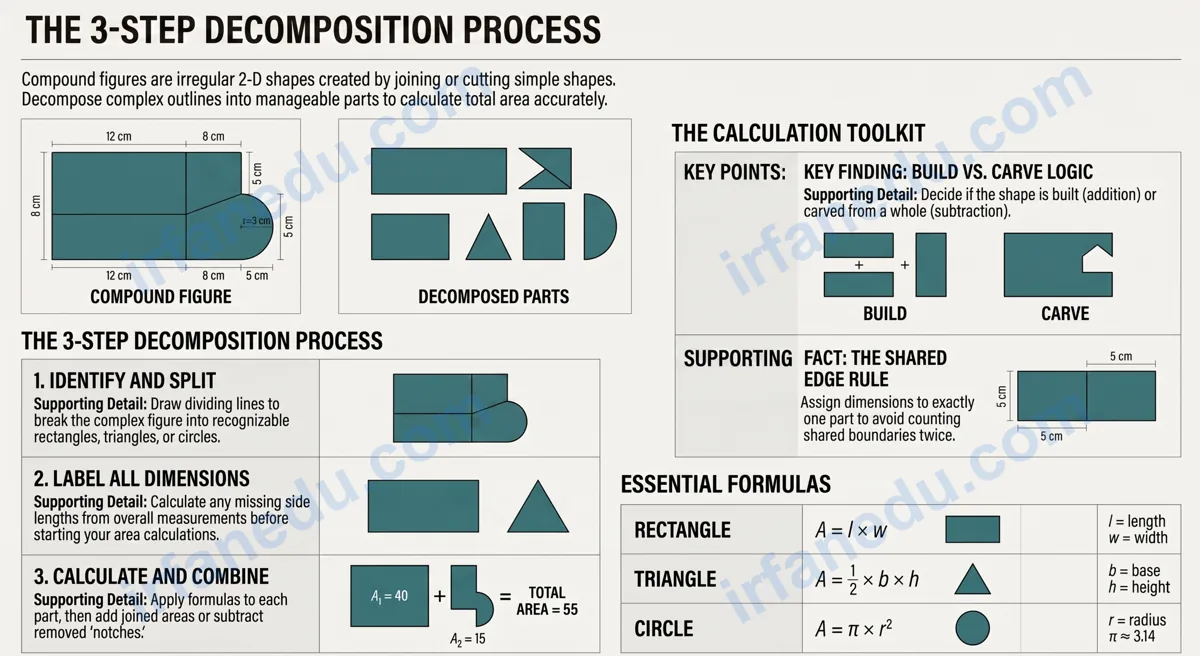
Most geometry worksheets hand you a clean rectangle and ask you to multiply two numbers. Real shapes — floor plans, garden beds, sports fields, window frames — are never that simple. They are compound figures: irregular outlines built from two or more simple shapes glued together. Knowing how to break them apart and calculate their total area is one of the most practical math skills a student can own.
A compound figure (also called a composite shape) is a 2-D shape made by joining or cutting simple shapes — rectangles, triangles, semicircles — together. To find its area, you split it into those simple parts, calculate each area with the right formula, then add or subtract the results.
In this post I give you a full lesson, three worked examples, a visual diagram, a 10-problem printable worksheet with answer key, and a downloadable PDF — everything in one place. By the end, compound figures will feel like a puzzle you actually enjoy solving. 🧩
- Understand what makes a shape “compound”
- Apply the decompose-and-calculate method confidently
- Avoid the three most common errors students make
- Practice with 10 graded problems and check your answers instantly
📄 Free printable PDF worksheet (10 problems + full answer key) — grades 5–8:
⚡ TL;DR – Quick Summary
- 🔷 A compound figure is two or more simple shapes joined or cut together.
- 🔷 Split the shape, calculate each part’s area, then add or subtract.
- 🔷 Always label missing side lengths before you calculate.
- 🔷 Add areas when shapes are joined; subtract when a piece is removed.
- 🔷 This worksheet has 10 problems, easy to hard, with a full answer key.
- 🔷 Aligns to Common Core 6.G.A.1 and 7.G.B.6.
📊 Quick Facts
| Detail | Info |
|---|---|
| Topic | Area of compound / composite figures |
| Grade Level | Grades 5–8 (Common Core 6.G.A.1, 7.G.B.6) |
| Problems | 10 (ordered easy → hard) |
| Shapes Covered | Rectangles, L-shapes, T-shapes, triangles, semicircles, circles, irregular rectilinear |
| Answer Key | Included (on-page collapsible + PDF) |
| Download | Free PDF via button above |
| Pi value used | 3.14 (as standard in most US curricula) |
🔷 What Is a Compound Figure?
A compound figure is any flat (2-D) shape that cannot be described by a single standard formula. It is built by joining two or more simple shapes — or by cutting a simple shape out of a larger one. Common examples include L-shapes, T-shapes, cross shapes, and rectangles with semicircles attached.
Other names you will see on worksheets and textbooks: composite shape, composite figure, irregular polygon, and rectilinear figure (when all angles are right angles). They all mean the same thing: a shape you cannot measure with a single formula.
| Shape Type | Simple or Compound? | Area Formula |
|---|---|---|
| Rectangle | Simple | l × w |
| Triangle | Simple | ½ × b × h |
| Circle | Simple | π × r² |
| L-shape | Compound (2 rectangles) | Split → add |
| T-shape | Compound (2 rectangles) | Split → add |
| Rectangle + semicircle | Compound | Split → add |
| Rectangle with notch cut | Compound | Split → subtract |
🌍 Why Does This Skill Matter?
Area of compound figures is not just a test topic — it shows up everywhere in real life. Architects calculate floor areas of L-shaped rooms. Landscapers price irregular garden beds. Tilers estimate how many tiles to buy for a kitchen with a cut-out island. Engineers calculate cross-sections of beams.
In my experience teaching this skill to hundreds of middle-school students, the ones who master compound figures early gain a huge advantage in high-school geometry and standardised tests like the ACT and SAT, where composite-shape problems appear regularly. It is also one of the highest-leverage skills for students who struggle with geometry — because once you see that every complex shape is just simple shapes in disguise, the subject becomes far less intimidating.
🛠️ Step-by-Step Method: How to Find the Area of a Compound Figure
Follow these five steps every time — they work for any compound figure, from a simple L-shape to a complex irregular polygon with semicircles.
- Identify the simple shapes. Look at the compound figure and name every simple shape you can see inside it — rectangles, triangles, semicircles, etc.
- Draw dividing lines. Lightly draw lines on the figure to separate the simple shapes. There is often more than one valid way to split a shape — choose the way that gives you dimensions you already know.
- Label ALL dimensions. Mark the length and width (or base and height) of each part. If a dimension is not given, calculate it from the overall measurements. This is the step most students rush and get wrong.
- Calculate each area. Apply the correct formula to each simple shape.
- Add or subtract. Add all part-areas if the shape is formed by joining. Subtract a part-area if a piece has been removed. Write the answer with squared units.
🖼️ Visual: Decomposing an L-Shape (CSS Diagram)
  ┌──────────────┐
  │              │  ← Part A: Rectangle
  │   Part A     │     Width = 8 cm, Height = 2 cm
  │   8 × 2      │     Area A = 16 cm²
  └────┬─────────┘
       │  Part B  │  ← Part B: Rectangle
       │  3 × 6   │     Width = 3 cm, Height = 6 cm
       │          │     Area B = 18 cm²
       └──────────┘

  Total Area = Area A + Area B
             = 16 + 18
             = 34 cm²

  KEY: Split → Label → Calculate → Add
📐 The Five Essential Area Formulas
| Shape | Formula | Variables |
|---|---|---|
| Rectangle / Square | A = l × w | l = length, w = width |
| Triangle | A = ½ × b × h | b = base, h = perpendicular height |
| Circle | A = π × r² | r = radius, π ≈ 3.14 |
| Semicircle | A = ½ × π × r² | r = radius of full circle |
| Parallelogram | A = b × h | b = base, h = perpendicular height |
✏️ 3 Fully Worked Examples
Example 1 — L-Shape (Addition Method) 🟩
Problem: An L-shaped room has an overall width of 10 m and height of 8 m. A rectangular section 4 m wide and 5 m tall is cut from the top-right corner. Find the floor area.
Step 1: The L-shape = full rectangle MINUS the missing corner.
Step 2: Full rectangle area = 10 × 8 = 80 m²
Step 3: Missing corner area = 4 × 5 = 20 m²
Step 4: L-shape area = 80 − 20 = 60 m²

Answer: 60 m²
Check: You can also split the L into two rectangles and add them — you should still get 60 m². Always verify with both methods when time allows.
Example 2 — Rectangle + Triangle (Addition Method) 🔺
Problem: A garden plot is shaped like a rectangle 12 ft long and 5 ft wide, with a triangular flower bed attached to one short end. The triangle has a base of 5 ft and a height of 4 ft. What is the total area?
Step 1: Rectangle area = 12 × 5 = 60 ft²
Step 2: Triangle area = ½ × 5 × 4 = 10 ft²
Step 3: Total area = 60 + 10 = 70 ft²

Answer: 70 ft²
Example 3 — Rectangle + Semicircle (Addition with π) 🔵
Problem: A running track end-cap is a rectangle 15 m long and 6 m wide, with a semicircle of diameter 6 m attached to one short end. Use π = 3.14. Find the total area.
Step 1: Rectangle area = 15 × 6 = 90 m²
Step 2: Semicircle radius = 6 ÷ 2 = 3 m
Step 3: Semicircle area = ½ × 3.14 × 3² = ½ × 3.14 × 9 = 14.13 m²
Step 4: Total area = 90 + 14.13 = 104.13 m²

Answer: 104.13 m²
⚠️ Common Mistakes — Wrong vs. Right
These three errors account for the majority of lost marks on compound-figure problems. Recognise them now so you never make them in a test.
Wrong: Using the full outer length (e.g., 10 cm) for an inner rectangle that only spans part of the shape.
Right: Subtract the known partial length from the total to find the missing inner dimension. Always label every side before calculating.
Wrong: Calculating the area of the full outer rectangle and calling it done when a notch has been removed.
Right: Identify whether the problem says a piece is “cut out,” “removed,” or “missing” — those words mean subtract.
Wrong: When splitting an L-shape into two rectangles, using the dividing line as part of both rectangles’ dimensions, inflating one measurement.
Right: Draw the dividing line clearly, then assign each dimension to exactly one rectangle. The shared edge is a boundary, not a measurement to add twice.
💡 Unique Insight — What Most Guides Get Wrong About Compound Figures
Almost every worksheet site teaches one decomposition method: always split into rectangles and add. That works for rectilinear shapes, but it quietly fails students when they hit a shape with a cut-out region — because the instinct to add is so ingrained that they forget to subtract.
The deeper insight is this: decomposition has two directions — additive (join parts) and subtractive (remove a part from a whole). Recognising which direction to use is a higher-order skill that most worksheets never explicitly teach. I call it the “build or carve?” question. Before calculating anything, ask: “Was this shape built by joining pieces, or carved by removing a piece from a whole?” That single question prevents the most common category of error on compound-figure tests.
A second non-obvious point: for many L-shapes, the subtraction method (big rectangle minus corner) is faster and less error-prone than splitting into two rectangles — because you only need two measurements instead of four. Yet most students default to splitting because that is all they were shown.
📝 On-Page Practice Worksheet — 10 Problems
Work through these problems in order — they go from straightforward to challenging. Show your working for each one. Use the collapsible answer key below to self-check. 🖊️
How to use this worksheet: Print the PDF (button below) or work directly on this page. Attempt every problem before checking the answer key. If you get one wrong, re-read the worked example for that shape type above, then try again.
- An L-shape is made of two rectangles. Rectangle A is 8 cm wide and 2 cm tall. Rectangle B is 3 cm wide and 6 cm tall. What is the total area?
- A rectangle 10 m long and 5 m wide has a 2 m × 3 m rectangular notch cut from one corner. What is the remaining area?
- A T-shape: the top bar is 12 cm wide and 3 cm tall; the vertical stem is 4 cm wide and 7 cm tall. What is the total area?
- A compound shape is a 6 ft × 6 ft square with a right triangle attached to its right side. The triangle has a base of 4 ft and a height of 6 ft. What is the total area?
- A plus-sign (+) shape: a horizontal bar 10 m × 2 m, with two vertical extensions each 2 m wide and 3 m tall (one above, one below the bar). What is the total area?
- A compound figure has a large rectangle 15 cm × 8 cm with a semicircle of diameter 8 cm added to one short end. Use π = 3.14. What is the total area?
- An irregular rectilinear shape has overall dimensions 10 m × 8 m, but a 4 m × 3 m rectangle is missing from the top-right corner. What is the area?
- A compound shape is made of a rectangle 9 ft × 4 ft and a triangle on top with base 9 ft and height 5 ft. What is the total area?
- A running-track end-cap: a rectangle 20 m × 7 m with a full circle of diameter 7 m attached to one short end (outside the rectangle). Use π = 3.14. What is the total area?
- A large right triangle has base 12 cm and height 10 cm. A rectangle 4 cm × 3 cm is cut out from inside it. What is the remaining area?
📋 Show Answer Key
- 34 cm² — A = 8×2 = 16; B = 3×6 = 18; Total = 34
- 44 m² — Full = 10×5 = 50; Notch = 2×3 = 6; 50−6 = 44
- 64 cm² — Top bar = 12×3 = 36; Stem = 4×7 = 28; Total = 64
- 48 ft² — Square = 6×6 = 36; Triangle = ½×4×6 = 12; Total = 48
- 32 m² — Horizontal bar = 10×2 = 20; Two vertical stubs = 2×(2×3) = 12; Total = 32
- 145.12 cm² — Rectangle = 15×8 = 120; Semicircle r=4: ½×3.14×16 = 25.12; Total = 145.12
- 68 m² — Full = 10×8 = 80; Missing = 4×3 = 12; 80−12 = 68
- 58.5 ft² — Rectangle = 9×4 = 36; Triangle = ½×9×5 = 22.5; Total = 58.5
- 178.47 m² — Rectangle = 20×7 = 140; Circle r=3.5: 3.14×12.25 = 38.465; Total ≈ 178.47
- 48 cm² — Triangle = ½×12×10 = 60; Cut-out = 4×3 = 12; 60−12 = 48
📄 Want a print-ready version? Download the free PDF — includes all 10 problems and the full answer key on a separate page:
🧠 Quick Quiz — Test Yourself (3 Questions)
Q1. A rectangle 8 cm × 5 cm has a triangle attached to one short end with base 5 cm and height 3 cm. What is the total area?
Q2. Which method do you use when a piece is CUT OUT of a larger shape?
Q3. A semicircle is attached to a rectangle. The rectangle is 10 m × 4 m and the semicircle has diameter 4 m. Using π = 3.14, what is the total area?
❓ Frequently Asked Questions
What is a compound figure in math?
A compound figure (also called a composite shape) is any 2-D shape made by joining two or more simple shapes — such as rectangles, triangles, or semicircles — together. You find its area by splitting it into those simple parts, calculating each area separately, then adding or subtracting the results to get the total.
How do you find the area of a compound figure?
Split the compound figure into recognisable simple shapes. Calculate the area of each part using the correct formula (rectangle: l × w; triangle: ½ × b × h; circle: π × r²). Then add all the parts together — or subtract a cut-out piece — to get the total area. Always include squared units in your answer.
What grade level is area of compound figures?
Area of compound figures is typically taught in grades 5 through 8, aligning with Common Core standards 6.G.A.1 (grade 6) and 7.G.B.6 (grade 7). Students revisit and extend
Sources & References
Reviewed by Dr. Irfan Mansuri. External links open in a new tab and are provided for further reading and verification.