
Good PSAT Score for 10th Grade: The Number That Actually Matters 📊
⚠️ Step Zero: Most Guides Skip This Completely
Before you ask “Is my score good?”, you need to understand which test you actually took and what the score is even measuring. Most PSAT score articles jump straight to numbers without explaining that the PSAT has two different versions, two different purposes, and that your 10th grade score does NOT count for National Merit. That context changes everything about how you should interpret your result.
You just got your PSAT score back and you are staring at a three or four-digit number wondering whether to celebrate or panic. I get it. Every student I have worked with goes through that same moment of uncertainty.
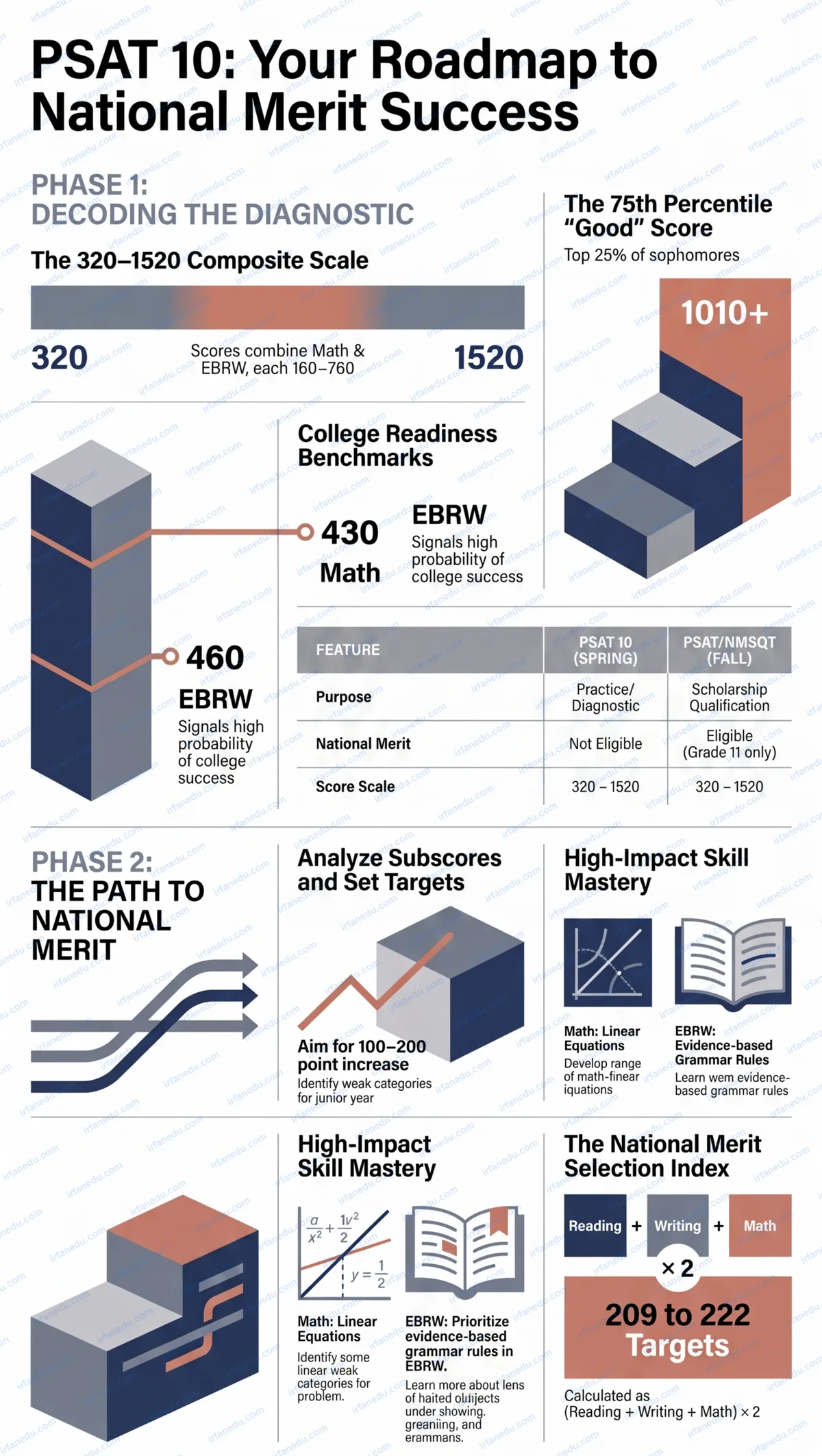
A good PSAT score for 10th grade is 1010 or above, placing you in the top 25% of sophomores. The College Board’s official benchmarks are 430 in Math and 460 in Evidence-Based Reading and Writing (EBRW). Scoring 1150 or higher puts you in the top 10% and signals strong SAT readiness.
But a raw number without context is almost meaningless. In this guide, I walk you through the full picture: what the score scale actually means, how your score compares to other 10th graders, what the College Board benchmarks tell you, and exactly how to use your 10th grade result to crush the 11th grade PSAT/NMSQT.
- 🎯 Understand the 320-1520 PSAT score scale
- 📈 Know where you stand using real percentile data
- ✅ Identify whether you have hit College Board benchmarks
- 🏆 Learn what National Merit requires (and why 10th grade does not count)
- 🛠️ Build a clear improvement plan from sophomore to junior year
⚡ TL;DR – Quick Summary
- 📊 PSAT scores range from 320 to 1520 (two sections: Math and EBRW)
- ✅ A score of 1010+ is good for 10th grade (top 25% of sophomores)
- 🏆 1150+ is excellent; 1200+ puts you in strong National Merit territory for 11th grade
- ⚠️ 10th grade PSAT does NOT qualify for National Merit — only 11th grade does
- 📋 College Board benchmarks: 430 Math, 460 EBRW — both signal college readiness
- 🛠️ Use your score report subscores to build a targeted 12-month study plan
1. What Is the PSAT and Which Version Did You Take? 🤔
The PSAT is not one single test. The College Board offers three related assessments, and knowing which one you took shapes how you interpret your score.
As a 10th grader, you most likely took either the PSAT 10 (administered in spring of sophomore year) or the PSAT/NMSQT (administered in fall, which some schools offer to 10th graders as early practice). Both use the same 320-1520 scale and test the same content, but their purposes differ significantly.
| Feature | PSAT 10 (Spring, Grade 10) | PSAT/NMSQT (Fall, Grade 11) |
|---|---|---|
| Score Scale | 320 – 1520 | 320 – 1520 |
| Sections | Math + EBRW | Math + EBRW |
| National Merit Eligibility | ❌ No | ✅ Yes (11th grade only) |
| Primary Purpose | Practice & diagnostic | Scholarship qualification + practice |
| Selection Index Used | ❌ No | ✅ Yes |
| Best Use | Identify gaps for 11th grade prep | Compete for National Merit |
2. The PSAT Score Scale Explained 📏
The PSAT uses a composite scale of 320 to 1520. This is made up of two section scores, each ranging from 160 to 760.
Those two sections are Math and Evidence-Based Reading and Writing (EBRW). You add them together to get your composite. So a student who scores 500 in Math and 520 in EBRW has a composite of 1020.
  PSAT SCORE STRUCTURE
  ════════════════════════════════════════════════════════

  COMPOSITE SCORE (320 – 1520)
  ┌─────────────────────────────┬──────────────────────────┐
  │  MATH SECTION               │  EBRW SECTION            │
  │  Score: 160 – 760           │  Score: 160 – 760        │
  │                             │                          │
  │  • Algebra & Functions      │  • Reading Test          │
  │  • Data Analysis            │  • Writing & Language    │
  │  • Advanced Math            │    Test                  │
  └─────────────────────────────┴──────────────────────────┘

  SUBSCORES (1–15 each, 7 total)
  ┌──────────────────────────────────────────────────────┐
  │  Heart of Algebra | Problem Solving | Adv. Math     │
  │  Words in Context | Command of Evidence             │
  │  Expression of Ideas | Standard English Conventions │
  └──────────────────────────────────────────────────────┘

  SELECTION INDEX (for PSAT/NMSQT 11th grade only)
  = (Reading Test Score + Writing Test Score + Math Test Score) × 2
  Range: 48 – 228
Beyond the composite, your score report includes subscores and cross-test scores. These are the real gold in your report. They tell you exactly which skill areas need work, far more precisely than the composite alone.
3. What Is a Good PSAT Score for 10th Grade? 🎯
A good PSAT score for 10th grade depends on your personal goal, but here is a clear framework I use with my students to categorize every score range.
| Score Range | Zone | Percentile (Approx.) | What It Means |
|---|---|---|---|
| 320 – 760 | Needs Work | Bottom 25% | Significant foundational gaps; start with core skills |
| 760 – 920 | Below Average | 25th – 50th | Below national average; targeted practice needed |
| 920 – 1010 | Average | 50th – 75th | Near national average; solid base to build from |
| 1010 – 1150 | Good | 75th – 90th | Above average; on track for strong SAT performance |
| 1150 – 1280 | Excellent | 90th – 96th | Top tier; strong National Merit potential in 11th grade |
| 1280 – 1520 | Exceptional | 96th – 99th+ | Elite; very strong National Merit Semifinalist candidate |
4. PSAT Percentile Rankings for Sophomores 📈
Percentile rankings tell you how your score compares to other 10th graders who took the same test. A 75th percentile score means you scored higher than 75% of your peers.
The College Board publishes percentile tables annually. Here are the approximate benchmark percentiles for 10th grade PSAT takers based on recent data:
| Composite Score | Approximate Percentile (Grade 10) |
|---|---|
| 1400 – 1520 | 99th |
| 1300 | 97th – 98th |
| 1200 | 90th – 92nd |
| 1100 | 78th – 82nd |
| 1010 | ~75th |
| 960 | ~60th |
| 920 | ~50th (Average) |
| 860 | ~35th |
| 800 | ~20th |
| 760 or below | Below 15th |
[IMAGE: PSAT percentile chart for 10th graders showing score zones from 320 to 1520 | ALT: PSAT 10th grade percentile chart showing score ranges and corresponding percentile rankings]
5. College Board Benchmark Scores: The Overlooked Metric 🏁
Most students focus only on the composite score and completely ignore the College Board benchmarks. This is one of the biggest mistakes I see. The benchmarks are actually more actionable than the composite.
The College Board sets benchmark scores for each section to indicate whether a student is on track for college readiness. For the PSAT 10 and PSAT/NMSQT, those benchmarks are:
| Section | Benchmark Score | Scale | What It Signals |
|---|---|---|---|
| Evidence-Based Reading and Writing (EBRW) | 460 | 160 – 760 | 70% probability of earning a C or better in first-year college English |
| Math | 430 | 160 – 760 | 70% probability of earning a C or better in first-year college Math |
Meeting both benchmarks means your composite is at least 890. If you hit both, you have demonstrated the foundational skills that predict college success. If you miss one or both, your score report will tell you exactly which skills to target.
6. National Merit and the PSAT: What 10th Graders Must Understand 🏆
The National Merit Scholarship Program is one of the most prestigious academic competitions in the United States. But there is a critical fact that most 10th graders do not know: your 10th grade PSAT score does not count.
Only the PSAT/NMSQT taken in 11th grade qualifies you for National Merit consideration. The College Board uses a metric called the Selection Index to determine eligibility.
Selection Index = (Reading Test Score + Writing & Language Test Score + Math Test Score) × 2
Each test score ranges from 8 to 38. The Selection Index ranges from 48 to 228.
Typical Semifinalist cutoffs: approximately 209 to 222 (varies by state/region). This corresponds to roughly a 1400 to 1520 composite score.
| National Merit Level | Approximate Composite Score Needed | Who Qualifies |
|---|---|---|
| Commended Scholar | ~1340 – 1380 | Top ~3% nationally |
| Semifinalist | ~1400 – 1520 | Top ~1% (varies by state) |
| Finalist | Semifinalist + application review | ~15,000 students per year |
| Scholarship Winner | Finalist + selection criteria | ~7,500 students per year |
So why does your 10th grade score matter for National Merit? Because it gives you a full year to close the gap. If you score 1150 in 10th grade, you have 12 months to push toward 1400+. That is very achievable with a structured plan.
7. How to Improve Your PSAT Score from 10th to 11th Grade 🛠️
The gap between your 10th grade PSAT and your 11th grade PSAT/NMSQT is your opportunity window. Here is the step-by-step process I recommend to every student I work with.
Step 1: Analyze Your Score Report Deeply
Log into your College Board account and download your full score report. Do not just look at the composite. Study your subscores across all seven categories. Find the two or three weakest subscores. Those are your starting points.
Step 2: Set a Realistic Target Score
Add 100 to 200 points to your current composite as your 11th grade target. If you scored 1000, aim for 1100 to 1200. If you scored 1200, aim for 1350 to 1400. Work backward from that target to figure out how many points each section needs to improve.
Step 3: Focus on High-Impact Math Topics
The PSAT Math section rewards three main skill clusters. In my experience, Heart of Algebra (linear equations, inequalities, systems) and Problem Solving and Data Analysis (ratios, percentages, data interpretation) together account for over 50% of Math questions. Master these first.
Step 4: Build EBRW Skills Systematically
For Evidence-Based Reading, practice finding evidence in passages and answering “command of evidence” questions. For Writing and Language, focus on grammar rules: subject-verb agreement, punctuation, sentence structure, and transitions. These are the highest-frequency question types.
Step 5: Take Full-Length Timed Practice Tests
Download official College Board practice PSATs from their website. Take at least one full-length test every four to six weeks under real timed conditions. Score it, review every wrong answer, and categorize your errors.
Step 6: Keep a Systematic Error Log
Every wrong answer goes into a log with three columns: question type, why I got it wrong, and the rule or concept I need to review. Revisit your log weekly. This single habit is responsible for the biggest score jumps I have seen in students.
[IMAGE: Student studying with PSAT prep materials and score report | ALT: 10th grade student reviewing PSAT score report to build improvement plan for 11th grade]
8. Common Mistakes Students Make Reading Their PSAT Scores ❌
After working with hundreds of students, I have seen the same score-reading mistakes over and over. Avoiding these will save you weeks of misdirected effort.
| ❌ Wrong Approach | ✅ Right Approach |
|---|---|
| Comparing your score to 11th grade averages | Compare only to 10th grade percentile tables |
| Thinking 10th grade score counts for National Merit | Know that only 11th grade PSAT/NMSQT qualifies |
| Studying everything equally after getting results | Prioritize the 2-3 weakest subscores first |
| Ignoring the benchmark scores | Check whether you cleared 430 Math and 460 EBRW |
| Treating the composite as the only number that matters | Use subscores and cross-test scores as your roadmap |
| Waiting until 11th grade to start preparing | Start targeted prep immediately after 10th grade results |
9. 🧠 Quick Knowledge Check: Test What You Learned
PSAT Score Quiz (3 Questions)
Q1. What is the maximum possible composite score on the PSAT?
Show Answer
Q2. Which PSAT score qualifies a student for National Merit Scholarship consideration?
Show Answer
Q3. What are the College Board benchmark scores for the PSAT?
Show Answer
10. 📝 Practice Problems: Apply What You Know
Problem 1: Calculate a Composite Score
Solution: Composite = 510 + 490 = 1000. This falls in the “Average to Good” zone, approximately the 65th to 75th percentile for 10th graders. The student cleared the Math benchmark (510 > 430) and the EBRW benchmark (490 > 460). Next step: review subscores to find the weakest skill area.
Problem 2: Calculate a Selection Index
Solution: Selection Index = (35 + 34 + 36) × 2 = 105 × 2 = 210. This is in the range that qualifies as a National Merit Semifinalist in many states. The composite score would be approximately 1400 to 1450.
Problem 3: Identify the Improvement Gap
Solution: Total improvement needed = 1300 – 1080 = 220 points. A balanced split might target +110 in each section: aiming for 670 EBRW and 630 Math. However, the student should check their subscores — if Math subscores are weaker, they might target +130 Math / +90 EBRW instead for maximum efficiency.
11. ❓ Frequently Asked Questions
What is a good PSAT score for 10th grade?
What is the average PSAT score for a 10th grader?
Does the PSAT score matter in 10th grade?
What PSAT score do I need for National Merit in 11th grade?
What is the difference between PSAT 10 and PSAT/NMSQT?
How do I improve my PSAT score from 10th to 11th grade?
Is a 1200 a good PSAT score for 10th grade?
🔑 Key Takeaways
- The PSAT composite scale runs from 320 to 1520; a score of 1010+ is good for 10th grade (top 25%)
- The average 10th grade PSAT score is approximately 920
- College Board benchmarks are 430 Math and 460 EBRW — clearing both signals college readiness
- Your 10th grade PSAT does NOT qualify for National Merit; only the 11th grade PSAT/NMSQT does
- National Merit Semifinalist typically requires a Selection Index of 209 to 222 (roughly 1400 to 1520 composite)
- Subscores and cross-test scores are more actionable than the composite for building a study plan
- Students who analyze their 10th grade results and prep systematically for 12 months see the
Sources & References
Reviewed by Dr. Irfan Mansuri. External links open in a new tab and are provided for further reading and verification.