
Area of Triangle Activity Sheet: Free Printable PDF + Answer Key
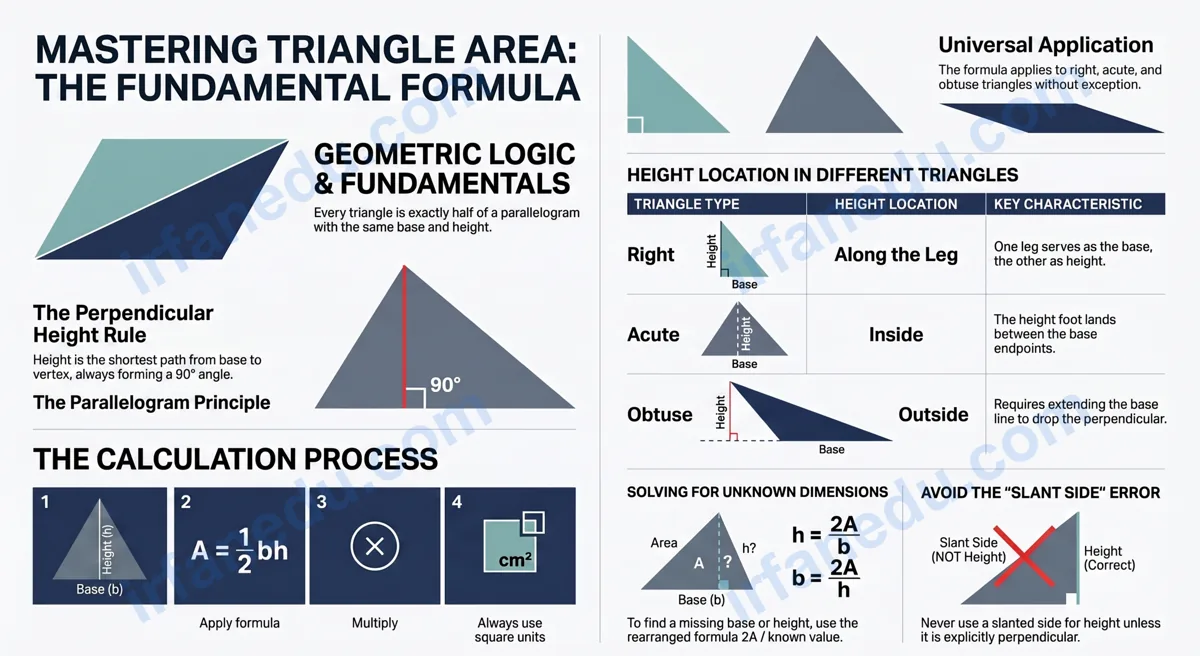
Cheat Sheet: Everything on This Page
- The formula: A = (1/2) × base × height — works for every triangle type
- Height rule: always the perpendicular distance, never a slant side
- Right triangle shortcut: use the two legs directly as base and height
- Reverse the formula: find a missing dimension when area is given
- 10 graded problems below, from simple integers to algebra
- Free printable PDF with a separate answer key section
Table of Contents
- Quick Answer
- Download the Free PDF
- TL;DR + Quick Facts
- What Is the Area of a Triangle?
- Step-by-Step: How to Find the Area
- 3 Fully Worked Examples
- Common Mistakes (Wrong vs. Right)
- Unique Insight
- On-Page Activity Sheet (10 Problems)
- Download PDF Again
- Quick Quiz
- FAQ
- Key Takeaways
- Related Articles
- About the Author
- Sources & References
If you have ever stared at a triangle and wondered how to find the space inside it, you are in the right place. This activity sheet gives you a clear lesson, three worked examples, and ten practice problems that go from easy to challenging — all in one page you can print or work through on-screen.
The area of a triangle is the amount of flat space enclosed by its three sides. You calculate it with the formula A = (1/2) × base × height, where the height is always the perpendicular distance from the base to the opposite vertex. This formula works for right triangles, acute triangles, and obtuse triangles.
By the end of this page you will be able to:
- State the area formula and explain why the factor of 1/2 appears
- Identify the correct height for any triangle type
- Solve for area, base, or height when two of the three values are known
- Avoid the three most common errors students make on tests
What you get on this page
- A concise lesson with visual diagrams
- Three fully worked examples (right, acute, and algebra-based)
- 10 graded practice problems with a collapsible answer key
- A free printable PDF with a separate answer key section
Download the free printable PDF worksheet (with answer key)
⚡ TL;DR – Quick Summary
- Area of a triangle = (1/2) × base × height, in square units.
- Height is always perpendicular to the base, not a slant side.
- For right triangles, the two legs are the base and height.
- Rearrange the formula to find a missing base or height.
- 10 problems below go from simple integers to algebraic expressions.
- Download the free PDF to print and practise offline.
| Fact | Detail |
|---|---|
| Formula | A = (1/2) × b × h |
| Units | Always square units (cm², m², ft², in²) |
| Works for | Right, acute, and obtuse triangles |
| Grade level | Grades 5–8 (ages 10–14) |
| Number of problems | 10 (easy to hard) |
| Printable PDF | Yes, free download with answer key |
| Skill tested | Find area; find missing base or height |
What Is the Area of a Triangle?
The area of a triangle is the total flat space enclosed inside its three sides, measured in square units. Every triangle is exactly half of a parallelogram with the same base and height — that is where the factor of 1/2 in the formula comes from.
Think of it this way: if you draw any triangle on grid paper and then copy it, flip the copy, and attach it to the original, you always get a parallelogram. A parallelogram’s area is base × height. So a triangle’s area is (1/2) × base × height.
Visual: Why the 1/2 Factor Exists
  Parallelogram (base × height):
  ┌─────────────────────┐
  │ Triangle A          │  Triangle B (flipped copy)
  │    *                │                *
  │   * *               │               * *
  │  *   *              │              *   *
  │ *     *             │             *     *
  └─────────────────────┘
  Area of each triangle = (1/2) × base × height
The formula A = (1/2) × b × h uses:
- b = the length of the chosen base (any side)
- h = the perpendicular height from that base to the opposite vertex
► MY POV: In my experience teaching this topic, the single biggest confusion is the word “height.” Students often measure a slant side of the triangle and call it the height. I always tell them: the height is the shortest path from the base to the opposite corner — it makes a right angle with the base. Draw that right-angle symbol on every diagram until it becomes automatic.
How Do You Find the Area of a Triangle? (Step-by-Step)
Finding the area of a triangle takes exactly four steps. Follow them in order every time and you will not make an error.
- Identify the base. Choose any side as the base and write down its length with units.
- Find the perpendicular height. Locate (or draw) the line that goes straight from the base to the opposite vertex at a 90° angle. Write down that length.
- Apply the formula. Calculate A = (1/2) × b × h. Multiply base by height first, then divide by 2 (or multiply by 0.5).
- Write the answer in square units. If the base and height are in centimetres, the area is in cm². Never leave off the units.
That is the complete process. The worked examples below show you exactly how to apply each step.
3 Fully Worked Examples
Example 1 — Right Triangle (Simple)
Problem: A right triangle has a base of 8 cm and a height of 5 cm. Find its area.
Step 1 — Base: b = 8 cm
Step 2 — Height: h = 5 cm (the two legs of a right triangle are perpendicular, so either leg is the height)
Step 3 — Formula: A = (1/2) × 8 × 5 = (1/2) × 40 = 20 cm²
Answer: 20 cm²
Example 2 — Acute Triangle (Decimal Height)
Problem: An acute triangle has a base of 12 m and a perpendicular height of 6.5 m. Find its area.
Step 1 — Base: b = 12 m
Step 2 — Height: h = 6.5 m
Step 3 — Formula: A = (1/2) × 12 × 6.5 = (1/2) × 78 = 39 m²
Answer: 39 m²
Example 3 — Algebra: Find the Missing Base
Problem: A triangle has an area of 45 ft² and a height of 9 ft. Find the base.
Step 1 — Write the formula: 45 = (1/2) × b × 9
Step 2 — Multiply both sides by 2: 90 = b × 9
Step 3 — Divide both sides by 9: b = 90 / 9 = 10 ft
Answer: base = 10 ft
[IMAGE: Three triangle diagrams side by side — right, acute, obtuse — each labeled with base b and perpendicular height h with a right-angle marker | ALT: labeled diagrams showing base and perpendicular height for right acute and obtuse triangles]
How Does the Formula Apply to Different Triangle Types?
The formula A = (1/2) × b × h applies to every triangle type without exception. The only thing that changes is where the height line falls.
| Triangle Type | Where the Height Falls | Special Note |
|---|---|---|
| Right triangle | Along one of the legs (inside) | Use the two legs as base and height directly |
| Acute triangle | Inside the triangle | Height foot lands between the base endpoints |
| Obtuse triangle | Outside the triangle (extended base) | You may need to extend the base line to drop the perpendicular |
The obtuse triangle case trips up many students. The height line goes outside the triangle, but the formula still works perfectly once you measure that external perpendicular distance.
What Are the Most Common Mistakes with Triangle Area?
Three errors account for the vast majority of wrong answers on tests. Knowing them in advance is the fastest way to avoid them.
Mistake 1 — Using a Slant Side as the Height
Wrong: A triangle has a base of 6 cm and a slant side of 5 cm. Student writes A = (1/2) × 6 × 5 = 15 cm².
Right: The height must be the perpendicular distance from the base to the opposite vertex. If the problem gives a slant side, you cannot use it as h unless it is explicitly labeled as the perpendicular height.
Mistake 2 — Forgetting to Divide by 2
Wrong: A = b × h (treating the triangle like a rectangle).
Right: A = (1/2) × b × h. The 1/2 is non-negotiable. A triangle is always half a parallelogram.
Mistake 3 — Leaving Off Square Units
Wrong: Area = 24 (no units).
Right: Area = 24 cm². Area is always two-dimensional, so units must be squared. On a standardised test, a missing unit can cost a mark even when the number is correct.
► MY POV: I have reviewed hundreds of student test papers over the years, and Mistake 1 — the slant-side error — is by far the most costly. It is not a careless slip; it comes from a genuine misunderstanding of what “height” means geometrically. The fix is simple: always draw the height as a dashed line with a small square at its foot before you plug any numbers into the formula.
💡 Unique Insight: Why Most Worksheets Teach the Formula Wrong
Most activity sheets show only right triangles, where the height conveniently lines up with a leg. This trains students to look for a vertical side and call it the height — which fails the moment they see an obtuse triangle on a test. The real insight is that base and height are a pair: you choose the base first, and the height is always defined relative to that specific base. If you flip the triangle and use a different side as the base, the height changes too — but the area stays the same. Practising with all three triangle types (as this sheet does) builds that flexible understanding, not just formula memorisation.
Area of Triangle Activity Sheet — 10 Practice Problems
Work through all ten problems below. Show your working for each one. Problems 1–5 give you both the base and height. Problems 6–7 introduce a special case (right triangle legs). Problems 8–10 ask you to find a missing dimension or solve an equation. Round decimal answers to 2 decimal places.
Formula to use: A = (1/2) × b × h
- Base = 6 cm, Height = 4 cm. Find the area.
- Base = 10 m, Height = 5 m. Find the area.
- Base = 8 in, Height = 3 in. Find the area.
- Base = 7 ft, Height = 9 ft. Find the area.
- Base = 12 cm, Height = 6.5 cm. Find the area.
- A right triangle has legs 9 cm and 12 cm. Find the area. (Hint: the legs are the base and height.)
- Base = 15 m, Height = 8 m. Find the area.
- Area = 30 cm², Base = 10 cm. Find the height.
- Area = 45 ft², Height = 9 ft. Find the base.
- A triangle has base (3x) cm and height 4 cm. Its area is 24 cm². Find x.
Show Answer Key
- 12 cm²
- 25 m²
- 12 in²
- 31.5 ft²
- 39 cm²
- 54 cm²
- 60 m²
- Height = 6 cm
- Base = 10 ft
- x = 4
How to use this worksheet: Print the page or work on-screen. Attempt every problem before checking the answer key. For problems 8–10, write out the rearranged formula before solving — that step-by-step habit prevents errors on timed tests.
Download the free printable PDF worksheet (with answer key)
Reveal-on-Click Practice Problems
Try each problem, then click to reveal the full worked solution.
Challenge A: A triangle has base 14 cm and height 11 cm. Find the area.
A = (1/2) × 14 × 11 = (1/2) × 154 = 77 cm²
Challenge B: Area = 60 m², Base = 12 m. Find the height.
60 = (1/2) × 12 × h → 120 = 12h → h = 120/12 = 10 m
Challenge C: A triangle has base (2x + 1) cm and height 6 cm. Area = 39 cm². Find x.
39 = (1/2) × (2x + 1) × 6 → 39 = 3(2x + 1) → 13 = 2x + 1 → 2x = 12 → x = 6
Quick Quiz — Test Yourself
Q1. A triangle has base 10 cm and height 8 cm. What is its area?
Select an answer — correct answer turns green.
Q2. Which measurement is the “height” in the area formula?
Q3. Area = 36 cm², Height = 9 cm. What is the base?
Frequently Asked Questions
What is the formula for the area of a triangle?
The area of a triangle is A = (1/2) × base × height. The height must be the perpendicular distance from the chosen base to the opposite vertex. This formula works for all triangle types: right, acute, and obtuse. Always express the answer in square units.
What grade level is this area of triangle activity sheet for?
This activity sheet targets grades 5–8 (ages 10–14). The first five problems use simple integer values, suitable for grade 5–6. Problems 8–10 involve rearranging the formula and solving for unknowns, which aligns with grade 7–8 algebra standards. Advanced students can use the reveal-on-click challenges for extra stretch.
How do I find the height of a triangle when only the area and base are given?
Rearrange the formula: start with A = (1/2) × b × h, multiply both sides by 2 to get 2A = b × h, then divide both sides by b: h = (2 × A) / b. For example, if A = 30 cm² and b = 10 cm, then h = 60 / 10 = 6 cm.
Does A = (1/2) × b × h work for obtuse triangles?
Yes, the formula works for every triangle type. For an obtuse triangle, the perpendicular height falls outside the triangle — you extend the base line and drop a perpendicular from the obtuse vertex to that extended line. Measure that external perpendicular distance as h, and the formula gives the correct area.
Can I use the legs of a right triangle as base and height?
Yes. In a right triangle, the two legs meet at a 90° angle, which means they are already perpendicular to each other. You can use either leg as the base and the other as the height. A = (1/2) × leg1 × leg2. This is one of the cleanest applications of the formula.
What is the most common mistake students make when finding triangle area?
The most common mistake is using a slant side instead of the perpendicular height. The height must always form a 90° angle with the base. A second frequent error is forgetting to multiply by 1/2, which gives an answer twice as large as the correct one. Always draw the height with a right-angle marker before calculating.
How is the area of a triangle related to the area of a parallelogram?
Any triangle is exactly half of a parallelogram with the same base and height. If you copy a triangle, flip it, and attach it to the original along one side, you always form a parallelogram. Since a parallelogram’s area is base × height, a triangle’s area is (1/2) × base × height. This geometric relationship is why the 1/2 factor is always there.
Key Takeaways
- The area formula A = (1/2) × b × h works for every triangle type without exception.
- Height is always the perpendicular distance from the base to the opposite vertex — never a slant side.
- For right triangles, use the two legs directly as base and height.
- Rearrange the formula to find a missing base or height: b = (2A)/h or h = (2A)/b.
- Always include square units in your final answer.
- Practise with all three triangle types so you are not caught off guard by obtuse triangles on a test.
Dr. Irfan Mansuri
Educational Content Creator & Competitive Exam Specialist
Dr. Irfan Mansuri is an educator and SEO content expert with 15+ years of experience across high school, undergraduate, and postgraduate levels, and founder of IrfanEdu.com. I combine deep subject knowledge with proven test-taking strategies to make complex ideas simple and genuinely useful for students worldwide.
Sources & References
- Khan Academy. Area of triangles. khanacademy.org → — Authoritative free lesson on the triangle area formula with interactive exercises.
- Britannica. Triangle (geometry). britannica.com → — Encyclopaedic definition of triangle types and properties.
- National Council of Teachers of Mathematics (NCTM). Geometry standards for grades 6–8. nctm.org