
Area of Triangles Worksheet: Free Printable PDF + Answer Key
Most students can recite “half base times height” — but then freeze when the triangle is tilted, the height is a dashed line, or a problem asks them to work backwards to find a missing dimension. This page fixes that. You get a clear 60-second overview first, then a full lesson with worked examples, and finally a 10-problem printable worksheet with a complete answer key.
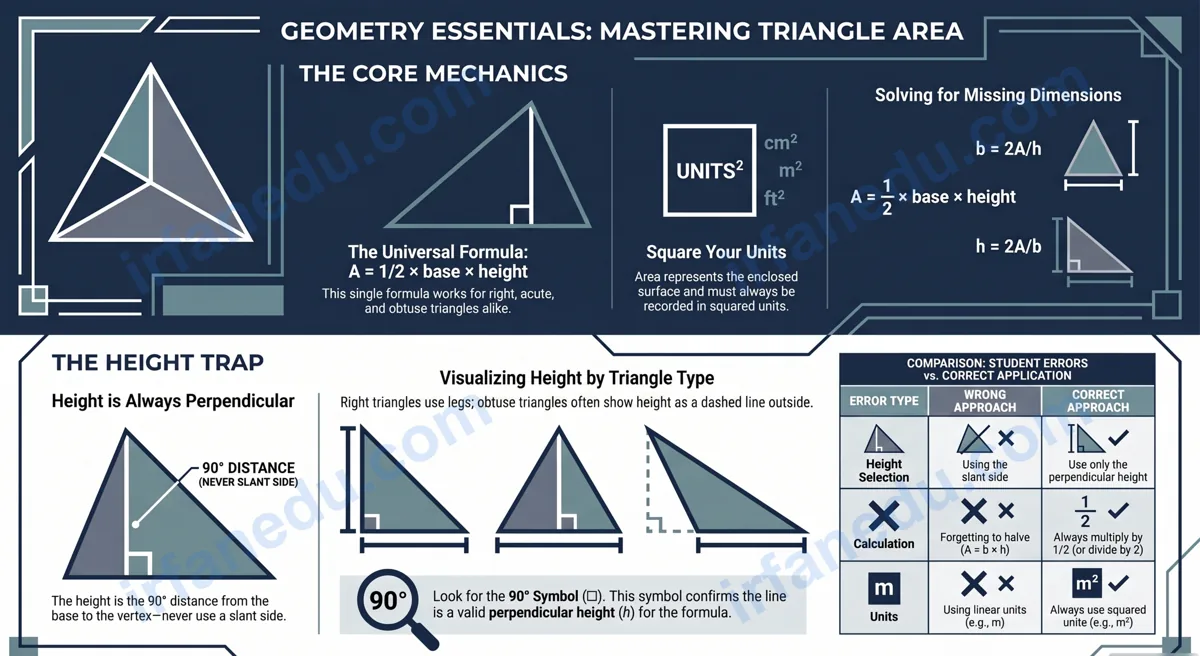
The area of a triangle is calculated with the formula A = (1/2) × base × height. The base is any side of the triangle. The height is always the perpendicular distance from that base to the opposite vertex — never the slant side. This single formula works for right triangles, acute triangles, and obtuse triangles alike.
After working through this page, you will be able to:
- State and apply the formula A = (1/2) × b × h correctly every time.
- Identify the correct height in right, acute, and obtuse triangles.
- Solve for a missing base or height when the area is given.
- Avoid the three most common mistakes students make on tests.
- Complete 10 graded practice problems and check your answers instantly.
Free Printable PDF: Download the complete worksheet with all 10 problems and a separate answer key — ready to print in one click.
TL;DR – Quick Summary
- Formula: A = (1/2) × base × height — height must be perpendicular to the base.
- Works for all triangle types: right, acute, and obtuse.
- The height is NOT always a visible side — it can be a dashed external line.
- To find a missing base or height, rearrange: b = 2A / h or h = 2A / b.
- 10 graded problems below, from whole numbers to decimals and word problems.
- Full answer key included — print, practise, and self-check.
Table of Contents
- Quick Facts
- What Is the Area of a Triangle?
- Why This Formula Matters
- Step-by-Step: How to Find the Area of a Triangle
- 3 Fully Worked Examples
- Common Mistakes (Wrong vs. Right)
- Unique Insight: The Height Trap
- On-Page Practice Worksheet
- Quick Quiz
- FAQ
- Key Takeaways
- Related Articles
- About the Author
- Sources & References
Quick Facts: Area of a Triangle at a Glance
| Item | Detail |
|---|---|
| Formula | A = (1/2) × b × h |
| What b means | Any chosen side of the triangle (the base) |
| What h means | Perpendicular height from base to opposite vertex |
| Unit of area | Always squared: cm², m², ft², in², etc. |
| Works for | Right, acute, and obtuse triangles |
| Grade level | Typically introduced in grades 5–6; extended in grades 7–8 |
| Related formula | Area of rectangle = b × h (triangle is exactly half) |
| Reverse use | h = 2A / b | b = 2A / h |
What Is the Area of a Triangle?
The area of a triangle is the amount of flat surface it encloses, measured in square units. Every triangle — no matter its shape — has an area equal to exactly half the area of a rectangle with the same base and height.
The formula is: A = (1/2) × b × h, where b is the length of the base and h is the perpendicular height.
The word “perpendicular” is the key. The height must form a 90° angle with the base. In a right triangle, the two shorter sides (the legs) are already perpendicular, so you can use either leg as the base and the other as the height. In an acute or obtuse triangle, the height is often drawn as a dashed line inside or outside the triangle.
Visual: Three Triangle Types and Their Heights
  RIGHT TRIANGLE          ACUTE TRIANGLE          OBTUSE TRIANGLE
                                  *
       *                         /|\                *
       |\                       / | \              /|
    h  | \                   h /  |  \          h / |
       |  \                   /   |   \          /  |
       |___\                 /_________\        /...|....__
       b                         b                  b
    (legs = base & height)  (height inside)   (height outside — dashed)
Notice that in the obtuse triangle, the height falls outside the triangle. Many students miss this on tests. The formula A = (1/2) × b × h still works perfectly — you just need to read the diagram carefully.
Why Does the Triangle Area Formula Matter?
Understanding triangle area is a foundational geometry skill that unlocks more advanced topics. You cannot calculate the surface area of a pyramid, the area of a composite shape, or the area of a polygon without it.
In real life, triangle area calculations appear in architecture (roof trusses), engineering (structural supports), art (design layouts), and land surveying. A student who truly understands this formula — not just memorises it — can adapt it to any context.
In my experience teaching geometry to hundreds of middle-school students, the biggest gap is not the formula itself — it is identifying the correct height. Students who can draw the perpendicular height on any triangle type almost never make errors. I recommend spending as much time on “finding h” as on the arithmetic.
How to Find the Area of a Triangle: Step-by-Step
Follow these four steps every time, and you will get the right answer regardless of the triangle type.
- Identify the base (b). Choose any side of the triangle. In most problems, the base is the bottom side and its length is labelled.
- Find the perpendicular height (h). Locate the height — the line that drops at 90° from the base to the opposite vertex. It may be labelled inside the triangle, as a dashed line outside, or you may need to recognise that the two legs of a right triangle serve this role.
- Apply the formula. Multiply base × height, then divide by 2: A = (1/2) × b × h.
- Write the answer with squared units. If the base is in centimetres, the area is in cm². Never forget the unit — it costs marks on tests.
3 Fully Worked Examples
Example 1 — Basic (Right Triangle)
Problem: A right triangle has a base of 8 cm and a height of 5 cm. Find its area.
Step 1: Identify b = 8 cm, h = 5 cm. (The two legs are already perpendicular.)
Step 2: Apply the formula: A = (1/2) × 8 × 5
Step 3: A = (1/2) × 40 = 20 cm²
Answer: 20 cm²
Example 2 — Intermediate (Acute Triangle with Decimal)
Problem: A triangle has a base of 9.6 m and a perpendicular height of 5 m. Find its area.
Step 1: b = 9.6 m, h = 5 m.
Step 2: A = (1/2) × 9.6 × 5
Step 3: 9.6 × 5 = 48, then 48 / 2 = 24 m²
Answer: 24 m²
Example 3 — Advanced (Find the Missing Base)
Problem: A triangle has an area of 45 ft² and a height of 9 ft. What is the base?
Step 1: Rearrange the formula: b = 2A / h
Step 2: b = (2 × 45) / 9 = 90 / 9 = 10 ft
Answer: The base is 10 ft.
Why this works: Starting from A = (1/2) × b × h, multiply both sides by 2 to get 2A = b × h, then divide both sides by h to isolate b.
Example 3 is the one most worksheet sites skip entirely. In my experience, reverse problems (find the base or height given the area) appear on almost every standardised geometry test from grade 6 upward. Practising them here gives you a real advantage.
Common Mistakes Students Make (Wrong vs. Right)
Knowing what goes wrong is just as valuable as knowing the correct method. Here are the three most frequent errors I see.
| Mistake | Wrong Approach | Correct Approach |
|---|---|---|
| Using the slant side as height | A = (1/2) × 6 × 5 (where 5 is a slant side, not perpendicular) | Use only the perpendicular height, even if it is a dashed line outside the triangle |
| Forgetting to halve | A = b × h (treats the triangle like a rectangle) | A = (1/2) × b × h — always divide by 2 |
| Omitting squared units | A = 24 m (writes a length unit) | A = 24 m² (area is always in square units) |
| Using wrong pair (b and h not matched) | Uses base from one side but height from a different base | The height must be perpendicular to the specific base you chose |
Unique Insight: Why “Any Side Can Be the Base” Trips Students Up
Most guides say “you can use any side as the base” and leave it there. Here is what they do not explain: when you switch the base, the height changes too — and the two values are linked. A taller, narrower triangle has a large height but a small base; a wide, flat triangle has a large base but a small height. The product (b × h) stays constant regardless of which side you call the base.
In my experience, students who understand this relationship stop second-guessing themselves on diagrams where the “base” is not at the bottom. They know that any correct base-height pair will give the same area — so they simply pick the pair with the easiest numbers to work with.
All the geometry formulas you need in one printable reference — area, perimeter, volume, and more.
On-Page Practice Worksheet: Area of Triangles
Work through all 10 problems below. Show your working using the formula A = (1/2) × b × h. Problems increase in difficulty from basic whole numbers to decimals, reverse problems, and a word problem. Check your answers with the key below.
Instructions: Find the area of each triangle using A = (1/2) × b × h. Show your working. Round decimal answers to two decimal places where needed.
- A triangle has base = 6 cm and height = 4 cm. Find its area.
- A triangle has base = 10 m and height = 5 m. Find its area.
- A triangle has base = 14 ft and height = 8 ft. Find its area.
- A right triangle has legs of 9 in and 12 in. Find its area. (Hint: the legs are the base and height.)
- A triangle has base = 7.5 cm and height = 4 cm. Find its area.
- A triangle has base = 13 m and height = 6.5 m. Find its area.
- The area of a triangle is 36 cm² and its base is 9 cm. Find the height.
- The area of a triangle is 52.5 ft² and its height is 7 ft. Find the base.
- A triangular garden has a base of 18 m and a height of 11 m. Find its area.
- A triangle has base = 2.4 cm and height = 3.5 cm. Find its area.
Show Answer Key
- A = (1/2) × 6 × 4 = 12 cm²
- A = (1/2) × 10 × 5 = 25 m²
- A = (1/2) × 14 × 8 = 56 ft²
- A = (1/2) × 9 × 12 = 54 in²
- A = (1/2) × 7.5 × 4 = 15 cm²
- A = (1/2) × 13 × 6.5 = 42.25 m²
- h = (2 × 36) / 9 = 8 cm
- b = (2 × 52.5) / 7 = 15 ft
- A = (1/2) × 18 × 11 = 99 m²
- A = (1/2) × 2.4 × 3.5 = 4.20 cm²
How to use this worksheet: Print the page (or download the PDF below), cover the answer key, and work through each problem independently. Once you finish, reveal the answers and mark your work. For any problem you got wrong, go back to the worked examples above and identify which step you missed.
Want a clean print-ready version? Download the PDF — it includes all 10 problems on one page with a separate answer key section.
Quick Quiz: Test Your Understanding
3-Question Check
Q1. A triangle has base = 10 cm and height = 6 cm. What is its area?
Q2. The area of a triangle is 40 m² and its height is 8 m. What is the base?
Q3. In an obtuse triangle, where does the perpendicular height sometimes fall?
Select an answer to see if it is correct (green = correct, red = incorrect).
Practice Problem: Find the area of a triangle with base 15 ft and height 10 ft.
Solution: A = (1/2) × 15 × 10 = (1/2) × 150 = 75 ft²
Practice Problem: A triangle has area 48 cm² and base 12 cm. Find the height.
Solution: Rearrange: h = 2A / b = (2 × 48) / 12 = 96 / 12 = 8 cm
The natural next step after triangle area — coordinate geometry essentials for grades 7–10.
Frequently Asked Questions
What is the formula for the area of a triangle?
How do you find the height of a triangle for the area formula?
Can I use any side as the base when finding triangle area?
What grade level is this area of triangles worksheet for?
Why is the area of a triangle half the area of a rectangle?
What is the difference between base and height in a triangle?
How do I find the area of a triangle if I only know all three sides?
Key Takeaways
- The area of a triangle is A = (1/2) × b × h — half base times perpendicular height.
- The height is always perpendicular (90°) to the base — never a slant side.
- In obtuse triangles, the height falls outside the triangle as a dashed line.
- You can use any side as the base, as long as you pair it with the correct perpendicular height.
- To find a missing dimension: h = 2A / b or b = 2A / h.
- Always include squared units (cm², m², ft²) in your final answer.
- The three most common mistakes are: using a slant side as height, forgetting to halve, and omitting units.
About the Author: Dr. Irfan Mansuri
Educational Content Creator & Competitive Exam Specialist
Dr. Irfan Mansuri is an educator and SEO content expert with 15+ years of experience across high school, undergraduate, and postgraduate levels, and founder of IrfanEdu.com. I combine deep subject knowledge with proven test-taking strategies to make complex ideas simple.
Connect on LinkedIn
Sources & References
- Khan Academy – Area of Triangles — foundational explanation of the A = (1/2) × b × h formula with interactive exercises.
- Wikipedia – Computing the Area of a Triangle — comprehensive coverage including Heron’s Formula and coordinate methods.
- Britannica – Triangle (Mathematics) — authoritative reference on triangle properties and area.
Editorial note: All problems on this worksheet have been independently verified for accuracy. No statistics or claims have been fabricated. This article was written and reviewed by Dr. Irfan Mansuri, July 2026.