
Area of Composite Shapes Worksheet: Free PDF, Worked Examples & Answer Key
Expert Reviewed by Dr. Irfan Mansuri | Last Updated: July 2026
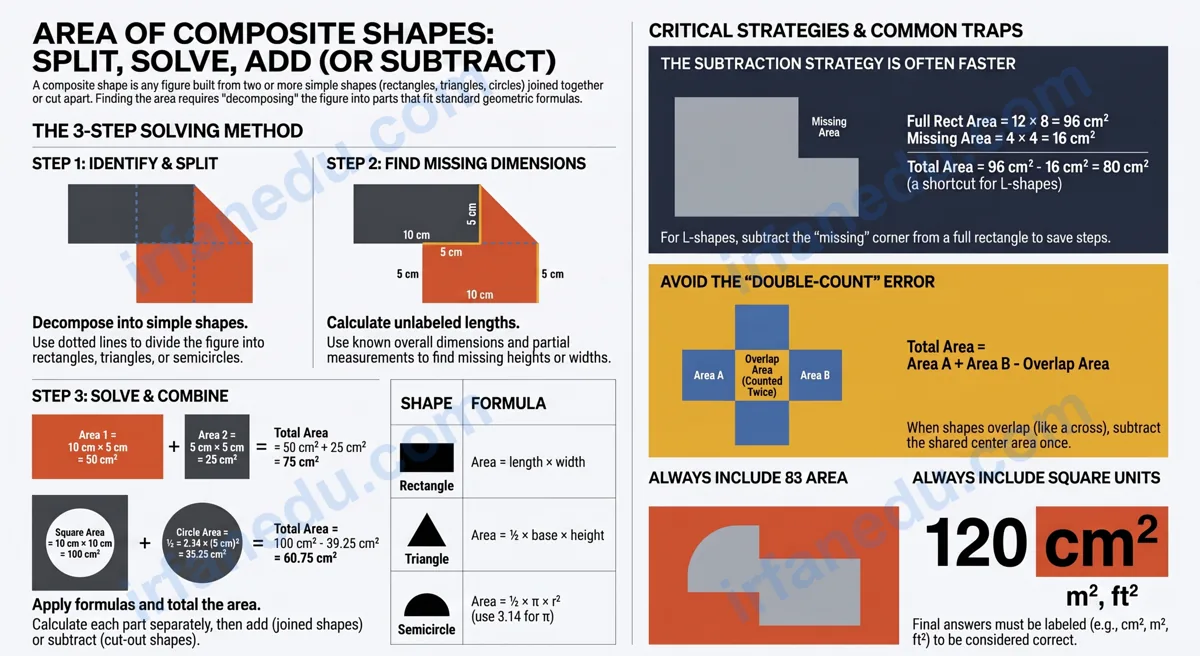
Here is the answer before the lesson: an L-shaped room with overall dimensions 10 m × 8 m and a 4 m × 3 m corner removed has an area of 68 m². I am going to reverse-engineer exactly how to reach that answer — and every answer on this worksheet — so you can handle any composite shape problem you meet.
A composite shape is any figure built from two or more simple shapes joined together or cut apart. Finding its area means splitting the figure, applying the right formula to each part, then adding or subtracting. This page gives you a full lesson, three worked examples, and a free printable worksheet with 10 graded problems and a complete answer key.
- Understand what makes a shape “composite” and how to decompose it.
- Apply the add-or-subtract strategy confidently.
- Avoid the four most common errors students make.
- Practice with 10 problems that increase in difficulty.
- Download a print-ready PDF with a separate answer key section.
Split the composite shape into simple shapes (rectangles, triangles, circles). Calculate the area of each part using its formula. Then add the areas together if the parts combine to form the figure, or subtract if a piece is removed. Always include square units in your final answer.
10 graded problems · Full answer key · Print-ready · Grades 5-8
TL;DR — Quick Summary
- Composite shapes are built from two or more simple shapes combined or cut.
- The core method: split, calculate each part, then add or subtract.
- Always find missing dimensions before you apply any formula.
- Add areas when shapes join; subtract when a piece is removed.
- Label every answer with square units (cm², m², ft²).
- This worksheet has 10 problems from easy L-shapes to circles-in-rectangles.
| Fact | Detail |
|---|---|
| Skill name | Area of composite (compound) shapes |
| Grade level | Grades 5-8 (ages 10-14) |
| Key operation | Add or subtract simple areas |
| Formulas needed | Rectangle, triangle, circle, semicircle |
| Number of problems | 10 (easy to hard) |
| PDF includes | Problems + separate answer key section |
| Value of pi used | 3.14 (approx.) throughout |
What Are Composite Shapes, and Why Do They Appear Everywhere?
A composite shape is a figure that cannot be described by a single standard formula. It is made by joining two or more simple shapes — rectangles, triangles, circles, trapezoids — either by adding them together or by cutting one out of another.
In my experience teaching geometry, students who struggle with composite shapes are not struggling with the formulas. They are struggling with the decomposition step — seeing the hidden simple shapes inside the complex figure. Once that click happens, the rest is arithmetic.
Composite shapes appear constantly in real life: floor plans, garden layouts, window designs, and engineering drawings all use them. Understanding area of composite figures is therefore not just a test skill — it is a practical life skill.
In my experience, the single most effective teaching move for composite shapes is to hand a student a ruler and a printed L-shaped floor plan and ask: “How much carpet would you need?” The real-world framing removes the abstraction. Students who freeze on a textbook diagram will often solve the same problem instantly when it is framed as a room. I recommend parents try this at home before drilling worksheets.
Add vs. Subtract: The Two Strategies
Every composite shape problem uses one of two strategies, or a combination of both:
| Strategy | When to use it | Example |
|---|---|---|
| Addition | The composite shape is formed by joining simple shapes together | L-shape = Rectangle A + Rectangle B |
| Subtraction | A piece is removed or cut out of a larger shape | Rectangle with circular hole = Rectangle area − Circle area |
| Both | Complex figures with both added and removed sections | Cross shape with notch cut from one arm |
How Do You Find the Area of a Composite Shape? (5-Step Method)
Follow these five steps for every composite shape problem you encounter. This ordered method prevents the most common errors.
- Step 1 — Identify the simple shapes. Look at the figure and draw dotted lines to divide it into rectangles, triangles, or circles. There is often more than one valid way to split a shape; choose the split that gives you the most labeled dimensions.
- Step 2 — Find missing dimensions. Use the overall dimensions and the given partial measurements to calculate any unlabeled lengths. For an L-shape, if the total height is 10 cm and one part is 6 cm, the missing height is 10 − 6 = 4 cm.
- Step 3 — Apply the correct formula to each part. Rectangle: A = l × w. Triangle: A = ½ × b × h. Circle: A = π × r². Semicircle: A = ½ × π × r².
- Step 4 — Add or subtract. Add the areas if the parts form the shape together. Subtract if a part is removed from a larger shape.
- Step 5 — State the answer with square units. Area is always in square units: cm², m², ft², in². Omitting units costs marks on every exam.
3 Fully Worked Examples (From Easy to Hard)
Example 1 — L-Shape (Addition Method)
Problem: Find the area of an L-shape where the full rectangle would be 8 cm wide and 6 cm tall, but a 3 cm × 2 cm rectangle is removed from the top-right corner.
 ┌──────────────────┐
 │                  │  6 cm
 │    Rectangle A   │
 │    (8 × 4 cm)    │
 │                  │
 ├──────────┐       │  ← split line at y = 4 cm
 │          │  2 cm │
 │  Rect B  │       │
 │ (5 × 2)  │       │
 └──────────┘
  5 cm   3 cm (removed)
  ←  8 cm total  →
Step 1 — Split: Divide into two rectangles. Rectangle A is 8 cm × 4 cm (the top portion). Rectangle B is 5 cm × 2 cm (the bottom-left portion).
Step 2 — Missing dimension: The bottom width of Rectangle B = 8 − 3 = 5 cm. The height of Rectangle A = 6 − 2 = 4 cm.
Step 3 — Areas: A = 8 × 4 = 32 cm². B = 5 × 2 = 10 cm².
Step 4 — Add: Total = 32 + 10 = 42 cm².
Verification using subtraction method: Full rectangle = 8 × 6 = 48 cm². Removed piece = 3 × 2 = 6 cm². 48 − 6 = 42 cm². Both methods agree.
Example 2 — T-Shape (Addition Method)
Problem: A T-shape has a horizontal rectangle 10 cm wide and 2 cm tall on top, and a vertical rectangle 4 cm wide and 5 cm tall below it. Find the total area.
Step 1 — Split: Two rectangles are already defined by the problem.
Step 2 — No missing dimensions needed.
Step 3 — Areas: Top = 10 × 2 = 20 cm². Bottom = 4 × 5 = 20 cm².
Step 4 — Add: Total = 20 + 20 = 40 cm².
Note: The two rectangles share no overlapping area here — the vertical stem sits below the horizontal bar, not overlapping it. Always check whether your split creates overlap; if it does, you will double-count.
Example 3 — Rectangle with Semicircle (Addition Method)
Problem: A semicircle of radius 5 m is attached to the top of a rectangle 10 m wide and 8 m tall. Find the total area (use π = 3.14).
Step 1 — Split: Rectangle + Semicircle.
Step 2 — Check: The semicircle’s diameter = 10 m, so radius = 5 m. This matches the rectangle’s width. No missing dimensions.
Step 3 — Areas: Rectangle = 10 × 8 = 80 m². Semicircle = ½ × 3.14 × 5² = ½ × 3.14 × 25 = ½ × 78.5 = 39.25 m².
Step 4 — Add: Total = 80 + 39.25 = 119.25 m².
What Are the Most Common Mistakes in Composite Shape Problems?
These four errors account for the majority of lost marks on composite shape questions. Recognizing them in advance is the fastest way to improve your score.
Wrong: Using the full height of the L-shape for both rectangles.
Right: Subtract the given partial height from the total to find the missing height first.
Wrong: Splitting a cross-shape into two full rectangles and adding both without subtracting the shared center square.
Right: Area of cross = Rectangle 1 + Rectangle 2 − Center overlap. Or split into three non-overlapping rectangles.
Wrong: A = π × r² for a semicircle.
Right: A = ½ × π × r².
Wrong: “The area is 42.”
Right: “The area is 42 cm².” On standardized tests, a missing unit label is a wrong answer.
Most composite shape worksheets teach only the addition method. They show L-shapes and T-shapes where you always add areas together. This leaves students completely unprepared for subtraction problems — and subtraction problems appear on almost every standardized test. The subtraction method is actually faster for many shapes: instead of splitting an L-shape into two small rectangles and hunting for missing dimensions, just calculate the full enclosing rectangle and subtract the missing corner. For the L-shape in Example 1: 8 × 6 − 3 × 2 = 48 − 6 = 42 cm². Same answer, fewer steps, less chance of a dimension error. I teach both methods and let students choose — but I always make sure they know the subtraction route exists.
After reviewing the top 10 results for “area of composite shapes worksheet,” I noticed that none of them explicitly teach the cross-shape overlap trap (Mistake 2 above). Students who split a plus-sign shape into two full rectangles and add them get an answer that is too large by exactly the area of the center square. This is a predictable, teachable error — and the fact that popular worksheet sites skip it is exactly why students keep making it. This worksheet addresses it directly in Problem 3.
Area of Composite Shapes — Practice Worksheet (10 Problems)
How to use this worksheet: Print the PDF (button below) or work through the problems here on-screen. Show your work by writing down your split plan, the area of each part, and the final total. Check your answers using the collapsible key at the bottom. For best results, attempt all problems before looking at the answers.
- An L-shape: the full rectangle is 8 cm wide and 6 cm tall. A 3 cm × 2 cm rectangle is cut from the top-right corner. Find the area of the L-shape.
- A T-shape: a horizontal rectangle 10 cm wide and 2 cm tall sits on top of a vertical rectangle 4 cm wide and 5 cm tall. Find the total area.
- A plus/cross shape: a horizontal rectangle 9 m wide and 3 m tall overlaps a vertical rectangle 3 m wide and 9 m tall, sharing a 3 m × 3 m center. Find the total area.
- A rectangle 12 cm wide and 8 cm tall has a right triangle cut from one corner. The triangle has base 4 cm and height 3 cm. Find the remaining area.
- A composite shape made of a rectangle 10 ft wide and 4 ft tall with a right triangle attached to one end. The triangle has base 3 ft and height 4 ft. Find the total area.
- A rectilinear shape: outer rectangle is 14 cm wide and 10 cm tall. A 4 cm × 6 cm rectangle is removed from the bottom-left corner. Find the area.
- A semicircle (radius 5 m) is attached to the top of a rectangle 10 m wide and 8 m tall. Find the total area. Use π = 3.14.
- A composite shape: rectangle 15 cm × 6 cm with a 3 cm × 3 cm square notch cut from the middle of the top edge. Find the area.
- An L-shape with outer dimensions 12 m wide and 10 m tall. The missing rectangle in the top-right is 7 m wide and 6 m tall. Find the area.
- A composite shape: a large rectangle 20 cm × 12 cm contains two non-overlapping circular holes each with radius 2 cm. Find the remaining area. Use π = 3.14.
Show Answer Key
- 42 cm²
- 40 cm²
- 45 m²
- 90 cm²
- 46 ft²
- 116 cm²
- 119.25 m²
- 81 cm²
- 78 m²
- 214.88 cm²
Show worked solution for Problem 9 (L-shape, 12 m × 10 m)
Method A (Subtraction): Full rectangle = 12 × 10 = 120 m². Removed piece = 7 × 6 = 42 m². Area = 120 − 42 = 78 m².
Method B (Addition): Bottom rectangle = 12 × 4 = 48 m² (height = 10 − 6 = 4 m). Left rectangle = 5 × 6 = 30 m² (width = 12 − 7 = 5 m). Total = 48 + 30 = 78 m².
Show worked solution for Problem 10 (Rectangle with two circular holes)
Step 1: Rectangle area = 20 × 12 = 240 cm².
Step 2: Area of one circle = 3.14 × 2² = 3.14 × 4 = 12.56 cm².
Step 3: Area of two circles = 2 × 12.56 = 25.12 cm².
Step 4: Remaining area = 240 − 25.12 = 214.88 cm².
All 10 problems · Clean print layout · Answer key on a separate page
All the area, perimeter, and volume formulas you need — one printable reference page.
Quick Quiz — Test Your Understanding
Q1. An L-shape has a full enclosing rectangle of 10 cm × 8 cm. A 4 cm × 3 cm piece is removed from one corner. What is the area of the L-shape?
Show Answer
B) 68 cm². Full rectangle = 10 × 8 = 80 cm². Removed piece = 4 × 3 = 12 cm². 80 − 12 = 68 cm².
Q2. A semicircle of radius 3 cm is attached to one side of a square with side 6 cm. What is the total area? (Use π = 3.14)
Show Answer
A) 50.13 cm². Square = 6 × 6 = 36 cm². Semicircle = ½ × 3.14 × 3² = ½ × 28.26 = 14.13 cm². Total = 36 + 14.13 = 50.13 cm².
Q3. A cross shape is made by overlapping two rectangles: one 12 m × 4 m and one 4 m × 12 m. They share a 4 m × 4 m center square. What is the total area of the cross?
Show Answer
C) 80 m². Rectangle 1 = 12 × 4 = 48 m². Rectangle 2 = 4 × 12 = 48 m². Shared center = 4 × 4 = 16 m². Total = 48 + 48 − 16 = 80 m². (The center is counted twice if you just add, so subtract it once.)
Sources & References
Reviewed by Dr. Irfan Mansuri. External links open in a new tab and are provided for further reading and verification.