
How Do We Multiply and Divide Fractions? (Step-by-Step + Free Worksheet)
The first time I taught fraction multiplication to a class of sixth-graders, one student raised her hand and asked: “Why don’t we need a common denominator here?” That single question stopped the whole lesson — because she was right to ask it, and most textbooks never explain the why. They just say “multiply across.” By the end of that class, I had rewritten how I teach this topic entirely.
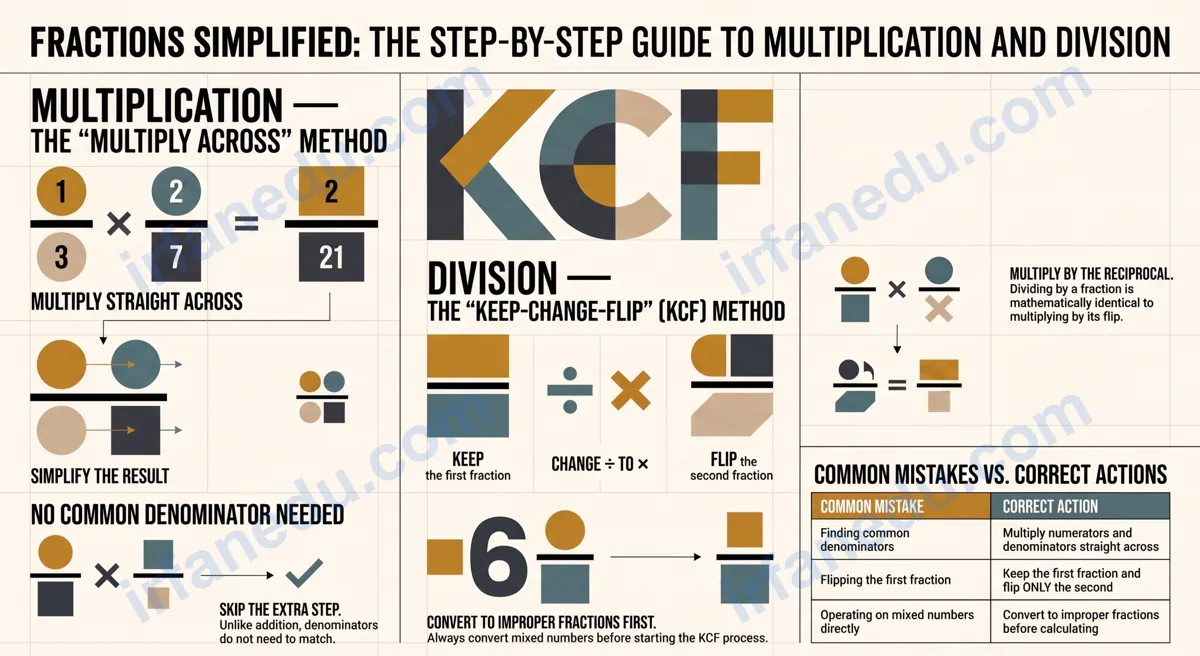
To multiply fractions, multiply the numerators together and the denominators together, then simplify. To divide fractions, use the Keep-Change-Flip method: keep the first fraction, change ÷ to ×, and flip the second fraction, then multiply and simplify. Neither operation requires a common denominator — that is the most important thing to understand.
In this guide, I walk you through both operations with fully worked examples, a clear visual diagram, a common-mistakes table, and a free printable worksheet with an answer key. Whether you are a student tackling this for the first time or a parent helping with homework, you will leave with a method that actually sticks.
- 🎯 Understand why multiplying fractions works — not just how
- 🔢 Master the Keep-Change-Flip method for division
- 📐 Handle mixed numbers with confidence
- ✏️ Practise with 12 graded problems (free PDF included)
- 🚫 Avoid the 4 most common fraction mistakes
📄 Free Printable Worksheet Included! Get 12 graded problems (easy to hard) with a full answer key — ready to print or use on screen.
⚡ TL;DR – Quick Summary
- ✅ Multiply fractions: numerator × numerator, denominator × denominator, then simplify.
- ✅ Divide fractions: Keep-Change-Flip, then multiply and simplify.
- ✅ No common denominator needed for either operation.
- ✅ Mixed numbers: convert to improper fractions first, then operate.
- ✅ Cross-cancel before multiplying to keep numbers small.
- ✅ The reciprocal of a/b is b/a — that is the entire secret of fraction division.
📊 Quick Facts Table
| Feature | Multiplication | Division |
|---|---|---|
| Common denominator needed? | ❌ No | ❌ No |
| Core method | Multiply across | Keep-Change-Flip, then multiply |
| Key concept | Numerator × Numerator; Denominator × Denominator | Multiply by the reciprocal |
| Mixed numbers | Convert to improper fraction first | Convert to improper fraction first |
| Result can be | Smaller than both fractions | Larger than the first fraction |
| Simplify when? | After multiplying (or cross-cancel before) | After multiplying (or cross-cancel before) |
What Are Fractions? (And Why These Operations Are Easier Than You Think)
A fraction represents a part of a whole. It has two parts: the numerator (top number — how many parts you have) and the denominator (bottom number — how many equal parts the whole is divided into).
Here is the insight that changes everything: when you add fractions, you need a common denominator because you are combining parts of the same-sized whole. But when you multiply fractions, you are asking “what is a fraction of a fraction?” — a completely different question that does not require matching denominators at all.
🔍 Intuitive Example (Before the Rule)
Imagine you have 3/4 of a pizza. You eat 1/2 of that piece. How much of the whole pizza did you eat?
Visually: half of three-quarters = three-eighths. So 1/2 × 3/4 = 3/8.
Notice: you multiplied 1×3 = 3 (numerators) and 2×4 = 8 (denominators). The rule is just a shortcut for what makes visual sense.
This “fraction of a fraction” idea is why multiplication always gives you a smaller result when both fractions are less than 1. Division does the opposite — dividing by a fraction smaller than 1 makes the result larger.
How Do You Multiply Fractions? (Step-by-Step)
Multiplying fractions takes exactly three steps: multiply the numerators, multiply the denominators, then simplify.
The 3-Step Method
- Step 1: Multiply the numerators (top numbers) together.
- Step 2: Multiply the denominators (bottom numbers) together.
- Step 3: Simplify the fraction to its lowest terms.
🖼️ Visual: How Fraction Multiplication Works
  MULTIPLY FRACTIONS:  a/b  ×  c/d  =  (a×c) / (b×d)

  Example:   2     3       2×3       6       1
             ─  ×  ─   =  ─────  =  ──  =  ─
             3     4       3×4      12       2

             ↑ numerators multiply   ↑ denominators multiply   ↑ simplify
✏️ Worked Example 1 — Simple Fractions
Problem: 5/6 × 3/10
Step 1: Multiply numerators: 5 × 3 = 15
Step 2: Multiply denominators: 6 × 10 = 60
Step 3: Simplify 15/60 — GCF of 15 and 60 is 15, so 15 ÷ 15 = 1, 60 ÷ 15 = 4.
Answer: 1/4
✏️ Worked Example 2 — Whole Number × Fraction
Problem: 4 × 2/5
Write 4 as 4/1. Then: 4/1 × 2/5 = (4×2)/(1×5) = 8/5 = 1 3/5
How Do You Divide Fractions? (Keep-Change-Flip Explained)
Dividing fractions uses the Keep-Change-Flip (KCF) method — you transform the division problem into a multiplication problem, then solve it the same way as above.
The Keep-Change-Flip Method
- KEEP the first fraction exactly as it is.
- CHANGE the division sign (÷) to a multiplication sign (×).
- FLIP the second fraction (write its reciprocal — swap numerator and denominator).
- Multiply and simplify.
🖼️ Visual: Keep-Change-Flip
  DIVIDE FRACTIONS:  a/b  ÷  c/d

  Step 1 KEEP:   a/b  ÷  c/d
                  ↑
              keep this

  Step 2 CHANGE: a/b  ×  c/d
                      ↑
                 ÷ becomes ×

  Step 3 FLIP:   a/b  ×  d/c
                          ↑
                     flip this one

  Then MULTIPLY:  (a×d) / (b×c)  and SIMPLIFY.

  Example:  3/4  ÷  1/2  =  3/4  ×  2/1  =  6/4  =  3/2  =  1 1/2
✏️ Worked Example 3 — Dividing Fractions
Problem: 7/8 ÷ 7/4
Keep: 7/8
Change: ÷ becomes ×
Flip: 7/4 becomes 4/7
Multiply: 7/8 × 4/7 = (7×4)/(8×7) = 28/56 = 1/2
In my experience, “Keep-Change-Flip” is the most reliably remembered mnemonic I have ever used in a classroom. But I always follow it up with the why: dividing by a number is the same as multiplying by its reciprocal. That is not a trick — it is a mathematical identity. Once students see that 6 ÷ 2 = 6 × (1/2) = 3, the fraction version stops feeling like magic and starts feeling obvious.
How Do You Multiply and Divide Mixed Numbers?
Mixed numbers (like 2 1/3 or 1 3/4) must be converted to improper fractions before you multiply or divide. Trying to multiply the whole-number parts and fraction parts separately is the single most common error I see.
Converting a Mixed Number to an Improper Fraction
- Multiply the whole number by the denominator.
- Add the numerator.
- Write the result over the original denominator.
✏️ Worked Example 4 — Mixed Number Multiplication
Problem: 2 1/4 × 1 1/3
Convert: 2 1/4 = (2×4+1)/4 = 9/4 and 1 1/3 = (1×3+1)/3 = 4/3
Multiply: 9/4 × 4/3 = 36/12 = 3
✏️ Worked Example 5 — Mixed Number Division
Problem: 3 1/2 ÷ 1 3/4
Convert: 3 1/2 = 7/2 and 1 3/4 = 7/4
Keep-Change-Flip: 7/2 × 4/7 = 28/14 = 2
Notice how converting first keeps the method identical — you never need a separate rule for mixed numbers.
What Is Cross-Cancelling and When Should You Use It?
Cross-cancelling (also called cross-simplifying) is a shortcut that lets you simplify before multiplying, keeping the numbers smaller throughout. It works because you are dividing a numerator and a denominator by the same factor — which does not change the value of the fraction.
✏️ Cross-Cancelling in Action
Problem: 4/9 × 3/8
Without cross-cancelling: 4×3 / 9×8 = 12/72, then simplify by GCF 12 → 1/6
With cross-cancelling:
- 4 (numerator of first) and 8 (denominator of second) share factor 4: 4÷4=1, 8÷4=2
- 3 (numerator of second) and 9 (denominator of first) share factor 3: 3÷3=1, 9÷3=3
- Now multiply: 1/3 × 1/2 = 1/6 — same answer, much easier numbers.
Cross-cancelling is especially useful in multi-step problems and on timed tests. I recommend it as a default habit, not an optional trick.
Common Mistakes Students Make (Wrong vs. Right)
These four errors account for the majority of fraction mistakes I see in student work. Recognising them is half the battle.
| ❌ Wrong | ✅ Right |
|---|---|
| Finding a common denominator before multiplying: 2/3 × 3/4 → 8/12 × 9/12 → ??? | Multiply straight across: 2/3 × 3/4 = 6/12 = 1/2. No common denominator needed. |
| Flipping the wrong fraction: 3/4 ÷ 1/2 → 4/3 × 1/2 = 4/6 | Keep the FIRST fraction, flip only the SECOND: 3/4 × 2/1 = 6/4 = 3/2 |
| Multiplying mixed numbers part by part: 2 1/2 × 1 1/3 = 2×1 + 1/2×1/3 = 2 1/6 | Convert first: 5/2 × 4/3 = 20/6 = 10/3 = 3 1/3 |
| Forgetting to simplify: leaving 6/12 as the final answer | Always reduce to lowest terms: 6/12 = 1/2 |
The “flip the wrong fraction” mistake is the one I see most on tests. Students remember KCF but apply the flip to the first fraction out of habit. My fix: always write out the three steps explicitly — KEEP (circle the first fraction), CHANGE (draw an × over the ÷), FLIP (draw an arrow flipping the second fraction). The physical act of writing it prevents the error almost every time.
💡 Unique Insight: Why “Keep-Change-Flip” Works (What Most Guides Never Explain)
Most fraction guides teach KCF as a memory trick and stop there. Here is what they skip: dividing by any number is mathematically identical to multiplying by its reciprocal. This is true for whole numbers too — 12 ÷ 4 = 12 × (1/4) = 3. When you flip the second fraction, you are not doing something arbitrary; you are applying the definition of division. This means KCF is not a shortcut — it IS the rule. Understanding this prevents students from misapplying it (e.g., flipping the wrong fraction) because they understand the logic, not just the steps. In my 15 years of teaching, students who understand the “why” here make far fewer errors on mixed-number division problems than those who only memorise the mnemonic.
📝 Practice Worksheet: Multiply and Divide Fractions
Work through these 12 problems in order — they start easy and get progressively harder. Print the PDF for a clean worksheet experience, or solve them right here on screen. Check your answers with the key below.
How to Use This Worksheet
Print the PDF (or use a notebook), solve each problem showing your working, then check the collapsible answer key below. For problems 7–12, remember to convert mixed numbers to improper fractions before operating. Self-checking is one of the most effective study habits you can build.
- 1/2 × 3/4
- 2/3 × 3/5
- 5/6 × 3/10
- 3/4 ÷ 1/2
- 2/5 ÷ 4/5
- 7/8 ÷ 7/4
- 1 1/2 × 2/3
- 2 1/4 × 1 1/3
- 3 1/2 ÷ 1 3/4
- 4/9 × 3/8 ÷ 1/6
- 2 2/3 ÷ 1 1/3
- 5/7 × 14/15 ÷ 2/3
📋 Show Answer Key
- 3/8
- 2/5
- 1/4
- 3/2 (or 1 1/2)
- 1/2
- 1/2
- 1
- 3
- 2
- 1
- 2
- 1
📥 Want a clean printable version? Download the PDF worksheet with all 12 problems and a formatted answer key — perfect for classroom or home use.
🧠 Quick Quiz: Test Yourself (3 Questions)
1. What is 3/5 × 5/9?
2. What is 2/3 ÷ 4/9?
3. Which step comes FIRST when dividing fractions?
🔍 Reveal-on-Click Practice Problems
Practice Problem A: What is 4/5 × 15/16?
Solution: Cross-cancel first: 4 and 16 share factor 4 → 1 and 4. 15 and 5 share factor 5 → 3 and 1.
Now multiply: 1/1 × 3/4 = 3/4
Practice Problem B: What is 2 1/2 ÷ 5/6?
Convert: 2 1/2 = 5/2
Keep-Change-Flip: 5/2 × 6/5 = 30/10 = 3
Practice Problem C: A recipe needs 3/4 cup of sugar. You want to make 2/3 of the recipe. How much sugar do you need?
This is a multiplication problem: 2/3 × 3/4 = 6/12 = 1/2 cup
Real-world tip: “of” in a word problem almost always means multiply.
❓ Frequently Asked Questions
How do you multiply two fractions?
How do you divide fractions?
Do you need a common denominator to multiply or divide fractions?
Sources & References
Reviewed by Dr. Irfan Mansuri. External links open in a new tab and are provided for further reading and verification.