
Add Fractions with Unlike Denominators Worksheet (Free PDF + Answer Key)
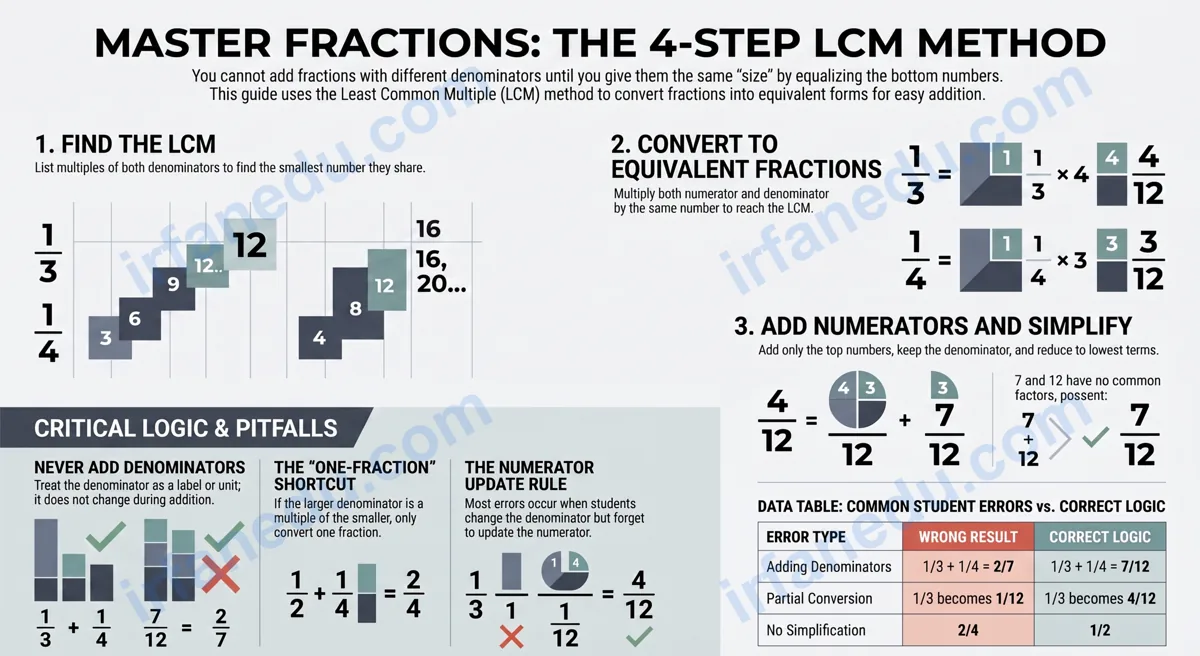
If a student can add 1/2 + 1/3 without hesitation, they have cleared one of the biggest conceptual hurdles in elementary math. If they cannot, every subsequent fraction topic — subtraction, mixed numbers, algebra — becomes harder than it needs to be. This page gives you a clear lesson and a free printable worksheet to fix that gap today.
Adding fractions with unlike denominators means finding a common denominator (the LCM of the two bottom numbers), converting both fractions to equivalent fractions with that denominator, then adding the numerators. The denominator stays the same after adding. Simplify the result if possible.
- Understand what “unlike denominators” means and why they must be made equal.
- Follow a clear 4-step method with two fully worked examples.
- Spot and fix the three most common student errors.
- Complete 10 graded practice problems and check your work with the answer key.
- Download a print-ready PDF worksheet to use offline or in class.
Free Printable PDF: Download the full worksheet (10 problems + answer key) — print it at home or use it in class.
⚡ TL;DR – Quick Summary
- Unlike denominators = different bottom numbers; you must equalize them before adding.
- Find the LCM of both denominators — that becomes the common denominator.
- Multiply each fraction’s numerator and denominator to reach the LCM.
- Add only the numerators; the denominator does not change.
- Simplify the answer; convert improper fractions to mixed numbers.
- 10 graded practice problems are below — free PDF download included.
| Feature | Detail |
|---|---|
| Skill | Adding fractions with unlike denominators |
| Grade Level | Grades 4–6 (US Common Core 4.NF.B.3, 5.NF.A.1) |
| Key Concept | Least Common Multiple (LCM) as common denominator |
| Number of Problems | 10 (easy to hard) |
| Answer Key | Included (on-page + PDF) |
| Prerequisite Skills | Multiples, equivalent fractions, simplifying fractions |
| Time to Complete | 15–20 minutes |
What Are Unlike Denominators?
Fractions with unlike denominators simply have different numbers on the bottom. For example, in 1/3 + 1/4, the denominators are 3 and 4 — they are unlike. The denominator tells you how many equal parts a whole has been divided into. Because 1/3 and 1/4 use differently-sized parts, you cannot combine them directly any more than you can add metres and kilometres without converting first.
The solution is to rewrite both fractions so they use the same-sized parts — a process called finding a common denominator. The most efficient common denominator is the Least Common Multiple (LCM) of the two denominators.
Why Does This Skill Matter Beyond the Worksheet?
Adding fractions with unlike denominators is not just a worksheet exercise. It is the foundation for subtracting fractions, adding mixed numbers, solving algebraic equations with fractions, and understanding ratios. In my experience teaching this topic across multiple grade levels, students who skip the conceptual understanding and just memorise steps tend to fall apart as soon as the numbers get larger or the context changes.
According to the US Common Core State Standards, students are expected to add and subtract fractions with unlike denominators by Grade 5 (standard 5.NF.A.1). Getting this right early prevents a cascade of confusion in middle school math.
In my experience, the single biggest source of fraction errors is not the LCM calculation — it is students forgetting to update the numerator when they change the denominator. I have seen this in hundreds of student papers. The fix is simple: always write the conversion step explicitly (multiply top AND bottom by the same number) rather than trying to do it mentally. Slow down on that one step and accuracy jumps dramatically.
How Do You Add Fractions with Unlike Denominators? (Step-by-Step)
The 4-step method below works for every problem on this worksheet and beyond. Follow each step in order.
- Find the LCM of the two denominators. List multiples of each until you find the first one they share.
- Convert each fraction to an equivalent fraction with the LCM as the denominator. Divide the LCM by the original denominator, then multiply both the numerator and denominator by that number.
- Add the numerators. Write the sum over the common denominator. Do not add the denominators.
- Simplify. Reduce to lowest terms. If the fraction is improper (top > bottom), convert to a mixed number.
Worked Example 1 — Simple: 1/3 + 1/4
Step 1 — Find the LCM of 3 and 4:
Multiples of 3: 3, 6, 9, 12, 15 …
Multiples of 4: 4, 8, 12, 16 …
LCM = 12
Step 2 — Convert each fraction:
1/3: LCM ÷ 3 = 4, so multiply top and bottom by 4 → (1×4)/(3×4) = 4/12
1/4: LCM ÷ 4 = 3, so multiply top and bottom by 3 → (1×3)/(4×3) = 3/12
Step 3 — Add the numerators:
4/12 + 3/12 = (4+3)/12 = 7/12
Step 4 — Simplify:
GCF of 7 and 12 is 1 → 7/12 is already in simplest form.
Answer: 7/12
Worked Example 2 — Harder (Improper Result): 5/6 + 3/4
Step 1 — Find the LCM of 6 and 4:
Multiples of 6: 6, 12, 18 …
Multiples of 4: 4, 8, 12, 16 …
LCM = 12
Step 2 — Convert each fraction:
5/6: LCM ÷ 6 = 2, so → (5×2)/(6×2) = 10/12
3/4: LCM ÷ 4 = 3, so → (3×3)/(4×3) = 9/12
Step 3 — Add the numerators:
10/12 + 9/12 = 19/12
Step 4 — Simplify and convert:
19/12 is improper. 19 ÷ 12 = 1 remainder 7 → 1 and 7/12
GCF of 7 and 12 is 1, so 7/12 is already simplified.
Answer: 1 7/12
Visual Walkthrough: Seeing the LCM Method
Visual: Adding 1/3 + 1/4 Step by Step
  PROBLEM:   1/3  +  1/4

  STEP 1 — Find LCM:
  ┌─────────────────────────────────────┐
  │  Multiples of 3:  3,  6,  9, [12]  │
  │  Multiples of 4:  4,  8, [12]      │
  │  LCM = 12  (common denominator)    │
  └─────────────────────────────────────┘

  STEP 2 — Convert fractions:
  ┌──────────────────────────────────────────┐
  │  1/3  →  ×4/×4  →  4/12                 │
  │  1/4  →  ×3/×3  →  3/12                 │
  └──────────────────────────────────────────┘

  STEP 3 — Add numerators:
  ┌──────────────────────────────────────────┐
  │  4/12 + 3/12 = (4+3)/12 = 7/12          │
  └──────────────────────────────────────────┘

  STEP 4 — Simplify:
  ┌──────────────────────────────────────────┐
  │  GCF(7,12) = 1  →  7/12 (already done)  │
  │  ANSWER: 7/12                            │
  └──────────────────────────────────────────┘
What Are the Most Common Mistakes When Adding Fractions with Unlike Denominators?
These three errors appear in student work more than any others. Recognising them before you practice is the fastest way to avoid them.
| Mistake | Wrong | Correct |
|---|---|---|
| Adding denominators | 1/3 + 1/4 = 2/7 | 1/3 + 1/4 = 4/12 + 3/12 = 7/12 |
| Changing denominator but not numerator | 1/3 becomes 1/12 (only bottom changed) | 1/3 × 4/4 = 4/12 (both top and bottom ×4) |
| Not simplifying the answer | 2/4 left as 2/4 | 2/4 = 1/2 (divide by GCF of 2) |
I always tell students: treat the denominator like a label on a measuring cup. If one cup is marked in thirds and another in quarters, you cannot pour them together and call the result “sevenths.” You first pour both into a cup marked in twelfths. That mental image has helped more students than any rule I have ever written on a board.
💡 Unique Insight — What Most Guides Get Wrong
Most worksheet sites teach only the LCM method and stop there. But there is a faster mental shortcut for cases where one denominator is a multiple of the other — and it is almost never taught explicitly. If the larger denominator is already a multiple of the smaller one (e.g., 1/4 + 3/8), the larger denominator IS the LCM. You only need to convert one fraction, not both. For 1/4 + 3/8: 4 divides into 8 twice, so 1/4 = 2/8. Now add: 2/8 + 3/8 = 5/8. Done in one conversion step instead of two. Teaching students to check this first cuts working time by roughly half on problems where it applies — a real advantage on timed tests.
On-Page Worksheet: 10 Practice Problems
Work through these problems using the 4-step method. Show your work on paper. Problems increase in difficulty from 1 to 10. Check your answers with the key below.
Instructions: Find the LCM of the denominators, convert each fraction to an equivalent fraction, add the numerators, and simplify your answer if possible. Show your work.
- 1/2 + 1/3 = ______
- 1/4 + 1/2 = ______
- 2/3 + 1/6 = ______
- 3/4 + 1/8 = ______
- 1/3 + 2/5 = ______
- 5/6 + 1/4 = ______
- 3/5 + 2/3 = ______
- 7/8 + 1/6 = ______
- 2/5 + 3/7 = ______
- 5/9 + 7/12 = ______
Show Answer Key
- 1/2 + 1/3 = 5/6
- 1/4 + 1/2 = 3/4
- 2/3 + 1/6 = 5/6
- 3/4 + 1/8 = 7/8
- 1/3 + 2/5 = 11/15
- 5/6 + 1/4 = 13/12 = 1 1/12
- 3/5 + 2/3 = 19/15 = 1 4/15
- 7/8 + 1/6 = 25/24 = 1 1/24
- 2/5 + 3/7 = 29/35
- 5/9 + 7/12 = 41/36 = 1 5/36
How to use this worksheet: Print the page or download the PDF below. Cover the answer key, work through each problem, then reveal the key to self-check. For any problem you got wrong, re-read the worked example that matches its difficulty level and try again.
Want a clean print-ready version? Download the free PDF — includes all 10 problems on one page plus a separate answer key section.
Quick Quiz: Test Your Understanding
3-Question Quiz
Q1. What is the LCM of 4 and 6?
Show answer
12. Multiples of 4: 4, 8, 12. Multiples of 6: 6, 12. The smallest shared multiple is 12.
Q2. What is 1/4 + 1/6?
Show answer
5/12. LCM of 4 and 6 is 12. 1/4 = 3/12 and 1/6 = 2/12. 3/12 + 2/12 = 5/12.
Q3. A student writes 1/3 + 1/5 = 2/8. What error did they make?
Show answer
They added both numerators AND denominators. The correct approach: LCM of 3 and 5 is 15. 1/3 = 5/15 and 1/5 = 3/15. 5/15 + 3/15 = 8/15.
Reveal-on-Click Practice Problems
Practice: What is 3/8 + 1/4? (Click to reveal solution)
LCM of 8 and 4 is 8 (since 4 divides evenly into 8 — use the shortcut). Convert 1/4: 1/4 × 2/2 = 2/8. Now add: 3/8 + 2/8 = 5/8. GCF(5,8) = 1. Answer: 5/8.
Practice: What is 2/3 + 3/5? (Click to reveal solution)
LCM of 3 and 5 is 15. Convert 2/3: 2/3 × 5/5 = 10/15. Convert 3/5: 3/5 × 3/3 = 9/15. Add: 10/15 + 9/15 = 19/15. Convert to mixed number: 19 ÷ 15 = 1 remainder 4. Answer: 1 4/15.
Practice: What is 5/12 + 1/8? (Click to reveal solution)
LCM of 12 and 8: multiples of 12: 12, 24; multiples of 8: 8, 16, 24. LCM = 24. Convert 5/12: 5/12 × 2/2 = 10/24. Convert 1/8: 1/8 × 3/3 = 3/24. Add: 10/24 + 3/24 = 13/24. GCF(13,24) = 1. Answer: 13/24.
Frequently Asked Questions
What is the first step to add fractions with unlike denominators?
The first step is to find the Least Common Multiple (LCM) of the two denominators. The LCM becomes the common denominator, which lets you rewrite both fractions so they share the same bottom number before you add. Without this step, the fractions represent different-sized parts and cannot be combined correctly.
Why can’t you just add the numerators and denominators straight across?
Adding straight across (1/2 + 1/3 = 2/5) gives a wrong answer because fractions represent parts of a whole. The denominator tells you the size of each part. You must convert to equal-sized parts before combining them. Think of it like adding 1 slice of a pizza cut into 2 pieces plus 1 slice of a pizza cut into 3 pieces — the slices are different sizes.
What is the LCM and how do you find it?
The Least Common Multiple (LCM) is the smallest number that is a multiple of both denominators. List multiples of each denominator (e.g., multiples of 3: 3, 6, 9, 12; multiples of 4: 4, 8, 12) and pick the smallest shared value — here, 12. For larger numbers, use prime factorisation to find the LCM more efficiently.
What do you do when the answer is an improper fraction?
An improper fraction has a numerator larger than its denominator (e.g., 7/4). Convert it to a mixed number by dividing: 7 divided by 4 is 1 remainder 3, so 7/4 = 1 and 3/4. Always check if the fraction can be simplified before converting. Most teachers and textbooks expect answers as mixed numbers when the fraction is improper.
Can you multiply the denominators instead of finding the LCM?
Yes — multiplying the denominators always gives a valid common denominator, but it is often larger than necessary. For 1/4 + 1/6, multiplying gives 24 while the LCM is 12. Using the LCM keeps numbers smaller and makes simplification easier. On a timed test, smaller numbers mean fewer arithmetic errors.
What grade level is this worksheet for?
This worksheet targets Grades 4 to 6, aligned with US Common Core standards 4.NF.B.3 and 5.NF.A.1. The 10 problems range from simple (1/2 + 1/3) to more challenging (5/9 + 7/12), making it suitable for differentiated instruction — use problems 1–5 for Grade 4 and all 10 for Grade 5–6.
How do I simplify the final answer?
Find the Greatest Common Factor (GCF) of the numerator and denominator, then divide both by it. For example, 4/8 simplifies to 1/2 because the GCF of 4 and 8 is 4. If the GCF is 1, the fraction is already in its simplest form. If the fraction is improper after simplifying, convert it to a mixed number.
Key Takeaways
- Unlike denominators must be made equal before you can add fractions — this is non-negotiable.
- The LCM of the denominators is the most efficient common denominator to use.
- When converting, always multiply both the numerator AND the denominator by the same number.
- Add only the numerators after converting; the common denominator stays unchanged.
- Always simplify the final answer; convert improper fractions to mixed numbers.
- If one denominator is a multiple of the other, only one fraction needs converting — a useful time-saver on tests.
- The three most common errors are: adding denominators, changing only the denominator, and forgetting to simplify.