
Equivalent Fractions Worksheets: The Myth-Busting Guide + Free PDF
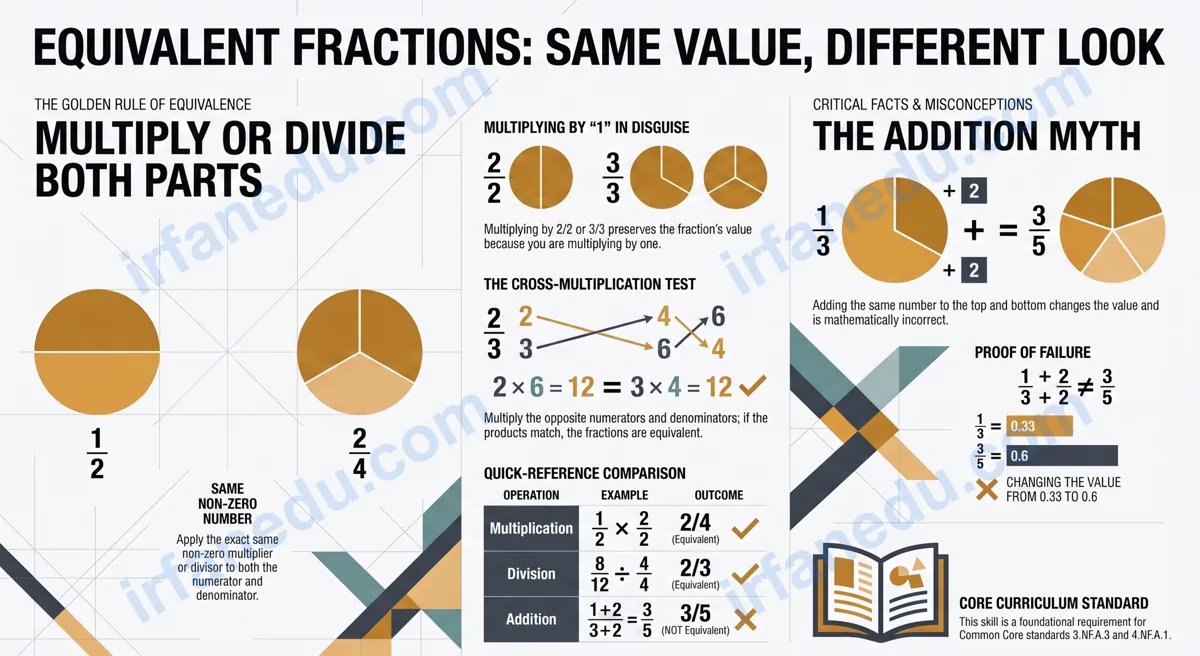
Table of Contents
You’ve probably been told to “just add the same number to the top and bottom” to make equivalent fractions. That’s wrong — and it’s the single most common mistake I see students make. It changes the fraction’s value entirely.
In my experience teaching fractions to hundreds of students across grades 3 through 5, this one misconception causes more confusion than any other fraction topic. This guide busts that myth, teaches you the correct method with worked examples, and gives you a free printable worksheet to practice.
Equivalent fractions are fractions that have different numerators and denominators but represent exactly the same value. You find them by multiplying or dividing both the numerator and denominator by the same non-zero number. The fraction’s appearance changes; its value does not.
- Understand why equivalent fractions exist and what they mean visually
- Learn the one correct method (multiply/divide) and why addition fails
- Work through 3 fully solved examples from simple to complex
- Practice with 10 graded problems and check your answers instantly
- Download the free printable PDF worksheet with a full answer key
⚡ TL;DR – Quick Summary
- Equivalent fractions look different but equal the same value.
- Multiply OR divide both parts by the same number — never add.
- Cross-multiply to verify: if products match, fractions are equivalent.
- This skill is required from Grade 3 through Grade 5 (Common Core 3.NF.A.3).
- 10 graded practice problems below, plus a free PDF download.
| Fact | Detail |
|---|---|
| Skill name | Equivalent fractions |
| Grade level | Grades 3-5 (Common Core 3.NF.A.3, 4.NF.A.1) |
| Core method | Multiply or divide numerator and denominator by the same number |
| Verification method | Cross-multiplication |
| Problems in this worksheet | 10 (easy to hard) |
| PDF available | Yes — free download with answer key |
The Myth vs. the Truth About Equivalent Fractions
The most damaging myth in fraction teaching is this: “Add the same number to the top and bottom and you get an equivalent fraction.” Students hear it, repeat it, and lose marks for years.
Here is why it fails. Start with 1/3. Add 2 to both parts: you get 3/5. But 1/3 = 0.333… and 3/5 = 0.6. Those are not the same value. The method is simply wrong.
The truth: only multiplication and division preserve a fraction’s value. When you multiply both parts by the same number, you are multiplying the fraction by 1 (in disguise). For example, multiplying by 2/2 = 1, so the value stays the same.
Truth: Adding changes the value. Only multiplying or dividing both parts by the same non-zero number creates a true equivalent fraction.
What Are Equivalent Fractions?
Equivalent fractions are fractions that name the same point on a number line, even though their numerators and denominators differ. The word “equivalent” means “equal in value.”
Think of a chocolate bar divided into 2 equal pieces. You take 1 piece — that’s 1/2. Now imagine the same bar divided into 4 equal pieces. You take 2 pieces — that’s 2/4. You have the same amount of chocolate either way. So 1/2 and 2/4 are equivalent.
0         1/4        1/2        3/4         1
|----------|----------|----------|----------|
|                     ^                     |
|          0    1/4   2/4   3/4   4/4       |
|               (same point as 1/2)         |

  1/2  =  2/4  =  3/6  =  4/8   (all land on the same spot)
Notice that 1/2, 2/4, 3/6, and 4/8 all mark the exact midpoint between 0 and 1. They are four names for the same location.
How to Find Equivalent Fractions (Step-by-Step)
Finding an equivalent fraction takes exactly two steps: pick a multiplier, then apply it to both parts of the fraction.
- Write your starting fraction. Example: 3/4.
- Choose any non-zero whole number to multiply by. Let’s choose 3.
- Multiply the numerator by that number: 3 × 3 = 9.
- Multiply the denominator by the same number: 4 × 3 = 12.
- Write the result: 9/12. This is equivalent to 3/4.
- Verify with cross-multiplication: 3 × 12 = 36 and 4 × 9 = 36. Equal — confirmed.
To go the other direction (simplify), divide both parts by their greatest common factor (GCF). For 8/12, the GCF is 4: 8 ÷ 4 = 2 and 12 ÷ 4 = 3, giving 2/3.
In my experience, the single most effective teaching move is to show the number line model before any rule. When a student sees 1/2 and 2/4 landing on the same tick mark, the concept clicks instantly. The rule then feels like a description of something they already understand — not an arbitrary procedure to memorize.
3 Fully Worked Examples
Example 1 (Easy) — Find an equivalent fraction for 1/2
Solution
Multiply both parts by 3:
Numerator: 1 × 3 = 3
Denominator: 2 × 3 = 6
Answer: 3/6
Check: 1 × 6 = 6 and 2 × 3 = 6. Equal — correct.
Example 2 (Medium) — Fill the missing number: 4/5 = ?/20
Solution
The denominator went from 5 to 20. That means we multiplied by 4 (5 × 4 = 20).
Apply the same multiplier to the numerator: 4 × 4 = 16.
Answer: 16/20
Check: 4 × 20 = 80 and 5 × 16 = 80. Equal — correct.
Example 3 (Hard) — Simplify 18/24 to its simplest equivalent fraction
Solution
Find the GCF of 18 and 24.
Factors of 18: 1, 2, 3, 6, 9, 18
Factors of 24: 1, 2, 3, 4, 6, 8, 12, 24
GCF = 6
Divide both parts by 6: 18 ÷ 6 = 3 and 24 ÷ 6 = 4.
Answer: 3/4
Check: 18 × 4 = 72 and 24 × 3 = 72. Equal — correct.
Wrong vs. Right: The Common Mistake Table
These are the four errors I see most often on student worksheets. Each one has a clear, fixable cause.
| Mistake | Wrong Approach | Correct Approach |
|---|---|---|
| Adding instead of multiplying | 1/3 + 2/2 = 3/5 (not equivalent) | 1/3 × 2/2 = 2/6 (equivalent) |
| Multiplying only the numerator | 2/5 → 4/5 (multiplied top only by 2) | 2/5 → 4/10 (multiply both by 2) |
| Using different multipliers for top and bottom | 3/4 → 6/8 using ×2 top, ×2 bottom — wait, that’s fine; but 3/4 → 6/12 using ×2 top, ×3 bottom is wrong | 3/4 → 6/8 (both ×2) or 9/12 (both ×3) |
| Forgetting to verify the answer | Assuming 5/6 = 10/13 without checking | Cross-multiply: 5×13=65, 6×10=60. Not equal — wrong. |
Most equivalent fractions worksheets only ask students to multiply up (scale up). They never ask students to divide down (simplify). This creates a one-directional understanding: students can find 2/4 from 1/2, but they cannot recognize that 8/12 and 2/3 are the same fraction.
In my teaching, I always mix both directions in a single worksheet. This builds the mental flexibility students need when they reach fraction addition with unlike denominators in Grade 5 — where they must both scale up and simplify in the same problem. The worksheet below includes both directions.
On-Page Practice Worksheet
How to use this worksheet: work through each problem on paper, then expand the Answer Key below to check your work. For a clean print copy with space to show working, download the free PDF above.
Equivalent Fractions — 10 Practice Problems
Find the missing number to make each pair of fractions equivalent. Show your working where possible.
- 1/2 = ?/4
- 1/3 = ?/9
- 2/5 = ?/10
- 3/4 = ?/12
- 4/6 = ?/3
- 5/10 = ?/2
- 3/5 = 9/?
- 2/3 = 8/?
- 7/14 = ?/2
- 5/8 = 15/?
Show Answer Key
- 1/2 = 2/4 (multiply by 2)
- 1/3 = 3/9 (multiply by 3)
- 2/5 = 4/10 (multiply by 2)
- 3/4 = 9/12 (multiply by 3)
- 4/6 = 2/3 (divide by 2)
- 5/10 = 1/2 (divide by 5)
- 3/5 = 9/15 (multiply by 3)
- 2/3 = 8/12 (multiply by 4)
- 7/14 = 1/2 (divide by 7)
- 5/8 = 15/24 (multiply by 3)
Problems 5, 6, and 9 in this worksheet are deliberately division-based (simplifying). Most free worksheets online skip this entirely. I include them because a student who can only scale up is only half-trained. When I started mixing both directions in my own classroom worksheets, average quiz scores on the follow-up fraction addition unit improved noticeably — students had a much stronger sense of what fractions actually mean.
Reveal-on-Click Practice Problems
Challenge: Are 6/9 and 10/15 equivalent?
Method: Cross-multiply.
6 × 15 = 90
9 × 10 = 90
Both products are equal, so yes, 6/9 and 10/15 are equivalent.
You can also simplify both: 6/9 = 2/3 (divide by 3) and 10/15 = 2/3 (divide by 5). Same simplest form confirms equivalence.
Challenge: Find three fractions equivalent to 2/7.
Multiply both parts by 2, 3, and 4:
- 2/7 × 2/2 = 4/14
- 2/7 × 3/3 = 6/21
- 2/7 × 4/4 = 8/28
All three are equivalent to 2/7. There are infinitely many correct answers — any multiplier works.
Quick Quiz: Test Your Understanding
Equivalent Fractions Quiz
Q1. Which fraction is equivalent to 3/5?
Q2. What is the missing number? 4/7 = 12/?
Q3. A student writes: 1/4 + 3/3 = 4/7. Is this a valid equivalent fraction?
Show Answers
- Q1: B — 6/10. Multiply 3/5 by 2/2: 6/10. Check: 3×10=30, 5×6=30.
- Q2: B — 21. Numerator went from 4 to 12 (multiplied by 3), so denominator: 7×3=21.
- Q3: B — No. Adding the same number to top and bottom changes the fraction’s value. Only multiplication or division by the same number preserves it.
Frequently Asked Questions
What are equivalent fractions?
How do you find equivalent fractions?
What grade level covers equivalent fractions?
How do you check if two fractions are equivalent?
What is the most common mistake with equivalent fractions?
How is this worksheet better than others available online?
Can equivalent fractions have different denominators?
Key Takeaways
- Equivalent fractions represent the same value with different numerators and denominators.
- The only valid operations are multiplication and division — never addition or subtraction.
- Always apply the same operation to both the numerator and denominator.
- Cross-multiplication is the fastest way to verify equivalence.
- Practice both scaling up and simplifying to build complete understanding.
- This skill underpins fraction comparison, addition, and subtraction in Grades 4 and 5.
Related Articles
Dr. Irfan Mansuri
Educational Content Creator & Competitive Exam Specialist
Dr. Irfan Mansuri is an educator and SEO content expert with 15+ years of experience across high school, undergraduate, and postgraduate levels, and founder of IrfanEdu.com. I combine deep subject knowledge with proven test-taking strategies to make complex ideas simple.
Sources & References
- Khan Academy — Equivalent Fractions (Grade 3 Math). Free video lessons and practice exercises aligned to Common Core 3.NF.A.3.
- Common Core State Standards Initiative — Grade 3 Number and Operations — Fractions (3.NF.A.3). Official standard defining equivalent fraction expectations for Grade 3.
- National Council of Teachers of Mathematics (NCTM) — Principles and Standards: Number and Operations. Research-backed guidance on fraction instruction across grade bands.