
🏗️ Asphalt Calculator: Tonnage, Cost & Volume
📋 Table of Contents
- Three Quick Questions — Answered
- Interactive Asphalt Calculator
- How to Use This Calculator
- What Is Asphalt & Why Does Density Matter?
- The Formula Explained + Variables Table
- 3 Fully Worked Examples
- Common Mistakes (Wrong vs. Right)
- Real-World Applications
- Quick Quiz
- Practice Problems
- FAQ
- Key Takeaways
- Related Articles
- About the Author
- Sources & References
🙋 Three Quick Questions — Answered First
❓ How much asphalt do I need for my driveway?
Multiply your area (length × width in feet) by the thickness in feet, then multiply by 145 lb/cu ft (standard hot-mix density), and divide by 2,000 to get short tons. A 20 ft × 40 ft driveway at 2 inches thick needs roughly 4.8 tons.
❓ What density should I use for asphalt calculations?
Use 145 lb/cu ft (approximately 2,322 kg/m³) for standard hot-mix asphalt (HMA). This is the industry-standard compacted density used by contractors and DOT engineers across the US.
❓ How much does asphalt cost per ton in 2026?
Material-only hot-mix asphalt runs $100–$150 per short ton in most US regions as of mid-2026. Installed cost (labor + equipment) typically adds $2–$5 per square foot on top of material.
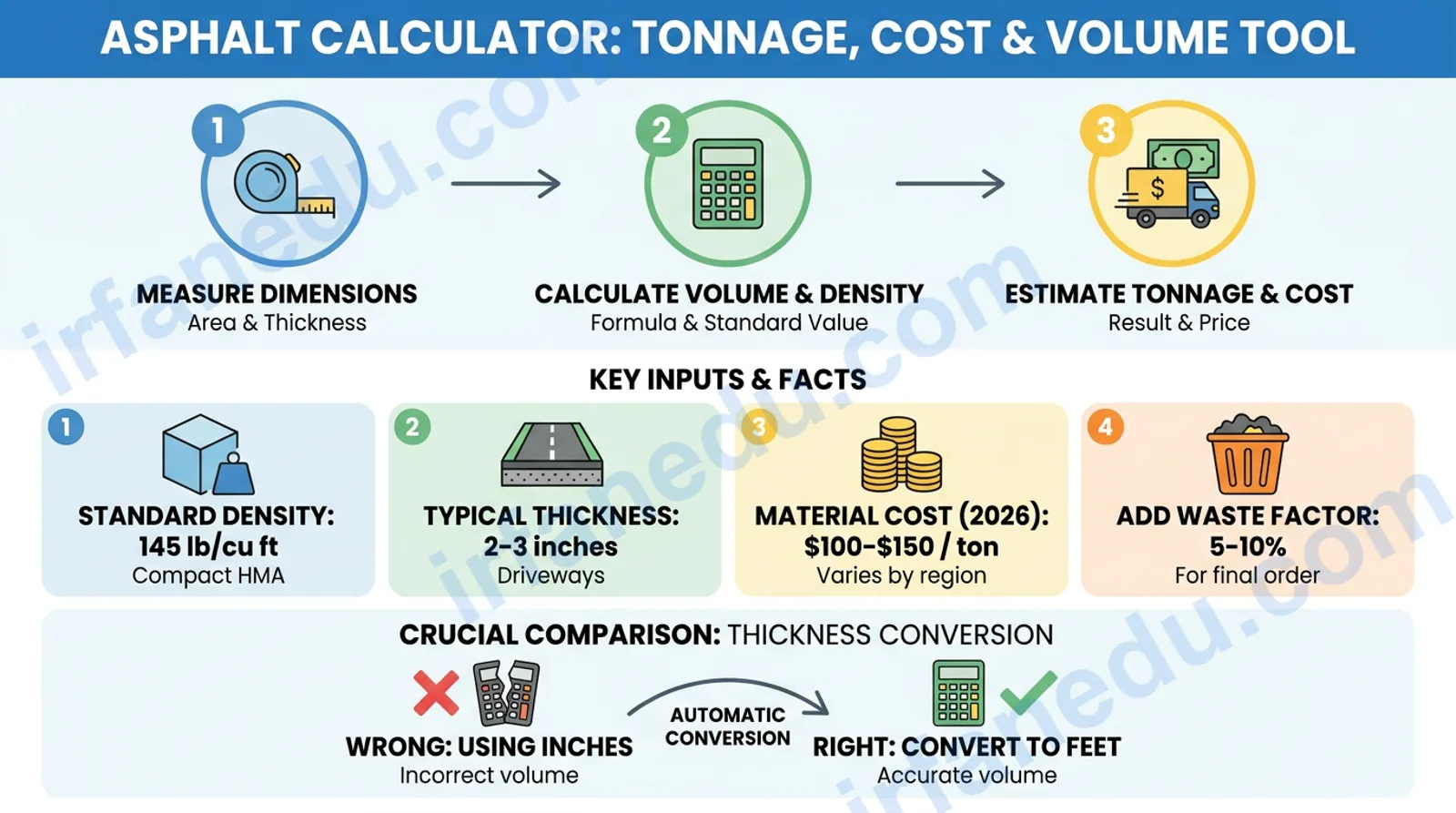
An asphalt calculator uses the standard hot-mix asphalt (HMA) formula — Volume × Density ÷ 2,000 — to convert your project’s dimensions into short tons and material cost. It removes guesswork from ordering, prevents costly over- or under-buying, and gives you a number you can use to compare contractor quotes.
- ✅ Instantly convert area + thickness into tons of asphalt
- ✅ Estimate total material cost at your local price per ton
- ✅ See unit conversions: cubic feet, cubic yards, metric tonnes
- ✅ Understand the step-by-step formula behind every result
- ✅ Avoid the #1 mistake: forgetting to convert thickness to feet
⚡ TL;DR – Quick Summary
- 🏗️ Formula: Tons = (L × W × T_ft × 145) ÷ 2,000 where T_ft = thickness in feet
- 📐 Standard HMA density: 145 lb/cu ft (2,322 kg/m³)
- 💰 US material cost: roughly $100–$150/ton in 2026
- 📏 Driveway standard: 2–3 inches compacted HMA over gravel base
- ➕ Always add 5–10% waste factor to your final order
- 🔢 1 cubic yard of HMA ≈ 1.96 short tons (handy shortcut)
| Parameter | Standard Value | Notes |
|---|---|---|
| HMA Compacted Density | 145 lb/cu ft | Industry default; some mixes: 140–148 lb/cu ft |
| Density (metric) | 2,322 kg/m³ | Equivalent to 145 lb/cu ft |
| 1 cubic yard of HMA | ≈ 1.96 short tons | Useful quick-check shortcut |
| Driveway thickness | 2–3 inches | Compacted; over 4–6 in gravel base |
| Road / commercial | 3–4 inches | Over engineered sub-base |
| Material cost (US, 2026) | $100–$150/ton | Material only; varies by region |
| Installed cost (US, 2026) | $3–$7/sq ft | Includes labor, equipment, base prep |
| Waste factor | 5–10% | Add to calculated tonnage before ordering |
🧮 Interactive Asphalt Calculator
Enter your project dimensions below and click Calculate to instantly get tonnage, cubic yards, and total material cost — with a full step-by-step solution.
Asphalt Calculator
Tonnage · Cubic Yards · Material Cost
ft
ft
inches
lb/cu ft
$/ton
📋 Step-by-Step Solution
Tons = (Length × Width × Thickness_ft × Density) ÷ 2,000
Where Thickness_ft = Thickness_inches ÷ 12, and Density = 145 lb/cu ft (default).
Tons = (π × (Diameter/2)² × Thickness_ft × Density) ÷ 2,000
Cu Yd = (Length × Width × Thickness_ft) ÷ 27
| Symbol | Meaning | SI / US Unit |
|---|---|---|
| L | Length of paving area | feet (ft) / metres (m) |
| W | Width of paving area | feet (ft) / metres (m) |
| T | Compacted thickness | inches → ÷12 → feet |
| ρ (rho) | Compacted HMA density | 145 lb/ft³ ≈ 2,322 kg/m³ |
| V | Volume of asphalt | cubic feet (ft³) / cubic yards (yd³) |
| m | Mass (weight) of asphalt | short tons (US) / metric tonnes |
| C | Material cost | USD ($) |
SI Dimensions: 1 short ton = 2,000 lb. 1 metric tonne = 2,204.6 lb ≈ 1.102 short tons. 1 cubic yard = 27 cubic feet.
Hot-Mix Asphalt (HMA) is a construction material made from a mixture of aggregate (crushed stone, gravel, or sand) and bitumen (asphalt cement), heated and mixed at high temperatures, then compacted while hot. It is the standard surface material for driveways, parking lots, and roads.
HMA is not the same as asphalt sealcoating (a thin protective coating applied over existing pavement) or cold-mix asphalt (used for patching in cold weather). This calculator is for new HMA paving.
- Compacted density: 140–148 lb/cu ft; use 145 as the default
- Typical application: 2–4 inches compacted, over a 4–8 inch aggregate base
- Sold by: short ton (US), metric tonne (international)
- Related terms: blacktop, tarmac, bituminous concrete, macadam
📖 How to Use This Asphalt Calculator — Step by Step
Using this tool takes under 60 seconds. Here is the exact process:
- Choose your shape: Click “Rectangle / Square” for most driveways and paths, or “Circle” for round areas like cul-de-sacs or pads.
- Enter dimensions in feet: Measure your project area and type in length and width (or diameter for circles). Use decimal feet — for example, 22.5 ft.
- Enter thickness in inches: Type the desired compacted asphalt depth. Use 2 for a standard residential driveway, 3 for heavier use, or 1.5 for a light foot-traffic path.
- Adjust density if needed: Leave it at 145 lb/cu ft for standard HMA. If your contractor specifies a different mix density, enter that value.
- Enter price per ton (optional): Type your local material price to get a cost estimate. Leave blank if you only need tonnage.
- Select a waste factor: Choose 5% for a straight rectangle, 10% for irregular shapes or areas with curves.
- Click Calculate: Read your tonnage, cubic yards, metric tonnes, and cost in the green result card — with a numbered step-by-step solution showing every calculation.
🛣️ What Is Asphalt, and Why Does Density Matter for Calculations?
Asphalt (hot-mix asphalt, or HMA) is a dense composite of aggregate and bitumen binder, sold and delivered by weight — in short tons in the US. Because you measure your project by area and thickness (volume), you need density to convert volume into the weight your supplier will quote.
The standard compacted density of HMA is 145 lb per cubic foot. This figure comes from field compaction testing and is the default used by state DOT estimating guides across the US. In practice, mix density varies slightly (140–148 lb/cu ft) depending on aggregate type, gradation, and binder content — but 145 lb/cu ft is accurate enough for material ordering on any residential or light commercial project.
In my experience reviewing construction estimates, the most common error I see is students and DIYers using 110–120 lb/cu ft — the density of loose, uncompacted asphalt. Compacted HMA is significantly denser. If you use the loose density, you will under-order by 20–25% and run short mid-project. Always use 145 lb/cu ft for compacted HMA unless your contractor’s mix design specifies otherwise.
Asphalt is not the same as concrete (which uses a completely different density of ~150 lb/cu ft and is sold by the cubic yard, not the ton). It is also distinct from asphalt sealcoating, which is a thin surface treatment — not a structural layer. This calculator is specifically for new HMA paving.
📐 The Asphalt Formula Explained
The asphalt tonnage formula has four sequential steps. Each step converts one unit into another until you reach short tons.
🗺️ Visual: Asphalt Calculation Flow
  ┌─────────────────────────────────────────────────────────────┐
  │  STEP 1: Area (sq ft)                                       │
  │  Rectangle: Area = Length (ft) × Width (ft)                 │
  │  Circle:    Area = π × (Diameter/2)²                        │
  ├─────────────────────────────────────────────────────────────┤
  │  STEP 2: Volume (cu ft)                                     │
  │  Volume = Area × (Thickness_inches ÷ 12)                    │
  │           ↑ converts inches → feet                          │
  ├─────────────────────────────────────────────────────────────┤
  │  STEP 3: Weight (lb)                                        │
  │  Weight = Volume × 145 lb/cu ft                             │
  │           ↑ standard HMA compacted density                  │
  ├─────────────────────────────────────────────────────────────┤
  │  STEP 4: Short Tons                                         │
  │  Tons = Weight ÷ 2,000                                      │
  │         ↑ 1 short ton = 2,000 lb                            │
  ├─────────────────────────────────────────────────────────────┤
  │  STEP 5: Apply Waste Factor + Cost                          │
  │  Tons_ordered = Tons × (1 + waste%)                         │
  │  Cost = Tons_ordered × Price_per_ton                        │
  └─────────────────────────────────────────────────────────────┘
| Symbol | Meaning | Unit (US) | Unit (SI) |
|---|---|---|---|
| L | Length | feet (ft) | metres (m) |
| W | Width | feet (ft) | metres (m) |
| T | Thickness (compacted) | inches → ÷12 → ft | mm → ÷1000 → m |
| ρ | HMA compacted density | 145 lb/ft³ | 2,322 kg/m³ |
| V | Volume | ft³ or yd³ | m³ |
| m | Mass / weight | short tons (2,000 lb) | metric tonnes (1,000 kg) |
| C | Material cost | USD ($) | — |
SI Dimensions note: 1 short ton = 2,000 lb = 907.2 kg. 1 metric tonne = 1,000 kg = 2,204.6 lb ≈ 1.102 short tons. 1 cubic yard = 27 cubic feet.
✏️ 3 Fully Worked Examples
These examples mirror exactly what the calculator’s step-by-step output shows — so you can verify your results by hand.
📌 Example 1 — Standard Residential Driveway
Project: 40 ft long × 12 ft wide driveway, 2 inches thick, at $120/ton, 5% waste.
- Area:
Sources & References
Reviewed by Dr. Irfan Mansuri. External links open in a new tab and are provided for further reading and verification.