
📺 TV Mount Height Calculator: Find Your Perfect Viewing Height
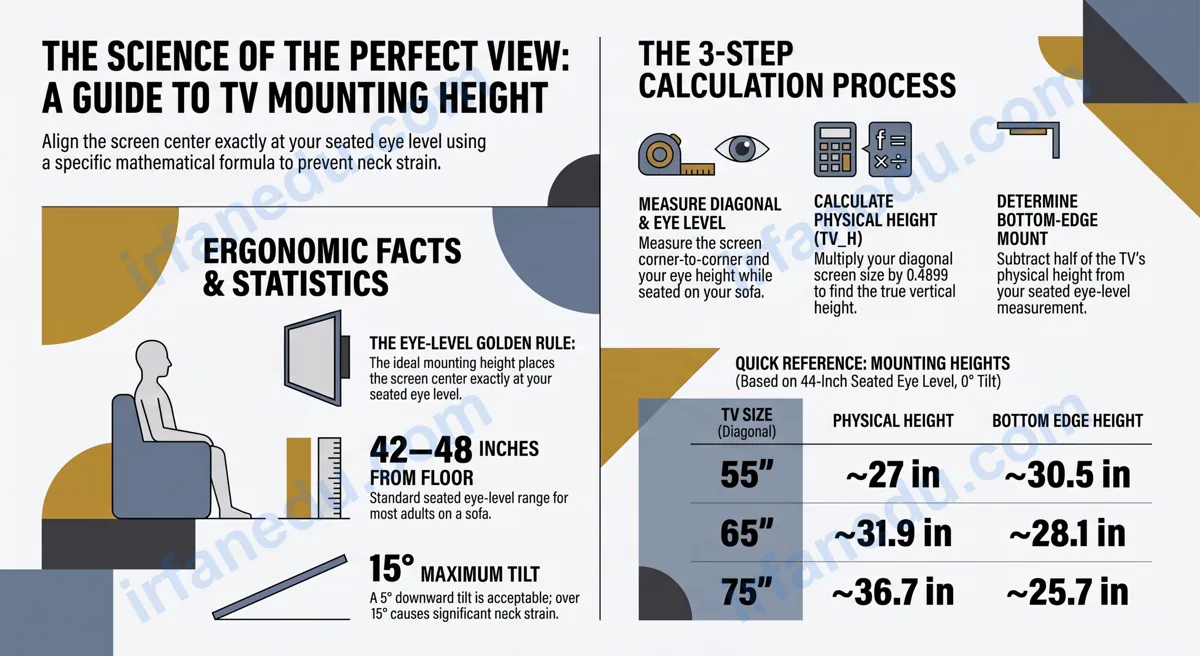
If I could teach you one thing about mounting a TV, it would be this: the number-one mistake people make is mounting the screen too high. I have helped dozens of friends and family members set up their living rooms, and every single time the first instinct is to go higher than necessary. The result? Neck pain after a two-hour movie and a room that looks like a hotel lobby rather than a comfortable home.
This free TV mount height calculator removes all the guesswork. Enter your TV size, your seated eye level, and your seating distance — and you get the exact mounting height in seconds, with a full step-by-step solution you can hand to your installer.
🎯 What You Will Learn
- The correct formula for TV mounting height (and why most guides get it wrong)
- How to measure your seated eye level accurately
- How TV screen size affects where the bottom edge should sit
- How tilt angle changes the optimal height calculation
⚡ TL;DR – Quick Summary
- 📺 Mount the TV center at your seated eye level (typically 42–48 inches from the floor).
- 📐 Bottom-edge height = Eye Level − (TV Physical Height ÷ 2).
- 🔢 A 55-inch TV has a physical height of ~27 inches; a 65-inch TV is ~32 inches tall.
- 📏 Slight downward tilt (5°) is fine; anything over 15° strains your neck.
- 🛋️ Measure eye level while actually seated — not standing.
- 🖥️ Standard desk height (28–30 in) matters if your TV sits on a media console.
📺 TV Mount Height Calculator
TV Mount Height Calculator
Enter your measurements — get the exact mounting height instantly
inches
inches
feet
degrees
🔢 Step-by-Step Solution
TV Center Height = Eye Level + (Distance_in × tan(θ)) − (TV_H / 2)
WHERE
TV_H = TV Screen Size × 0.4899 (physical height, 16:9 ratio)
Distance_in = Seating Distance (ft) × 12
θ = Tilt angle (degrees → radians for tan)
BOTTOM EDGE MOUNT HEIGHT
Bottom Edge = TV Center Height − (TV_H / 2)
| Symbol | Meaning | Unit |
|---|---|---|
| Eye Level | Seated eye height from floor | inches |
| Distance_in | Seating distance from wall | inches |
| θ (theta) | Preferred tilt angle | degrees |
| TV_H | Physical height of TV screen | inches |
| TV Center Height | Floor to screen center | inches |
| Bottom Edge | Floor to bottom of screen | inches |
The 0.4899 factor derives from the 16:9 aspect ratio: sin(arctan(9/16)) = 9/√(256+81) ≈ 0.4899. For 4:3 TVs use 0.6.
Quick reference: recommended TV center height for common screen sizes at 44-inch seated eye level, flat mount (0° tilt).
| TV Size | Physical Height | Center Height | Bottom Edge |
|---|---|---|---|
| 43 in | ~21 in | 44 in | ~33.5 in |
| 50 in | ~24.5 in | 44 in | ~31.8 in |
| 55 in | ~27 in | 44 in | ~30.5 in |
| 65 in | ~31.9 in | 44 in | ~28.1 in |
| 75 in | ~36.7 in | 44 in | ~25.7 in |
| 85 in | ~41.6 in | 44 in | ~23.2 in |
Note: “Center Height” = 44 in (eye level) for a flat mount. Adjust up or down based on your actual seated eye level.
How Do You Use This TV Mount Height Calculator?
Using this tool takes under a minute. Here are the exact steps:
- Enter your TV screen size — the diagonal measurement in inches (printed on the box or the back of the TV).
- Measure your seated eye level — sit on your sofa, have someone measure from the floor to your eyes, and enter that number.
- Measure your seating distance — the distance in feet from the wall to where you sit.
- Set your tilt angle — leave it at 0° for a flat mount, or enter 5–10° if you plan to use a tilting wall bracket.
- Click Calculate — the result shows the TV center height, bottom-edge height, top-edge height, and a numbered step-by-step solution.
What Is the TV Mounting Height Formula?
The core formula accounts for your eye level, the TV’s physical size, and any tilt you apply to the bracket.
📐 Side-View Diagram
   WALL
    |          ← Top edge of TV
    |  ┌──────────────────┐
    |  │                  │  ↑ TV Physical Height
    |  │   TV SCREEN      │  │ (tvSize × 0.4899)
    |  │   CENTER ●───────┼──┼── TV Center Height (from floor)
    |  │                  │  │
    |  └──────────────────┘  ↓
    |          ← Bottom edge (mount here)
    |
    |←──────── Seating Distance ──────────→ 👁 Eye Level
    |                                        (seated)
   FLOOR ─────────────────────────────────────────────
The formula in plain language:
Bottom Edge = TV Center Height − (TV_H ÷ 2)
TV_H = TV Screen Size × 0.4899
| Symbol | Meaning | SI / Common Unit |
|---|---|---|
| Eye Level | Seated eye height from floor | inches (in) |
| Distance_in | Seating distance converted to inches | inches (in) |
| θ (theta) | Bracket tilt angle | degrees (°) |
| TV_H | Physical screen height (16:9) | inches (in) |
| TV Center Height | Floor to screen center | inches (in) |
| Bottom Edge | Floor to bottom of screen | inches (in) |
Worked Examples: TV Mounting Height Step by Step
🏠 Example 1 — 55-inch TV, Standard Living Room
Given: TV = 55 in, Eye Level = 44 in, Distance = 10 ft, Tilt = 0°
- TV physical height = 55 × 0.4899 = 26.9 in
- Distance in inches = 10 × 12 = 120 in
- Tilt offset = 120 × tan(0°) = 0 in
- TV Center Height = 44 + 0 − (26.9 ÷ 2) = 44 − 13.45 = 30.55 in
- Bottom edge = 30.55 − 13.45 = 17.1 in from floor
Mount the bottom edge of the TV at about 17 inches from the floor.
🏠 Example 2 — 65-inch TV, Slight Downward Tilt
Given: TV = 65 in, Eye Level = 46 in, Distance = 12 ft, Tilt = 8°
- TV physical height = 65 × 0.4899 = 31.8 in
- Distance in inches = 12 × 12 = 144 in
- Tilt offset = 144 × tan(8°) = 144 × 0.1405 = 20.2 in
- TV Center Height = 46 + 20.2 − (31.8 ÷ 2) = 66.2 − 15
Sources & References
Written and fact-checked by Dr Irfan Mansuri. External links open in a new tab and are provided for further reading and verification.