
Teacher as a Resource: What It Really Means and How to Use It
Meet Maya, a 9th-grade student struggling with algebra. She sits in the front row, takes notes, reads the textbook, and watches YouTube tutorials every night. Her test scores stay stuck at a C. Her classmate Jordan, who sits in the back row and never opens the textbook at home, consistently scores a B+ or better.
The difference? Jordan talks to their teacher. Before class, after class, during office hours. Jordan asks specific questions, shows their work, and asks for feedback on practice problems before the test. Maya treats the teacher as a performer to watch. Jordan treats the teacher as a resource to use.
By the end of this article, you will understand exactly what that difference means — and how to close it.
A teacher as a resource means treating your teacher not just as someone who delivers information, but as a living, responsive, personalized learning tool you can actively consult, question, and engage with to accelerate your own understanding.
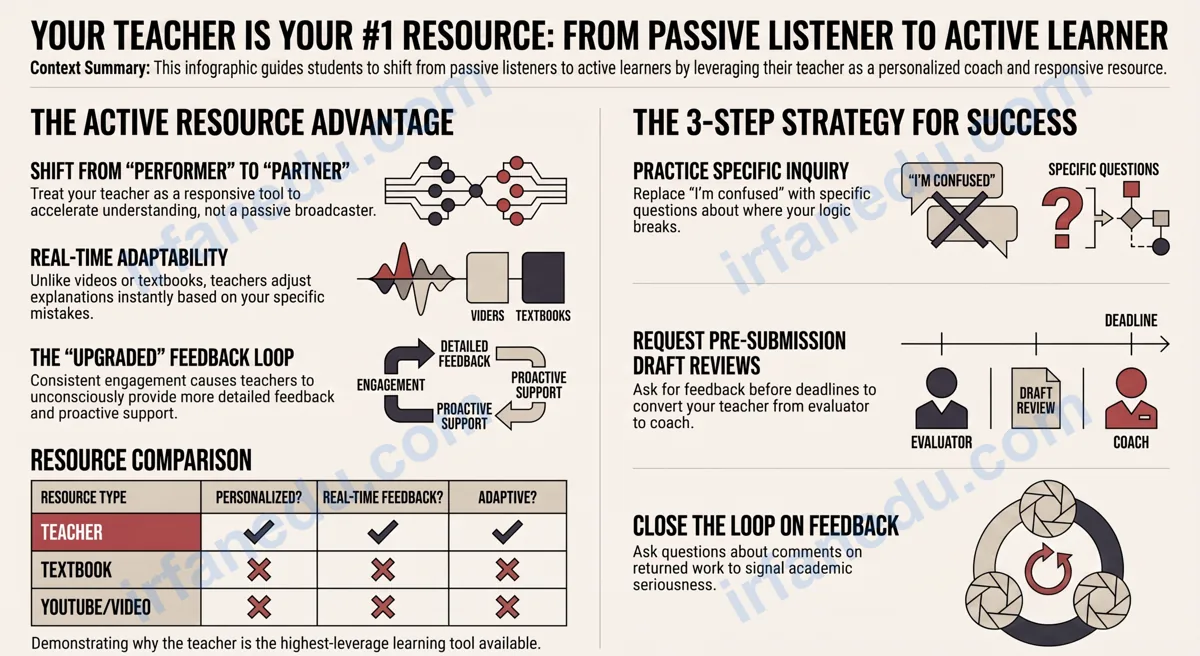
Most students think of their teacher the way they think of a textbook — something to receive information from, passively. That mental model costs them enormously. A textbook cannot notice your confusion. A YouTube video cannot adjust its explanation based on the specific mistake you just made. Your teacher can do both, in real time, for free.
In this guide, I will explain exactly what the phrase means, break down the different ways a teacher functions as a resource, walk through a clear step-by-step strategy for students, and cover the RSP teacher role that often comes up in this context. I will also share what most guides completely miss about this topic.
- 🎯 Understand the full meaning of “teacher as a resource”
- 📚 Learn the different types of teacher resources (including RSP)
- 🛠 Get a practical 6-step strategy for using your teacher effectively
- 👨👩👧 See how parents can use this approach too
- ⚠️ Avoid the most common mistakes students make
⚡ TL;DR – Quick Summary
- 🧑🏫 A teacher as a resource = using your teacher actively, not just listening passively.
- 📖 Teachers provide knowledge, feedback, mentorship, and emotional support as resources.
- 🏫 RSP teachers are specialized resources for students with IEPs or learning disabilities.
- ✋ Asking specific questions before/during/after class is the single highest-ROI habit.
- 👨👩👧 Parents can also use teachers as resources through proactive, structured communication.
- ⚠️ Most students underuse this resource by waiting for the teacher to come to them.
| Fact | Detail |
|---|---|
| Concept origin | Rooted in constructivist learning theory (Vygotsky’s Zone of Proximal Development) |
| Who benefits | Students at every grade level, K–12 and beyond |
| RSP teacher role | Specialized resource teacher for students with IEPs / learning disabilities |
| Most underused form | Pre-submission feedback (asking teacher to review drafts before the deadline) |
| Biggest student mistake | Treating the teacher as an evaluator rather than a coach |
| Parent opportunity | Requesting home-support strategies at parent-teacher conferences |
What Does “Teacher as a Resource” Actually Mean?
A teacher as a resource is a teacher who functions as a tool for learning — someone students actively draw on for knowledge, guidance, feedback, and support, rather than simply receiving information from. The phrase captures a shift in how we think about the teacher’s role: from broadcaster to resource.
The idea has deep roots in educational theory. Lev Vygotsky’s concept of the Zone of Proximal Development (ZPD) — the gap between what a learner can do alone and what they can do with guidance — is essentially an argument that a skilled human resource (the teacher) unlocks learning that no independent study can reach.
In practical terms, a teacher acts as a resource in at least four distinct ways:
- Knowledge resource: The teacher holds subject expertise students can access by asking questions.
- Feedback resource: The teacher can evaluate your work and tell you specifically what to improve — something no textbook can do.
- Mentorship resource: The teacher can advise on study strategies, course selection, and academic goals.
- Emotional support resource: A trusted teacher can help students navigate academic anxiety, motivation problems, and learning challenges.
Jordan uses all four. Before the algebra test, Jordan asks the teacher to explain one specific concept (knowledge). Jordan brings a completed practice test and asks “what did I do wrong on problem 7?” (feedback). Jordan asks “should I take pre-calculus next year?” (mentorship). When Jordan feels overwhelmed before finals, Jordan tells the teacher (emotional support). Maya uses zero of the four. Same classroom. Completely different outcomes.
What Are the Different Types of Teacher Resources?
Not all teachers function as resources in the same way — the role depends on context, subject, and the student’s needs. Understanding the different types helps you know exactly which resource to access and when.
1. 🏫 The General Education Teacher (Core Resource)
This is the teacher most students interact with daily. As a resource, they provide subject-matter expertise, real-time feedback during lessons, and access to supplementary materials. The key insight: most students use only 20% of what this resource offers by limiting interaction to what happens during the lesson itself.
2. 📋 The RSP Teacher (Specialist Resource)
The RSP (Resource Specialist Program) teacher is a certified special education teacher who works with students who have Individualized Education Programs (IEPs) or identified learning disabilities. I cover this role in its own section below because it comes up frequently in searches related to this topic.
3. 🧑💼 The Counselor-Teacher (Guidance Resource)
School counselors who also teach or advise act as a resource for academic planning, college preparation, and social-emotional support. Many students never access this resource at all.
4. 🔬 The Subject Specialist (Deep-Knowledge Resource)
In secondary school and beyond, subject specialists (AP teachers, department heads, lab instructors) hold deep expertise in a narrow area. For a student preparing for an AP exam or a specific career path, this is an extremely high-value resource that is almost always underused.
In my 15 years working with students, the most consistently underused teacher resource is the school counselor. Students visit them only in a crisis. But counselors who know you well — your strengths, your goals, your learning style — can open doors that no amount of self-study can. I tell every student I work with: introduce yourself to your counselor in September, not April.
What Is an RSP Teacher and How Do They Fit In?
An RSP teacher — short for Resource Specialist Program teacher — is a credentialed special education professional who provides targeted academic support to students with identified learning disabilities, attention challenges, or other conditions covered under an IEP (Individualized Education Program).
The RSP model is widely used in US public schools. Rather than placing students with disabilities in fully separate classrooms, the RSP teacher works with them in a resource room (small group or one-on-one) while the student remains enrolled in general education classes for most of the day. This is called a “pull-out” or “push-in” model.
Suppose Maya’s algebra struggles stem from a documented processing disorder. In that case, she would be assigned an RSP teacher — let’s call her Ms. Rivera. Ms. Rivera would review Maya’s IEP goals, work with Maya’s algebra teacher to identify where the curriculum needs modification, and meet with Maya three times a week in the resource room to pre-teach concepts before they appear in the general class. Maya would enter each algebra lesson already familiar with the vocabulary and core idea — giving her a real chance to keep up. The RSP teacher is not a replacement for the general education teacher; she is an additional, specialized resource layered on top.
What Does an RSP Teacher Actually Do?
- Delivers small-group or individual instruction aligned to IEP goals
- Modifies or adapts general education curriculum and assessments
- Coordinates with general education teachers to ensure access to grade-level content
- Tracks progress toward IEP goals and adjusts strategies accordingly
- Communicates regularly with parents about progress and strategies
How Do You Use Your Teacher as a Resource? (Step-by-Step)
Using your teacher as a resource is a learnable skill, not a personality trait. Here is the exact process I teach students who want to get more out of every class.
-
Prepare specific questions before each class.
Review your notes from the previous lesson and write down exactly what confused you. Vague confusion (“I don’t get chapter 4”) is hard for a teacher to address. Specific confusion (“I understand how to set up the equation, but I don’t understand why we flip the inequality sign when dividing by a negative”) is something a teacher can resolve in 90 seconds. -
Ask during class — don’t save it all for later.
Raise your hand when something is unclear. Teachers prefer in-class questions because they can address the whole group. Waiting until after class means you spend the rest of the lesson confused, which compounds the problem. -
Use office hours with a prepared agenda.
Bring a specific problem, a draft, or a list of questions. “I tried solving this three different ways and got three different answers — can you show me where my logic breaks?” is the kind of question that turns a 5-minute office-hours visit into a breakthrough. -
Request pre-submission feedback on drafts.
This is the single most underused strategy. Ask your teacher to look at your outline or first draft before you submit the final version. This converts the teacher from an evaluator (who grades you after the fact) into a coach (who helps you improve before the deadline). -
Ask for resource recommendations.
Teachers know which practice books, websites, and videos actually work for their subject. They rarely volunteer this information unprompted. Ask directly: “What would you recommend for extra practice on this topic?” -
Close the loop on returned work.
When you get graded work back, read every comment and ask about any feedback you do not fully understand. This is where the real learning happens — and it signals to your teacher that you are serious, which changes how they interact with you going forward.
[IMAGE: A student at a teacher’s desk showing a marked-up practice test, both looking at the paper | ALT: student using teacher as a resource by reviewing feedback on a practice test]
In my experience teaching and tutoring, the single biggest performance jump I have ever seen came from students who started asking teachers to review drafts before submission. One student I worked with went from a C+ to an A- in one semester — not because she got smarter, but because she stopped treating the teacher as a grader and started treating them as a coach. The teacher’s job is to help you learn. Asking for pre-submission feedback is not cheating — it is using the resource correctly.
What Most Students Get Wrong About Using Their Teacher as a Resource
Most guides on this topic list the same generic advice: “ask questions,” “go to office hours,” “be respectful.” That is fine as far as it goes, but it misses the deeper mistakes that actually hold students back.
❌ Mistake 1: Treating the Teacher as an Evaluator, Not a Coach
The most common mental block. Students see the teacher as the person who assigns grades, so they avoid showing weakness or confusion. This is backwards. The teacher’s primary job is to help you learn — the grade is just a measurement of how well that happened. The moment you stop trying to impress your teacher and start trying to learn from them, the dynamic changes completely.
Wrong: “I won’t ask because the teacher will think I wasn’t paying attention.”
Right: “I will ask because that is exactly what the teacher is there for, and a specific question shows I was engaged.”
❌ Mistake 2: Asking Too Late
Students typically seek teacher help 48 hours before a test. By that point, there is not enough time to genuinely close a knowledge gap — only enough time to cram. Using a teacher as a resource works best as a continuous habit, not a last-minute emergency strategy.
❌ Mistake 3: Asking Vague Questions
A teacher cannot help you with “I don’t understand the chapter.” They can help you with “I understand the main idea but I cannot figure out how to apply it to this type of problem.” Specificity is the key that unlocks the resource.
❌ Mistake 4: Ignoring Non-Academic Resources
Teachers know which courses to take, which extracurriculars look strong on applications, which scholarships exist, and which study strategies actually work for their subject. Students who only use teachers for academic content miss the mentorship dimension entirely.
📊 Visual: The Teacher Resource Spectrum
PASSIVE USE ◄─────────────────────────────────► ACTIVE USE
(Low Outcome)                                  (High Outcome)

  [Listening to lectures only]
          │
          ▼
  [Reading handouts]
          │
          ▼
  [Asking a question in class]
          │
          ▼
  [Visiting office hours with a question]
          │
          ▼
  [Requesting feedback on a draft]
          │
          ▼
  [Using teacher as mentor for course/career planning]
          │
          ▼
  [Building an ongoing learning dialogue]
          ↑
   Jordan is here. Maya started here ──────────────────────────┘
How Can Parents Use a Teacher as a Resource?
Parents have access to the same resource — and most use it even less effectively than students do. A parent who treats a teacher as a resource does not just show up to parent-teacher conferences to hear a report. They come with specific questions and leave with an action plan.
What to Ask at a Parent-Teacher Conference
- “What is the one skill my child most needs to strengthen right now?”
- “What can I do at home to reinforce what you are teaching in class?”
- “Are there any early warning signs I should watch for?”
- “What resources — books, websites, practice sets — do you recommend for this subject?”
- “How does my child respond to feedback? Does anything seem to block their learning?”
After Maya’s first C on an algebra test, her parent emails the teacher with a specific question: “Maya says she understands the steps but keeps making errors on the final calculation. Is this a procedural issue or a conceptual one?” The teacher replies within a day: it is conceptual — Maya does not understand why the steps work, only that they do. The parent now knows exactly what to target. That one email changed the entire tutoring strategy at home. The teacher had this insight all along. The parent just had to ask.
Teacher vs. Other Learning Resources: How Do They Compare?
A teacher as a resource is uniquely powerful because of one property no other resource has: real-time adaptability. Here is how the teacher compares to other common learning resources.
| Resource | Personalized? | Real-Time Feedback? | Adaptive to Your Mistakes? | Free? |
|---|---|---|---|---|
| 🧑🏫 Teacher | ✅ Yes | ✅ Yes | ✅ Yes | ✅ Yes |
| 📖 Textbook | ❌ No | ❌ No | ❌ No | Usually yes |
| 🎥 YouTube / Video | ❌ No | ❌ No | ❌ No | ✅ Yes |
| 🤖 AI Tutor | Partially | ✅ Yes | Partially | Partially |
| 👥 Study Group | Partially | Partially | Partially | ✅ Yes |
| 💰 Private Tutor | ✅ Yes | ✅ Yes | ✅ Yes | ❌ No (expensive) |
The table makes it clear: a teacher combines every advantage of a private tutor at zero additional cost. The only difference is that a private tutor comes to you. With a teacher, you have to go to them. That is the entire barrier — and it is a very small one.
💡 Unique Insight: The Feedback Loop Nobody Talks About
Here is something almost no guide on this topic mentions: using your teacher as a resource changes how the teacher teaches you. When a student consistently asks good questions, seeks feedback, and follows up on returned work, the teacher unconsciously recalibrates. They start calling on that student more, offering more detailed written feedback, and flagging resources proactively. The student has not just accessed the resource — they have upgraded the quality of the resource itself.
In my experience, this effect kicks in within three to four weeks of consistent engagement. It is not favoritism — it is a natural human response to a student who signals they are genuinely trying to learn. The implication: the students who most need extra teacher attention (struggling students) are often the ones least likely to ask for it, while the students who least need it (already high-performing) are most likely to seek it. Closing that gap is the single highest-leverage thing a struggling student can do.
🧠 Quick Knowledge Check
Select your answer, then click “Reveal Answer” to check.
1. What is the primary advantage a teacher has over a textbook as a learning resource?
Reveal Answer
2. What does RSP stand for in the context of “RSP teacher”?
Reveal Answer
3. According to this article, what is the single most underused strategy for using a teacher as a resource?
Reveal Answer
🛠 Practice: Apply What You Have Learned
Use these scenarios to test your understanding. Think through your answer, then reveal the suggested response.