
📘 RSP Teacher: What They Do, Who They Help, and Why It Matters
Imagine a student who is sharp, curious, and clearly intelligent — but every time a reading assignment lands on their desk, they freeze. They’re not lazy. They’re not “slow.” They just process written language differently. Now imagine a specialist who steps in for 45 minutes a day, works in a small group, and teaches that student the exact strategies they need to decode text, organize ideas, and keep up with their grade-level peers. That specialist is an RSP teacher.
An RSP teacher — short for Resource Specialist Program teacher — is a credentialed special education professional who provides targeted academic support to students with Individualized Education Programs (IEPs). These students spend most of their school day in a general education classroom but receive additional, specialized instruction to help them access grade-level content.
In this guide, I’ll walk you through exactly what RSP teachers do, how the program is structured, who qualifies, and what parents can do if they think their child needs this support. I’ve worked alongside RSP teachers for years, and I’ll share what most guides leave out.
- The clear definition of an RSP teacher and the Resource Specialist Program
- How pull-out and push-in support models work in real classrooms
- The difference between RSP and a Special Day Class (SDC)
- How IEP goals drive every RSP session
- The step-by-step process for requesting RSP services
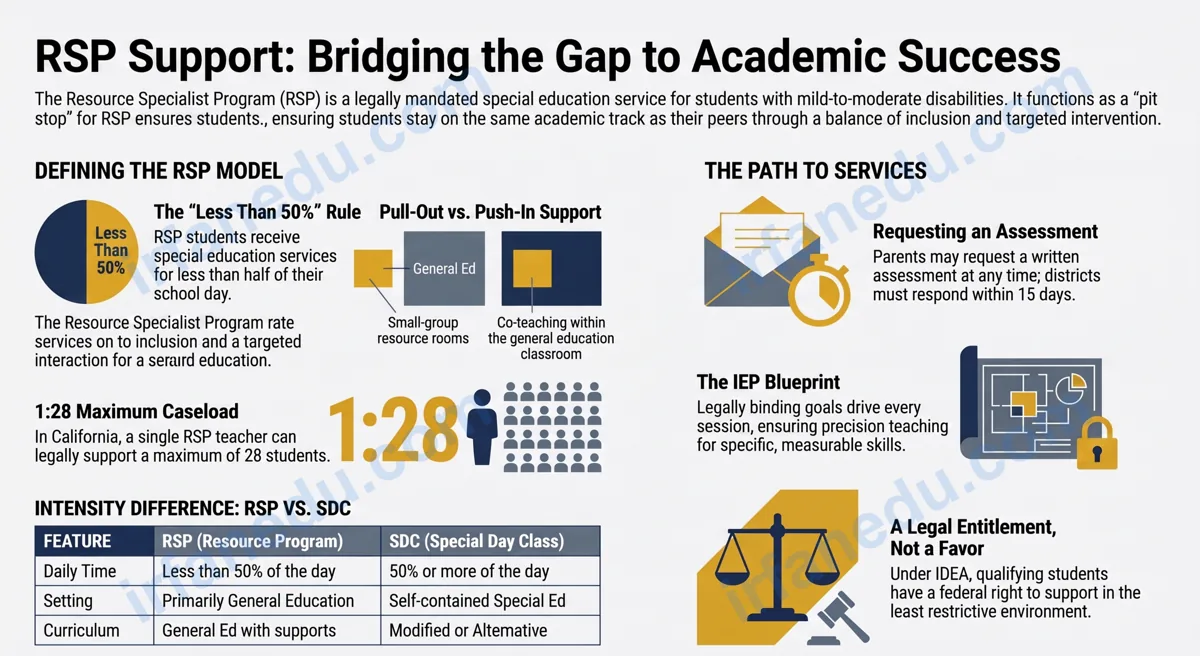
An RSP teacher (Resource Specialist Program teacher) is a credentialed special education professional who provides individualized academic support to students with IEPs. RSP students spend most of their day in general education classes but receive targeted help — in a small resource room or inside their regular classroom — to access grade-level content. RSP is one of the least restrictive special education placements available in US schools.
⚡ TL;DR – Quick Summary
- 📌 RSP = Resource Specialist Program; the teacher is a credentialed special education specialist.
- 📌 RSP students have IEPs but spend most of the day in general education classes.
- 📌 Support is delivered via pull-out (small resource room) or push-in (co-teaching in class).
- 📌 RSP is less intensive than a Special Day Class (SDC); it’s for students who need supplemental, not full-time, special ed.
- 📌 Parents can request an assessment in writing at any time — the district must respond.
- 📌 IEP goals are the blueprint; every RSP session targets a specific, measurable skill.
🔍 The Analogy That Makes RSP Click Instantly
Think of a general education classroom like a highway. Most students travel at the posted speed limit without trouble. But some students are driving a car that needs a tune-up — the engine is fine, but the tires are mismatched, and the GPS keeps glitching. They can absolutely reach the destination. They just need a pit stop with a specialist mechanic.
That pit stop is the RSP resource room. The RSP teacher is the specialist mechanic — not replacing the highway, not putting the student in a completely different vehicle, but making targeted adjustments so the student can re-enter the highway and keep pace.
This analogy captures something important: RSP is not a separate track. It is a support system that keeps students on the same track as their peers, with expert help at key moments.
📚 What Is an RSP Teacher? (Formal Definition)
An RSP teacher — formally called a Resource Specialist — is a special education teacher who holds a specific credential authorizing them to provide services to students with mild-to-moderate disabilities. In the United States, the Resource Specialist Program is most prominently codified in California education law (California Education Code §56362), but equivalent programs exist in every state under different names, all governed by the federal Individuals with Disabilities Education Act (IDEA).
The defining feature of RSP is placement: students receive special education services for less than 50% of the school day. This makes RSP one of the least restrictive environment (LRE) options on the special education continuum.
📊 Quick Facts: RSP at a Glance
| Feature | RSP Details |
|---|---|
| Full name | Resource Specialist Program |
| Governing federal law | IDEA 2004 (Individuals with Disabilities Education Act) |
| Time in special ed setting | Less than 50% of the school day |
| Typical daily support time | 30 minutes – 2 hours per day |
| Requires an IEP? | Yes — always |
| Delivery models | Pull-out (resource room) and/or push-in (co-teaching) |
| Common qualifying disabilities | Specific Learning Disability, Speech-Language Impairment, Mild ADHD, Mild Autism Spectrum Disorder |
| Teacher credential required | Education Specialist Credential (Mild/Moderate) or state equivalent |
| Max caseload (California) | 28 students per RSP teacher |
| Placement decision made by | IEP team (includes parents) |
🧑🏫 What Does an RSP Teacher Actually Do Every Day?
An RSP teacher’s day is far more complex than “tutoring in a small room.” Their responsibilities span direct instruction, collaboration, documentation, and advocacy — all simultaneously.
Direct Instruction (The Core Job)
The RSP teacher delivers targeted, evidence-based instruction aligned to each student’s IEP goals. This might mean teaching a structured literacy program to a student with dyslexia, breaking down multi-step math word problems for a student with a processing disorder, or building executive function skills for a student with ADHD.
Co-Teaching and Push-In Support
In push-in models, the RSP teacher enters the general education classroom and co-teaches alongside the classroom teacher. They might circulate to support specific students, provide real-time accommodations, or lead a small group in the back of the room while the main lesson continues.
IEP Development and Progress Monitoring
RSP teachers write, implement, and monitor each student’s IEP. They collect data on goal progress, write annual reports, and lead or participate in IEP meetings. This paperwork load is substantial — experienced RSP teachers often say it rivals their direct instruction time.
Collaboration with General Education Teachers
A strong RSP teacher is a bridge between special and general education. They consult with classroom teachers about accommodations (extended time, preferential seating, graphic organizers), help modify assignments, and ensure the student’s IEP is implemented consistently across all settings.
In my experience working with special education teams, the most effective RSP teachers I’ve seen spend at least 20% of their week in collaborative planning with general education teachers — not just in the resource room. When that collaboration breaks down, students fall through the cracks between their two worlds. The resource room becomes an island instead of a bridge. If you’re a parent, ask at the IEP meeting: “How often does the RSP teacher meet with my child’s classroom teachers?” The answer tells you a lot about the program’s quality.
🔄 Pull-Out vs Push-In: What’s the Difference?
RSP services are delivered in two main ways, and most students receive a combination of both. Understanding the difference helps parents advocate for the right model at IEP meetings.
| Feature | Pull-Out (Resource Room) | Push-In (Inclusive Co-Teaching) |
|---|---|---|
| Where it happens | Separate resource room | Inside the general education classroom |
| Group size | 1–5 students | Whole class, with targeted support |
| Best for | Intensive skill-building (decoding, math facts, writing) | Applying skills in context; reducing stigma |
| Disruption to class | Student leaves and returns | No disruption; student stays with peers |
| Privacy | High — work is separate | Lower — peers may notice support |
| Typical use | Foundational skill gaps | Comprehension, note-taking, discussion support |
⚖️ RSP vs SDC: Which Placement Is Right?
The most common question I hear from parents is: “What’s the difference between RSP and a Special Day Class?” The answer comes down to intensity and time.
| Dimension | RSP | SDC (Special Day Class) |
|---|---|---|
| Time in special ed | Less than 50% of the day | 50% or more of the day |
| Primary setting | General education classroom | Self-contained special ed classroom |
| Disability severity | Mild to moderate | Moderate to severe |
| Curriculum | General ed curriculum with supports | Modified or alternative curriculum |
| Class size | General ed class + small group pull-out | 8–12 students with 1 teacher + aide(s) |
| Social inclusion | High — with general ed peers most of the day | Lower — primarily with SDC peers |
| LRE principle | Less restrictive | More restrictive |
Federal law under IDEA requires that students be educated in the least restrictive environment appropriate for their needs. RSP is typically the first placement considered for students with mild-to-moderate disabilities. SDC is recommended when a student’s needs cannot be met adequately with RSP-level support.
📝 How the IEP Drives RSP Services
Every RSP student has an Individualized Education Program (IEP) — a legally binding document that defines their disability, present levels of performance, annual goals, and the specific services they will receive. The IEP is the blueprint for everything the RSP teacher does.
What an IEP Contains (RSP-Relevant Sections)
- Present Levels of Academic Achievement: Where the student is right now, based on assessments.
- Annual Goals: Specific, measurable targets (e.g., “By June 2027, Marcus will read 90 words per minute at a 4th-grade level with 80% accuracy”).
- Services: How many minutes per week of RSP support, in what setting.
- Accommodations: Modifications to the general education environment (extended time, reduced assignments, text-to-speech).
- Progress Reporting: How and when the RSP teacher will report progress to parents.
Goal: “By May 2027, given a 4th-grade reading passage, Sofia will correctly identify the main idea and two supporting details in 4 out of 5 trials as measured by teacher-created probes.”
What this means for the RSP teacher: Every RSP session that targets this goal must include a reading passage at 4th-grade level, a structured response task, and data recording. The RSP teacher tracks Sofia’s progress weekly and adjusts instruction if she isn’t on track. This is not tutoring — it is precision teaching.
Here’s what most guides don’t tell you about IEP goals: vague goals protect no one. I’ve reviewed IEPs that say things like “Student will improve reading skills.” That goal is unenforceable and unmeasurable. A good RSP teacher will push back on vague goals and insist on specific, measurable language. As a parent, you can do the same. Ask at every IEP meeting: “How will we know if this goal has been met? What data will be collected?” If the team can’t answer clearly, the goal needs to be rewritten.
📋 How to Request RSP Services for Your Child
Parents do not need to wait for a teacher to refer their child. You have the legal right to request a special education assessment in writing at any time. Here is the step-by-step process:
- Write a formal assessment request letter addressed to the school principal or special education coordinator. State your child’s name, grade, and your specific concerns. Send it by email or certified mail to create a paper trail.
- Wait for the district’s Assessment Plan — the district must respond within 15 calendar days in California (timelines vary by state; IDEA sets a 60-day evaluation timeline from consent). Review the plan carefully before signing.
- The assessment is completed by a multidisciplinary team: school psychologist, RSP teacher, speech therapist (if relevant), and others. This covers cognitive, academic, and functional areas.
- Attend the IEP eligibility meeting where the team reviews results and determines if your child qualifies for special education services. You are an equal member of this team — bring questions and, if needed, an advocate.
- Review and sign the IEP once services are agreed upon. RSP services begin after your signature. You receive a full copy of the IEP and can request a review meeting at any time.
🚫 4 Common Myths About RSP — Corrected
Misconceptions about RSP keep some families from seeking help their child genuinely needs. Here are the four I hear most often, and the truth behind each one.
Truth: RSP serves students with a wide range of intellectual abilities, including gifted students who also have learning disabilities (twice-exceptional, or “2e” students). RSP addresses how a student learns, not how intelligent they are. Many RSP students go on to college and graduate school.
Truth: RSP is legally mandated special education delivered by a credentialed specialist using evidence-based instructional methods tied to IEP goals. It is not tutoring. It is a federally protected educational service with legal timelines, documentation requirements, and parental rights attached to it.
Truth: RSP placement is reviewed annually. Students who meet their IEP goals and no longer need special education services can be exited from the program. This is called “graduation” from special education, and it happens regularly.
Truth: Research consistently shows that students who receive appropriate support have better academic outcomes and higher self-esteem than students with unaddressed learning disabilities who struggle silently. The stigma of failure is far more damaging than the stigma of getting help.
🗺️ The Special Education Placement Continuum (Visual)
RSP sits near the “least restrictive” end of the special education continuum. Here’s how the full continuum looks, from most inclusive to most specialized:
LEAST RESTRICTIVE ◄─────────────────────────────────────► MOST RESTRICTIVE

┌─────────────────────────────────────────────────────────────────────┐
│                                                                     │
│  1. General Education Only                                          │
│     (No special ed; accommodations via 504 Plan if needed)          │
│                                                                     │
│  2. ★ RSP / Resource Room ★  ← YOU ARE HERE                        │
│     (General ed most of day + pull-out/push-in support <50%)       │
│                                                                     │
│  3. Special Day Class (SDC)                                         │
│     (Self-contained special ed classroom ≥50% of day)              │
│                                                                     │
│  4. Non-Public School (NPS)                                         │
│     (Specialized private school, district-funded)                   │
│                                                                     │
│  5. Home/Hospital Instruction                                       │
│     (Medical necessity; temporary)                                  │
│                                                                     │
│  6. Residential Placement                                           │
│     (24-hour specialized care; most restrictive)                    │
│                                                                     │
└─────────────────────────────────────────────────────────────────────┘

IDEA requires placement in the LEAST RESTRICTIVE environment
appropriate for the student's individual needs.
Most articles about RSP describe it as a “support service” — which is technically true but misses the most important thing: RSP is a legal entitlement, not a school favor. I’ve seen parents thank teachers profusely for “letting” their child receive RSP services, as if it were a gift. It is not. Under IDEA, a student who qualifies for special education has a federal right to a Free Appropriate Public Education (FAPE) in the least restrictive environment. The school district is legally obligated to provide it. Understanding this shifts the dynamic entirely: parents are not petitioners — they are equal partners with enforceable rights. If a district denies or delays services, parents can request mediation, file a state complaint, or pursue a due process hearing. Knowing this is the single most powerful thing a parent can bring to an IEP meeting.
🧠 Quick Quiz: Test Your RSP Knowledge
1. What does RSP stand for?
Show Answer
2. An RSP student spends _______ of their school day in a special education setting.
Show Answer
3. Which document is the legal blueprint for all RSP services?
Show Answer
✏️ Scenario-Based Practice: Apply What You Know
Scenario 1: Is RSP the right placement for Aiden?
Situation: Aiden is a 3rd grader with a diagnosed specific learning disability in reading. He reads at a 1st-grade level but performs at grade level in math and science. He is social, happy at school, and his classroom teacher reports he participates well in class discussions.
Question: Would RSP likely be an appropriate placement for Aiden?
Answer: Yes — RSP is a strong fit. Aiden has a specific, documented learning disability affecting one academic area (reading) while performing at grade level in others. He is socially integrated and thriving in the general education environment. He needs targeted, intensive reading instruction (pull-out RSP) without being removed from his general education setting. An SDC would be overly restrictive for his profile.
Scenario 2: What should this parent do next?
Situation: A parent has noticed their 2nd-grade daughter struggles significantly with writing — she avoids it, her letters are inconsistent, and she cries during homework. The classroom teacher says she’s “just not trying hard enough.” The parent suspects dysgraphia.
Question: What is the parent’s best next step?
Answer: The parent should submit a written assessment request to the school principal or special education coordinator immediately. They do not need a private diagnosis first. Under IDEA’s “Child Find” obligation, the district must evaluate any student suspected of having a disability that affects their education. The parent should document their concerns in writing, request a comprehensive psycho-educational assessment, and keep a copy of everything sent. If the teacher’s comment is the only response, escalate to the district’s special education office.
Scenario 3: RSP goal — is this goal measurable?
Sources & References
Written and fact-checked by Dr Irfan Mansuri. External links open in a new tab and are provided for further reading and verification.