
Main Idea Sheets: The Complete Student Guide to Finding What a Text Is Really About
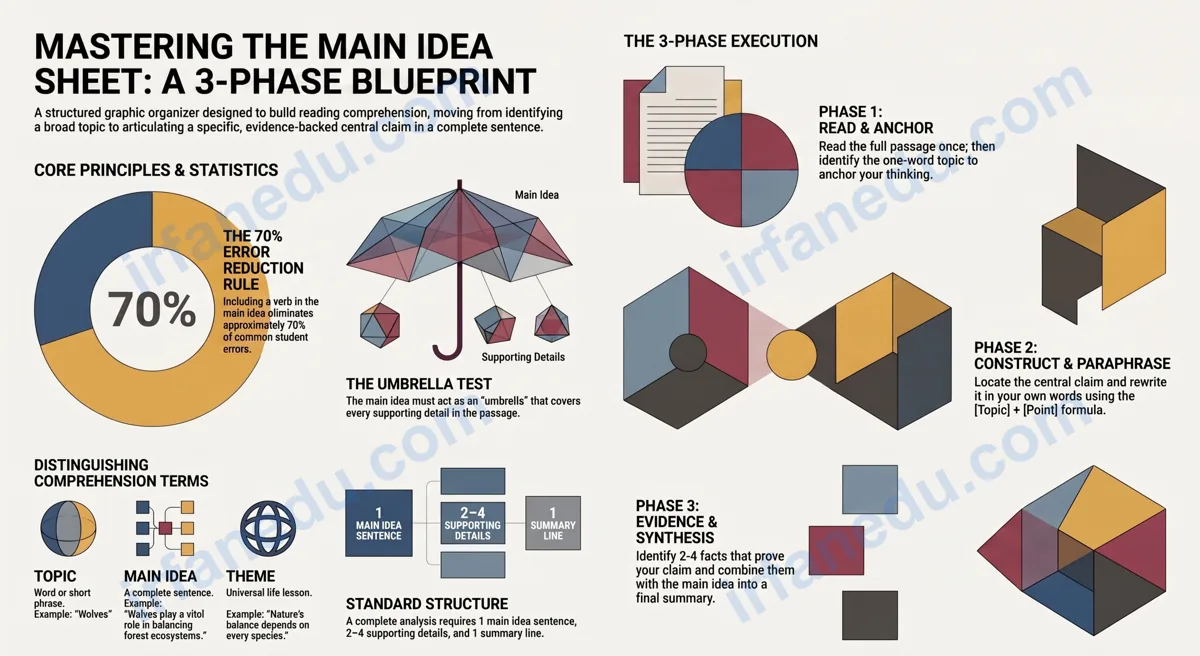
- What Is a Main Idea Sheet?
- What a Finished Sheet Looks Like (Start Here)
- Main Idea vs. Topic vs. Theme: The Difference That Trips Everyone Up
- How Do You Complete a Main Idea Sheet? (6 Steps)
- Worked Examples by Grade Level
- What If the Main Idea Is Implied?
- Common Mistakes on Main Idea Sheets (Wrong vs. Right)
- Types of Main Idea Graphic Organizers
- Quick Quiz
- Practice Problems
- FAQ
- Sources & References
Here is the finished product first. Below is what a correctly completed main idea sheet looks like for a real passage about ocean pollution. Every section of this guide reverse-engineers exactly how a student gets there.
  ┌─────────────────────────────────────────────────────┐
  │                      TOPIC                         │
  │               Ocean Pollution                      │
  └─────────────────────────────────────────────────────┘
                           │
  ┌─────────────────────────────────────────────────────┐
  │                    MAIN IDEA                        │
  │  "Ocean pollution harms marine life and threatens   │
  │   the food supply that billions of people depend    │
  │   on."                                              │
  └─────────────────────────────────────────────────────┘
       │                   │                   │
  ┌─────────┐         ┌─────────┐         ┌─────────┐
  │DETAIL 1 │         │DETAIL 2 │         │DETAIL 3 │
  │Plastic  │         │Chemical │         │Dead     │
  │kills 1M │         │runoff   │         │zones    │
  │seabirds │         │destroys │         │reduce   │
  │per year │         │coral    │         │fish     │
  │         │         │reefs    │         │stocks   │
  └─────────┘         └─────────┘         └─────────┘
                           │
  ┌─────────────────────────────────────────────────────┐
  │                    SUMMARY                          │
  │  "Because pollution kills marine life and destroys  │
  │   reefs, the world's ocean food supply is at risk." │
  └─────────────────────────────────────────────────────┘
That is the goal. Now let’s work backwards and understand every decision that produced it.
What is a main idea sheet? A main idea sheet is a graphic organizer that helps students identify the central message of a reading passage and separate it from supporting details. Students write the main idea — a complete sentence stating the author’s most important point — in a central box, then record 2-4 supporting details below it. Using one consistently builds the reading comprehension skill that underpins every subject.
- A main idea sheet is a graphic organizer: one central box for the main idea, smaller boxes for supporting details.
- The main idea is a complete sentence; the topic is just a word or phrase.
- Read the full passage first, then ask “What is this mostly about?” to find the main idea.
- Supporting details prove or explain the main idea — they do not replace it.
- The main idea can be stated (written in the text) or implied (you must infer it).
- Six steps take you from a blank sheet to a completed organizer every time.
| Fact | Detail |
|---|---|
| Also called | Main idea graphic organizer, main idea and supporting details worksheet |
| Grade range | Grades 2-8 (complexity scales with grade) |
| Core skill tested | Reading comprehension, informational text analysis |
| Standard alignment | Common Core ELA Standards RI.2-8 (Key Ideas and Details) |
| Typical structure | 1 main idea box + 2-4 supporting detail boxes + 1 summary line |
| Main idea format | Always a complete sentence (subject + verb + key point) |
| Time to complete | 5-15 minutes depending on passage length |
A main idea sheet is a structured graphic organizer used in reading comprehension instruction. It has a central box where students write the main idea — the most important point an author makes about a topic — and two to four smaller boxes where students record supporting details. The sheet trains students to distinguish between what a text is mostly about and what it merely mentions in passing.
- The exact difference between a main idea, a topic, and a theme
- A reliable 6-step method for completing any main idea sheet
- Worked examples from Grades 3, 5, and 7 passages
- How to handle implied (unstated) main ideas
- The most common student mistakes and how to fix them
What Is the Difference Between Main Idea, Topic, and Theme?
These three terms are the source of more confusion than any other reading comprehension concept. Here is the clearest way to separate them.
| Term | What It Is | Format | Example (wolves passage) |
|---|---|---|---|
| Topic | The subject the passage is about | A word or short phrase | “Wolves” |
| Main Idea | The most important point the author makes about the topic | A complete sentence | “Wolves play a vital role in balancing forest ecosystems.” |
| Theme | The universal life lesson or message (usually in fiction) | A complete sentence or abstract concept | “Nature’s balance depends on every species.” |
In my experience teaching reading comprehension across grade levels, the single most common error I see is students writing the topic in the main idea box instead of a complete sentence. A student writes “wolves” and thinks they are done. That is the topic, not the main idea. I tell students: “If your main idea does not have a verb, it is not a main idea.” That one rule eliminates about 70% of the errors I see on these sheets.
How Do You Complete a Main Idea Sheet? (6 Steps)
Follow these six steps in order and you will complete any main idea sheet correctly, regardless of the passage or grade level.
-
Read the full passage once without stopping. Do not highlight or take notes on the first read. Your goal is to get the overall picture. Stopping to annotate too early causes students to fixate on details before they understand the whole.
-
Identify the topic. Ask yourself: “What one word or short phrase names what this passage is about?” Write it above the main idea box as a label. This anchors your thinking.
-
Find the main idea sentence. Check the first sentence of the first paragraph and the last sentence of the last paragraph — these are the two most common locations. If neither works, look for the sentence that every other sentence seems to support.
-
Write the main idea in your own words. Paraphrase it as a complete sentence in the central box. Do not copy the text word for word — paraphrasing proves you understand it. Use the pattern: [Topic] + [what the author says about it].
-
Find 2-4 supporting details. Re-read the passage and look for facts, examples, statistics, or reasons that directly back up your main idea. A useful test: ask “Does this sentence prove or explain my main idea?” If yes, it is a supporting detail.
-
Write a summary sentence at the bottom. Combine the main idea and the single most important detail into one sentence. This is your synthesis — the step most worksheets skip but that most teachers grade on.
Worked Examples by Grade Level
Abstract instructions only go so far. Here are three complete worked examples — one each for Grades 3, 5, and 7 — showing the exact thought process behind each completed sheet.
Grade 3 Example — “Bees Are Important”
“Bees are very important insects. They help flowers grow by carrying pollen from one flower to another. Without bees, many fruits and vegetables would not grow. Bees also make honey, which people have eaten for thousands of years. Scientists say that bees help produce one third of the food humans eat.”
Topic: Bees
Main Idea: “Bees are important insects because they help plants grow and produce food that people depend on.”
Supporting Detail 1: Bees carry pollen between flowers, helping fruits and vegetables grow.
Supporting Detail 2: Bees make honey, which humans have eaten for thousands of years.
Supporting Detail 3: Scientists say bees help produce one third of the food humans eat.
Summary: “Bees are essential because their pollination work and honey production support a large part of the human food supply.”
Notice that the main idea is not “Bees make honey.” That is only one detail. The main idea covers the whole passage — the author’s biggest point is that bees matter to the food supply, not just that they make honey.
Grade 5 Example — “The Water Cycle”
“The water cycle is the continuous movement of water through Earth’s systems. Water evaporates from oceans and lakes when the sun heats the surface. It rises as water vapor, cools in the atmosphere, and forms clouds through condensation. When clouds hold enough water, precipitation falls as rain or snow. This water flows into rivers and oceans, and the cycle begins again. The water cycle distributes fresh water across the planet and regulates temperature.”
Topic: The Water Cycle
Main Idea: “The water cycle is a continuous process that moves water through Earth’s systems, distributing fresh water and regulating temperature.”
Supporting Detail 1: Water evaporates from oceans and lakes when heated by the sun.
Supporting Detail 2: Water vapor condenses in the atmosphere to form clouds, then falls as rain or snow.
Supporting Detail 3: The cycle distributes fresh water across the planet and helps regulate Earth’s temperature.
Summary: “The water cycle continuously moves water from Earth’s surface into the atmosphere and back again, making fresh water available globally.”
Grade 7 Example — Implied Main Idea
“In 1854, Dr. John Snow mapped cholera cases in London and found they clustered around a single water pump on Broad Street. He had the pump handle removed, and new cases dropped immediately. Snow had no knowledge of germ theory at the time. He relied entirely on observing patterns in data. His work is now considered the founding act of modern epidemiology.”
Topic: John Snow and epidemiology
Main Idea (implied — not stated in the text): “Careful observation of data patterns can lead to life-saving discoveries even without a complete scientific theory to explain them.”
Supporting Detail 1: Snow mapped cholera cases and found they clustered around one water pump.
Supporting Detail 2: Removing the pump handle stopped the outbreak, proving his data-driven hypothesis.
Supporting Detail 3: Snow had no knowledge of germ theory — he used only data observation.
Summary: “John Snow’s data-driven approach to the 1854 cholera outbreak, conducted without germ theory, founded modern epidemiology.”
The Grade 7 example above is the one most guides skip entirely. In my experience, implied main ideas are where students lose the most points on standardized reading tests. The passage never says “careful observation leads to discoveries” — a student must synthesize that from three separate details. I teach students to ask: “If I had to write a title for this passage that was a complete sentence, what would it be?” That question almost always surfaces the implied main idea faster than any other technique I have tried.
What If the Main Idea Is Implied Rather Than Stated?
An implied main idea is never written directly in the text — the reader must infer it by combining the supporting details. This is common in narrative writing, descriptive essays, and many standardized test passages.
Use this three-step method to find an implied main idea:
- List all the supporting details you can find in the passage.
- Ask what they all have in common. What single point do they all support?
- Write that point as a complete sentence in the main idea box. It must cover all the details — not just one or two.
Common Mistakes on Main Idea Sheets (Wrong vs. Right)
These are the five mistakes I see most often, with the corrected version beside each one.
Writing the topic in the main idea box: “Wolves”
Writing a complete sentence: “Wolves help balance forest ecosystems by controlling deer populations.”
Copying the first sentence of the passage word for word as the main idea
Paraphrasing the main idea in your own words — this proves comprehension
Writing the same point in both the main idea box and a supporting detail box
Main idea box = the central claim; detail boxes = evidence that proves the claim
Choosing an interesting detail as the main idea: “Bees make honey.”
Choosing the point that covers the whole passage: “Bees are essential to the global food supply.”
Leaving the summary line blank because “the main idea already says it”
Writing a synthesis sentence that combines the main idea with the strongest detail
Most main idea worksheets and guides treat the main idea as something you find — as if it is always sitting in the first sentence waiting to be copied. In reality, research on reading comprehension (including work by literacy scholar P. David Pearson) shows that skilled readers construct the main idea by integrating information across the whole text. This is why copying the first sentence so often produces the wrong answer: the first sentence is frequently a hook or a background statement, not the central claim. The real main idea is the sentence that all other sentences serve. Teaching students to ask “Which sentence would make all the others pointless if I removed it?” is a more reliable heuristic than “Find the topic sentence” — and it is the approach that transfers to harder texts at higher grade levels.
Types of Main Idea Graphic Organizers
Not all main idea sheets look the same. The structure you use should match the passage type and grade level.
| Type | Structure | Best For | Grade Range |
|---|---|---|---|
| Basic 3-Box | 1 main idea box + 2 detail boxes | Short paragraphs, early readers | Grades 2-3 |
| Standard 4-Box | 1 main idea box + 3 detail boxes + summary line | Single-passage informational text | Grades 3-5 |
| Umbrella Organizer | Main idea as umbrella canopy, details as raindrops | Visual learners, classroom display | Grades 2-4 |
| Two-Column T-Chart | Left: main idea | Right: supporting details listed | Longer passages, research notes | Grades 5-8 |
| Multi-Paragraph Map | One main idea box per paragraph + overall main idea at top | Multi-paragraph articles, essays | Grades 6-8 |
[IMAGE: Side-by-side comparison of a basic 3-box main idea sheet and a multi-paragraph map organizer | ALT: main idea graphic organizer types comparison chart for students grades 2-8]
Quick Quiz — Test Your Understanding
1. A student reads a passage about dolphins and writes “Dolphins” in the main idea box. What is wrong?
2. Which sentence is the main idea of a passage that says: “Rainforests cover only 6% of Earth’s surface. They contain over half of the world’s plant and animal species. They produce 20% of the world’s oxygen. Scientists discover new species there every year.”
3. What is the purpose of the summary line at the bottom of a main idea sheet?
Practice Problems — Reveal the Answer
Read each passage and identify the main idea. Click to reveal the answer and explanation.
Passage 1 (Grade 4): “Exercise and the Brain”
“Regular exercise does more than build muscles. Studies show that physical activity increases blood flow to the brain, which improves memory and concentration. Students who exercise before school score higher on attention tests. Exercise also reduces stress hormones that interfere with learning. Physical education is not just about fitness — it is about academic performance.”
Why: The first and last sentences signal the author’s central claim. Every other sentence (blood flow, attention tests, stress hormones) is a supporting detail that proves this point. The topic is “exercise” but the main idea is the specific claim about its effect on the brain and learning.