
Alien Angles: Definition, Properties & Worked Examples
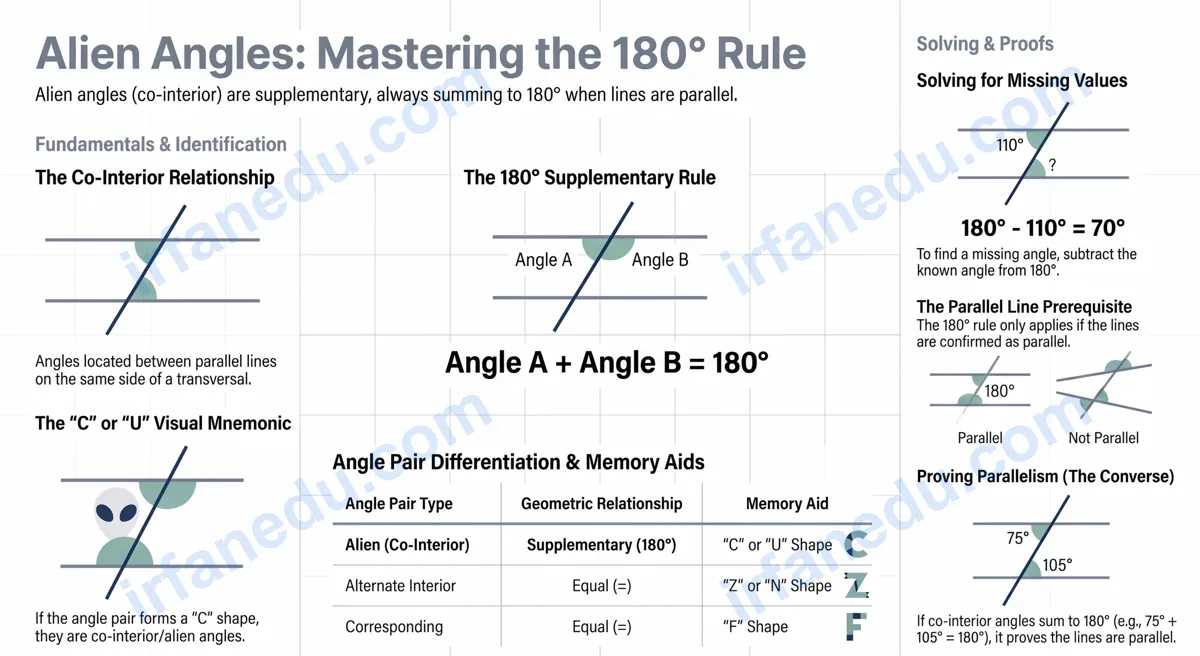
Alien angles are the pair of interior angles that form on the same side of a transversal when it crosses two parallel lines. Because they sit between the parallel lines and share the same side, they are also called co-interior angles or same-side interior angles. Their defining property: they always add up to 180° (they are supplementary).
If you have ever stared at a geometry diagram and wondered which angle pairs to use, alien angles are one of the most useful — and most misidentified — relationships in the whole topic. The name sounds unusual, but once you see the shape they make, you will never forget it.
Alien angles are co-interior angles: a pair of angles on the same side of a transversal, between two parallel lines, that always add up to 180°. Knowing this single rule lets you find missing angles in triangles, quadrilaterals, and multi-line diagrams instantly.
In this guide, I cover the formal definition, the visual trick that makes them unforgettable, step-by-step worked examples, a comparison table of all transversal angle pairs, and the one misconception that trips up even strong students. By the end, you will be able to spot alien angles in any diagram and solve for missing values with confidence.
- Understand what alien angles are and why they are supplementary
- Identify them correctly in diagrams (and avoid confusing them with alternate angles)
- Solve for missing angles using the co-interior rule
- Apply the concept to multi-step geometry problems
Alien angles — also called co-interior or same-side interior angles — are the pair of angles on the same side of a transversal between two parallel lines. They are always supplementary: they add up to 180°. If one angle is 65°, its alien angle partner is 115°. The name comes from the alien-face shape the pair creates in a diagram.
TL;DR — Quick Summary
- Alien angles = co-interior angles = same-side interior angles.
- They form between two parallel lines, on the same side of the transversal.
- They always add up to 180° (supplementary rule).
- To find a missing one: subtract the known angle from 180°.
- They are NOT equal — unlike alternate interior angles, which are.
- The “alien face” visual makes them easy to spot in any diagram.
What Are Alien Angles?
Alien angles are a nickname for co-interior angles, a specific angle pair that appears whenever a straight line (called a transversal) crosses two other lines. When those two lines are parallel, the co-interior angles on the same side of the transversal always sum to exactly 180°.
The term “alien angles” is widely used in middle school geometry classrooms because the diagram looks like a cartoon alien face — the two angles form the “eyes,” and the transversal forms the body. It is a mnemonic, not an official mathematical term, but it maps precisely to the formal concept of co-interior angles.
| Property | Value / Description |
|---|---|
| Formal name | Co-interior angles / Same-side interior angles / Consecutive interior angles |
| Position | Between two parallel lines, on the same side of the transversal |
| Relationship | Supplementary — always sum to 180° |
| Are they equal? | Only when both are 90° (transversal is perpendicular) |
| Condition required | Lines must be parallel for the 180° rule to hold |
| Converse use | If co-interior angles sum to 180°, the lines are parallel |
| Common confusion | Often mixed up with alternate interior angles (which are equal, not supplementary) |
Why Alien Angles Matter in Geometry
Alien angles are one of the core tools for solving angle problems involving parallel lines — a topic that appears in geometry at every level from middle school through standardized tests.
Here is why they are worth mastering:
- Multi-step problems: Many geometry questions chain several angle relationships together. Knowing co-interior angles lets you set up equations and solve for unknowns across a diagram.
- Proof writing: Co-interior angles are used to prove lines are parallel (the converse) and to prove properties of quadrilaterals like parallelograms and trapezoids.
- Standardized tests: ACT, SAT, and state math assessments regularly test transversal angle relationships. Co-interior angles appear in both direct and embedded forms.
- Real-world geometry: Architects, engineers, and designers use parallel-line relationships constantly — from roof trusses to road layouts.
In my experience teaching geometry, alien angles are the angle pair students most often get right on a first pass — and then second-guess themselves on. The supplementary rule is simple, but students keep expecting co-interior angles to be equal (like alternate angles), because “they look symmetric.” They are not equal. That single confusion causes more lost marks than almost anything else in this topic. I address it directly in the Common Mistakes section below.
How to Identify Alien Angles in a Diagram
To correctly identify alien angles, apply this three-part checklist to any diagram. All three conditions must be true.
- Two lines are present. They must be parallel (marked with arrows or stated in the problem).
- A transversal crosses both lines. The transversal is the line that cuts through the parallel lines at an angle.
- Both angles are interior AND on the same side. Interior means between the two parallel lines. Same side means both angles are to the left of the transversal, or both are to the right — not one on each side.
How to Find a Missing Alien Angle: Step-by-Step
Finding a missing co-interior angle takes one equation and one subtraction. Here is the exact method.
- Confirm the lines are parallel. Look for the parallel-line arrows on the diagram, or check the problem statement. Without parallel lines, the 180° rule does not apply.
- Locate the co-interior pair. Find the two angles that are (a) between the parallel lines and (b) on the same side of the transversal. These are your alien angles.
- Write the supplementary equation. Let the unknown angle be x. Set up: known angle + x = 180°.
- Solve for x. Subtract the known angle from 180°: x = 180° − known angle.
- Check your answer. Add both angles. The sum must equal 180°. If it does not, recheck which angle pair you identified.
Visual Diagram: Seeing the Alien Shape
The diagram below shows two parallel lines (L1 and L2) cut by a transversal (T). The alien angles are the two shaded interior angles on the right side of the transversal.
        T
        |
L1 ----/----------- L1
      / <-- angle A (interior, right side of T)
     /
    /
L2 /------------ L2
    <-- angle B (interior, right side of T)
        |

  Angle A + Angle B = 180°  (alien / co-interior angles)

  Example: A = 65°,  B = 115°
           65° + 115° = 180° ✓

  Compare: alternate interior angles (Z-shape)
           are on OPPOSITE sides and are EQUAL.
           Alien angles are on the SAME side and are SUPPLEMENTARY.
Notice how angles A and B sit on the same side of the transversal, between the two parallel lines. That “C”-shaped enclosure is the alien face. The two angles are the eyes.
Worked Examples
Example 1: Find the missing angle
Step 1: Confirm parallel lines — yes, stated in the problem.
Step 2: Identify the pair — both angles are interior, same side. Alien angles confirmed.
Step 3: Set up equation: 73° + x = 180°
Step 4: Solve: x = 180° − 73° = 107°
Check: 73° + 107° = 180° ✓
Example 2: Algebraic alien angles
Step 1: Apply the alien angle rule: (3x + 10) + (2x + 20) = 180
Step 2: Simplify: 5x + 30 = 180
Step 3: Subtract 30: 5x = 150
Step 4: Divide: x = 30
Angle 1: 3(30) + 10 = 100°
Angle 2: 2(30) + 20 = 80°
Check: 100° + 80° = 180° ✓
Example 3: Prove lines are parallel (converse)
Step 1: Add the angles: 112° + 68° = 180°
Step 2: Since the co-interior angles sum to 180°, the converse of the co-interior angles theorem applies.
Conclusion: Yes, the lines are parallel.
Get the Complete Geometry Formula Sheet
Alien Angles vs Other Angle Pairs: Comparison Table
One of the most common errors in geometry is mixing up the four transversal angle pairs. This table makes the differences clear and extractable.
| Angle Pair | Position | Same or Opposite Side? | Relationship | Memory Aid |
|---|---|---|---|---|
| Alien angles (co-interior) | Between the parallel lines | Same side | Supplementary (sum = 180°) | “C” or “U” shape |
| Alternate interior angles | Between the parallel lines | Opposite sides | Equal | “Z” or “N” shape |
| Corresponding angles | One interior, one exterior | Same side | Equal | “F” shape |
| Alternate exterior angles | Outside the parallel lines | Opposite sides | Equal | Outer “Z” shape |
| Vertically opposite angles | At the intersection point | Opposite (across vertex) | Equal | “X” shape |
The critical distinction: alien angles are the only interior pair that are supplementary, not equal. Every other interior pair (alternate interior) is equal. Keep that contrast sharp in your mind.
Common Mistakes Students Make with Alien Angles
These are the four errors I see most often — and the exact fix for each.
Students write “angle A = angle B” because the diagram looks symmetric. Wrong. Alien angles are supplementary (sum = 180°), not equal. Only alternate interior angles are equal. Fix: always ask “same side or opposite side?” Same side = supplementary. Opposite side = equal.
The 180° rule only holds for parallel lines. If the problem does not state or mark the lines as parallel, you cannot assume co-interior angles are supplementary. Fix: always check for parallel-line markers (arrows) before applying any transversal rule.
Students sometimes pick one interior angle and one exterior angle, or one from each side of the transversal. Fix: use the three-part checklist — both interior, both same side. If either condition fails, it is not an alien angle pair.
The co-interior rule works both ways. If co-interior angles sum to 180°, the lines are parallel. Many students only know the forward direction. Fix: memorize both: “parallel lines make co-interior angles sum to 180°” AND “co-interior angles summing to 180° prove lines are parallel.”
Real-World Applications of Alien Angles
Geometry is not abstract — co-interior angles appear in real structures and designs every day.
- Architecture and construction: Roof trusses use parallel beams cut by diagonal supports. Engineers use co-interior angle relationships to calculate load distribution and cut angles for rafters.
- Road design: When a road (transversal) crosses two parallel streets, the angles at each intersection are co-interior. Traffic engineers use these relationships to design consistent turn angles.
- Graphic design and typography: Designers align parallel guidelines cut by diagonal elements. Understanding co-interior angles helps maintain visual balance.
- Navigation: Parallel lines of latitude crossed by a course bearing create co-interior angle relationships that navigators use to calculate heading corrections.
I once used co-interior angles to explain to a student why the cut angles on a picture frame always add up to 180° at each corner joint. The moment he saw it in a physical object — not just a textbook diagram — the concept locked in permanently. Whenever you can tie a geometry rule to something you can hold or see, retention jumps dramatically. Look for alien angles in window frames, staircases, and striped fabric next time you are away from your desk.
Most geometry guides teach alien angles as a one-way rule: “parallel lines make co-interior angles supplementary.” They stop there. But the converse is equally powerful — and it is what exam questions actually test most often at higher levels.
Here is the non-obvious point: the co-interior angle theorem is a biconditional. “Two lines are parallel IF AND ONLY IF the co-interior angles they form with a transversal sum to 180°.” This means you can use alien angles to PROVE lines are parallel, not just to find missing angles. In a proof-based geometry course, that converse direction is used in theorems about parallelograms, trapezoids, and polygon interior angle sums.
A second insight most guides miss: alien angles are the geometric reason why the interior angles of any triangle sum to 180°. Draw a line through the apex of a triangle parallel to the base. The two angles at the apex are alternate interior angles to the base angles — and the straight line gives you 180°. The co-interior relationship is embedded in the triangle angle sum proof itself. Understanding alien angles at this level turns a memorized rule into a connected piece of mathematical reasoning.
Master Parallel & Perpendicular Lines Next
Quick Quiz: Test Your Understanding
Q1. Two parallel lines are cut by a transversal. One co-interior angle is 55°. What is the other?
Q2. Which letter shape best represents alien (co-interior) angles?
Q3. Two same-side interior angles measure (4x + 5)° and (3x + 15)°. If the lines are parallel, what is x?
Practice Problems (Reveal the Solution)
Problem 1: Two parallel lines cut by a transversal. Co-interior angles are (5x − 10)° and (3x + 30)°. Find x and both angles.
(5x − 10) + (3x + 30) = 180
8x + 20 = 180
8x = 160
x = 20
Angle 1: 5(20) − 10 = 90°
Angle 2: 3(20) + 30 = 90°
Check: 90° + 90° = 180° ✓
Note: both angles equal 90° — the transversal is perpendicular to the parallel lines. This is the only case where alien angles are equal to each other.
Problem 2: In a diagram, two lines are cut by a transversal. The same-side interior angles are 95° and 88°. Are the lines parallel?
Add the angles: 95° + 88° = 183°
183° ≠ 180°
The lines are NOT parallel. For co-interior angles to confirm parallel lines, they must sum to exactly 180°. A sum of 183° means the lines are slightly converging.
Problem 3: A transversal crosses two parallel lines. One co-interior angle is three times the other. Find both angles.
Let the smaller angle = x. Then the larger = 3x.
x + 3x = 180
4x = 180
x = 45°
Angles: 45° and 135°
Check: 45° + 135° = 180° ✓
Problem 4: Explain why a parallelogram’s consecutive angles are supplementary using the alien angle theorem.
In a parallelogram, opposite sides are parallel. Consider two adjacent sides as parallel lines, with the connecting side acting as a transversal. The two interior angles at the ends of that transversal are co-interior (same-side interior) angles. By the alien angle theorem, they must sum to 180°. Therefore, consecutive angles in a parallelogram are always supplementary — a direct application of the co-interior angle rule.
Frequently Asked Questions
What are alien angles in geometry?
Alien angles are the informal name for co-interior angles (also called same-side interior angles or consecutive interior angles). They are the pair of angles that form on the same side of a transversal between two parallel lines. They are always supplementary — they add up to 180°.
Do alien angles add up to 180 degrees?
Yes. When the two lines cut by the transversal are parallel, alien (co-interior) angles always add up to exactly 180°. If the lines are not parallel, the angles will not sum to 180°. This is both the rule and its converse: a sum of 180° proves the lines are parallel.