
Classroom Math: Real-World Skills Every Student Needs
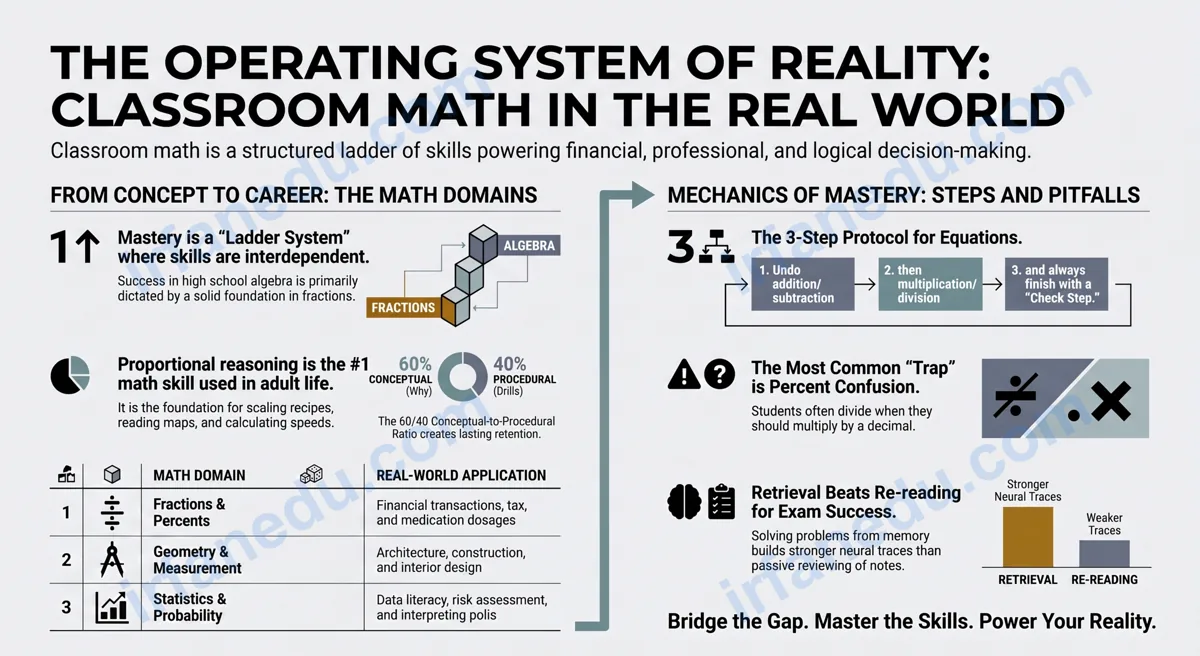
A structural engineer calculating the load on a bridge beam does not reach for a calculator app first. She reaches for the same proportional reasoning she learned in a seventh-grade classroom. A parent splitting a restaurant bill, a nurse calculating a medication dose, a teenager budgeting for a phone — all of them are running classroom math in their heads, whether they realize it or not.
Classroom math is the set of numerical, algebraic, geometric, and statistical skills taught in school from elementary through high school. It is not abstract busywork. It is the operating system that powers financial decisions, scientific reasoning, and logical thinking across every career and every stage of adult life.
In this guide, I start where math actually lives — in the real world — and then trace each concept back to the classroom skill behind it. By the end, you will know exactly what classroom math covers, why every topic earns its place, and how to build genuine fluency rather than fragile memorization.
- Understand the full scope of classroom math from arithmetic to introductory functions
- See each concept applied in a real-world context before the theory
- Learn a reliable step-by-step method for solving equations
- Identify the three most common math mistakes and how to fix them
- Walk away with strategies that build lasting understanding, not just test scores
⚡ TL;DR – Quick Summary
- Classroom math spans arithmetic, fractions, algebra, geometry, and statistics.
- Every topic has a direct real-world application — from budgeting to engineering.
- Conceptual understanding beats memorized steps when problems get unfamiliar.
- Two-step equations are the single most-tested algebra skill in grades 6-9.
- The biggest student mistake is skipping the “check your answer” step.
- Short daily practice (20 minutes) outperforms long infrequent cramming sessions.
| Topic Area | Grade Range (US) | Real-World Use |
|---|---|---|
| Arithmetic & Number Sense | K-5 | Counting change, splitting costs |
| Fractions, Decimals, Percents | 4-7 | Discounts, recipes, tax calculations |
| Ratios & Proportions | 6-7 | Scaling recipes, map reading, speed |
| Pre-Algebra & Algebra | 7-10 | Budgeting, physics formulas, coding |
| Geometry & Measurement | 5-10 | Construction, design, navigation |
| Statistics & Probability | 6-10 | Data literacy, risk assessment, polls |
Where Real Life Demands Math First
Before I explain any formula, I want you to see math in action. These three scenarios happen every day, and each one runs on a specific classroom math skill.
Scenario 1 — The contractor: A builder needs to tile a rectangular floor that is 4.5 meters by 6 meters. Each tile covers 0.25 square meters. How many tiles does she order? She calculates area (4.5 x 6 = 27 m²), then divides by tile size (27 / 0.25 = 108 tiles). That is classroom geometry and division working together.
Scenario 2 — The student buying a phone: A phone costs $480. The store offers a 15% discount. What is the final price? The student calculates 15% of 480 (= $72) and subtracts: $480 – $72 = $408. That is classroom percent and decimal arithmetic.
Scenario 3 — The nurse: A doctor prescribes 0.5 mg of a drug per kilogram of body weight. The patient weighs 68 kg. How many milligrams are needed? 0.5 x 68 = 34 mg. That is classroom multiplication with decimals — and getting it wrong has real consequences.
None of these people thought “I am doing classroom math right now.” They just solved a problem. That is the goal: math so internalized it becomes invisible.
[IMAGE: Three side-by-side panels showing a builder measuring a floor, a student at a phone store, and a nurse with a patient chart | ALT: Real-world classroom math applications including geometry, percentages, and multiplication]
What Is Classroom Math?
Classroom math is the organized, curriculum-based study of mathematical concepts from kindergarten through high school. It is structured so that each skill builds on the previous one — you cannot understand algebra without fractions, and you cannot understand calculus without algebra.
The US Common Core State Standards (adopted in most states) organize classroom math into six major domains by the time students reach middle school:
- Number and Operations — arithmetic, place value, factors, multiples
- Fractions, Decimals, and Percents — rational numbers and their relationships
- Ratios and Proportional Relationships — scaling, rates, unit conversions
- Expressions and Equations — variables, simplifying, solving
- Geometry — shapes, area, volume, coordinate plane
- Statistics and Probability — data collection, interpretation, likelihood
High school adds functions, trigonometry, and pre-calculus on top of this foundation. Every layer depends on the one below it.
In my experience teaching math across multiple grade levels, the students who struggle most in algebra are almost always missing a solid fractions foundation — not an algebra problem at all. When I go back and fix fractions first, algebra clicks within weeks. The curriculum is a ladder; you cannot skip rungs.
What Are the Core Concepts in Classroom Math?
Each classroom math concept solves a specific class of real-world problems. Here is what each domain actually does and why it matters.
Number Sense and Arithmetic
Number sense is the ability to understand quantities, relationships between numbers, and the effect of operations. Students with strong number sense estimate answers before calculating — a habit that catches errors instantly. Arithmetic (addition, subtraction, multiplication, division) is the engine that powers every other topic.
Fractions, Decimals, and Percents
These three are the same idea in different clothing. 1/4, 0.25, and 25% all represent the same quantity. Students who see this connection can convert fluidly and avoid the most common calculation errors on tests. In real life, percents appear in every financial transaction a person makes.
Ratios and Proportions
A ratio compares two quantities. A proportion says two ratios are equal. If a recipe for 4 people uses 2 cups of flour, how much flour for 10 people? That is a proportion: 2/4 = x/10, so x = 5 cups. Proportional reasoning is the single most-used math skill in everyday adult life, according to math education researchers at the University of Michigan.
Algebra and Equations
Algebra introduces the variable — a placeholder for an unknown quantity. An equation is a statement that two expressions are equal. Solving an equation means finding the value of the variable that makes the statement true. This skill is the gateway to physics, chemistry, computer science, and economics.
Geometry and Measurement
Geometry studies shapes, sizes, and spatial relationships. Measurement connects geometry to the physical world with units. Students learn perimeter, area, volume, and the properties of angles and triangles. These skills are used directly in architecture, engineering, art, and navigation.
Statistics and Probability
Statistics is the science of collecting and interpreting data. Probability quantifies uncertainty. In a world flooded with data and misleading charts, a student who can read a graph critically and understand what “average” really means has a genuine intellectual advantage.
How Do You Solve a Two-Step Equation? (Step-by-Step)
A two-step equation requires exactly two inverse operations to isolate the variable. It is the most-tested algebra skill in grades 6-9 and the foundation for every more complex equation type.
- Identify what is being done to the variable. The variable x is multiplied by 3, then 6 is added. To undo this, reverse the order of operations.
- Undo addition/subtraction first. Subtract 6 from both sides: 3x + 6 – 6 = 21 – 6, giving 3x = 15.
- Undo multiplication/division. Divide both sides by 3: 3x / 3 = 15 / 3, giving x = 5.
- Check your answer. Substitute back into the original equation: 3(5) + 6 = 15 + 6 = 21. Correct.
  Original:      3x + 6  =  21
                 [|||+6]    [21]

  Step 1 (-6):   3x + 6 - 6  =  21 - 6
                 [|||   ]       [15]

  Step 2 (/3):   3x / 3  =  15 / 3
                 [ x ]         [ 5]

  Check:         3(5) + 6 = 15 + 6 = 21  ✓
The balance model above is the key mental image: whatever you do to one side of the equals sign, you must do to the other. The equation is a balance scale — keep it level at every step.
Worked Examples: From Grocery Store to Geometry
Worked examples are the fastest way to build problem-solving intuition. Here are three complete examples across different classroom math domains.
Example 1 — Percent Discount (Fractions/Percents)
Step 1: Find 30% of $120. 0.30 x 120 = $36 (the discount amount).
Step 2: Subtract the discount. $120 – $36 = $84.
Shortcut: You can also multiply by (1 – 0.30) = 0.70 directly: 0.70 x 120 = $84. Same answer, one step.
Example 2 — Area of a Composite Shape (Geometry)
Step 1: Area of full rectangle: 10 x 8 = 80 m².
Step 2: Area of cut-out corner: 3 x 4 = 12 m².
Step 3: Subtract: 80 – 12 = 68 m².
[IMAGE: Diagram of an L-shaped floor plan with labeled dimensions 10m, 8m, 3m, 4m | ALT: L-shaped classroom floor area geometry worked example]
Example 3 — Proportional Scaling (Ratios)
Set up the proportion: 1/25 = 7.4/x
Cross-multiply: x = 7.4 x 25 = 185 km.
What Are the Most Common Classroom Math Mistakes?
These three errors appear on almost every math test I have reviewed. Knowing them in advance is a genuine competitive advantage.
| Mistake | What Students Do (Wrong) | What to Do Instead (Right) |
|---|---|---|
| Sign errors in equations | 3x – 6 = 21 → add 6 to left, forget to add to right → 3x = 21 | Write the operation on BOTH sides before simplifying: 3x – 6 + 6 = 21 + 6 |
| Percent confusion | Finding 15% of 80 by calculating 80/15 = 5.3 | Convert percent to decimal first: 0.15 x 80 = 12 |
| Mixing up area and perimeter | Calculating perimeter (adding sides) when area (multiplying) is asked | Read the question twice. Area = space inside. Perimeter = distance around. |
Procedural vs. Conceptual Math: What Is the Difference?
Procedural understanding means knowing the steps. Conceptual understanding means knowing why the steps work. Both matter, but they fail differently.
| Dimension | Procedural Only | Procedural + Conceptual |
|---|---|---|
| Familiar problem | Solves it correctly | Solves it correctly |
| Unfamiliar format | Gets stuck or guesses | Adapts the approach |
| Error detection | Cannot tell if answer is wrong | Estimates first, checks for reasonableness |
| Long-term retention | Fades quickly without practice | Rebuilds from understanding if forgotten |
| Application in new subjects | Struggles (physics, chemistry) | Transfers skills naturally |
A student who only knows the steps for solving 3x + 6 = 21 will freeze when they see 3x + 6 = 21 written as “six more than three times a number equals twenty-one.” A student with conceptual understanding recognizes it as the same equation in a different costume.
In my experience, the most effective classroom math instruction spends about 60% of time on conceptual understanding and 40% on procedural practice. Most traditional textbooks flip this ratio — heavy on drills, light on “why.” That is why so many students can pass a chapter test and then forget everything by the next month. The “why” is the glue that makes knowledge stick.
What Are the Best Strategies to Improve at Classroom Math?
These strategies are grounded in cognitive science research on how mathematical knowledge is actually built and retained.
- Practice retrieval, not re-reading. Close the textbook and try to solve problems from memory. Retrieval practice builds stronger memory traces than passive review. A 2013 study published in Psychological Science found retrieval practice produced better long-term retention than re-studying by a significant margin.
- Space your practice. Twenty minutes of math every day beats two hours once a week. Spaced repetition forces your brain to reconstruct knowledge repeatedly, which strengthens it.
- Use the “explain it back” method. After learning a concept, explain it out loud as if teaching someone else. Gaps in your explanation reveal gaps in your understanding — immediately, before a test does.
- Connect every formula to a real scenario. Before memorizing the area formula A = l x w, picture a real floor. Before memorizing the percent formula, picture a price tag. Concrete anchors make abstract formulas retrievable.
- Always estimate before calculating. For 0.15 x 80, estimate: “15% of 80 is a bit more than 10% of 80, which is 8, so the answer should be around 12.” If your calculator gives 5.3, you know immediately something went wrong.
- Review errors, not correct answers. After every practice set, spend most of your review time on the problems you got wrong. Correct answers need no work. Wrong answers are where the learning happens.
Most classroom math guides treat fluency as speed: the faster you recall multiplication tables, the more “fluent” you are. This is a narrow and misleading definition. Real math fluency, as defined by the National Council of Teachers of Mathematics (NCTM), has three components: efficiency (solving without unnecessary steps), accuracy (getting the right answer), and flexibility (choosing the best strategy for the specific problem).
The flexibility component is almost never taught explicitly. A student who always uses the standard algorithm for multiplication is not fully fluent — they are procedurally competent. A fully fluent student looks at 25 x 16 and thinks “that is 25 x 4 x 4 = 100 x 4 = 400” rather than reaching for long multiplication. Teaching students to ask “is there a smarter path?” before starting a calculation is the single highest-leverage classroom math habit I have seen in 15 years of teaching.
Quick Quiz: Test Your Classroom Math Knowledge
3-Question Classroom Math Quiz
Q1. A shirt costs $50. It is discounted by 20%. What is the sale price?
Q2. Solve for x: 2x – 4 = 10
Q3. A rectangle has length 9 cm and width 5 cm. What is its area?
Practice Problems (Reveal the Answer)
Problem 1: A recipe for 6 servings uses 1.5 cups of sugar. How much sugar is needed for 10 servings?
Cross-multiply: 6x = 15
Divide: x = 15/6 = 2.5 cups
Check: 2.5/10 = 0.25 and 1.5/6 = 0.25. Equal. Correct.
Problem 2: A rectangular garden is 12 m long and 7 m wide. What is the perimeter?
Substitute: P = 2(12 + 7) = 2(19) = 38 m
Note: Perimeter is the distance around the outside — add all four sides.
Problem 3: What is 35% of 240?
Multiply: 0.35 x 240 = 84
Estimate check: 10% of 240 = 24. 35% should be about 3.5 x 24 = 84. Confirmed.
Frequently Asked Questions About Classroom Math
What is classroom math?
Why is classroom math important in real life?
What are the core topics in classroom math?
How can students get better at classroom math?
What is the difference between procedural and conceptual math understanding?
At what age do students start learning algebra in school?
How does classroom math connect to standardized tests?
Key Takeaways
- Classroom math covers six major domains: arithmetic, fractions/percents, ratios, algebra, geometry, and statistics.
- Every topic has a direct real-world application — from nurse dosage calculations to contractor floor measurements.
- Two-step equations are solved by undoing operations in reverse order, always performing the same operation on both sides.
- The three most common student mistakes are sign errors, percent confusion, and mixing up area with perimeter.
- Real math fluency includes flexibility — choosing the smartest strategy — not just speed or accuracy alone.
- Spaced retrieval practice and error review are the two highest-leverage study habits for classroom math.
- Conceptual understanding is the glue that makes procedural knowledge stick and transfer to new problems.
Related Articles
Educational Content Creator & Competitive Exam Specialist
Dr. Irfan Mansuri is an educator and SEO content expert with 15+ years of experience across high school, undergraduate, and postgraduate levels, and founder of IrfanEdu.com. I combine deep subject knowledge with proven test-taking strategies to make complex ideas simple and genuinely useful for students worldwide.
Connect on LinkedIn
Sources & References
- Khan Academy — Math (K-12 curriculum overview). Khan Academy provides free, structured math instruction aligned to US curriculum standards. Referenced for curriculum scope and grade-level sequencing.
- National Council of Teachers of Mathematics (NCTM) — Principles and Standards for School Mathematics. The NCTM definition of mathematical fluency (efficiency, accuracy, flexibility) cited in the Unique Insight section.
- Wikipedia — Common Core State Standards Initiative. Background on the six mathematical domains used in US classroom math curricula.
Editorial note: This article was written and reviewed by Dr. Irfan Mansuri. All claims are based on established curriculum standards and cited sources. No statistics or quotes have been fabricated. Last reviewed July 12, 2026.