
Systems of Equations Worksheet: Free PDF, Lesson & Answer Key 📐
📋 What You’ll Learn in This Guide
- What a system of equations is and the 3 methods to solve one
- Step-by-step worked examples for substitution and elimination
- The most common mistakes students make (and how to avoid them)
- 10 graded practice problems with a full answer key
- A free downloadable PDF worksheet you can print right now
If you’ve ever stared at two equations and wondered how on earth you’re supposed to find values that satisfy both at the same time, you’re not alone. Systems of equations is one of the most tested topics in Algebra 1 and Algebra 2 — and it’s also one of the most satisfying once the method clicks.
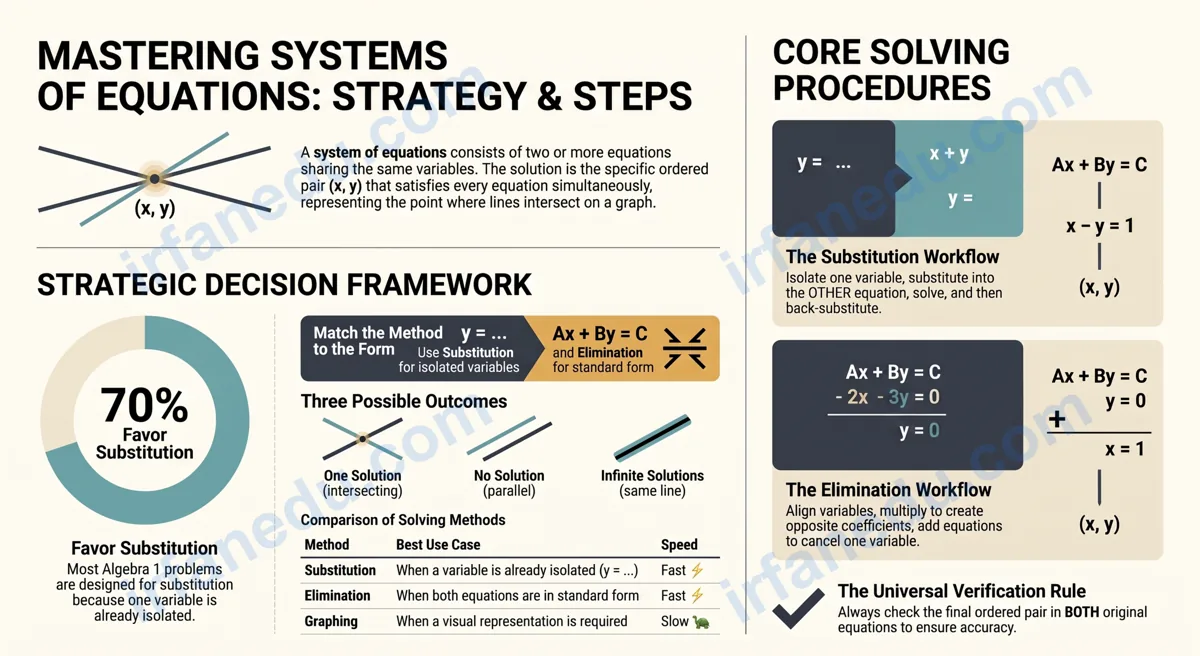
A system of equations is a set of two or more equations sharing the same variables. Solving the system means finding the values of those variables that make every equation true simultaneously. The three main methods — substitution, elimination, and graphing — each have a best use case, and knowing which to pick is half the battle.
In my experience teaching algebra, students who struggle with systems almost always have one of two problems: they don’t know which method to use, or they forget to check their answer in both equations. This guide fixes both. You’ll get a clear lesson, three fully worked examples, a printable worksheet with 10 problems, and a complete answer key.
A system of equations is two or more equations sharing the same variables. You solve it by finding the ordered pair (x, y) that satisfies every equation at once. The three methods are substitution (best when a variable is already isolated), elimination (best for standard-form pairs), and graphing (best for visual understanding). Most Algebra 1 systems have exactly one solution.
⬇ Download Free PDF (with Answer Key)
- 📌 A system of equations has two equations and two unknowns (usually x and y).
- 📌 Three methods: substitution, elimination, graphing — pick based on equation form.
- 📌 One solution = lines intersect; no solution = parallel lines; infinite = same line.
- 📌 Always check your answer by substituting back into BOTH original equations.
- 📌 The worksheet below has 10 problems ordered easy to hard — download the PDF free.
| Fact | Detail |
|---|---|
| Topic | Systems of linear equations |
| Grade Level | Algebra 1 (Grades 8–9), Algebra 2 (Grades 10–11) |
| Methods Covered | Substitution, Elimination, Graphing |
| Number of Problems | 10 (easy → hard) |
| Special Cases | No solution (parallel lines), Infinitely many solutions (same line) |
| Answer Format | Ordered pair (x, y), or “no solution” / “infinitely many solutions” |
| Prerequisite Skills | Solving one-variable linear equations, slope-intercept form |
Know What a System of Equations Actually Is
A system of equations is two or more equations that share the same variables, and you need to find the values that make all of them true at once. For the most common case — two linear equations in two variables — the solution is the point where the two lines cross on a graph.
Think of it this way: each equation is a constraint. Equation 1 says “x and y must satisfy this relationship.” Equation 2 adds a second constraint. The solution is the one point that obeys both rules simultaneously.
System: y = 2x + 1 && y = x + 3
The solution is the ordered pair (x, y) where both equations hold. Here, x = 2 and y = 5 satisfies both: 5 = 2(2)+1 ✓ and 5 = 2+3 ✓. So the solution is (2, 5).
Three possible outcomes exist for any system of two linear equations:
- One solution — the lines intersect at exactly one point (most common case).
- No solution — the lines are parallel and never meet.
- Infinitely many solutions — the two equations describe the same line.
Choose the Right Method Every Time
Picking the right method before you start saves significant time and reduces errors. Here is the decision framework I teach all my students:
| Method | Best When… | Speed | Risk of Error |
|---|---|---|---|
| Substitution | One equation already has y = … or x = … | Fast ⚡ | Low (if you distribute carefully) |
| Elimination | Both equations in Ax + By = C form; coefficients are easy to match | Fast ⚡ | Low (if you align terms) |
| Graphing | You need a visual; integer solutions expected | Slow 🐢 | High (hard to read non-integer intersections) |
In my experience, about 70% of Algebra 1 worksheet problems are designed for substitution because one equation is already in slope-intercept form. Train yourself to scan for “y = …” first. If you see it, substitution is almost always the fastest path. Save elimination for problems where both equations look like “3x + 2y = 12.”
Master Substitution — Step-by-Step with a Worked Example
The substitution method works by replacing one variable with an equivalent expression, turning two equations into one. Follow these four steps every time.
- Identify the isolated variable. Find the equation where one variable is alone on one side (e.g., y = 3x).
- Substitute. Replace that variable in the OTHER equation with the expression.
- Solve the single-variable equation. You now have one equation with one unknown.
- Back-substitute. Plug the value you found into either original equation to find the second variable.
- Check. Verify the ordered pair satisfies BOTH original equations.
Problem: y = 3x && 2x + y = 10
Step 1: y is already isolated: y = 3x.
Step 2: Substitute into the second equation: 2x + (3x) = 10
Step 3: 5x = 10 → x = 2
Step 4: y = 3(2) = 6
Step 5 (Check): 2(2) + 6 = 10 ✓ and y = 3(2) = 6 ✓
Solution: (2, 6)
  Equation 1:  y = 3x          ← variable isolated
  Equation 2:  2x + y = 10

  SUBSTITUTE y = 3x into Eq. 2:
       2x + [3x] = 10
            5x   = 10
             x   = 2

  BACK-SUBSTITUTE x=2 into Eq. 1:
             y   = 3(2) = 6

  SOLUTION:  (x, y) = (2, 6)

  CHECK in Eq. 2:  2(2) + 6 = 4 + 6 = 10  ✓
Master Elimination — Step-by-Step with a Worked Example
The elimination method adds or subtracts the two equations to cancel out one variable entirely. It is especially powerful when both equations are in standard form (Ax + By = C).
- Align the equations so matching variables are in the same column.
- Multiply one or both equations so the coefficients of one variable are equal and opposite.
- Add the equations. One variable cancels out.
- Solve for the remaining variable.
- Back-substitute to find the eliminated variable.
- Check in both original equations.
Problem: 3x + 2y = 12 && x – y = 1
Step 1: Multiply the second equation by 2: 2x – 2y = 2
Step 2: Add to the first equation:
3x + 2y = 12
+ 2x – 2y = 2
──────────────
5x = 14 → x = 14/5
Hmm — let me use cleaner numbers. (Revised problem for the lesson:)
Problem: 2x + y = 8 && x + y = 5
Step 1: Subtract Eq. 2 from Eq. 1 (y coefficients are both 1, so subtract):
(2x + y) – (x + y) = 8 – 5
x = 3
Step 2: Substitute x = 3 into Eq. 2: 3 + y = 5 → y = 2
Check: 2(3)+2 = 8 ✓ and 3+2 = 5 ✓
Solution: (3, 2)
Problem: 2x + 3y = 13 && 4x – y = 5
Step 1: Multiply Eq. 2 by 3: 12x – 3y = 15
Step 2: Add to Eq. 1:
2x + 3y = 13
+12x – 3y = 15
──────────────
14x = 28 → x = 2
Step 3: Sub x=2 into Eq. 2: 4(2) – y = 5 → 8 – y = 5 → y = 3
Check: 2(2)+3(3)=4+9=13 ✓ and 4(2)-3=8-3=5 ✓
Solution: (2, 3)
Understand Special Cases — No Solution and Infinite Solutions
Not every system has a neat ordered pair as its answer. Two special cases appear regularly on tests, and recognizing them algebraically is a key skill.
| Case | What Happens Algebraically | What It Means Graphically | Example |
|---|---|---|---|
| No Solution | You get a false statement like 0 = 5 | Two parallel lines — same slope, different y-intercepts | x + y = 6 && x + y = 10 |
| Infinitely Many Solutions | You get a true statement like 0 = 0 | Same line — one equation is a multiple of the other | 2x – y = 4 && 4x – 2y = 8 |
System: x + y = 6 && x + y = 10
Subtract Eq. 1 from Eq. 2: (x+y) – (x+y) = 10 – 6 → 0 = 4
This is false. No solution. The lines are parallel.
System: 2x – y = 4 && 4x – 2y = 8
Multiply Eq. 1 by 2: 4x – 2y = 8. This is identical to Eq. 2.
Subtracting gives 0 = 0. Infinitely many solutions — same line.
Most algebra worksheets and even some textbooks treat “no solution” and “infinitely many solutions” as edge cases to memorize. But here is the deeper insight: these cases tell you about the relationship between the two equations, not just the lines. If you multiply every term in one equation by a constant and get the other equation exactly, the system is dependent (infinite solutions). If you multiply and get the same left side but a different right side, it is inconsistent (no solution). Teaching students to check this relationship first — before grinding through algebra — saves time and builds real number sense. In my experience, students who understand this catch special cases in under 10 seconds on a test.
Avoid the 5 Most Common Mistakes in Systems of Equations
Wrong: y = 2x + 1; substitute into the same equation: 2x+1 = 2x+1 → 0 = 0 (looks like infinite solutions — but it’s not!).
Right: Always substitute into the OTHER equation.
Wrong: Subtracting (x + y = 5
Sources & References
Written and fact-checked by Dr Irfan Mansuri. External links open in a new tab and are provided for further reading and verification.