
Area of Trapezoid Worksheet: Free PDF + Lesson (With Answer Key) 📐
📋 Table of Contents
- Quick Answer: The Most-Asked Question Answered First
- Download the Free PDF Worksheet
- TL;DR & Quick Facts
- What Is a Trapezoid? (Clear Definition)
- Step-by-Step: How to Find the Area of a Trapezoid
- 3 Fully Worked Examples
- Common Mistakes Students Make (and How to Fix Them)
- 💡 Unique Insight: What Most Guides Get Wrong
- On-Page Practice Worksheet (10 Problems)
- Interactive Quiz
- Frequently Asked Questions
- Key Takeaways
- Related Articles
- About the Author
- Sources & References
The single most-searched question students type before opening a trapezoid worksheet is: “What is the formula for the area of a trapezoid and how do I use it?” So I am answering that right here, before anything else. Everything else on this page — the lesson, the 10 practice problems, and the free PDF — flows from that one formula.
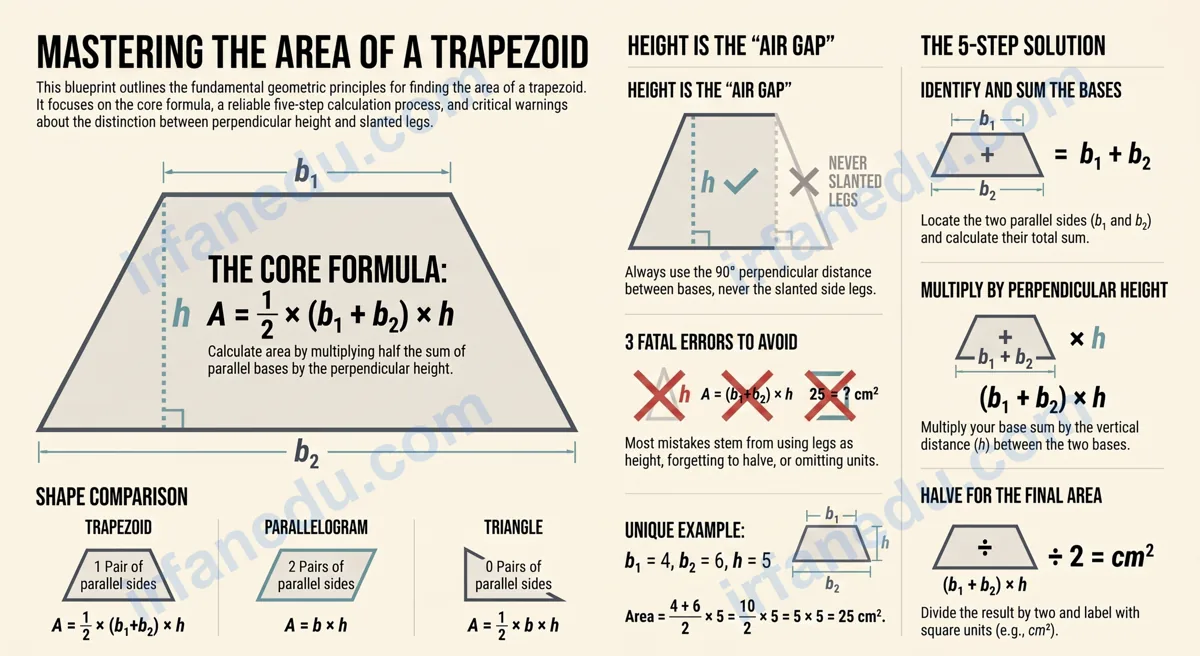
The area of a trapezoid equals half the sum of its two parallel sides multiplied by the perpendicular height: A = 1/2 × (b1 + b2) × h. This formula works for every trapezoid — right, isosceles, or scalene — as long as you use the perpendicular height, not the slanted leg.
- 🎯 Understand the trapezoid area formula and why it works
- 📝 Work through 3 fully solved examples (easy to hard)
- ⚠️ Spot and fix the 3 most common student mistakes
- ✏️ Practice with 10 graded problems and check your answers
- 📄 Download the free printable PDF with a separate answer key
Download Free PDF (with Answer Key)
⚡ TL;DR – Quick Summary
- ✅ Formula: A = 1/2 × (b1 + b2) × h — always use perpendicular height
- ✅ Add the two parallel bases first, then multiply by height, then halve
- ✅ Height ≠ slanted leg — this is the #1 mistake on tests
- ✅ You can rearrange the formula to find a missing base or height
- ✅ 10 practice problems below, graded easy to algebraic
- ✅ Free PDF download available — print and practice today
What Is a Trapezoid? (And What Makes It Different From Other Shapes)
A trapezoid is a four-sided flat shape (quadrilateral) that has exactly one pair of parallel sides. Those parallel sides are called the bases (b1 and b2). The non-parallel sides are called the legs. The perpendicular distance between the two bases is the height (h).
This is different from a parallelogram, which has two pairs of parallel sides. A rectangle and a square are special parallelograms. A trapezoid sits one level below — only one pair of parallel sides required.
       b1 (top base)
    ___________
   /           \
  /             \   } h (height — perpendicular)
 /_______________\
       b2 (bottom base)

  Legs = the two slanted sides (NOT the height)
  Area = 1/2 × (b1 + b2) × h
| Shape | Parallel Sides | Area Formula | Special Property |
|---|---|---|---|
| Trapezoid | 1 pair | 1/2 × (b1+b2) × h | One pair of parallel bases |
| Parallelogram | 2 pairs | b × h | Opposite sides equal & parallel |
| Rectangle | 2 pairs (right angles) | l × w | All angles 90° |
| Triangle | 0 pairs | 1/2 × b × h | 3 sides; trapezoid formula with b1=0 |
In my experience teaching geometry, students who struggle with the trapezoid formula almost always confuse the height with a leg. I tell them: “The height is invisible — it is the air gap between the two bases, measured at a perfect right angle.” Draw that dotted vertical line on every diagram before you plug in any numbers. That one habit eliminates the most common error on geometry tests.
How Do You Find the Area of a Trapezoid? (Step-by-Step)
Finding the area of a trapezoid takes exactly five steps. Follow them in order and you will get the right answer every time.
- Identify b1 and b2. Find the two sides that are parallel to each other. Label the shorter one b1 and the longer one b2 (or either way — the formula is symmetric).
- Identify h. Find the perpendicular height — the straight-down distance between the two bases. If the problem gives you a slanted leg instead, you need extra information (Pythagorean theorem or trigonometry) to find h first.
- Add the bases. Calculate b1 + b2.
- Multiply by the height. Calculate (b1 + b2) × h.
- Divide by 2. The result is the area. Write your answer in square units (cm², ft², m², etc.).
3 Fully Worked Examples (Easy → Hard)
Example 1 — Basic (Whole Numbers)
📌 Problem
A trapezoid has bases b1 = 5 cm and b2 = 9 cm, and a height of h = 4 cm. Find its area.
Step 1: b1 = 5, b2 = 9, h = 4
Step 2: b1 + b2 = 5 + 9 = 14
Step 3: (b1 + b2) × h = 14 × 4 = 56
Step 4: A = 56 / 2 = 28

Answer: A = 28 cm²
Example 2 — Decimals
📌 Problem
A trapezoid has b1 = 3.5 m, b2 = 6.5 m, and h = 4 m. Find its area.
Step 1: b1 = 3.5, b2 = 6.5, h = 4
Step 2: b1 + b2 = 3.5 + 6.5 = 10
Step 3: 10 × 4 = 40
Step 4: A = 40 / 2 = 20

Answer: A = 20 m²

Note: The decimals added to a clean whole number here.
Always add the bases FIRST — it often simplifies the arithmetic.
Example 3 — Working Backwards (Find a Missing Base)
📌 Problem
A trapezoid has area = 40 m², b1 = 6 m, and height = 5 m. Find b2.
Start with: A = 1/2 × (b1 + b2) × h
Substitute: 40 = 1/2 × (6 + b2) × 5

Multiply both sides by 2:
  80 = (6 + b2) × 5

Divide both sides by 5:
  16 = 6 + b2

Subtract 6:
  b2 = 10

Answer: b2 = 10 m

Check: A = 1/2 × (6 + 10) × 5 = 1/2 × 16 × 5 = 40 ✓
What Are the Most Common Mistakes When Finding the Area of a Trapezoid?
These three errors account for the majority of wrong answers on trapezoid area problems. Knowing them in advance is worth more than any formula review.
Wrong: A = 1/2 × (6 + 10) × 5 (where 5 is the leg, not the perpendicular height)
Right: Always use the perpendicular height — the vertical distance between the bases. If the diagram shows a slanted side, that is a leg, not h.
Wrong: A = (b1 + b2) × h (this gives double the area)
Right: A = 1/2 × (b1 + b2) × h. The “half” is non-negotiable — it is what separates the trapezoid formula from the parallelogram formula.
Wrong: A = 28 cm (linear unit)
Right: A = 28 cm² (square unit). Area is always two-dimensional. Losing the “²” costs marks on every standardised test.
Mistake 2 — forgetting to halve — is the sneakiest one because students often get a number that looks reasonable. I always ask my students to do a quick sanity check: “Is my trapezoid area less than the area of a rectangle with the same height and the longer base?” If not, you probably forgot the ÷2. That 10-second check has saved many test marks.
💡 Unique Insight: The “Average Base” Interpretation Nobody Teaches
Most guides just hand you the formula A = 1/2 × (b1 + b2) × h and move on. Here is the geometric reason it works — and why understanding it makes the formula unforgettable. If you slide the top base sideways until it sits directly above the midpoint of the bottom base, you can cut the trapezoid and rearrange the two pieces into a rectangle whose width equals the average of the two bases: (b1 + b2) / 2. That rectangle’s area is exactly (b1 + b2) / 2 × h — which is the trapezoid formula. In my teaching, students who see this rearrangement never confuse the trapezoid formula with the parallelogram formula again, because they understand why the ÷2 is there.
📝 On-Page Practice Worksheet — 10 Problems
Work through all 10 problems below. They are ordered from easy (whole numbers) to challenging (algebraic). Show your working for each one. When you are done, expand the Answer Key to check yourself.
How to use this worksheet: Print the PDF (button below) or work through the on-page problems. Cover the Answer Key until you have attempted every question. Self-check with the key, then revisit any problem you got wrong using the step-by-step method above.
- b1 = 4 cm, b2 = 6 cm, h = 3 cm. Find the area.
- b1 = 5 in, b2 = 9 in, h = 4 in. Find the area.
- b1 = 8 m, b2 = 12 m, h = 5 m. Find the area.
- b1 = 7 ft, b2 = 11 ft, h = 6 ft. Find the area.
- b1 = 3.5 cm, b2 = 6.5 cm, h = 4 cm. Find the area.
- b1 = 10 yd, b2 = 14 yd, h = 7 yd. Find the area.
- A trapezoid has area 40 m², b1 = 6 m, and h = 5 m. Find b2.
- b1 = 9.2 cm, b2 = 13.8 cm, h = 6 cm. Find the area.
- A trapezoid has area 72 ft² and b1 + b2 = 18 ft. Find the height.
- b1 = 2x, b2 = 4x, h = x, and the area = 54 cm². Find x.
✅ Show Answer Key
- 15 cm²
- 28 in²
- 50 m²
- 54 ft²
- 20 cm²
- 84 yd²
- b2 = 10 m
- 69 cm²
- h = 8 ft
- x = 3 cm
Download Free PDF (with Answer Key)
🧠 Quick Quiz — Test Yourself (3 Questions)
Area of Trapezoid — Quick Check
Q1. A trapezoid has b1 = 4 cm, b2 = 8 cm, and h = 5 cm. What is its area?
Reveal Answer
✅ B) 30 cm² — A = 1/2 × (4+8) × 5 = 1/2 × 12 × 5 = 30 cm²
Q2. A trapezoid has area = 36 m², height = 6 m, and b1 = 4 m. What is b2?
Reveal Answer
✅ B) 8 m — 36 = 1/2 × (4+b2) × 6 → 72 = (4+b2) × 6 → 12 = 4+b2 → b2 = 8 m
Q3. Which of these is the height of a trapezoid?
Reveal Answer
✅ C) The perpendicular distance between the two bases — height is always the 90° distance between the parallel sides, never the slanted leg.
🔍 Reveal-on-Click Practice Problems
Practice Problem A: A trapezoid has b1 = 6 ft, b2 = 14 ft, h = 8 ft. Find the area.
Practice Problem B: A trapezoid has area 90 cm², b1 = 10 cm, b2 = 8 cm. Find the height.
Practice Problem C: A trapezoidal garden has parallel sides of 12 m and 18 m with a perpendicular width of 7 m. What is its area?
❓ Frequently Asked Questions About the Area of a Trapezoid
What is the formula for the area of a trapezoid?
How do you find the area of a trapezoid step by step?
What is the height of a trapezoid — is it the same as the leg?
Can you find a missing base if you know the area and height?
What units should I use for the area of a trapezoid?
Is a parallelogram a special case of a trapezoid?
Why does the trapezoid area formula have a 1/2 in it?
✅ Key Takeaways
- The area of a trapezoid formula is A = 1/2 × (b1 + b2) × h.
- b1 and b2 are the two parallel sides; h is the perpendicular height.
- Always use the perpendicular height — never the slanted leg.
- You can rearrange the formula to find a missing base or height.
- Area is always expressed in square units (cm², ft², m²).
- The ÷2 in the formula converts the sum of bases into the average base.
- Practice with the 10 problems above and download the free PDF for offline use.
Dr. Irfan Mansuri
Educational Content Creator & Competitive Exam Specialist | Founder, IrfanEdu.com
Dr. Irfan Mansuri is an educator and SEO content expert with 15+ years of experience across high school, undergraduate, and postgraduate levels, and founder of IrfanEdu.com. I combine deep subject knowledge with proven test-taking strategies to make complex ideas simple. Connect on LinkedIn
📖 Sources & References
- Khan Academy — Area of Trapezoids (authoritative lesson and interactive exercises)
- Wikipedia — Trapezoid (definition, properties, inclusive vs. exclusive definitions)
- Britannica — Trapezoid (encyclopedic definition and geometric properties)
Editorial note: All worked examples and problems on this page were independently verified for accuracy. No statistics or data were fabricated. This article was written by Dr. Irfan Mansuri and last reviewed July 2026.