
Questions to ask your mortgage lender: 20+ must-ask questions before you sign
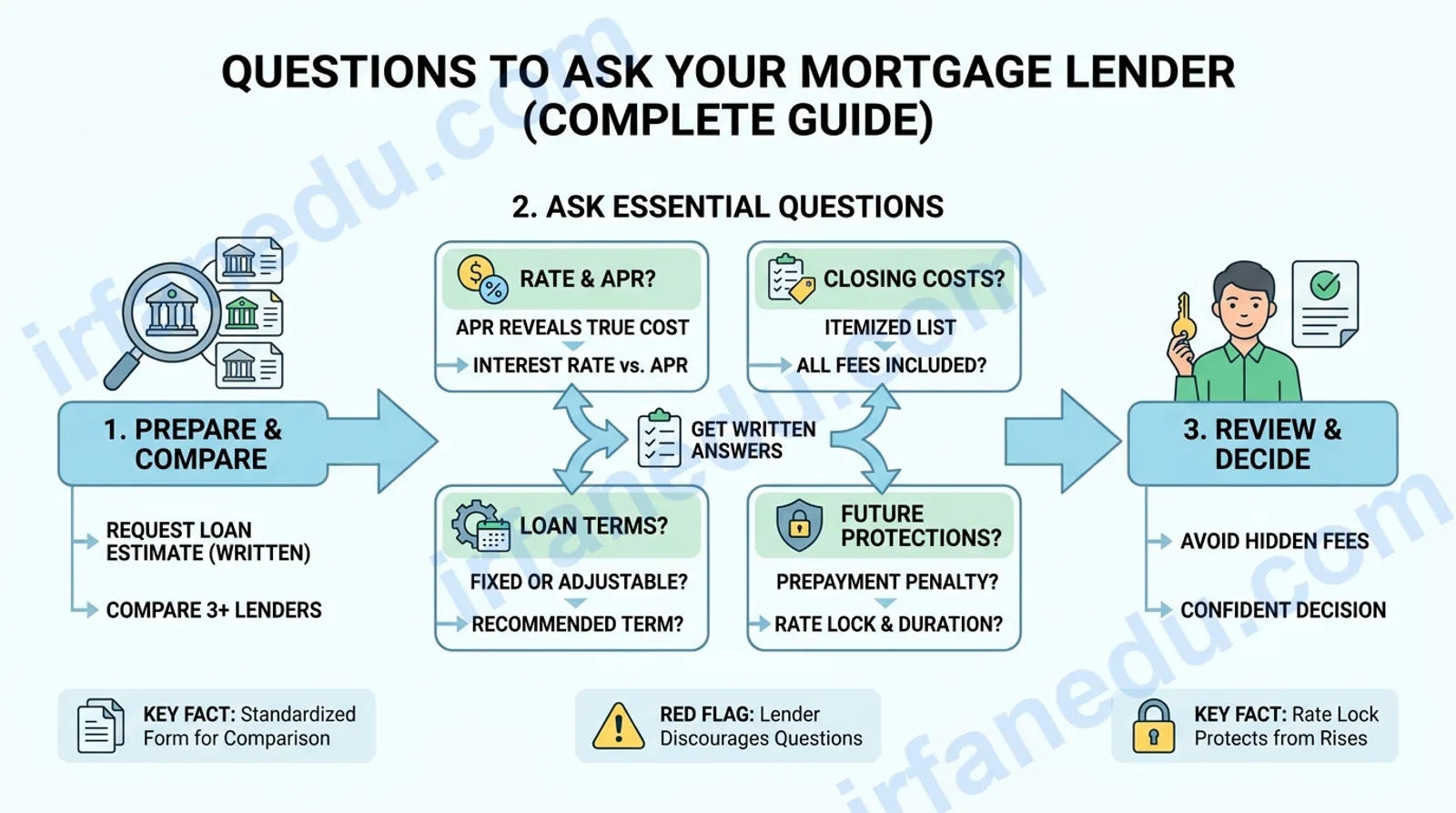
Knowing the right questions to ask a mortgage lender is the single most powerful thing a first-time homebuyer can do before signing. The difference between a well-prepared borrower and an unprepared one is not luck — it is a short list of targeted questions that expose hidden fees, unfavorable terms, and mismatched loan types before it is too late to walk away.
I have spent years helping students and parents understand financial concepts, and mortgage literacy is one of the most under-taught topics in any curriculum. Most people spend more time researching a laptop purchase than they do interviewing their mortgage lender. That gap costs real money — sometimes tens of thousands of dollars over the life of a loan.
In this guide, I walk you through every question worth asking, explain why each one matters, and show you exactly what a good answer looks like versus a red-flag answer. By the end, you will know how to walk into any lender meeting with confidence.
- Understand the difference between interest rate and APR — and why it matters for comparison shopping.
- Know which fees are negotiable and which are fixed.
- Recognize the warning signs of a lender who is not acting in your interest.
- Use a side-by-side comparison table to evaluate multiple lenders at once.
The most important questions to ask a mortgage lender are: What is the interest rate and APR? What are all the closing costs? Is the rate fixed or adjustable? What loan term do you recommend for my situation? Is there a prepayment penalty? Can I lock the rate, and for how long? Getting clear, written answers to these six questions before you apply can prevent thousands of dollars in unexpected costs at closing.
🎯 The Short Version
- Always ask for both the interest rate AND the APR — APR reveals the true cost.
- Request an itemized Loan Estimate in writing before committing to any lender.
- Ask specifically about prepayment penalties — many borrowers discover them too late.
- Rate locks protect you from rising rates; always ask about lock period and extension cost.
- Compare at least three lenders using the same standardized Loan Estimate form.
- A lender who discourages questions is a red flag — good lenders welcome them.
Quick facts about mortgage lender questions
| Topic | Key fact |
|---|---|
| Loan Estimate | Lenders are legally required to provide a standardized Loan Estimate within 3 business days of receiving your application (CFPB rule). |
| APR vs interest rate | APR is always equal to or higher than the stated interest rate because it includes fees. |
| Rate lock period | Typical rate locks run 30, 45, or 60 days. Longer locks usually cost more. |
| Closing costs | Average US closing costs run 2%–5% of the loan amount, according to the Consumer Financial Protection Bureau. |
| Prepayment penalty | Most conventional loans today have no prepayment penalty, but some non-QM and older loan products still do. |
| Minimum credit score | Conventional loans typically require a 620+ credit score; FHA loans allow as low as 580 with 3.5% down. |
| Debt-to-income ratio | Most lenders prefer a DTI below 43%; some allow up to 50% with compensating factors. |
Prepared borrower vs unprepared borrower: why your questions decide the outcome
Picture two people sitting across from the same mortgage loan officer. Both want a $350,000 home loan. Both have similar credit scores. The first person asks detailed questions and requests a written Loan Estimate. The second person nods along and signs where told.
Six months later, the first person is paying $180 less per month and has no prepayment penalty. The second person discovered a 1% origination fee they did not notice and an adjustable rate that reset after two years. The only difference was preparation.
In my experience teaching financial literacy, the single biggest mistake first-time buyers make is treating the lender meeting like a job interview where they are the candidate. Flip that dynamic. You are the employer. The lender is competing for your business. Asking hard questions is not rude — it is financially responsible.
Prepared vs unprepared borrower: side-by-side comparison
| Question / Action | Prepared borrower | Unprepared borrower | Financial impact |
|---|---|---|---|
| Asks for APR, not just interest rate | Yes — compares true cost | No — misled by low teaser rate | Saves $2,000–$8,000 in hidden fees |
| Requests itemized Loan Estimate | Yes — in writing, day 1 | No — surprised at closing | Avoids $1,500–$5,000 in surprise closing costs |
| Asks about prepayment penalty | Yes — avoids penalty loans | No — pays penalty when refinancing | Avoids 2%–5% of loan balance penalty |
| Asks about rate lock period | Yes — locks for 45 days | No — rate rises before closing | Saves $50–$200/month if rates rise 0.5% |
| Shops at least 3 lenders | Yes — negotiates best rate | No — accepts first offer | Saves $10,000–$30,000 over loan life |
| Asks about DTI and qualification criteria | Yes — knows approval odds | No — applies and gets denied | Avoids hard credit inquiry damage |
| Asks about escrow requirements | Yes — budgets accurately | No — shocked by escrow shortfall | Avoids $200–$500/month budget surprise |
The 20+ questions to ask a mortgage lender (organized by category)
These questions are organized by category so you can work through them systematically in any lender conversation. Print this list or save it on your phone before your first meeting.
Category 1: Rate and cost questions
- What is the interest rate, and what is the APR? The APR is the number that matters for comparison. It includes the interest rate plus origination fees, discount points, and other lender charges.
- Is this rate fixed or adjustable? A fixed rate stays the same for the life of the loan. An adjustable-rate mortgage (ARM) starts lower but can rise significantly after the initial fixed period ends.
- If it is an ARM, when does it adjust and by how much? Ask for the adjustment cap (how much the rate can rise per adjustment) and the lifetime cap (the maximum it can ever reach).
- Are you quoting me the rate with or without discount points? One point costs 1% of the loan amount and typically lowers the rate by 0.25%. Ask whether buying points makes sense for your timeline.
- What will my total monthly payment be, including taxes, insurance, and HOA? The “PITI” payment (principal, interest, taxes, insurance) is what you actually pay each month — not just the principal and interest figure lenders often advertise.
Category 2: Fees and closing cost questions
- Can I see an itemized list of all closing costs? Ask for this in writing as a Loan Estimate. Closing costs typically run 2%–5% of the loan amount.
- What is your origination fee? This is the lender’s charge for processing the loan. It is often negotiable, especially if you have a competing offer.
- Which fees are negotiable? Lender fees (origination, underwriting, processing) are often negotiable. Third-party fees (appraisal, title insurance) are less so, but you can sometimes shop for your own providers.
- Are there any prepayment penalties? A prepayment penalty charges you for paying off the loan early — including when you refinance. Most conventional loans today do not have them, but always confirm.
- What are the escrow requirements? Most lenders require you to escrow property taxes and homeowner’s insurance. Ask how much the initial escrow deposit will be and what the monthly escrow payment will be.
The CFPB’s standardized Loan Estimate form makes it easy to compare lenders line by line. Ask every lender you speak with to provide one — they are legally required to give you one within three business days of receiving your application, but you can request a preliminary estimate even before applying.
Category 3: Loan type and term questions
- What loan types do you offer, and which do you recommend for my situation? Common options include conventional, FHA, VA, and USDA loans. Each has different down payment requirements, mortgage insurance rules, and eligibility criteria.
- What loan term do you recommend, and why? A 30-year term has lower monthly payments but higher total interest. A 15-year term costs less overall but requires higher monthly payments. Ask the lender to show you both scenarios in writing.
- Do I need private mortgage insurance (PMI)? PMI is typically required when your down payment is less than 20% on a conventional loan. Ask how much it costs, when it can be removed, and whether there are loan options that avoid it.
- Is there a balloon payment? Some loan products require a large lump-sum payment at the end of the term. This is rare in standard residential mortgages but worth confirming.
Category 4: Rate lock and timeline questions
- Can I lock my interest rate, and for how long? Rate locks typically run 30–60 days. Ask whether the lock is free or costs extra.
- What happens if closing is delayed past the lock expiration? Ask about extension fees and whether the lender has a float-down option (lets you capture a lower rate if rates fall during the lock period).
- How long does your approval process take? Typical timelines run 30–45 days from application to closing. Delays can cost you your rate lock.
Category 5: Qualification and process questions
- What credit score do I need to qualify for your best rate? Rates improve significantly at credit score thresholds of 620, 680, 720, and 760. Ask exactly where you fall and whether it is worth waiting to improve your score.
- What debt-to-income ratio do you require? Most lenders cap DTI at 43%–50%. Ask how they calculate it and whether any of your debts can be excluded.
- What documents do you need from me? Get a complete list upfront to avoid delays. Typical requirements: two years of tax returns, recent pay stubs, bank statements, and a government-issued ID.
- Will you sell my loan after closing? Many lenders sell mortgages to other servicers. Your loan terms do not change, but your payment address and customer service contact will. Ask whether the lender services its own loans or sells them.
- What could cause my loan to fall through after approval? Common causes: a job change, a large new purchase on credit, or a drop in the home’s appraised value. Ask what to avoid doing between approval and closing.
Question 22 is the one most guides skip entirely. In my experience, borrowers who lose their approval at the last minute almost always made a financial move they did not know was risky — opening a new credit card, buying furniture on financing, or changing jobs. Asking this question upfront gives you a clear list of what NOT to do during the loan process.
How mortgage costs stack up: a visual breakdown
This diagram shows how the components of your total mortgage cost relate to each other. Understanding this structure helps you ask smarter questions about each layer.
YOUR TOTAL MONTHLY PAYMENT (PITI)
 |
 +-- [P] Principal repayment
 |       Reduces your loan balance each month
 |
 +-- [I] Interest
 |       = Loan balance x (annual rate / 12)
 |       Largest share in early years (amortization)
 |
 +-- [T] Property taxes
 |       Collected monthly into escrow account
 |       Paid to local government 1-2x per year
 |
 +-- [I] Insurance (homeowner's + PMI if applicable)
         Homeowner's: protects the structure
         PMI: protects the LENDER (not you)
              Removed when equity reaches 20%

CLOSING COSTS (paid once at closing)
 |
 +-- Lender fees: origination, underwriting, processing
 +-- Third-party fees: appraisal, title, escrow
 +-- Prepaid items: first year insurance, property tax deposit
 +-- Points (optional): 1 point = 1% of loan = ~0.25% rate reduction

APR = Interest rate + (Lender fees spread over loan term)
      Always >= interest rate. Use APR to compare lenders.
How to interview a mortgage lender in 6 steps
Follow this process with every lender you speak with. Consistency is what makes comparison possible.
- Gather your financial documents first. Collect two years of tax returns, recent pay stubs, two to three months of bank statements, and your most recent credit report before any meeting. You negotiate from a position of strength when you know your numbers.
- Request a preliminary Loan Estimate before applying. Most lenders will provide a good-faith estimate before you formally apply. This lets you compare without triggering a hard credit inquiry.
- Ask for both the interest rate and the APR in writing. Never compare loans on interest rate alone. APR is the standardized cost metric that includes fees.
- Get an itemized list of every closing cost. Ask the lender to walk you through each line of the Loan Estimate. Flag any fee you do not recognize and ask for an explanation.
- Ask about rate lock options and extension policies. Confirm the lock period, the cost (if any), and what happens if your closing is delayed.
- Repeat with at least two other lenders. Use the Loan Estimates side by side. Even a 0.25% rate difference on a $350,000 loan saves roughly $17,000 in interest over 30 years.
Most mortgage guides tell you to compare APRs. That is correct but incomplete. Here is what most guides get wrong: APR assumes you keep the loan for its full term. If you plan to sell or refinance within 5–7 years (which most US homeowners do), a loan with a slightly higher rate but lower upfront fees will often cost you less than a loan with a lower rate but high discount points. The break-even calculation is: upfront cost savings ÷ monthly payment difference = months to break even. If you plan to move before that break-even point, the “lower rate” loan is actually more expensive for you.
Ask your lender: “At what point does paying discount points break even for me, given my expected timeline in this home?” A lender who cannot answer this question clearly is not giving you personalized advice — they are selling you a product.
Common mortgage question mistakes: wrong vs right approach
These are the most frequent errors I see borrowers make when talking to lenders — and the corrections that save them money.
| Wrong approach | Right approach |
|---|---|
| “What is your interest rate?” (stops there) | “What is the interest rate AND the APR, and what fees are included in the APR?” |
| Comparing monthly payments across lenders | Comparing APR and total closing costs using the standardized Loan Estimate form |
| Assuming no prepayment penalty because the lender seems reputable | Asking explicitly: “Is there a prepayment penalty, and if so, what triggers it and how is it calculated?” |
| Accepting the first rate lock offered | Asking: “Do you offer a float-down option if rates drop during my lock period?” |
| Asking only about the down payment requirement | Also asking: “What is the minimum down payment to avoid PMI, and what does PMI cost per month if I put less down?” |
| Not asking about loan servicing | Asking: “Will you service this loan, or will you sell it to another servicer after closing?” |
Red flags to watch for when talking to a mortgage lender
Not every lender operates in your best interest. These warning signs tell you to slow down or walk away.
Pressure to decide quickly: A legitimate lender gives you time to review the Loan Estimate. Urgency tactics (“this rate expires today”) are a manipulation strategy, not a real deadline.
- Reluctance to provide a written Loan Estimate. Lenders are legally required to give you one. If they stall, that is a compliance problem.
- Vague answers about fees. Every fee should have a name and a dollar amount. “We will sort that out at closing” is not an acceptable answer.
- Discouraging you from shopping around. A confident lender welcomes comparison. A lender who says “you won’t find better” without evidence is deflecting.
- Quoting a rate without asking about your credit score or income. A real rate quote requires your financial profile. A lender quoting rates before asking any questions is giving you a marketing number, not a real offer.
- Suggesting you overstate your income on the application. This is mortgage fraud. Walk away immediately.
The most underrated red flag is a lender who answers every question with “don’t worry about that.” I have seen borrowers accept this reassurance and then discover at closing that their costs were $4,000 higher than expected. Worry about it. Ask again. Get it in writing. The Loan Estimate exists precisely so that lenders cannot surprise you at the closing table.
Practice problems: test your mortgage question knowledge
Work through each scenario, then reveal the answer and explanation.
Scenario 1: Lender A quotes 6.5% interest rate. Lender B quotes 6.7% APR. Which lender is offering the better deal?
Lender A gave you only the interest rate, not the APR. The APR includes fees. Lender B’s 6.7% APR might actually be cheaper overall than Lender A’s 6.5% rate once you add Lender A’s origination fees. Always ask both lenders for their APR and request a Loan Estimate to compare total costs on equal terms.
Scenario 2: You plan to sell your home in 4 years. Lender A offers 6.25% with 2 discount points ($7,000 upfront on a $350,000 loan). Lender B offers 6.75% with no points. Which is better?
The 0.5% rate difference on $350,000 saves roughly $145/month. Break-even: $7,000 ÷ $145 = 48 months (4 years). If you sell before 48 months, you never recover the upfront cost of the points. Since you plan to sell in 4 years, you are right at the break-even — any earlier sale and Lender B wins clearly. This is the break-even calculation most guides never show you.
Scenario 3: Your lender says “there is no prepayment penalty.” Three years later, you refinance and are charged 2% of your remaining balance ($6,200). What likely happened?
Some loan products — particularly non-QM (non-qualified mortgage) loans and certain portfolio loans — include prepayment penalties that are buried in the fine print. Verbal assurances are not enough. Always ask: “Is there a prepayment penalty clause in the loan documents?” and review the Note document (not just the Loan Estimate) before signing. The Note is the binding contract.
Scenario 4: You are pre-approved at 7.1%. Your rate lock expires in 30 days. Closing is delayed by 15 days due to a title issue. What should you have asked upfront?
Ask your lender: “What is the cost to extend my rate lock if closing is delayed, and how long can I extend it?” Extension fees typically run 0.15%–0.30% of the loan amount per 15-day extension. On a $350,000 loan, that is $525–$1,050 for a 15-day extension. Some lenders offer a free 15-day extension as a courtesy — but only if you ask about it before the lock expires, not after.
Scenario 5: A lender quotes you a monthly payment of $1,850. Your neighbor with the same loan amount pays $2,300/month. Why might these numbers differ?
The $1,850 figure is probably the P&I (principal and interest) payment only. Your neighbor’s $2,300 likely includes property taxes (~$300/month), homeowner’s insurance (~$100/month), and possibly PMI (~$150/month). Always ask: “Does this payment include taxes, insurance, and PMI?” The full PITI payment is what you actually budget for each month.
The Consumer Financial Protection Bureau (CFPB) — Owning a Home tool walks you through loan types, rate comparisons, and the Loan Estimate form in plain language. It is one of the most reliable free resources available to US homebuyers.