
APES Practice Exam: The Complete Study Guide to Score a 4 or 5
If you are staring at a stack of APES notes wondering where to start, you are not alone. AP Environmental Science has a reputation for being “the easy AP,” but the 2024 pass rate (score of 3 or higher) was just 53% — meaning nearly half of all test-takers did not pass. The gap between students who score a 4 or 5 and those who score a 2 almost always comes down to one thing: how well they practiced under real exam conditions.
The APES practice exam is a full-length simulation of the AP Environmental Science exam, consisting of 80 multiple-choice questions and 3 free-response questions. It mirrors the real exam’s timing, format, and scoring to help students identify weak units, build test-taking stamina, and refine their FRQ writing before exam day.
In this guide, I break down the exact exam structure, share the scoring formula most students misunderstand, walk through a real FRQ worked example, and give you a concrete 6-week study plan. I have taught AP Environmental Science for over a decade, and I will tell you what the top-scoring students do differently.
- Understand the exact format and timing of the APES exam
- Learn how your raw score converts to a 1-5 composite score
- Master the FRQ command verbs that determine how many points you earn
- Identify the highest-weight units to prioritize in your review
- Follow a realistic 6-week study schedule built around practice exams
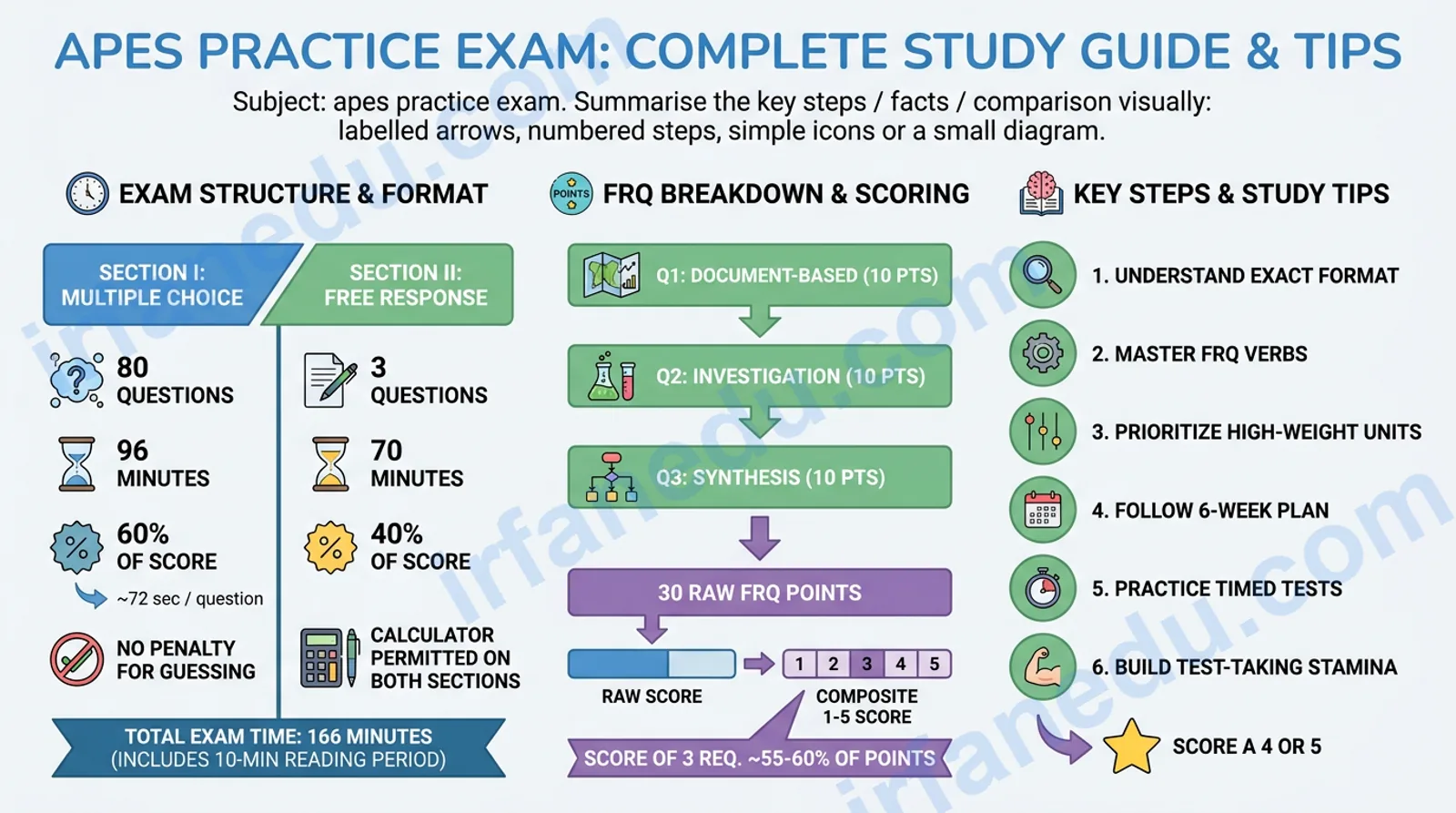
The APES practice exam mirrors the real AP Environmental Science exam: 80 multiple-choice questions (96 minutes) plus 3 free-response questions (70 minutes), totaling 150 minutes. Multiple choice counts for 60% of your score; FRQs count for 40%. Scoring a 3 typically requires roughly 55-60% of available points. Consistent practice with timed, full-length tests is the single most reliable way to raise your score.
What Is the APES Exam Structure?
The AP Environmental Science exam has two sections that test different skills. Section I is 80 multiple-choice questions completed in 96 minutes (72 seconds per question). Section II is 3 free-response questions completed in 70 minutes.
Section I (Multiple Choice): 80 questions, 96 minutes, 60% of composite score.
Section II (Free Response): 3 questions, 70 minutes, 40% of composite score.
Total exam time: 166 minutes (including a 10-minute reading period for Section II).
Calculator: four-function or scientific calculator permitted on both sections.
The three FRQs follow a predictable pattern each year. Question 1 is a document-based question that gives you a stimulus (graph, map, or data table) and asks you to analyze it. Question 2 is a design-an-investigation question. Question 3 is a synthesis and evaluation question that asks you to propose and justify a solution to an environmental problem.
Each FRQ is worth 10 points, for a total of 30 raw FRQ points. The multiple-choice section is worth 80 raw points. College Board then weights and scales these to produce your composite 1-5 score.
┌─────────────────────────────────────────────────────────────┐
│                    APES EXAM (166 min total)                 │
├───────────────────────────┬─────────────────────────────────┤
│   SECTION I               │   SECTION II                    │
│   Multiple Choice         │   Free Response                 │
│   80 questions            │   3 questions                   │
│   96 minutes              │   70 minutes                    │
│   60% of score            │   40% of score                  │
├───────────────────────────┼─────────────────────────────────┤
│  ~72 sec / question       │  Q1: Document-Based  (10 pts)   │
│  No penalty for guessing  │  Q2: Investigation   (10 pts)   │
│  All 1 point each         │  Q3: Synthesis       (10 pts)   │
└───────────────────────────┴─────────────────────────────────┘
  Calculator allowed on BOTH sections
How Is the APES Exam Scored?
Your APES score is a composite of your multiple-choice raw score and your FRQ raw score, weighted 60/40 and then converted to the 1-5 scale. There is no penalty for wrong answers on multiple choice, so you should answer every question.
| AP Score | Meaning | Approx. % of Points Needed | Typical College Credit |
|---|---|---|---|
| 5 | Extremely well qualified | ~75-100% | Full credit at most schools |
| 4 | Well qualified | ~60-74% | Credit at most schools |
| 3 | Qualified (passing) | ~45-59% | Credit at many schools |
| 2 | Possibly qualified | ~30-44% | Rarely accepted |
| 1 | No recommendation | Below 30% | Not accepted |
College Board adjusts the score cutoffs slightly each year based on exam difficulty. The percentages above are approximations based on historical released scoring data. Your actual score cutoff may shift by a few points in either direction. Always check College Board’s official score distributions after each exam cycle.
How Do You Maximize Your APES Multiple-Choice Score?
The multiple-choice section rewards students who can eliminate wrong answers quickly and manage time at roughly 72 seconds per question. The most effective strategy is process of elimination combined with unit-based pattern recognition.
- Read the question stem first, then the answer choices. Form a rough answer in your head before reading options — this prevents you from being anchored by a plausible-but-wrong choice.
- Eliminate absolute language. Answer choices containing “always,” “never,” or “only” are usually wrong in environmental science, where context almost always matters.
- Flag and move on. If a question takes more than 90 seconds, mark it and return after completing the rest. Running out of time on easy questions because you stalled on a hard one is the most common MC mistake.
- Use the data. About 30% of MC questions are stimulus-based (graph, map, table). Practice reading axes and units quickly — the answer is almost always directly in the data if you read it carefully.
- Never leave a blank. There is no penalty for wrong answers. A guess is always worth more than a blank.
On stimulus-based questions, cover the answer choices and write a one-word answer to the question using only the graph or table. Then find the choice that matches your word. This technique cuts through distractor traps that are designed to look plausible if you read them before analyzing the data.
How Do You Write a High-Scoring APES FRQ?
The FRQ section is where most students leave points on the table — not because they lack knowledge, but because they misread the command verb. College Board scorers award points for specific, direct responses to specific sub-parts. A long, vague paragraph earns fewer points than three short, precise sentences.
The five command verbs you must know cold:
| Command Verb | What It Requires | Common Student Error |
|---|---|---|
| Identify | Name the item — one word or phrase is enough | Writing a full paragraph when one word earns the point |
| Describe | State the characteristics or features | Explaining why instead of what |
| Explain | Give a cause-and-effect mechanism | Describing without linking cause to effect |
| Calculate | Show setup, work, units, and answer | Giving only the final number with no units |
| Propose / Recommend | Suggest a specific, named solution and justify it | Vague answers like “reduce pollution” |
- Read the entire question before writing. Identify every sub-part (a, b, c, d) and its command verb.
- Label your responses clearly: write “(a)” before your answer to part (a). Scorers read fast — unlabeled answers get missed.
- Lead with a direct claim, then add one sentence of supporting evidence or mechanism.
- For calculation sub-parts, write the formula, substitute values with units, and box your final answer.
- Never contradict yourself. If you write a correct answer and then add a contradicting sentence, scorers will award zero for that point.
In my experience grading student FRQ responses, the single biggest point-killer is not lack of knowledge — it is writing around the answer instead of stating it. I have read responses where a student clearly understood the concept but buried the answer in three sentences of background context. The scorer cannot award a point for an implied answer. Train yourself to state the answer in the first sentence of every sub-part, every time. That one habit alone is worth 3-5 extra points on the FRQ section.
Worked Example: A Real-Style APES FRQ Calculation
Calculation sub-parts appear in at least one FRQ every year and are worth 2-3 points each. Here is a worked example modeled on the style College Board uses.
A coal-fired power plant burns 500 metric tons of coal per day. The coal has a sulfur content of 2% by mass. Assume all sulfur is converted to SO₂ during combustion. Calculate the mass of SO₂ produced per day. Show your work and include units.
Step 1 — Find mass of sulfur burned:
500 metric tons × 0.02 = 10 metric tons of sulfur per day
Step 2 — Convert sulfur to SO₂ using molar mass ratio:
Molar mass of S = 32 g/mol; Molar mass of SO₂ = 64 g/mol
Ratio = 64/32 = 2
Step 3 — Calculate SO₂ mass:
10 metric tons × 2 = 20 metric tons of SO₂ per day
This answer earns full credit because it shows the setup, intermediate steps, the molar mass conversion, and the final answer with units.
Notice that even if you made an arithmetic error in Step 1, you would still earn partial credit in Steps 2 and 3 if your method was correct. This is called “error carried forward” — College Board scorers apply it consistently. Showing your work is never optional on calculation sub-parts.
Which APES Units Have the Highest Exam Weight?
College Board publishes the percentage of exam questions drawn from each unit. Studying high-weight units first gives you the highest return on your time investment.
| Unit | Topic | Exam Weight | Priority |
|---|---|---|---|
| Unit 1 | The Living World: Ecosystems | 6-8% | Medium |
| Unit 2 | The Living World: Biodiversity | 6-8% | Medium |
| Unit 3 | Populations | 10-15% | High |
| Unit 4 | Earth Systems and Resources | 10-15% | High |
| Unit 5 | Land and Water Use | 10-15% | High |
| Unit 6 | Energy Resources and Consumption | 10-15% | High |
| Unit 7 | Atmospheric Pollution | 7-10% | Medium-High |
| Unit 8 | Aquatic and Terrestrial Pollution | 7-10% | Medium-High |
| Unit 9 | Global Change | 15-20% | Highest |
Unit 9 (Global Change) alone accounts for 15-20% of the exam — the single largest unit. If you are short on time, make sure you can explain climate change mechanisms, ozone depletion, ocean acidification, and habitat loss with specific cause-and-effect chains. These topics appear on both MC and FRQ every single year.
What Are the Most Common APES Exam Mistakes?
After reviewing hundreds of student responses, I have identified the mistakes that consistently cost students points. Knowing them in advance lets you avoid them under pressure.
| Mistake | Why It Costs Points | Correct Approach |
|---|---|---|
| Confusing correlation with causation in data questions | Scorers reject causal language when the data only shows a trend | Use “associated with” or “as X increases, Y increases” language |
| Forgetting units on calculations | A number without units earns zero for the answer portion | Write units at every step, not just the final answer |
| Vague solutions on Synthesis FRQs | “Reduce emissions” earns no points — too generic | Name a specific policy, technology, or practice (e.g. “cap-and-trade carbon pricing”) |
| Mixing up primary and secondary succession | A common MC distractor that trips up unprepared students | Primary = bare rock, no soil. Secondary = soil remains after disturbance. |
| Spending too long on hard MC questions | Running out of time on easy questions you know | Flag hard questions, complete the rest, return with remaining time |
What Does a 6-Week APES Practice Exam Study Plan Look Like?
A structured 6-week plan built around full-length practice exams is the most efficient path to a 4 or 5. The key is to treat every practice exam as a diagnostic, not just a score check.
- Week 1 — Diagnostic. Take a full-length timed practice exam cold. Score it by section. Identify your three weakest units by error rate. This baseline drives everything else.
- Week 2-3 — Targeted Unit Review. Spend 45 minutes per day on your three weakest units. Use College Board’s AP Classroom resources and released FRQ scoring guidelines. Do 20-question unit-specific MC sets daily.
- Week 4 — FRQ Focus. Write at least one full FRQ response per day using released prompts from College Board. Score yourself against the official scoring guidelines. Focus on command verb compliance.
- Week 5 — Second Full Practice Exam. Take another timed full-length exam. Compare your error patterns to Week 1. Spend the rest of the week drilling your remaining weak spots.
- Week 6 — Final Review and Stamina. Do one more full practice exam under strict conditions (no phone, timed, no breaks). Review high-weight Unit 9 topics. The night before the exam: review your command verb list, not new content.
The “Explain” command verb has a hidden two-part requirement most guides never mention.
When an APES FRQ says “explain,” College Board’s scoring guidelines almost always require both a mechanism and a consequence — not just one. For example, if asked to “explain how burning fossil fuels contributes to ocean acidification,” a complete answer must state: (1) combustion releases CO₂ into the atmosphere, which dissolves in seawater to form carbonic acid (mechanism), AND (2) this lowers ocean pH, reducing carbonate ion availability for shell-forming organisms (consequence). Students who give only the mechanism — even if perfectly accurate — typically earn only 1 of the 2 available points for that sub-part.
I have never seen this two-part structure explicitly stated in any popular APES prep book. But it is embedded in virtually every College Board scoring guideline for “explain” sub-parts. Check any released scoring commentary from the past five years and you will see it confirmed.
Where Can You Find the Best APES Practice Exams?
The quality of your practice materials matters as much as the quantity of your practice. Here is what I recommend, ranked by reliability.
- College Board AP Classroom (official): The only source of real released MC questions and FRQ prompts with official scoring guidelines. Free with your AP course enrollment. This is your primary resource.
- College Board’s publicly released FRQs: Available at AP Central — every FRQ from 2013 onward, with scoring guidelines and sample student responses. Invaluable for FRQ practice.
- Khan Academy: Free video explanations for every APES unit. Best used for concept review, not full practice exams.
- Fiveable: Free live review sessions and unit-specific practice sets, particularly strong for Unit 9 (Global Change).
- Barron’s / Princeton Review prep books: Good for additional MC practice. Note that their FRQ scoring rubrics are approximations, not official — always cross-check with College Board guidelines.
One resource I specifically do not recommend for FRQ practice: any AI-generated practice questions that have not been validated against College Board’s actual scoring criteria. The command verb requirements and point-allocation logic are specific enough that unofficial rubrics frequently mislead students about what earns credit.
Frequently Asked Questions About the APES Practice Exam
How many questions are on the APES exam?
What score do you need to pass the APES exam?
How is the APES exam scored?
What are the hardest units on the APES exam?
Where can I find free APES practice exams?
How long should I study for the APES exam?
Can you use a calculator on the APES exam?
Related Articles
Dr. Irfan Mansuri is an educator