
Model Citizenship: Definition, Qualities & How to Practice It
Most students can name a few things a “good citizen” does. But model citizenship is something sharper and more actionable than a vague list of virtues. It is a set of specific, learnable behaviors that anyone can practice starting today.
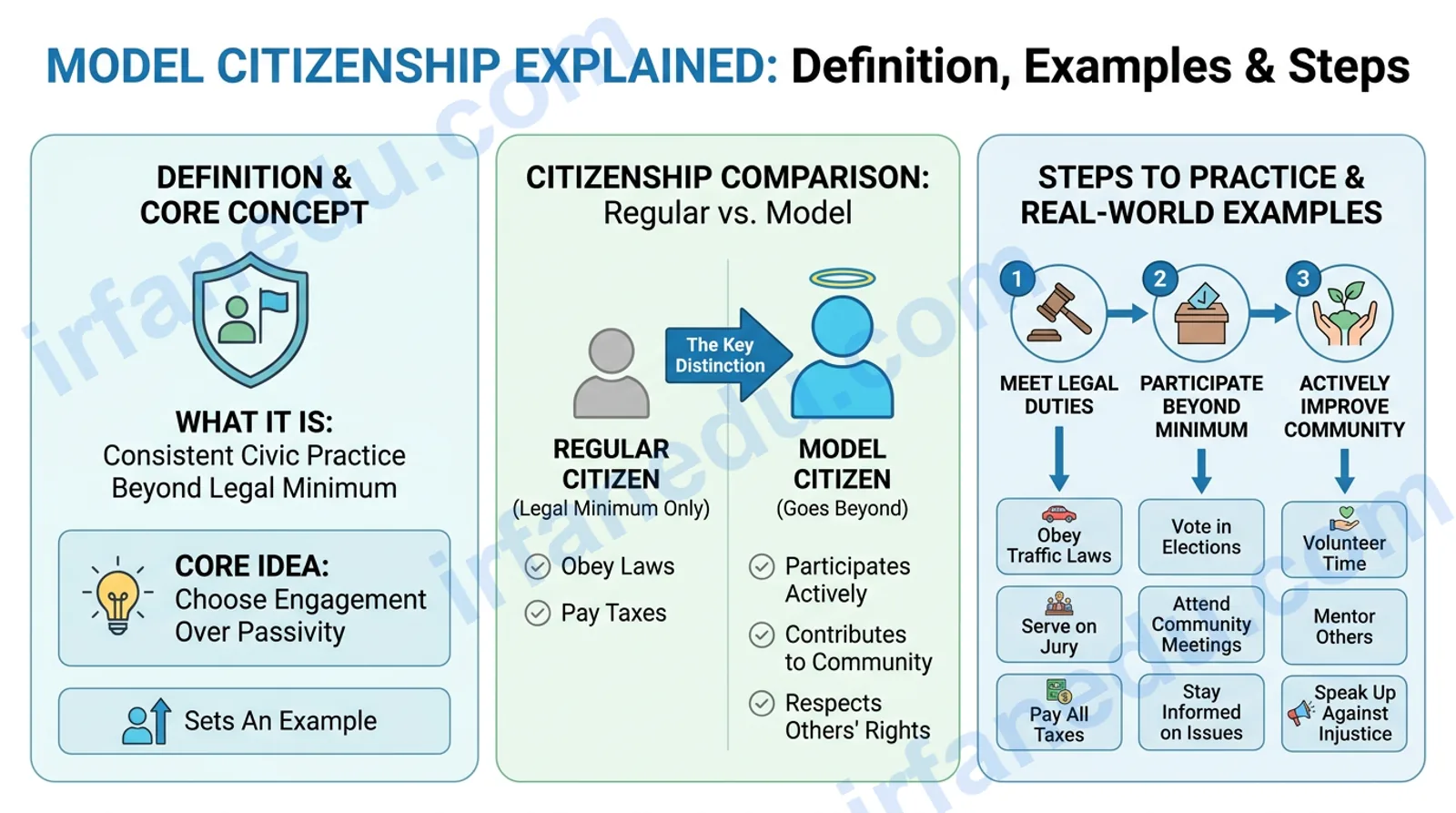
Model citizenship is the consistent practice of civic responsibilities that go beyond the legal minimum. A model citizen obeys laws, participates in democratic processes, respects others’ rights, contributes to the community through service, and stays informed about public issues. The word “model” signals that this person sets an example others can follow.
In this guide, I break down exactly what model citizenship means, what qualities it requires, how it connects to the “heart model” of civic identity, and how you can start practicing it today. I also correct a common misconception that trips up students on civics tests and essays.
- ✅ Understand the precise definition of model citizenship
- ✅ Identify the six core qualities of a model citizen
- ✅ See the difference between a regular citizen and a model citizen
- ✅ Follow a clear step-by-step path to practice model citizenship yourself
- ✅ Connect model citizenship to the heart model of civic identity
Model citizenship is not about being perfect. It is about consistently choosing civic engagement over civic passivity. Anyone can do it, at any age.
Model citizenship means consistently practicing the responsibilities and values of a good citizen: obeying laws, participating in civic life, respecting others, contributing to the community, and staying informed. A model citizen goes beyond the minimum legal duties. They actively make their community better through daily choices, service, and engagement. The term is used in civics education to describe the ideal standard of civic behavior.
⚡ Your 2-Minute Quick Win: The 3-Question Test
Before going deeper, here is something you can use right now. In my experience teaching civics, students who can answer these three questions confidently already understand model citizenship better than most adults.
Ask yourself these three questions about any person (or yourself):
- Do they meet their legal duties? (Obey laws, pay taxes, serve on a jury when called.)
- Do they participate beyond the minimum? (Vote, attend community meetings, volunteer.)
- Do they actively improve their community? (Mentor others, speak up against injustice, pick up litter.)
If the answer to all three is yes, that person is practicing model citizenship. If only the first is yes, they are a law-abiding citizen but not yet a model one. That distinction is the heart of every civics essay question you will ever see.
Maria pays her taxes and obeys traffic laws (legal minimum). She also volunteers at a food bank every Saturday and attends her city council meetings (beyond minimum). Maria is a model citizen. Her neighbor Tom pays taxes and obeys laws but does nothing else. Tom is a law-abiding citizen, not a model one.
What Is Model Citizenship? (Full Definition)
Model citizenship is a civic ideal that describes a person who fulfills all legal obligations AND voluntarily contributes to the health of their democratic community. The word “model” comes from the Latin modulus, meaning a standard or measure. A model citizen is literally a standard-setter.
Political scientists and educators typically break citizenship into three levels:
| Level | Description | Example Behavior |
|---|---|---|
| Minimal Citizen | Meets legal obligations only | Pays taxes, does not break laws |
| Participatory Citizen | Engages in civic life actively | Votes, joins community groups, recycles |
| Model / Justice-Oriented Citizen | Works to improve systems and community | Volunteers, advocates, mentors, votes in every election |
This three-level framework comes from political scientist Joel Westheimer and educator Joseph Kahne, whose widely cited 2004 research in American Journal of Education identified these distinct types of citizenship. Model citizenship sits at the top level: justice-oriented and participatory combined.
The key insight is that model citizenship is not a personality type. It is a set of behaviors. You do not have to be naturally outgoing or politically passionate. You just have to choose civic action over civic passivity, consistently.
What Are the Qualities of a Model Citizen?
A model citizen demonstrates six core qualities. These are not abstract virtues but observable, testable behaviors.
 ┌─────────────────────────────────────────────────────────┐
 │           6 QUALITIES OF A MODEL CITIZEN                │
 ├──────────────────────┬──────────────────────────────────┤
 │  1. LAWFULNESS       │  Obeys laws; respects authority  │
 │  2. PARTICIPATION    │  Votes; attends civic meetings   │
 │  3. RESPONSIBILITY   │  Pays taxes; keeps commitments   │
 │  4. COMMUNITY SERVICE│  Volunteers; helps neighbors     │
 │  5. RESPECT          │  Treats all people with dignity  │
 │  6. INFORMED MIND    │  Reads news; knows public issues │
 └──────────────────────┴──────────────────────────────────┘
         ↑  A model citizen practices ALL SIX  ↑
1. Lawfulness
A model citizen follows the law not just to avoid punishment but because they understand that laws protect everyone’s rights. This includes traffic laws, tax laws, and local ordinances.
2. Civic Participation
Voting is the most visible form of civic participation, but it is not the only one. Attending school board meetings, signing petitions, and contacting elected representatives all count. Participation is what makes democracy function.
3. Personal Responsibility
A model citizen keeps their commitments to the community: paying taxes honestly, showing up for jury duty, and following through on volunteer pledges. Responsibility is civic reliability.
4. Community Service
This is the quality that most clearly separates a model citizen from a merely law-abiding one. Volunteering at a shelter, tutoring a younger student, or organizing a neighborhood clean-up all count as community service.
5. Respect for Others
A model citizen treats every person with dignity, regardless of background, belief, or status. This includes speaking respectfully in disagreements and defending others’ rights even when it is inconvenient.
6. Staying Informed
You cannot participate meaningfully in a democracy if you do not know what is happening. A model citizen reads reliable news sources, follows local government decisions, and understands the issues that affect their community.
In my experience working with students across different grade levels, the quality most often left off civics essays is staying informed. Students list voting and volunteering but forget that uninformed participation can be as harmful as no participation at all. An informed vote is worth far more than a reflexive one. I always tell students: read before you act.
How Is a Model Citizen Different from a Regular Citizen?
The difference is not about being a better person morally. It is about the scope of civic engagement. Here is a direct comparison:
| Behavior | Regular (Law-Abiding) Citizen | Model Citizen |
|---|---|---|
| Obeys laws | ✅ Yes | ✅ Yes |
| Pays taxes | ✅ Yes | ✅ Yes |
| Votes in elections | ❓ Sometimes | ✅ Consistently |
| Volunteers in community | ❌ Rarely | ✅ Regularly |
| Attends civic meetings | ❌ Rarely | ✅ When relevant |
| Stays informed on issues | ❓ Casually | ✅ Actively |
| Speaks up against injustice | ❌ Rarely | ✅ When needed |
The key takeaway from this table: a regular citizen is passive. A model citizen is active. Both follow the rules, but only one works to make the community better.
How Does Model Citizenship Connect to the Heart Model?
The “heart model” of citizenship is a framework used in civic education that places values and identity at the center of civic behavior. Instead of asking “What must a citizen do?” it asks “What does a citizen care about?”
The heart model argues that lasting civic engagement comes from intrinsic motivation: a genuine sense of belonging, empathy for others, and a belief that your actions matter. External rules (laws, duties) can produce a minimal citizen. But only internal values (the “heart”) produce a model citizen who acts even when no one is watching.
Think of it this way: a person who volunteers only when it looks good on a college application is not practicing model citizenship. A person who volunteers because they genuinely care about their community is. The behavior looks the same from the outside, but the heart model says the motivation matters for long-term civic health.
If you are writing a civics essay about model citizenship, connect it to the heart model by arguing that civic education should build values and identity, not just teach rules. That argument shows higher-order thinking and will stand out to any teacher or grader.
How to Practice Model Citizenship: Step-by-Step
Model citizenship is not a destination. It is a daily practice. Here is a concrete path anyone can follow, starting today.
-
Know Your Rights and Responsibilities.
Study the civic duties in your country: voting eligibility, jury duty, tax obligations, and the rights protected by your constitution. You cannot fulfill a duty you do not know about. -
Stay Informed Every Day.
Choose two or three reliable news sources and spend 10 minutes reading them daily. Focus on local news first: your city council, school board, and local elections affect your daily life more directly than national headlines. -
Register and Vote in Every Election.
Local elections often have turnout below 20%. Your vote carries enormous weight in local races. Register as soon as you are eligible and vote in primaries, local elections, and national elections alike. -
Find One Volunteer Commitment.
You do not need to volunteer every weekend. Start with one recurring commitment: a monthly food bank shift, a weekly tutoring session, or a quarterly neighborhood clean-up. Consistency matters more than frequency. -
Participate in at Least One Civic Forum Per Year.
Attend a town hall, a school board meeting, or a community planning session. Simply showing up signals to elected officials that residents are paying attention. -
Respect Others Actively.
This means more than being polite. It means defending someone else’s right to speak even when you disagree with them, and calling out disrespect when you see it.
Monday: Reads a local news article about a proposed school budget cut. Tuesday: Discusses it respectfully with classmates who disagree. Wednesday: Writes a short letter to the school board expressing her view. Friday: Volunteers for 2 hours at the community library’s reading program. Saturday: Attends a neighborhood clean-up. This student has practiced all six qualities of model citizenship in a single week, without any grand gestures.
Real-World Examples of Model Citizenship
Abstract definitions only go so far. Here are concrete, real-world examples of model citizenship in action, from everyday people, not just famous figures.
Example 1: The Informed Voter
A 19-year-old first-time voter spends two weeks before an election reading candidate platforms, watching a local debate, and researching ballot measures. She votes in the primary AND the general election. She is not famous. She is a model citizen.
Example 2: The Community Organizer
A retired teacher notices that a local park is deteriorating. He organizes a volunteer clean-up, contacts the city parks department, and starts a monthly maintenance group. He did not run for office. He just acted. That is model citizenship.
Example 3: The Honest Taxpayer
A freelance designer earns income from multiple clients and reports all of it accurately on her tax return, even income that would be easy to hide. Honest tax compliance is a civic act that funds schools, roads, and emergency services. It is unglamorous but essential.
Example 4: The Upstander
A student sees a classmate being bullied and speaks up, even though it is socially risky. Defending others’ dignity is a core civic value. Upstander behavior at school is model citizenship in miniature.
What Does Model Citizenship Look Like for Students?
Students are full citizens, not citizens-in-waiting. Model citizenship for students looks different from adult civic life, but it is just as real and just as important.
Here is what model citizenship looks like inside a school setting:
- 🎓 Following school rules even when no teacher is watching
- 🎓 Participating in student government or class discussions
- 🎓 Helping classmates who are struggling academically or socially
- 🎓 Reporting safety issues to a trusted adult
- 🎓 Respecting school property and shared spaces
- 🎓 Staying informed about school policies and advocating to change unfair ones
Outside school, students can volunteer, participate in community events, and follow local news. The habits built in school become the civic habits of adulthood.
I have seen many students dismiss civic education as irrelevant because they cannot vote yet. That is a mistake. The research is clear: students who practice civic behaviors in school are significantly more likely to vote and volunteer as adults. Civic identity is built early. Every time you speak up in class, help a classmate, or follow a rule because it is right, you are practicing model citizenship. Do not wait until you are 18 to start.
Common Mistakes People Make About Citizenship
These are the misconceptions I see most often in student essays and civics tests. Correcting them will sharpen your understanding and your writing.
✅ Correction: Legal compliance is the floor, not the ceiling. A person who never breaks a law but never votes, never volunteers, and never engages with their community is a minimal citizen, not a model one. Model citizenship requires active engagement.
✅ Correction: Model citizenship is built from small, consistent actions. Picking up litter, helping a neighbor, voting in every election, and paying taxes honestly are all acts of model citizenship. Grand gestures are not required.
✅ Correction: Healthy democracies depend on citizens who question, criticize, and push for change through legitimate means. Peaceful protest, writing to elected officials, and voting out leaders you disagree with are all acts of model citizenship. Blind compliance is not.
✅ Correction: Civic identity and civic habits form long before voting age. Students who participate in school governance, volunteer, and treat others with respect are already practicing model citizenship. Age is not a barrier.
Most civics resources define model citizenship as a list of duties: vote, obey laws, pay taxes, volunteer. That framing is useful but incomplete. It treats citizenship as a transaction: you give these things, you get to be called a model citizen.
What the research actually shows (and what the heart model captures) is that durable model citizenship is identity-based, not duty-based. People who think of themselves as “someone who participates” vote more consistently, volunteer more reliably, and stay engaged longer than people who think of civic acts as external obligations.
The practical implication for students: do not just memorize the duties. Build a civic identity. Ask yourself: “What kind of citizen do I want to be?” and let that identity drive your actions. That shift from duty-list to identity is what most guides never tell you, and it is the difference between a student who votes once and a lifelong model citizen.
🏫 Quick Knowledge Check
Test what you have learned. Select your answer, then reveal the explanation.
1. Which behavior BEST distinguishes a model citizen from a merely law-abiding citizen?
2. According to the heart model of citizenship, what drives a model citizen’s civic behavior?
3. A student follows all school rules, helps classmates, and participates in student government. Which statement is most accurate?
Frequently Asked Questions About Model Citizenship
What is the definition of model citizenship?
What are the qualities of a model citizen?
How is a model citizen different from a regular citizen?
Can students be model citizens?
What is the heart model of citizenship?
Why is model citizenship important in a democracy?
What are some everyday examples of model citizenship?
✅ Key Takeaways
- Model citizenship means going beyond legal minimums to actively engage in civic life.
- The six core qualities are: lawfulness, participation, responsibility, community service, respect, and staying informed.
- A model citizen is active; a regular law-abiding citizen is passive.
- The heart model explains that lasting civic engagement comes from identity and values, not just duty.
- Students can and should practice model citizenship now, before voting age.
- Common misconceptions: citizenship is not just about obeying laws, and it does not require grand gestures or political office.
- Small, consistent civic actions (voting, volunteering, staying informed) add up to model citizenship over time.
Educational Content Creator & Competitive Exam Specialist | Founder, IrfanEdu.com
Dr. Irfan Mansuri is an educator and SEO content expert with 15+ years of experience across high school, undergraduate, and postgraduate levels. I combine deep subject knowledge with proven test-taking strategies to make complex ideas simple and actionable for students worldwide.
👤 Connect on LinkedIn
Sources & References
- Westheimer, J. & Kahne, J. (2004). “What Kind of Citizen? The Politics of Educating for Democracy.” American Journal of Education, 110(3), 237–269. Foundational research defining the three types of citizenship (personally responsible, participatory, justice-oriented) that underpins the model citizenship framework used in this article.
- Khan Academy: Citizenship and Civic Participation — A clear overview of civic rights and responsibilities for students, aligned with US civics curriculum.
- Wikipedia: Citizenship — Comprehensive overview of citizenship concepts, legal frameworks, and civic theory across different political systems.
- Center for Civic Education (civiced.org) — The leading US nonprofit for civic education standards, curriculum, and research. Their We the People and Project Citizen programs define civic competency benchmarks referenced in this article.
📝 Editorial note: This article