
CMU Block Calculator: Concrete Block Wall Estimator
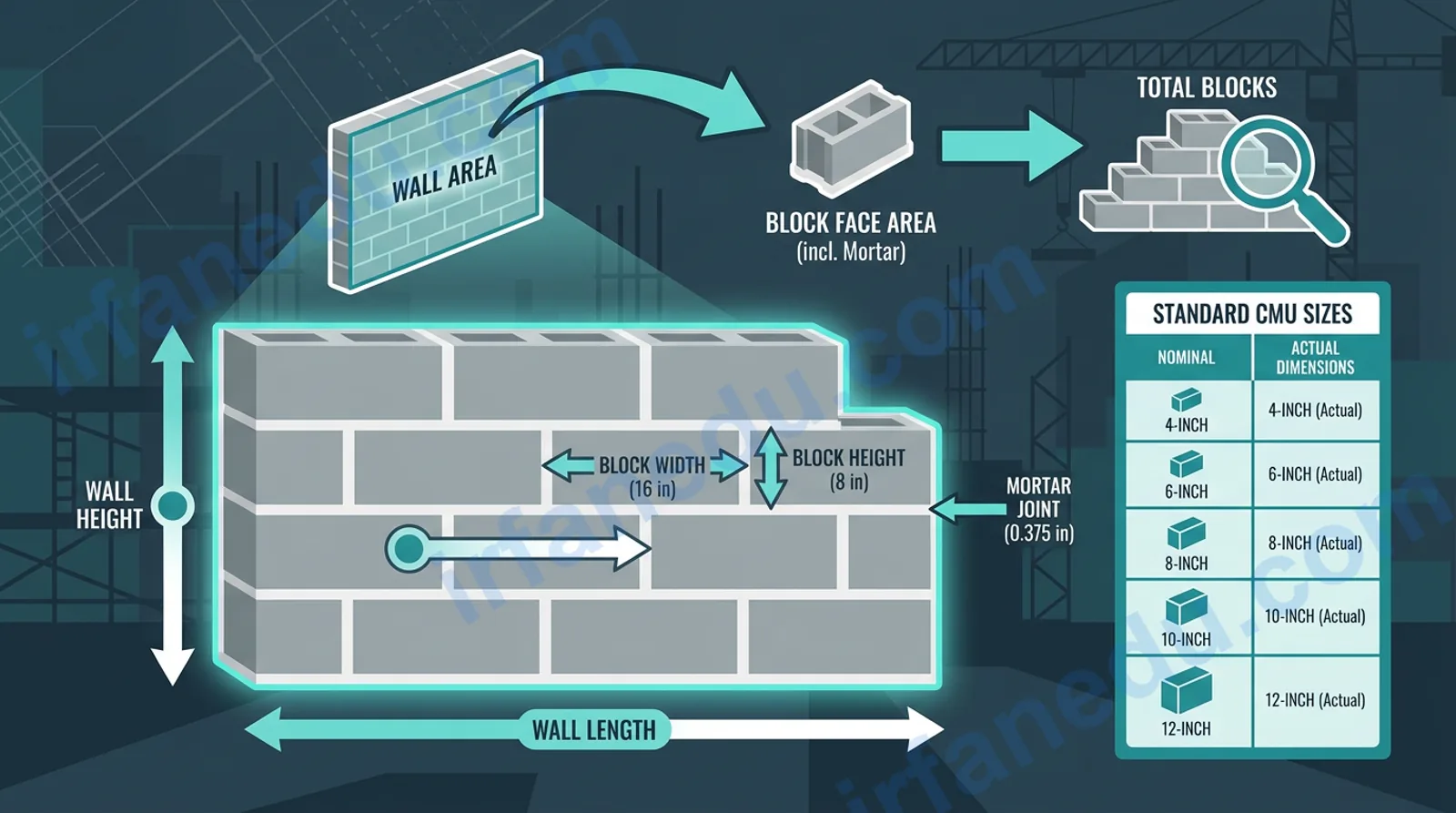
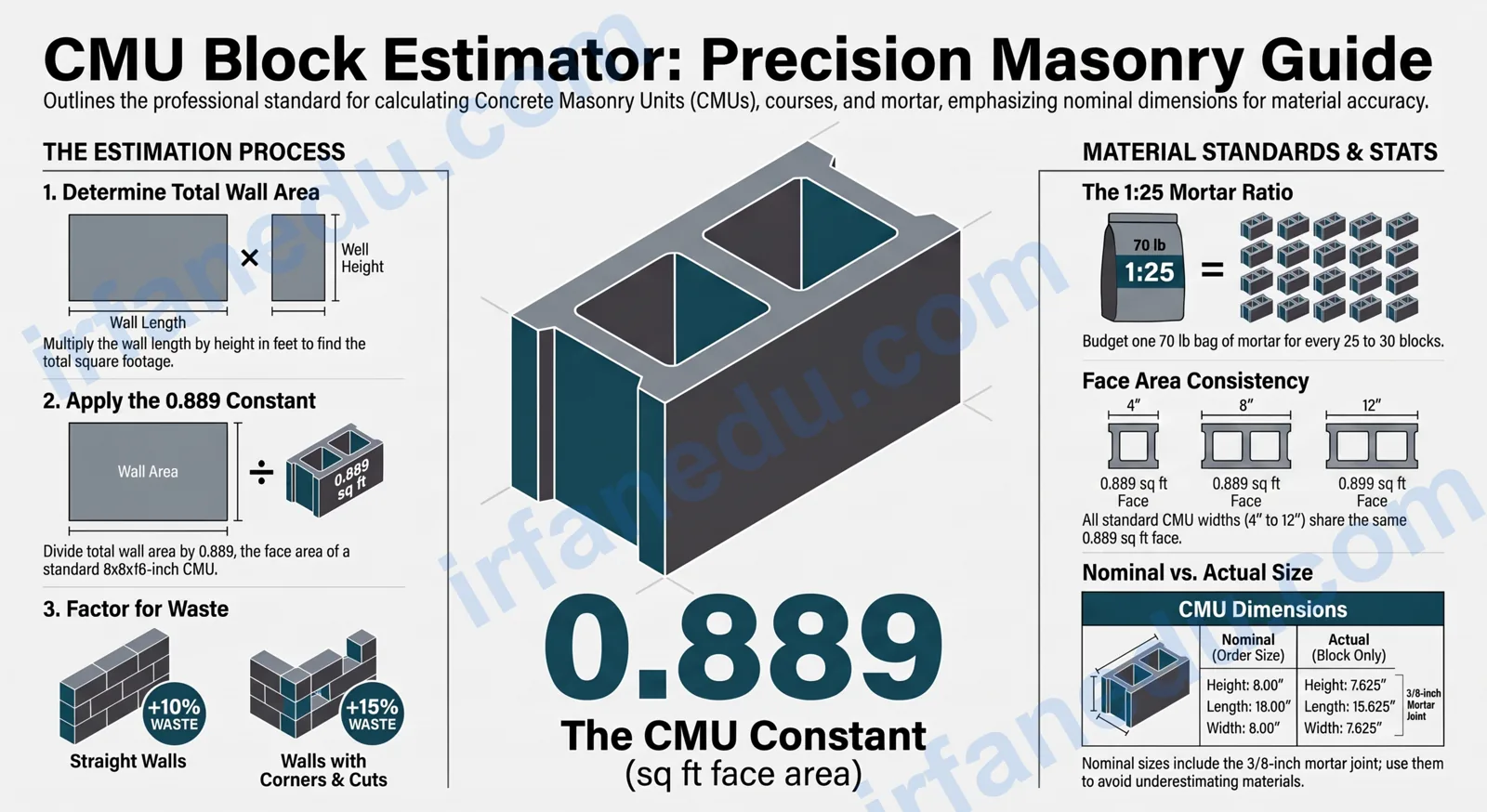
CMU Block Calculator – Quick Reference Cheat Sheet
- Core formula: Blocks needed = Wall area (sq ft) / Block face area (sq ft) x (1 + waste %)
- Standard 8x8x16 CMU face area: 0.889 sq ft (including 3/8-in mortar joint)
- Courses: Wall height (in) / 8 in per course
- Blocks per course: Wall length (in) / 16 in per block
- Mortar: 1 bag (70 lb) per 25-30 standard blocks
- Waste factor: 10% straight walls, 15% walls with cuts/corners
- Pallet size: ~90 blocks per pallet (8-inch CMU, verify with supplier)
⚡ In Short
- A standard 8x8x16-inch CMU covers 0.889 sq ft of wall face (mortar included).
- Blocks needed = (Wall length x Wall height) / 0.889, then add 10% waste.
- Courses = Wall height (inches) / 8; Blocks per course = Wall length (inches) / 16.
- Budget 1 mortar bag (70 lb) per 25-30 blocks for standard walls.
- Order in full pallets (approx. 90 blocks each) to avoid small re-orders.
Planning a concrete block wall and unsure how many blocks to order? This free CMU block calculator gives you an instant, accurate count of blocks, wall courses, and mortar bags based on your wall’s dimensions and your chosen block size. Enter your numbers, hit Calculate, and get a full step-by-step breakdown you can hand straight to your supplier.
CMU Block Calculator
Estimate blocks, courses & mortar for any wall
feet
feet
nominal (includes 3/8-in mortar joint)
% (10% standard, 15% for cuts/corners)
Your Estimate
Step-by-Step Solution
How to Use This CMU Block Calculator
- Enter wall length in feet (e.g., 20 ft for a 20-foot-long wall).
- Enter wall height in feet (e.g., 8 ft for a standard 8-foot wall).
- Select your block size from the dropdown. The 8x8x16-inch block is the most common choice for residential and commercial walls.
- Set your waste factor (default 10%). Use 15% if your wall has many corners, window openings, or angled cuts.
- Click Calculate. The result card shows total blocks, courses, blocks per course, mortar bags, and a full numbered solution you can screenshot for your supplier.
What Is a CMU Block?
A CMU (Concrete Masonry Unit) is a precast hollow or solid block made from Portland cement, water, and aggregate, manufactured to ASTM C90 standards. It is the correct technical term for what many people call a "cinder block" or "cement block." The hollow cores reduce weight and allow steel rebar and grout to be inserted for reinforced walls.
The nominal 8x8x16-inch CMU is the industry standard. Its actual dimensions are 7.625 x 7.625 x 15.625 inches. The 0.375-inch difference on each face is the mortar joint, so when laid, the nominal and actual dimensions align perfectly.
The CMU Block Formula Explained
The core calculation is straightforward. The number of blocks you need equals the wall's face area divided by the face area of one block (including its mortar joint), multiplied by a waste factor.
Courses = Wall Height (in) / Nominal block height (in)
Blocks per course = Wall Length (in) / Nominal block length (in)
Mortar bags = Total blocks / 25 (rounded up)
Variables & Symbols Table
| Symbol | Meaning | Typical Unit |
|---|---|---|
| L | Wall length | feet or inches |
| H | Wall height | feet or inches |
| Awall | Wall face area (L x H) | sq ft |
| hnom | Nominal block height (incl. mortar joint) | inches (typically 8) |
| lnom | Nominal block length (incl. mortar joint) | inches (typically 16) |
| Ablock | Block face area (hnom x lnom) | sq ft (typically 0.889) |
| W | Waste factor | decimal (0.10 = 10%) |
| N | Total blocks needed (rounded up) | blocks |
SI note: If you work in metric, convert dimensions to meters first. A standard metric CMU is 390 x 190 x 190 mm (actual), with a 10 mm mortar joint giving a nominal 400 x 200 x 200 mm. Divide wall area (m²) by 0.08 m² per block.
Worked Examples (Matching the Calculator's Steps)
Example 1: Standard 20 ft x 8 ft Garden Wall (8x8x16 CMU, 10% waste)
- Wall area = 20 ft x 8 ft = 160 sq ft
- Block face area = (8/12) x (16/12) = 0.6667 x 1.3333 = 0.8889 sq ft
- Blocks without waste = 160 / 0.8889 = 180.0 blocks
- Add 10% waste: 180.0 x 1.10 = 198.0 → 198 blocks
- Courses = (8 x 12) / 8 = 96 / 8 = 12 courses
- Blocks per course = (20 x 12) / 16 = 240 / 16 = 15 blocks/course
- Mortar bags = ceil(198 / 25) = 8 bags
Example 2: Basement Wall 30 ft x 9 ft (8x8x16 CMU, 15% waste for corners)
- Wall area = 30 x 9 = 270 sq ft
- Block face area = 0.8889 sq ft
- Blocks without waste = 270 / 0.8889 = 303.75 blocks
- Add 15% waste: 303.75 x 1.15 = 349.3 → 350 blocks
- Courses = 108 / 8 = 13.5 → 14 courses
- Blocks per course = 360 / 16 = 22.5 → 23 blocks/course
- Mortar bags = ceil(350 / 25) = 14 bags
Example 3: Small Retaining Wall 10 ft x 4 ft (6x8x16 CMU, 10% waste)
- Wall area = 10 x 4 = 40 sq ft
- Block face area (6x8x16 nominal) = (8/12) x (16/12) = 0.8889 sq ft (same face area as 8-in CMU)
- Blocks without waste = 40 / 0.8889 = 45.0 blocks
- Add 10%: 45.0 x 1.10 = 49.5 → 50 blocks
- Courses = 48 / 8 = 6 courses
- Blocks per course = 120 / 16 = 7.5 → 8 blocks/course
- Mortar bags = ceil(50 / 25) = 2 bags
  Wall Length: 20 ft (240 in)
  |<----- 16 in ----->|<----- 16 in ----->| ... x 15 blocks per course
  +-------------------+-------------------+
  |                   |                   |  ↑
  |    CMU Block      |    CMU Block      |  8 in (nominal, incl. 3/8-in mortar)
  |   7.625 x 15.625  |   7.625 x 15.625  |  ↓
  +-------------------+-------------------+  -- Course 12 (top)
  |                   |                   |
  |                   |                   |  -- Course 11
  +-------------------+-------------------+
  ...                                        -- Courses 10 down to 1
  +-------------------+-------------------+  -- Course 1 (bottom)
  |////// FOOTING ////|///////////////////|

  Total: 12 courses x 15 blocks = 180 blocks (+ 10% waste = 198 blocks)
Quick Facts: Standard CMU Block Dimensions
| Nominal Size | Actual Size (in) | Face Area (sq ft) | Blocks per 100 sq ft (no waste) |
|---|---|---|---|
| 4 x 8 x 16 in | 3.625 x 7.625 x 15.625 | 0.889 | 113 |
| 6 x 8 x 16 in | 5.625 x 7.625 x 15.625 | 0.889 | 113 |
| 8 x 8 x 16 in | 7.625 x 7.625 x 15.625 | 0.889 | 113 |
| 10 x 8 x 16 in | 9.625 x 7.625 x 15.625 | 0.889 | 113 |
| 12 x 8 x 16 in | 11.625 x 7.625 x 15.625 | 0.889 | 113 |
Note: All standard CMU sizes share the same 8x16-inch nominal face, so face coverage per block is identical. The nominal width (4, 6, 8, 10, 12 in) affects wall thickness and structural capacity, not the block count calculation.
CMU Block Size Comparison: Which Size Should You Use?
All standard CMU sizes have the same face dimensions (8 in high x 16 in long, nominal), so the block count formula is identical for all of them. The width you choose depends on structural load, insulation needs, and local building codes.
| Nominal Width | Best Use | Typical Application | Rebar/Grout? |
|---|---|---|---|
| 4 in | Non-load-bearing partitions | Interior walls, garden borders | Rarely |
| 6 in | Light retaining walls, fences | Low retaining walls (< 4 ft) | Sometimes |
| 8 in | Standard residential & commercial | Foundations, exterior walls, basements | Yes, common |
| 10 in | Higher load or insulation needs | Commercial walls, cold climates | Yes |
| 12 in | Heavy structural / high retaining | Tall retaining walls, industrial | Yes, required |
Common Mistakes When Calculating CMU Blocks
Sources & References
Written and fact-checked by Dr Irfan Mansuri. External links open in a new tab and are provided for further reading and verification.