
Block Estimator: Concrete & Cinder Block Calculator
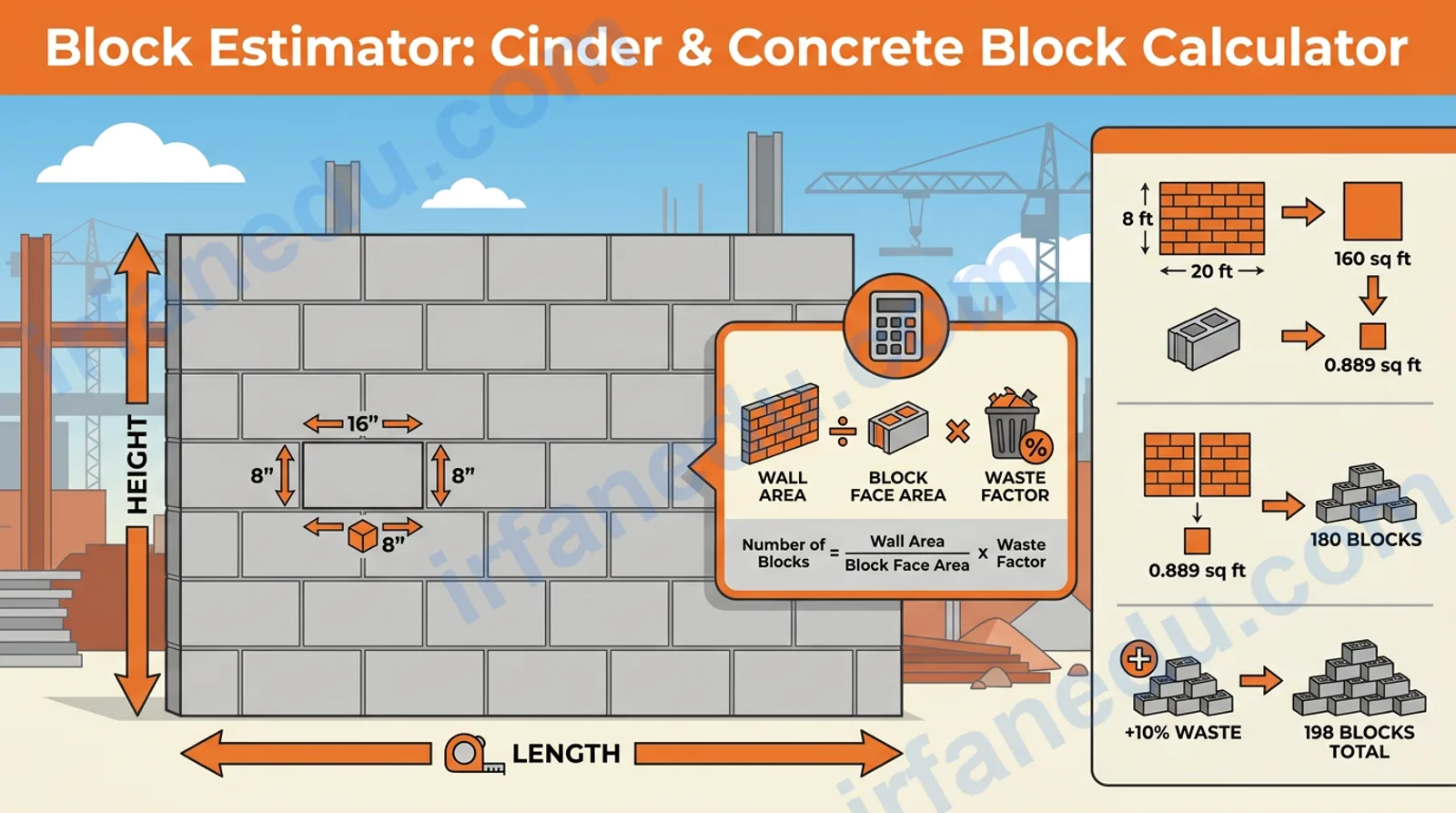
Is a block estimator really necessary, or can you just eyeball it at the hardware store? Honestly, eyeballing is how most DIYers end up making two extra trips mid-project. A single 20 ft x 8 ft garden wall needs 198 blocks with waste factored in — and being off by even 10% means 20 missing blocks that halt your pour day.
This free block estimator calculates exactly how many concrete blocks, cinder blocks, or CMU (concrete masonry units) you need for any wall. Enter your wall dimensions, pick your block size, set a waste factor, and get an instant count with a full step-by-step breakdown.
Divide your total wall area (length x height in square feet) by the face area of one block. A standard 8x8x16 inch CMU covers 0.889 sq ft. Then multiply by your waste factor (1.05 for 5% waste, 1.10 for 10%). Example: a 20 ft x 8 ft wall = 160 sq ft / 0.889 = 180 blocks x 1.10 = 198 blocks total.
📌 Quick Summary
- Standard 8x8x16 in CMU block covers 0.889 sq ft of wall face area.
- Formula: Blocks = (Wall Area / Block Face Area) x Waste Factor.
- Use 5-7% waste for simple walls; 10% for walls with openings or corners.
- Subtract door and window areas before calculating block count.
- One bag of mortar covers roughly 25-30 standard CMU blocks.
- Always round up to the nearest whole block when ordering.
Block Estimator Calculator
Concrete, Cinder & CMU Blocks — Free & Instant
Step-by-Step Solution
How to Use This Block Estimator
Using the calculator takes under 60 seconds. Follow these steps:
- Choose a mode. Select “Simple Wall” for a plain rectangular wall, or “Wall with Openings” if your wall has a door or window.
- Enter wall length and height in feet. If your measurements are in inches, divide by 12 first.
- Select your block size. The default is the standard 8x8x16 inch CMU. If you use a different size, pick the matching option or enter a custom face area.
- Set a waste factor. Use 5% for a clean rectangular wall, 10% for walls with cuts at corners or openings.
- Click Calculate. The result card shows your total block count, wall area, and a numbered step-by-step breakdown you can screenshot for the hardware store.
What Is a CMU / Concrete Block?
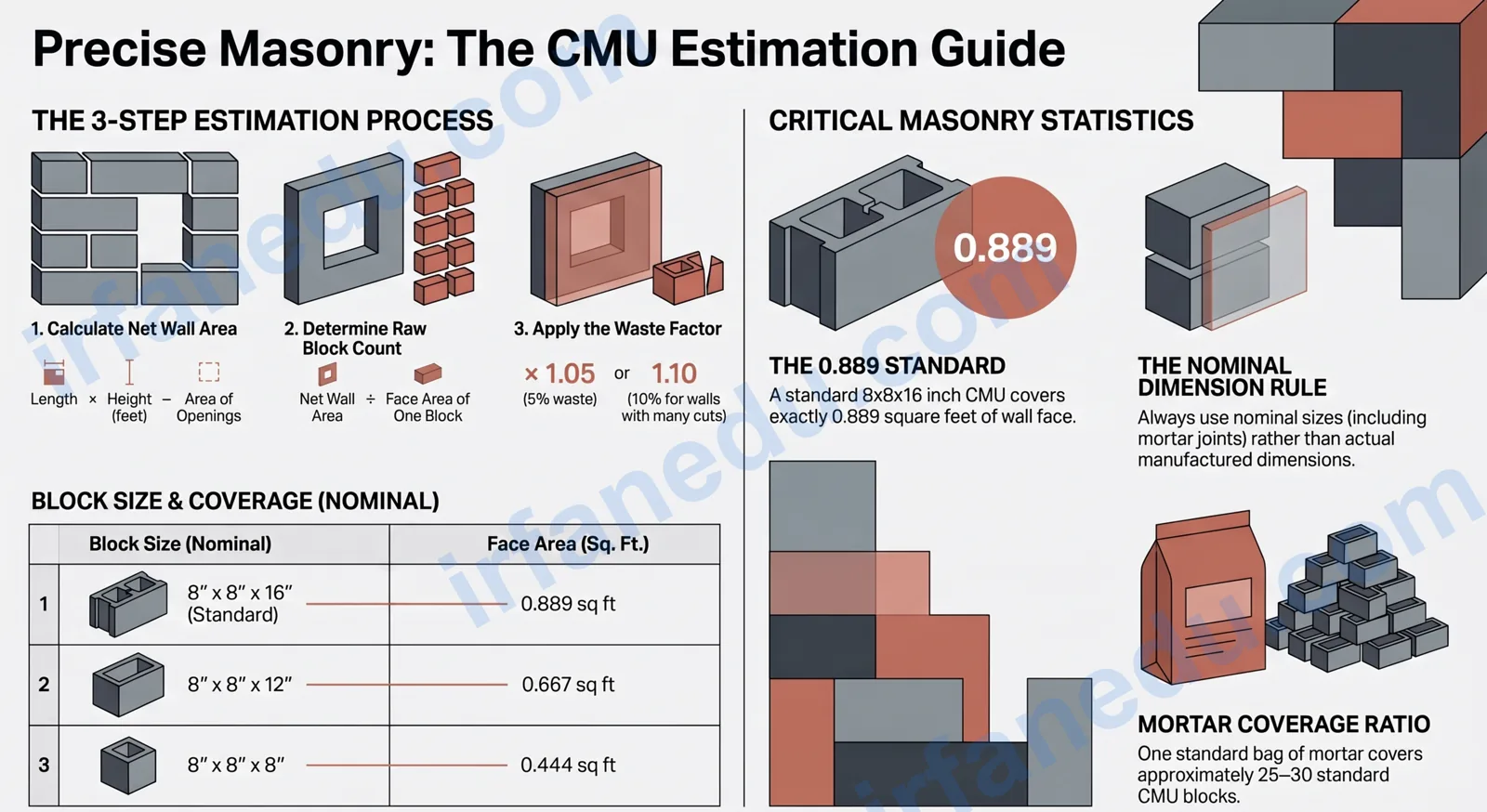
A concrete masonry unit (CMU) is a precast hollow or solid block made from Portland cement, water, and aggregates, used to build walls, foundations, and retaining structures. The term “cinder block” is the common name; CMU is the correct technical term used in engineering and construction specifications.
The nominal dimensions of the most common US block are 8 inches tall x 8 inches deep x 16 inches long. The actual manufactured size is 7-5/8 x 7-5/8 x 15-5/8 inches. The 3/8-inch difference on each face is filled by a standard mortar joint, bringing the installed dimension back to the nominal 8x8x16.
In my experience reviewing DIY project estimates, the single most common error is using the actual block dimension (15.625 in) instead of the nominal (16 in) when calculating how many blocks fit across a wall. Because mortar joints are included in the nominal size, you should always use nominal dimensions in your block count formula. Using actual dimensions overstates the number of blocks needed by about 2.4% per course — small per row, but it compounds across a 10-course wall.
The Block Estimator Formula Explained
The core formula for estimating blocks is straightforward. Every step below maps directly to what the calculator computes.
Step 1 — Wall Area:
Wall Area (sq ft) = Wall Length (ft) × Wall Height (ft)
Step 2 — Net Area (subtract openings):
Net Area = Wall Area - Sum of All Opening Areas
Step 3 — Raw Block Count:
Raw Blocks = Net Area ÷ Block Face Area
Step 4 — Apply Waste Factor:
Total Blocks = CEILING( Raw Blocks × (1 + Waste% ÷ 100) )
Variables & Symbols Table
| Symbol | Meaning | Unit |
|---|---|---|
| L | Wall length | feet (ft) |
| H | Wall height | feet (ft) |
| Awall | Total wall face area | square feet (sq ft) |
| Aopen | Total opening area (doors + windows) | square feet (sq ft) |
| Anet | Net wall area (Awall – Aopen) | square feet (sq ft) |
| Ablock | Block face area (nominal height × nominal length) | square feet (sq ft) |
| W | Waste factor percentage | % (dimensionless) |
| N | Total blocks needed (rounded up) | blocks (count) |
SI Note: If your measurements are in meters, use the same formula — just keep units consistent. 1 standard CMU in metric terms is approximately 200 mm x 200
Sources & References
Written and fact-checked by Dr Irfan Mansuri. External links open in a new tab and are provided for further reading and verification.