
French Drain Cost Calculator: Estimate Your Project
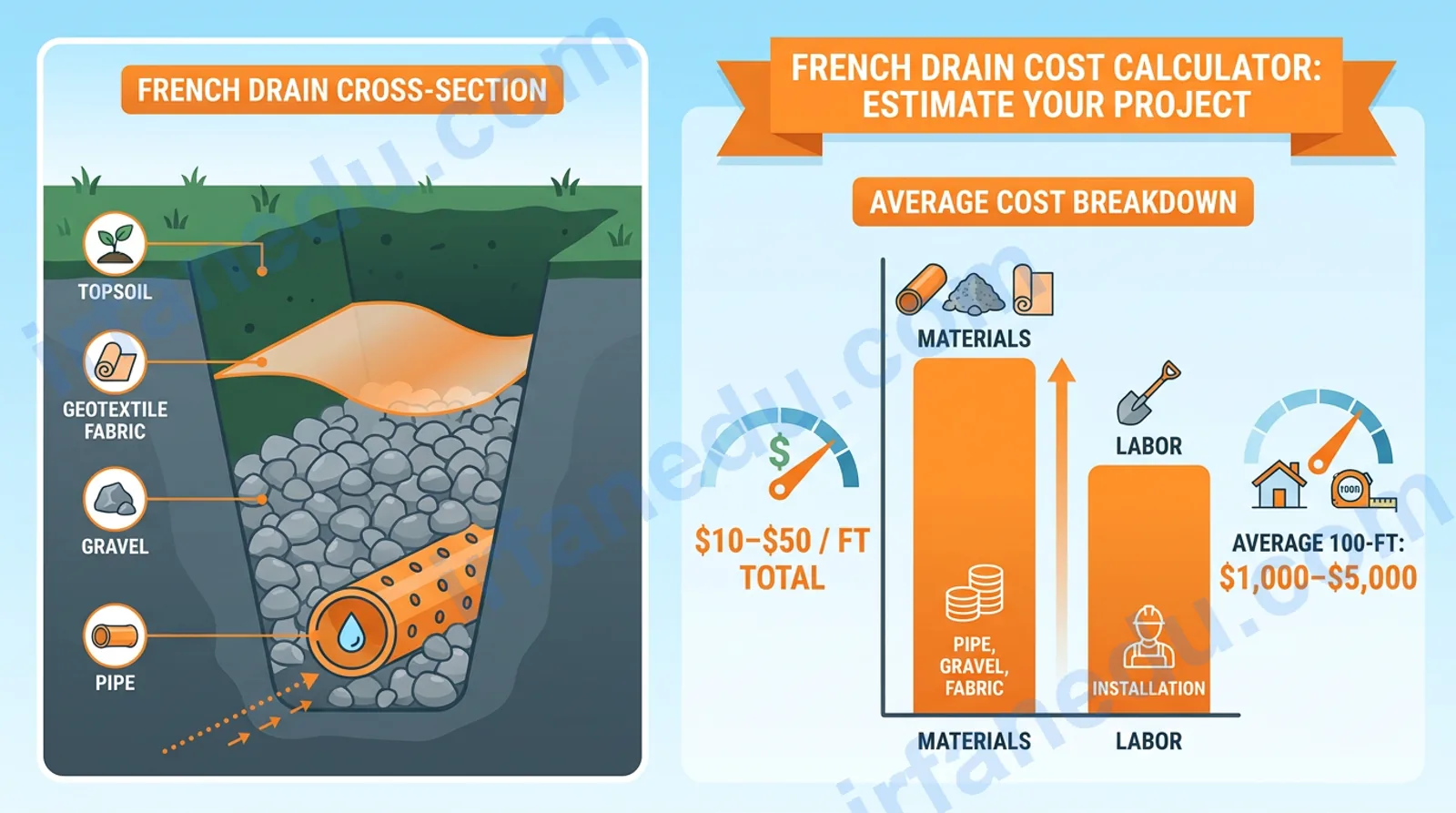
Landscape contractors use a French drain cost estimate before every bid to confirm the project is profitable at local labor rates. The math is simple once you know the four cost drivers: pipe, gravel, geotextile fabric, and labor per linear foot. This calculator does that math instantly and shows you a numbered breakdown so you understand exactly where the money goes.
Whether you are a homeowner getting quotes or a contractor double-checking a bid, this tool gives you a transparent, formula-driven estimate in under 30 seconds. Enter your project dimensions and local rates, hit Calculate, and get a total with a step-by-step cost breakdown.
- Estimate total French drain cost by length, depth, and local rates
- Understand the real formula contractors use to price jobs
- See 3 fully worked examples matching the calculator output
- Learn which cost factors move the needle most
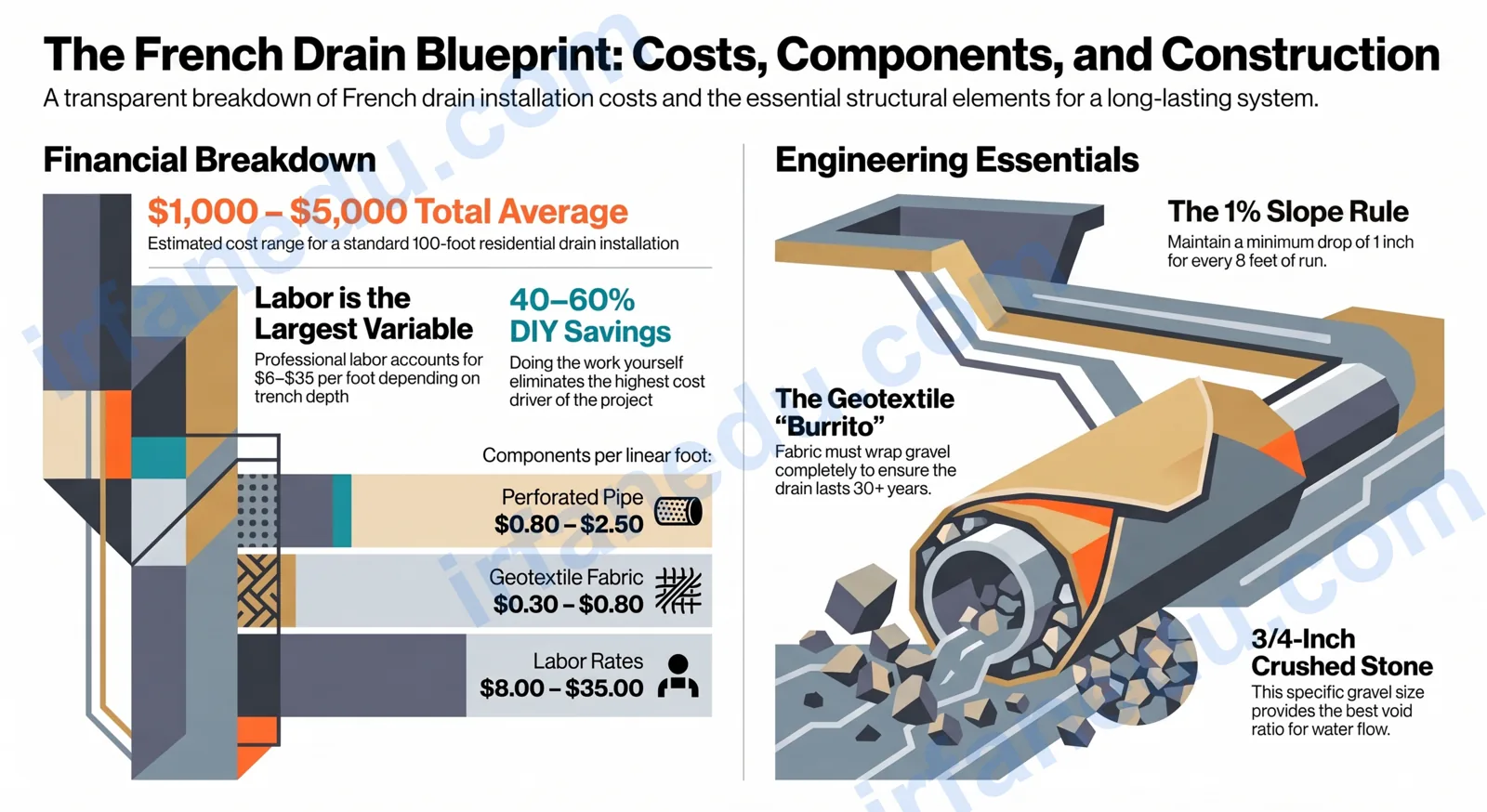
A French drain costs $10 to $50 per linear foot installed, or $1,000 to $5,000 for a standard 100-foot residential drain. Materials (perforated pipe, gravel, geotextile fabric) run $4–$15 per foot. Labor adds $6–$35 per foot depending on trench depth, soil type, and your location. Total cost = (pipe + gravel + fabric + labor) × drain length.
⚡ TL;DR
- Average cost: $10–$50 per linear foot, all-in
- A 100-ft drain typically costs $1,000–$5,000 installed
- Gravel is often the largest single material cost
- Trench depth drives labor cost more than any other factor
- Geotextile fabric is cheap but critical — skip it and the drain fails in years
- DIY saves 40–60% on labor; hire a pro for foundation drainage
French Drain Cost Calculator
How to Use This Calculator
- Choose a mode. Use “Total Project Cost” to estimate a full job by length. Use “Cost Per Linear Foot” if you already know your per-foot rates and want a quick unit cost.
- Enter drain length in linear feet (measure the path the trench will follow).
- Enter trench depth in inches. Residential drains are typically 18–24 inches deep.
- Enter pipe cost per linear foot. Standard 4-inch perforated PVC runs $0.80–$2.50/ft at most hardware stores.
- Enter gravel cost per cubic yard. Clean 3/4-inch crushed stone averages $35–$65/cu yd delivered.
- Enter fabric cost per linear foot. Geotextile filter fabric typically costs $0.30–$0.80/ft.
- Enter labor rate per linear foot. Contractor labor ranges from $8 to $35/ft depending on depth and soil.
- Click Calculate. The result card shows total cost, cost per foot, gravel volume, and a numbered breakdown.
What Is a French Drain?
A French drain is a gravel-filled trench containing a perforated pipe that redirects groundwater and surface water away from a problem area. Water enters through the gravel, flows into the pipe, and drains to a safe outlet — a dry well, a storm drain, or a lower point on the property.
The system was named after Henry Flagg French, who described it in his 1859 book on farm drainage. Despite the name, it has nothing to do with France. In my experience teaching home-improvement math to students, this is one of the most commonly misattributed construction terms.
  SURFACE (GROUND LEVEL)
  ┌──────────────────────────────────────────┐
  │  Topsoil / Grass                         │
  ├──────────────────────────────────────────┤
  │  Geotextile Fabric (wraps gravel)        │
  │  ┌──────────────────────────────────┐    │
  │  │  Clean Crushed Gravel (3/4")     │    │
  │  │     ┌─────────────────────┐      │    │
  │  │     │  Perforated PVC     │      │    │
  │  │     │  Pipe (4" dia.)     │      │    │
  │  │     │  holes face DOWN    │      │    │
  │  │     └─────────────────────┘      │    │
  │  └──────────────────────────────────┘    │
  │  Geotextile Fabric (bottom layer)        │
  ├──────────────────────────────────────────┤
  │  Native Soil / Subgrade                  │
  └──────────────────────────────────────────┘
     Water flow direction: ──────────────►
     Slope: minimum 1% (1 inch per 8 feet)
The Formula Explained
The total French drain cost formula adds four cost components, each multiplied by drain length:
Total Cost = (Pipe Cost/ft + Fabric Cost/ft + Labor Cost/ft) × Length + Gravel Cost/cu yd × Gravel Volume (cu yd)
Where: Gravel Volume (cu yd) = Length (ft) × Trench Width (ft) × Depth (ft) ÷ 27
Variables & Symbols Table
| Symbol | Meaning | Typical Unit | Typical Range |
|---|---|---|---|
| L | Drain length | linear feet (ft) | 50–300 ft residential |
| D | Trench depth | inches (in) | 18–36 in |
| W | Trench width | feet (ft) | 1–2 ft (calculator uses 1 ft) |
| Cpipe | Pipe cost per linear foot | $/ft | $0.80–$2.50/ft |
| Cgravel | Gravel cost per cubic yard | $/cu yd | $35–$65/cu yd delivered |
| Cfabric | Geotextile fabric cost per linear foot | $/ft | $0.30–$0.80/ft |
| Clabor | Labor cost per linear foot | $/ft | $8–$35/ft |
| Vgravel | Gravel volume | cubic yards (cu yd) | Calculated from L, W, D |
SI Note: This calculator uses US customary units (feet, inches, cubic yards) because that is the standard in US construction pricing. To convert: 1 linear foot = 0.305 m; 1 cubic yard = 0.765 m³.
Worked Examples
Inputs: Length = 50 ft, Depth = 18 in, Pipe = $1.50/ft, Gravel = $45/cu yd, Fabric = $0.50/ft, Labor = $12/ft
- Pipe cost: $1.50 × 50 = $75.00
- Gravel volume: 50 × 1 × (18/12) = 50 × 1.5 = 75 cu ft ÷ 27 = 2.78 cu yd
- Gravel cost: 2.78 × $45 = $125.00
- Fabric cost: $0.50 × 50 = $25.00
- Labor cost: $12 × 50 = $600.00
- Total: $825.00 ($16.50/ft)
Inputs: Length = 100 ft, Depth = 24 in, Pipe = $2.00/ft, Gravel = $50/cu yd, Fabric = $0.60/ft, Labor = $18/ft
- Pipe cost: $2.00 × 100 = $200.00
- Gravel volume: 100 × 1 × 2.0 = 200 cu ft ÷ 27 = 7.41 cu yd
- Gravel cost: 7.41 × $50 = $370.37
- Fabric cost: $0.60 × 100 = $60.00
- Labor cost: $18 × 100 = $1,800.00
- Total: $2,430.37 ($24.30/ft)
Inputs: Length = 150 ft, Depth = 36 in, Pipe = $2.50/ft, Gravel = $60/cu yd, Fabric = $0.75/ft, Labor = $28/ft
- Pipe cost: $2.50 × 150 = $375.00
- Gravel volume: 150 × 1 × 3.0 = 450 cu ft ÷ 27 = 16.67 cu yd
- Gravel cost: 16.67 × $60 = $1,000.00
- Fabric cost: $0.75 × 150 = $112.50
- Labor cost: $28 × 150 = $4,200.00
- Total: $5,687.50 ($37.92/ft)
Key Cost Factors That Move the Number
Comparison: DIY vs. Professional Installation
| Factor | DIY | Professional |
|---|---|---|
| Labor cost | $0 (your time) | $8–$35 per linear foot |
| Equipment rental | $150–$400 (trencher) | Included in labor rate |
| Materials | Same as pro | Same as DIY |
| Total savings | 40–60% vs. pro | — |
| Best for | Surface drainage, shallow trenches | Foundation drainage, deep trenches, clay soil |
| Risk | Wrong slope = standing water | Low if contractor is licensed |
In my experience reviewing home-improvement project budgets, homeowners consistently underestimate labor. A contractor charging $20/ft on a 150-ft job earns $3,000 in labor alone — and that is before materials. Always get at least three quotes and ask each contractor to break out labor from materials. That one step tells you immediately whether a bid is competitive or padded.
Soil type matters more than most guides admit. Rocky or clay-heavy soil can double excavation time and push labor costs to the top of the range. Sandy soil is fast and cheap to trench. If you are in a region with heavy clay, budget for the high end of the labor range from the start.
Trench depth drives gravel volume exponentially. Going from 18 inches to 36 inches doubles the gravel volume (and cost) for the same length drain. This is the single biggest lever in the formula — and the one most homeowners overlook when comparing bids.
Common Mistakes (And How to Avoid Them)
Wrong: Installing a French drain perfectly level. Water will pool in the pipe and the drain will fail within a season.
Right: Maintain a minimum slope of 1% (1 inch of drop for every 8 feet of run). For a 100-ft drain, that means the outlet end must be at least 12.5 inches lower than the inlet end.
Wrong: Filling the trench with gravel directly against native soil. Fine soil particles migrate into the gravel over time, clogging the voids and killing drainage in 3–7 years.
Right: Line the trench with geotextile filter fabric before adding gravel. Wrap the gravel completely (like a burrito). The drain will last 30+ years.
❗ Commonly Misunderstood: Gravel Type Changes Everything
Most cost guides say “use gravel” and leave it there. What they do not tell you is that the void ratio of the gravel — not just its volume — determines how well the drain actually works. Pea gravel (smooth, round) has a higher void ratio than crushed stone of the same size, so it drains faster. But pea gravel also migrates more easily through fabric, which means you need a tighter-weave geotextile.
In practice, 3/4-inch clean crushed stone is the best all-around choice: it is widely available, priced at $35–$65/cu yd delivered, and works with standard non-woven geotextile fabric. Avoid “crusher run” or “road base” —
Sources & References
Written and fact-checked by Dr Irfan Mansuri. External links open in a new tab and are provided for further reading and verification.