
Art appreciation class: what it is, what you learn, and why it matters 🎨
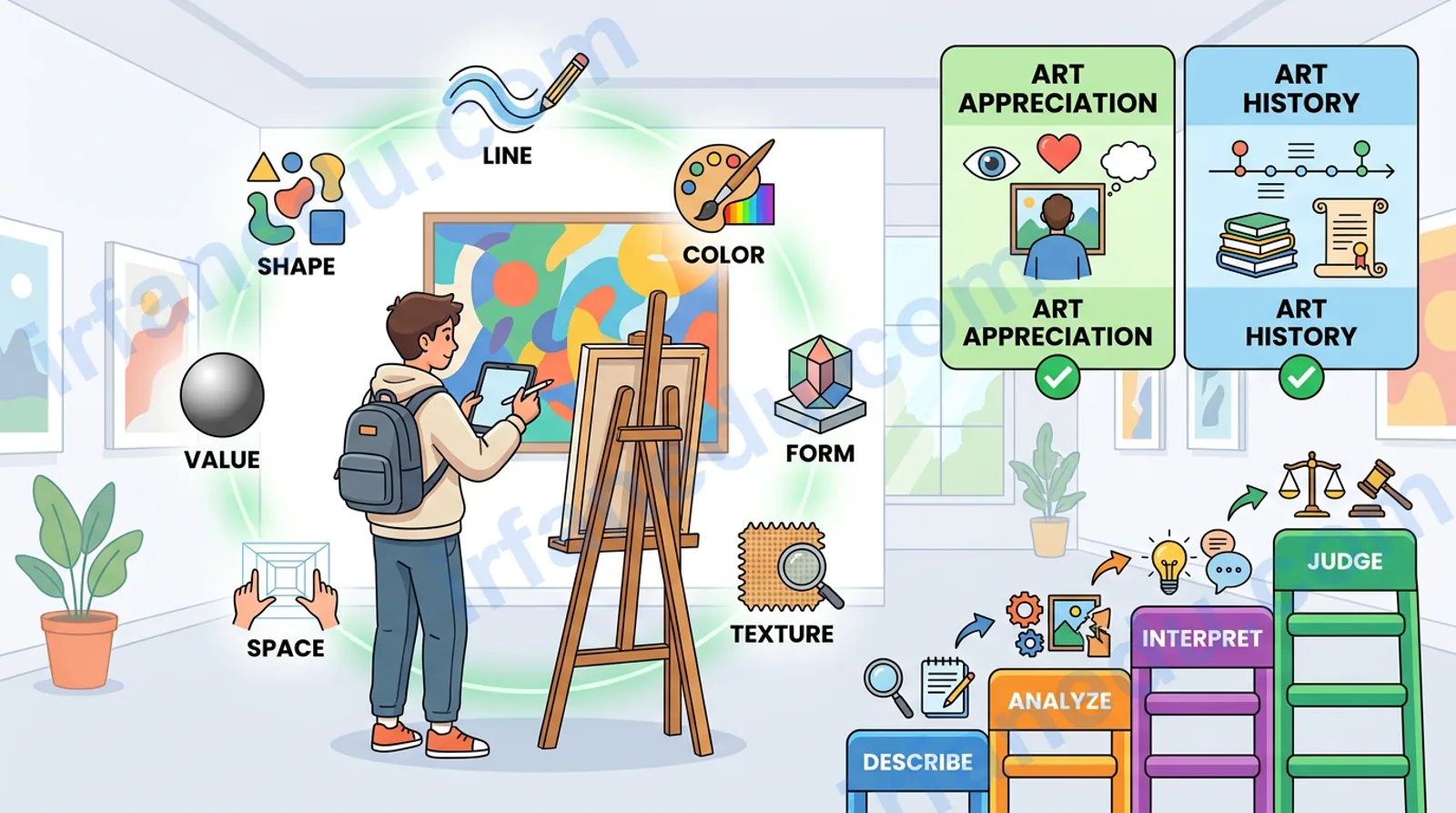
An art appreciation class is a course that teaches students to observe, analyze, and find personal meaning in visual art. It covers the seven elements of art, the principles of design, major art movements, and a four-step criticism method — all without requiring any drawing ability.
Let me ask you three quick questions before we go any further:
🟢 Have you ever stood in front of a painting and felt like everyone else “got it” except you? That feeling is exactly what this course fixes.
🟢 Do you think art class means you have to draw? It does not — art appreciation is a thinking and viewing course, not a studio course.
🟢 Is it just memorizing dead artists’ names? No. The real skill is learning a repeatable method to analyze any artwork — ancient or contemporary — and defend your interpretation with evidence.
In this guide I will walk you through everything: what the course actually covers, how you will be graded, how it compares to art history, and the one skill most students overlook that makes the difference between a B and an A.
- 🎯 Understand the seven elements of art and why they matter
- 🎯 Apply the four-step art criticism method to any artwork
- 🎯 Know how art appreciation differs from art history
- 🎯 See exactly how the course is graded and how to succeed
Art appreciation class builds visual literacy — the ability to read and respond to images critically. This skill transfers to graphic design, advertising, architecture, and everyday decision-making, making it one of the most broadly useful electives a student can take.
An art appreciation class teaches students to observe, analyze, and interpret visual art using formal elements and critical thinking — without requiring any drawing skill. It covers art movements, cultural context, and the four-step criticism method (Describe, Analyze, Interpret, Judge). Most courses are open to all students and count as a fine-arts or humanities elective credit.
What is an art appreciation class? 🖼️
An art appreciation class is a structured course that teaches students how to look at, think about, and respond to works of visual art. The course is not about making art — it is about understanding it.
The course typically spans one semester at the high school level or one term at the college level. Students examine paintings, sculptures, prints, photographs, and architecture from cultures around the world and across thousands of years of human history.
The central goal is visual literacy: the ability to decode what you see in an image, understand the choices the artist made, and form a reasoned personal response. Think of it as learning to read — but for images instead of words.
In my experience teaching this subject, the students who get the most out of art appreciation are not the ones who already love museums. They are the students who come in skeptical and leave with a completely new way of looking at the world around them — logos, films, architecture, even social media visuals. That shift in perception is the real payoff of this course.
Quick facts about art appreciation class 📊
| Feature | Details |
|---|---|
| 📚 Course type | Elective (fine arts or humanities) |
| 🎓 Typical level | High school (grades 9–12) and introductory college |
| ✏️ Drawing required? | No — this is a viewing and analysis course |
| ⏱️ Duration | One semester (high school) or one term (college) |
| 📝 Main assessments | Written analyses, art criticism essays, quizzes, museum visits |
| 🌍 Scope | Global art history from ancient to contemporary |
| 🔑 Core skill taught | Four-step art criticism: Describe, Analyze, Interpret, Judge |
| 🏅 Credit type | Fine arts or humanities elective (varies by institution) |
What are the seven elements of art? 🎨
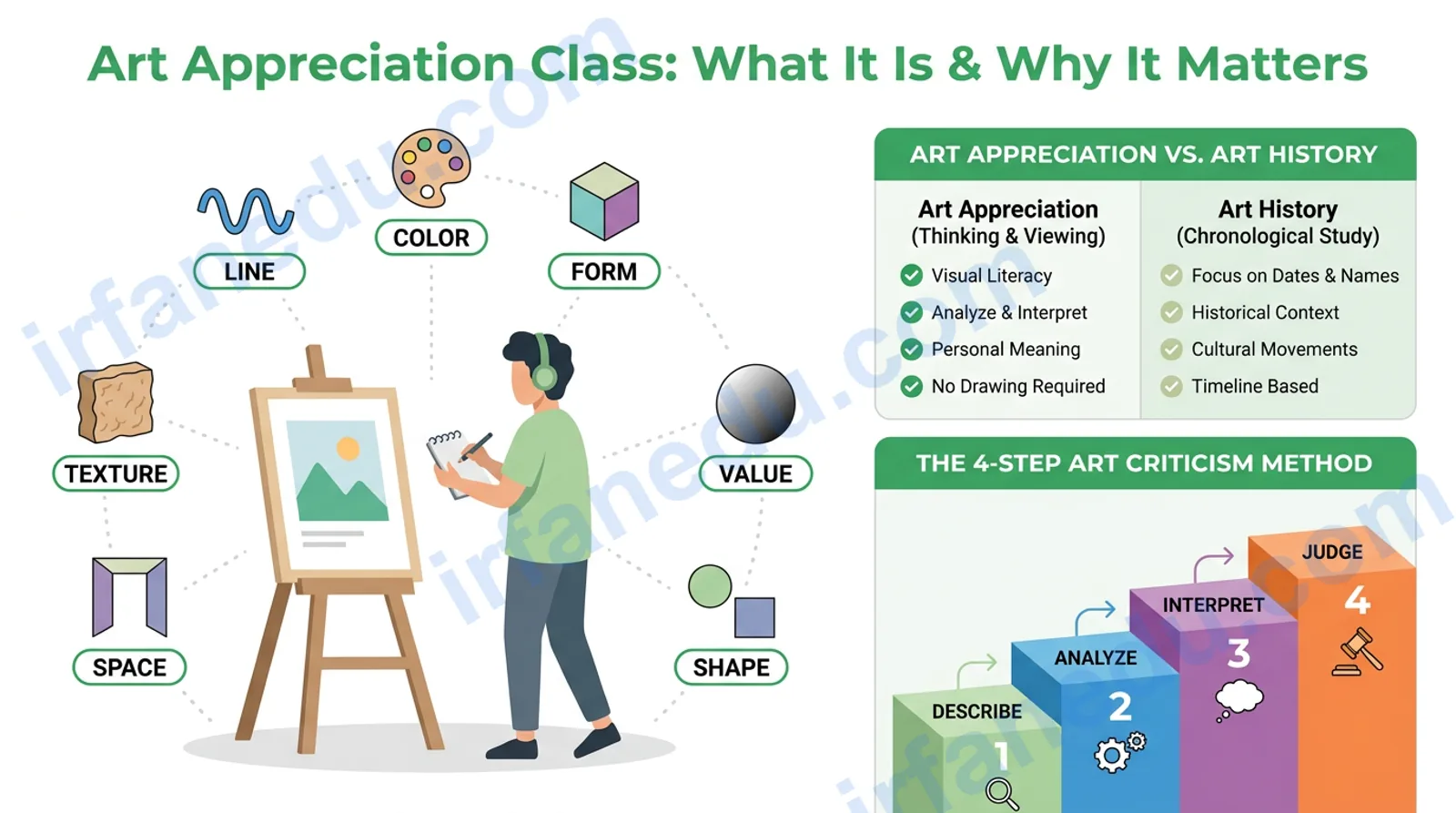
The seven elements of art are the basic building blocks every artist uses to create a work. Knowing them is the foundation of art appreciation — you cannot analyze what you cannot name.
┌─────────────────────────────────────────────────────────┐
│              THE 7 ELEMENTS OF ART                      │
├──────────────┬──────────────────────────────────────────┤
│  LINE        │  A mark with length and direction        │
│  SHAPE       │  A 2-D enclosed area (flat)              │
│  FORM        │  A 3-D shape with depth (cube, sphere)   │
│  COLOR       │  Hue + value + intensity                 │
│  VALUE       │  Lightness or darkness of a tone         │
│  TEXTURE     │  Surface quality (rough, smooth, bumpy)  │
│  SPACE       │  Area around, between, or within objects │
└──────────────┴──────────────────────────────────────────┘
Here is a quick breakdown of each element and what to look for when you encounter it in a work:
Line is the most fundamental element. A horizontal line suggests calm; a diagonal line suggests movement or tension. Artists use line to guide your eye around the composition.
Shape is a flat, enclosed area. Organic shapes (irregular, natural) feel different from geometric shapes (precise, mathematical). Recognizing shape helps you understand composition.
Form is shape with depth — a sphere instead of a circle, a cube instead of a square. Sculptors work almost entirely in form.
Color carries enormous emotional weight. Warm colors (red, orange, yellow) tend to feel energetic or aggressive; cool colors (blue, green, purple) tend to feel calm or melancholic. Color theory is a major sub-topic in most art appreciation courses.
Value refers to how light or dark a tone is. High contrast (very light next to very dark) creates drama. Low contrast creates a soft, unified mood.
Texture is the surface quality of a work — real texture you can touch, or implied texture created by brushwork or mark-making.
Space includes positive space (the subject) and negative space (the background or empty areas). Skilled artists use both intentionally.
How do you analyze art? The four-step criticism method 🔍
The four-step art criticism method gives you a repeatable framework for analyzing any artwork. It was formalized by art educator Edmund Burke Feldman and is the standard approach used in most art appreciation courses today.
-
Describe — List only what you literally see. Subject matter, colors, shapes, size, medium. No opinions yet. Example: “This oil painting shows a woman seated at a table. The palette is dominated by blues and grays. The brushwork is loose and visible.”
-
Analyze — Examine how the formal elements and principles of design work together. How does the artist use line, color, value, and space? Example: “Diagonal lines in the background create a sense of movement. The high contrast between the figure and the dark background draws the eye immediately to the subject’s face.”
-
Interpret — Propose what the work means or communicates. Use your analysis as evidence. Example: “The isolation of the figure against the dark background suggests loneliness or introspection. The muted palette reinforces a mood of quiet sadness.”
-
Judge — Form a reasoned opinion about the work’s success or impact. Defend it with evidence from the previous steps. Example: “This work succeeds in communicating emotional isolation through deliberate compositional and color choices. The loose brushwork adds a sense of vulnerability that a tighter technique would not achieve.”
Most students rush straight to Step 3 (Interpret) and skip Steps 1 and 2. This is the single biggest mistake in art criticism writing. Teachers grade on the quality of your evidence, and your evidence lives in Steps 1 and 2. Spend at least as much time describing and analyzing as you do interpreting.
Art appreciation vs. art history: what is the difference? 📚
Art appreciation and art history are related but distinct courses. Art history is primarily chronological and factual; art appreciation is primarily analytical and personal.
| Feature | Art appreciation | Art history |
|---|---|---|
| Primary focus | How to look at and respond to art | Who made what, when, and why |
| Chronological structure | Not always | Yes — ancient to contemporary |
| Personal response valued | Yes — central to the course | Less so — facts are primary |
| Memorization required | Moderate (movements, vocabulary) | Heavy (dates, artists, works) |
| Drawing required | No | No |
| Main assessment type | Written analysis, criticism essays | Slide identification, essays |
| Credit type | Fine arts or humanities | Fine arts or social studies |
In practice, most art appreciation courses include a significant amount of art history — you need context to interpret a work well. The difference is emphasis: appreciation asks “what does this mean to you and why?” while history asks “what does this tell us about its time and place?”
How is art appreciation class graded? 📝
Grading in art appreciation is more structured than most students expect. The course is not subjective in the way many assume — your grade depends on how well you apply the criticism method, not on whether your teacher agrees with your interpretation.
Typical grading components include:
- Art criticism essays (30–40%) — written analyses using the four-step method
- Quizzes and tests (25–35%) — art vocabulary, movements, and artist identification
- Class participation and discussion (15–20%) — verbal analysis and peer critique
- Museum visit or virtual gallery report (10–15%) — applied analysis in a real-world setting
- Journal or sketchbook (5–10%) — reflective writing, not drawing skill
I have reviewed dozens of student art criticism essays over the years, and the pattern is consistent: students who score highest are not the ones with the most “artistic” opinions. They are the ones who build their interpretation from specific, observable evidence in Steps 1 and 2. If your essay says “the painting feels sad,” that is an opinion. If it says “the painting uses a desaturated blue-gray palette and downward-sloping diagonal lines, which together create a mood of sadness,” that is an argument — and arguments earn marks.
Art appreciation does not mean all interpretations are equally valid.
Most students — and even some teachers — treat art appreciation as a purely subjective free-for-all where any opinion is acceptable. This is wrong, and it is the reason many students plateau at a B.
The Feldman criticism model is an evidence-based framework. Your interpretation (Step 3) must be supported by what you identified in Steps 1 and 2. An interpretation that ignores the formal elements of the work is not a valid art criticism response — it is a personal reaction. The distinction matters enormously for written assessments and for any college-level art course you take afterward.
In my experience, students who understand this distinction early write significantly stronger essays and develop a much deeper, more transferable visual literacy than those who treat the course as “just sharing feelings about art.”
1. Which step of the Feldman criticism method asks you to list only what you literally see, with no opinions?
2. Which of the following is NOT one of the seven elements of art?
3. Art appreciation class is primarily different from art history because it emphasizes:
Practice: apply what you have learned 🟢
Try these three practice exercises. Click to reveal the model answer for each.
Practice 1 — Describe this artwork: “A large oil painting shows a stormy sea at night. Waves crash against dark rocks. A small wooden boat is visible in the lower left corner. The palette is almost entirely black, dark gray, and white.”
Model answer (Describe step): The painting depicts a turbulent ocean scene at night. The dominant colors are black, dark gray, and white, creating a high-contrast, monochromatic palette. The composition is dominated by large, dynamic wave forms. A small wooden boat occupies the lower-left quadrant, appearing fragile against the scale of the waves. The medium is oil on canvas, and the brushwork appears energetic and gestural.
Practice 2 — Analyze: Using the description above, identify at least three formal elements and explain how they contribute to the work’s mood.
Model answer (Analyze step): Value: The extreme contrast between near-black waves and white foam creates a dramatic, threatening atmosphere. Line: The diagonal lines of the crashing waves create a sense of violent movement and instability. Space: The tiny boat in the lower left against the massive waves uses scale contrast to emphasize the smallness and vulnerability of humanity against nature. Together these elements build a mood of danger and awe.
Practice 3 — Interpret: Based on your analysis, what might this painting communicate about the relationship between humans and nature?
Model answer (Interpret step): The painting communicates the overwhelming power of nature and the fragility of human existence within it. The near-absence of the boat — dwarfed by the composition — suggests that human technology and effort are insignificant against natural forces. The monochromatic palette strips away any warmth or comfort, reinforcing a message of raw, indifferent natural power. This reading is supported by the deliberate scale contrast and the absence of any light source suggesting safety or rescue.
Frequently asked questions about art appreciation class ❓
Is art appreciation class hard?
Art appreciation is generally considered one of the more accessible electives. There are no drawing or painting requirements. Grades typically depend on written analysis, participation, and tests on art movements and vocabulary. Students who engage with the readings and practice the four-step criticism method consistently do well. The challenge is not technical — it is learning to write evidence-based arguments about visual experience.
Do you need to be able to draw to take art appreciation?
No. Art appreciation is a viewing and thinking course, not a studio course. You analyze and discuss art rather than create it. No drawing, painting, or prior art experience is required. The only skill you need coming in is the ability to write clearly and observe carefully — both of which the course itself will help you develop.
What is the difference between art appreciation and art history?
Art history focuses on chronological facts — who made what, when, and in what cultural context. Art appreciation focuses on how to look at and personally respond to art using formal elements and the criticism method. Many courses blend both, but appreciation emphasizes personal engagement and analytical writing over memorization of dates and names.
What does an art appreciation class cover?
A typical art appreciation course covers the seven elements of art (line, shape, form, color, value, texture, space), the principles of design, major art movements from ancient to contemporary, cultural context of artworks, and the four-step art criticism method: Describe, Analyze, Interpret, and Judge. Many courses also include a museum visit or virtual gallery component.
Does art appreciation count as a fine arts credit?
In most US school districts and many colleges, art appreciation counts as a fine arts or humanities elective credit. The exact credit type varies by institution. Always confirm with your school counselor or registrar before enrolling, especially if you are using the course to satisfy a specific graduation or degree requirement.
- Art appreciation class teaches visual literacy — how to observe, analyze, and interpret art — without any drawing requirement.
- The seven elements of art (line, shape, form, color, value, texture, space) are the vocabulary you use to describe any work.
- The four-step Feldman criticism method (Describe, Analyze, Interpret, Judge) is the core analytical framework of the course.
- Art appreciation differs from art history by emphasizing personal, evidence-based response over chronological memorization.
- Grades depend on the quality of your written arguments, not on your personal taste — evidence from Steps 1 and 2 is what earns marks.
- The most common student mistake is skipping to interpretation without building a foundation in description and analysis first.
- Visual literacy built in this course transfers directly to design, media literacy, advertising, and everyday critical thinking.
📚 Sources & references
- Khan Academy — Art History & Art Appreciation — free video lessons on art movements, formal analysis, and art criticism methods.
- Wikipedia — Art Criticism — overview of art criticism frameworks including the Feldman method.
- Encyclopædia Britannica — Art Criticism — authoritative reference on the history and practice of art criticism.
✍