
Crushed Stone Calculator: Cubic Yards & Tons
✍ Written & fact-checked by Dr. Irfan Mansuri
| Fact | Value |
|---|---|
| Standard density (crushed stone) | 1.35 – 1.5 tons per cubic yard |
| Cubic feet in 1 cubic yard | 27 ft³ |
| Typical driveway depth | 4 – 6 inches |
| Coverage at 2-inch depth | ~100 sq ft per ton |
| Recommended waste buffer | 10% |
| Most common stone type | #57 crushed limestone / granite |
A crushed stone calculator converts your project’s length, width, and depth into the exact cubic yards and tons you need to order. Enter your dimensions, pick a stone type, and get an instant result with a step-by-step breakdown — no guesswork, no over-ordering.
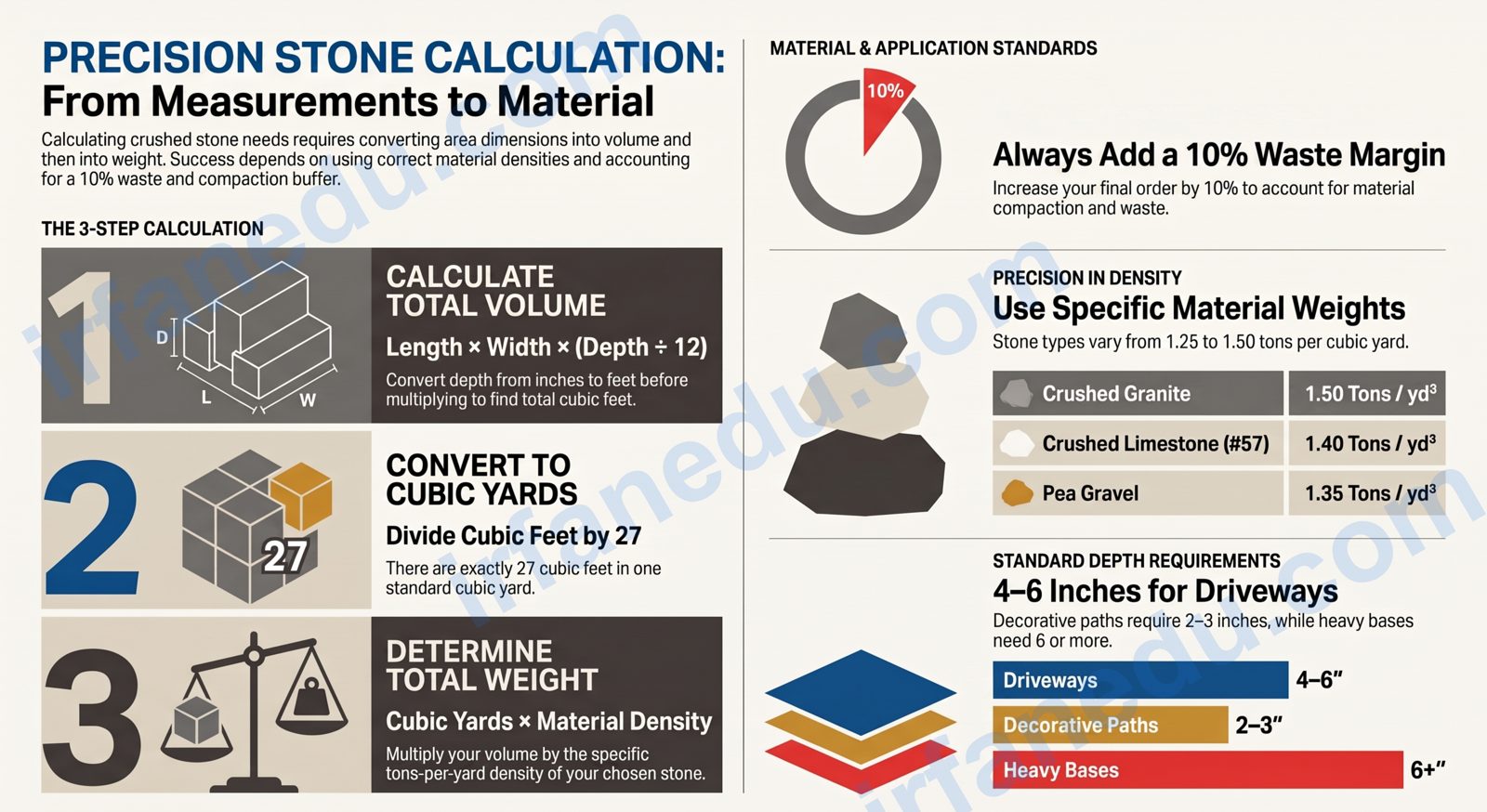
- Volume (ft³) = Length × Width × Depth (all in feet).
- Cubic yards = Volume ÷ 27; tons = cubic yards × density.
- Standard crushed stone density is 1.4 tons per cubic yard.
- Driveways need 4 – 6 in deep; paths need 2 – 3 in; base layers 6 – 8 in.
- Always add 10% extra to your final order for waste and compaction.
Crushed Stone Calculator
Get cubic yards & tons instantly — rectangular or circular area
How to Use This Calculator
- Choose your shape. Click "Rectangular Area" for standard beds, driveways, and paths. Click "Circular Area" for round features like fire-pit rings or garden circles.
- Enter dimensions. Type length and width in feet (rectangular) or the full diameter in feet (circular).
- Set depth. Enter how deep you want the stone layer in inches. Typical values: 2 in (decorative), 4 in (driveway), 6 in (heavy base).
- Pick stone type. Select from the preset list or choose "Custom density" and enter the value your supplier provides.
- Hit Calculate. Read your cubic yards, tons, and the recommended order quantity with a 10% waste buffer.
What Is Crushed Stone?
Crushed stone is mechanically quarried rock that has been broken and screened to a specific size. Unlike naturally rounded gravel, crushed stone has angular edges that interlock under load, making it the preferred base material for driveways, foundations, and drainage systems.
Common types include #57 limestone (the most widely used for driveways), crushed granite, basalt, and recycled concrete. Each type has a slightly different density, which is why the calculator lets you choose or enter a custom value.
In my experience reviewing construction projects, the single biggest ordering mistake homeowners make is using the wrong density. Many online calculators default to 1.5 tons/yd³ for all stone types. But pea gravel runs closer to 1.35 tons/yd³, so that default causes a 10-11% overestimate. Always ask your supplier for the actual bulk density of the specific product they stock — it takes 30 seconds and can save you a significant amount on large orders.
The Formula Explained
Step 1 — Volume in cubic feet:
Step 2 — Convert to cubic yards:
Step 3 — Convert to tons:
All three dimensions must be in feet before multiplying. Since depth is usually given in inches, divide it by 12 first. There are exactly 27 cubic feet in one cubic yard (3 ft × 3 ft × 3 ft = 27 ft³).
| Symbol | Meaning | SI / US Unit |
|---|---|---|
| L | Length of area | feet (ft) |
| W | Width of area | feet (ft) |
| D | Depth of stone layer | inches (in) → divide by 12 for ft |
| V | Volume | cubic feet (ft³) or cubic yards (yd³) |
| ρ | Bulk density of stone | tons per cubic yard (t/yd³) |
| T | Weight of stone needed | short tons (US tons) |
Worked Examples
Project: Rectangular driveway, 50 ft long, 12 ft wide, 4 inches of #57 limestone (1.40 t/yd³).
- Area = 50 × 12 = 600 ft²
- Depth = 4 ÷ 12 = 0.3333 ft
- Volume = 600 × 0.3333 = 200 ft³
- Cubic yards = 200 ÷ 27 = 7.41 yd³
- Tons = 7.41 × 1.40 = 10.37 tons
- Order with 10% buffer = 10.37 × 1.10 = 11.41 tons
Project: Rectangular path, 30 ft × 3 ft, 2 inches of pea gravel (1.35 t/yd³).
- Area = 30 × 3 = 90 ft²
- Depth = 2 ÷ 12 = 0.1667 ft
- Volume = 90 × 0.1667 = 15 ft³
- Cubic yards = 15 ÷ 27 = 0.56 yd³
- Tons = 0.56 × 1.35 = 0.75 tons
- Order with 10% buffer = 0.83 tons
Project: Circular area, 10 ft diameter, 3 inches of crushed granite (1.50 t/yd³).
- Radius = 10 ÷ 2 = 5 ft; Area = π × 5² = 78.54 ft²
- Depth = 3 ÷ 12 = 0.25 ft
- Volume = 78.54 × 0.25 = 19.64 ft³
- Cubic yards = 19.64 ÷ 27 = 0.73 yd³
- Tons = 0.73 × 1.50 = 1.09 tons
- Order with 10% buffer = 1.20 tons
Sources & References
Written and fact-checked by Dr Irfan Mansuri. External links open in a new tab and are provided for further reading and verification.