
What Size Aquarium Do You Actually Need? 🐠
✍ Written & fact-checked by Dr. Irfan Mansuri | Last Updated: September 2026
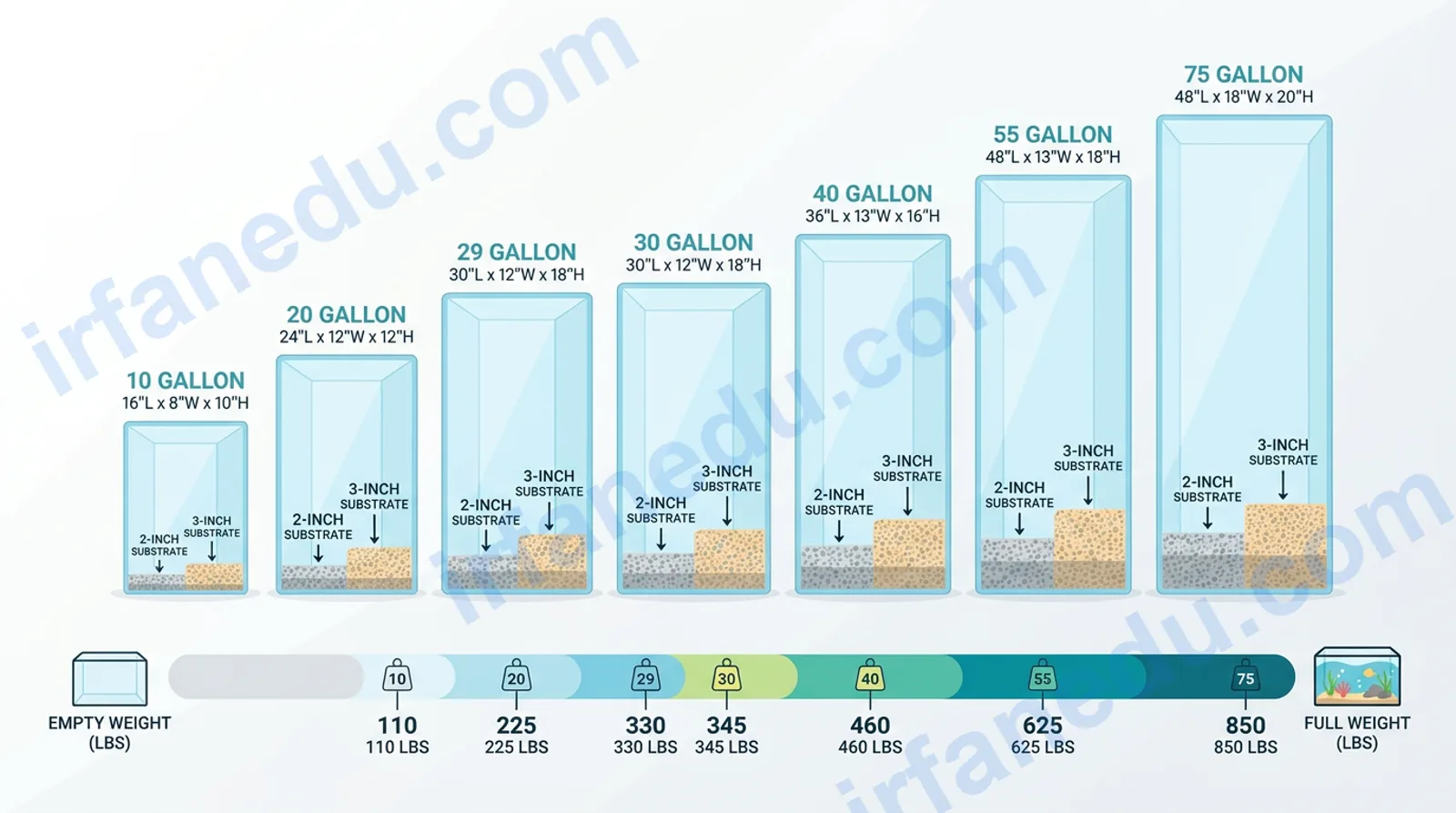
🤔 Quick self-test: You want a 30 gallon tank. How many pounds of gravel do you need for a 2-inch substrate layer? Jot down your guess — I’ll show you the exact answer with the calculator below.
Aquarium sizes in the US are measured in gallons and inches. Standard tanks range from 2.5 gallons up to 180 gallons, with the 10-gallon (20×10×12 in) and 55-gallon (48×13×21 in) being the most popular. Knowing your tank’s exact dimensions lets you buy the right stand, filter, heater, and — critically — the right amount of substrate.
In my experience helping students and hobbyists set up their first tanks, the single biggest mistake is buying substrate by guesswork. You either run short mid-setup or end up with 40 extra pounds of gravel you can’t return. This guide fixes that with a working calculator and a clear dimensions chart for every common US tank size.
- 🎯 Look up any standard US aquarium size in inches and pounds
- 🧮 Calculate exactly how much substrate you need (gravel, sand, or soil)
- 📐 Understand the volume formula so you can verify any tank
- ⚠️ Avoid the most common sizing mistakes beginners make
Aquarium sizes range from 2.5 gallons (12×6×8 in) to 180 gallons (72×24×25 in). The most popular US sizes are the 10-gallon (20×10×12 in), 20-gallon long (30×12×12 in), 29-gallon (30×12×18 in), and 55-gallon (48×13×21 in). Always confirm exact dimensions on the manufacturer’s label — sizes vary slightly by brand.
- 🐠 Standard US tanks run 2.5 to 180 gallons; 10 and 55 gallon are most popular
- 📏 A 10 gallon tank is 20×10×12 inches; a 30 gallon is 36×12×16 inches
- ⚖️ A filled 55 gallon tank weighs roughly 625 pounds — floor strength matters
- 🪨 Use 1.5 lb of gravel per gallon (2 in deep) or 2 lb per gallon (3 in deep)
- 🧮 Volume formula: L × W × H (inches) ÷ 231 = US gallons
- 🌱 Planted tanks need at least 3 inches of substrate for healthy root growth
Aquarium Substrate Calculator
Find out exactly how many pounds of gravel, sand, or soil you need
in
in
in
How to Use This Calculator
- Choose a mode: “Substrate Weight” tells you how many pounds of gravel/sand/soil you need. “Tank Volume” converts your tank’s dimensions to US gallons.
- Enter your tank’s length and width in inches. (Find these on the tank’s label or use the chart below.)
- For substrate mode: enter your desired substrate depth (2 inches for most fish-only tanks, 3 inches for planted tanks) and select your substrate type.
- Click Calculate. The result card shows the total pounds, bag count, and a numbered step-by-step solution.
- Answer to the self-test: A 30 gallon tank is 36×12 inches. At 2 inches deep with standard gravel: 36 × 12 × 2 × 1.4 × 0.03613 ≈ 43.5 lb. Did you get close? 🎉
Standard US Aquarium Sizes Chart 📏
These are the nominal dimensions used by most US manufacturers (Aqueon, Marineland, Tetra). Your actual tank may vary by up to 0.5 inch. The “Full Weight” column assumes water + standard glass + a 2-inch gravel layer.
| Tank Size | Length (in) | Width (in) | Height (in) | Empty Wt (lb) | Full Wt (lb) | Best For |
|---|---|---|---|---|---|---|
| 2.5 gal | 12 | 6 | 8 | 3 | 27 | Betta, shrimp |
| 5 gal | 16 | 8 | 10 | 7 | 62 | Betta, nano fish |
| 10 gal | 20 | 10 | 12 | 11 | 111 | Beginners, community |
| 15 gal | 24 | 12 | 12 | 21 | 170 | Community, planted |
| 20 gal (long) | 30 | 12 | 12 | 25 | 225 | Schooling fish |
| 20 gal (high) | 24 | 12 | 16 | 25 | 225 | Tall plants, angels |
| 29 gal | 30 | 12 | 18 | 40 | 330 | Community, cichlids |
| 30 gal | 36 | 12 | 16 | 48 | 348 | Community, planted |
| 40 gal (breeder) | 36 | 18 | 16 | 58 | 458 | Breeding, turtles |
| 55 gal | 48 | 13 | 21 | 78 | 625 | Cichlids, large community |
| 75 gal | 48 | 18 | 21 | 140 | 850 | Predators, large planted |
| 125 gal | 72 | 18 | 22 | 206 | 1400 | Large cichlids, reef |
A filled 55-gallon tank weighs roughly 625 lb and a 125-gallon weighs about 1,400 lb. Always place large tanks on load-bearing walls or consult a structural engineer. Most residential floors handle 40–50 lb/ft² — a 125-gallon tank can exceed that on a single footprint.
10 Gallon Aquarium Size: What You Need to Know 🐟
A 10 gallon aquarium measures 20 inches long × 10 inches wide × 12 inches tall. It is the best-selling tank size in the US because it is affordable (typically $15–$30 for the glass alone), widely available at pet stores, and manageable for a first-time fishkeeper.
At 20×10 inches of footprint, a 10 gallon gives you 200 square inches of bottom space — enough for a small community of nano fish or a single betta with live plants. For a 2-inch gravel layer, you need roughly 20 lb of standard gravel (use the calculator above to confirm).
The 10 gallon is often called a “beginner tank,” but in my experience it is actually harder to keep stable than a 20 gallon. Smaller water volume means temperature swings and ammonia spikes happen faster. If budget allows, start with a 20-gallon long — you will have far fewer water-quality headaches.
Size of a 30 Gallon Aquarium: Dimensions and Weight
A standard 30 gallon aquarium measures 36 inches long × 12 inches wide × 16 inches tall. Fully set up with water, gravel, and equipment, it weighs approximately 300–350 pounds.
The 36-inch length is a sweet spot — it fits most standard aquarium stands, accepts a wide range of hood/light sizes, and gives schooling fish enough horizontal swim space. Note that the 29 gallon (30×12×18 in) is taller and narrower, which suits tall plants and angelfish but gives less bottom territory.
  29 GALLON (30×12×18 in)     30 GALLON (36×12×16 in)
  ┌────────────────────┐       ┌──────────────────────────┐
  │                    │ 18"   │                          │ 16"
  │   Taller profile   │       │   Wider footprint        │
  │   Good for tall    │       │   Better for schooling   │
  │   plants/angels    │       │   fish & planted layouts │
  └────────────────────┘       └──────────────────────────┘
        30" wide                        36" wide
  Volume: ~29 gal               Volume: ~30 gal
The Aquarium Volume Formula Explained
You can calculate any rectangular aquarium’s volume in US gallons with one simple formula. There are exactly 231 cubic inches in one US gallon — that is the conversion constant you need.
Volume (gallons) = Length (in) × Width (in) × Height (in) ÷ 231

Substrate Weight (lb) = L (in) × W (in) × Depth (in) × Density (lb/in³)
| Symbol | Meaning | US Unit |
|---|---|---|
| L | Tank interior length | inches |
| W | Tank interior width | inches |
| H | Tank interior height | inches |
| 231 | Cubic inches per US gallon (exact) | in³/gal |
| D | Desired substrate depth | inches |