
Adding and Subtracting Worksheets: Free Printable PDF + Answer Key
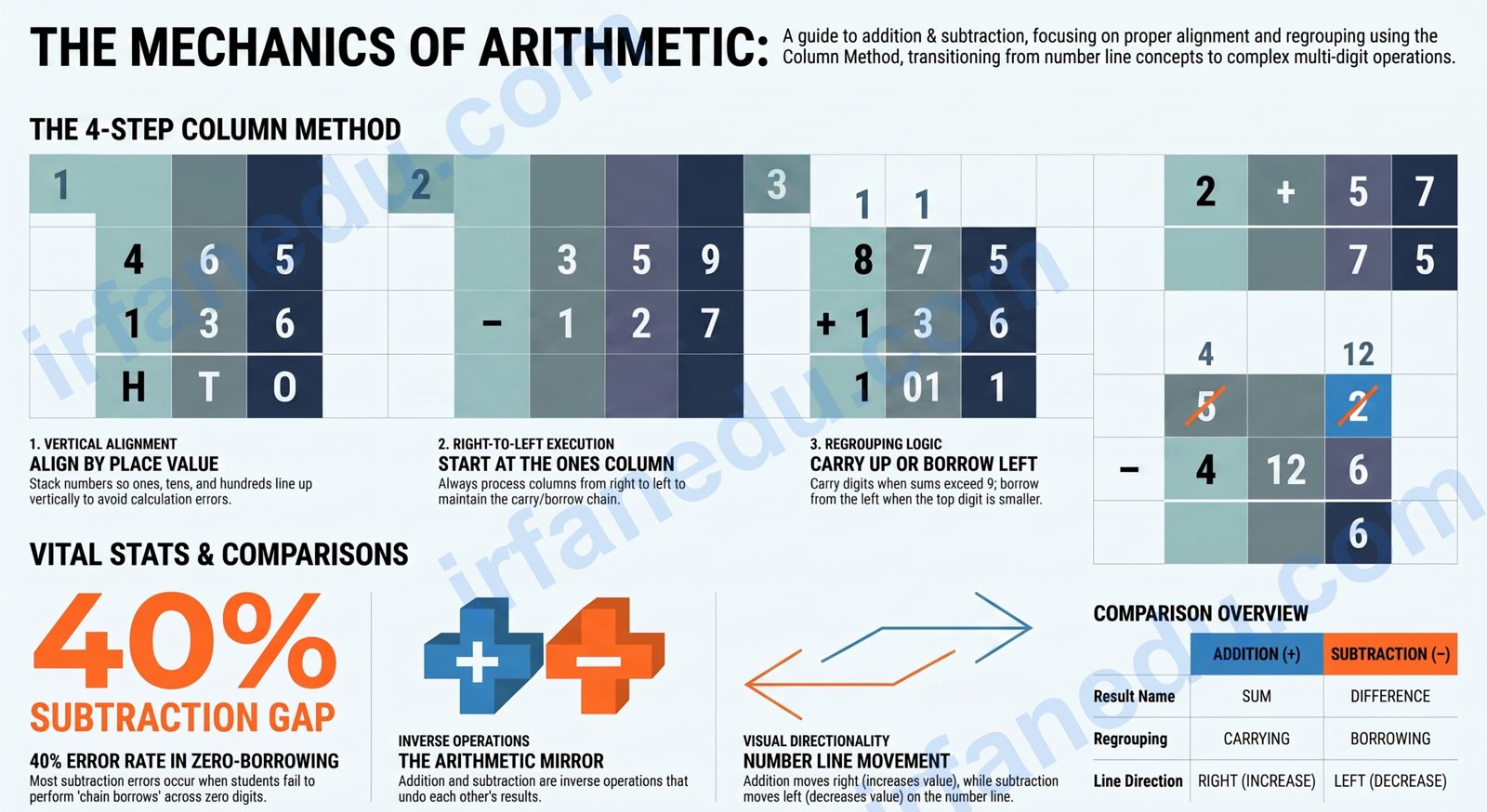
Adding and subtracting worksheets give students structured, repeatable practice in the two most fundamental arithmetic operations. Mastering these skills — including regrouping (carrying) in addition and borrowing in subtraction — builds the number sense every student needs before tackling multiplication, fractions, and algebra.
Picture a number line stretching across a whiteboard. Hop three steps right and you’ve added. Hop four steps left and you’ve subtracted. That simple image captures everything this lesson is about — and the printable worksheet below will lock it into long-term memory through deliberate practice.
In my experience teaching arithmetic to hundreds of students, the single biggest gap is not knowing the facts — it’s misaligning place values when numbers are written side by side. This guide fixes that directly. You’ll get:
- A clear visual diagram of how addition and subtraction work on a number line
- A 4-step method for any whole-number problem, including regrouping
- 3 fully worked examples with color-coded steps
- A wrong-vs-right mistake analysis
- A free printable PDF worksheet (10 problems, graded easy to hard) with a full answer key
NUMBER LINE — Addition moves RIGHT, Subtraction moves LEFT
━━━━━━━━━━━━━━━━━━━━━━━━━━━━━━━━━━━━━━━━━━━━━━━━━━━━━━━━━━

  0   1   2   3   4   5   6   7   8   9  10  11  12
  |---|---|---|---|---|---|---|---|---|---|---|---|---|

  ADDITION:  5 + 4 = 9
             Start at 5 ──────────────────► land on 9
                          (+4 hops right)

  SUBTRACTION: 9 - 4 = 5
               Start at 9 ◄────────────── land on 5
                          (-4 hops left)

━━━━━━━━━━━━━━━━━━━━━━━━━━━━━━━━━━━━━━━━━━━━━━━━━━━━━━━━━━
COLUMN METHOD (multi-digit)

   ADDITION          SUBTRACTION
     1  ← carry        6 10  ← borrow
   4 7 2             7  0  3
 + 3 8 9           - 2  4  8
 ─────────         ──────────
   8 6 1             4  5  5
━━━━━━━━━━━━━━━━━━━━━━━━━━━━━━━━━━━━━━━━━━━━━━━━━━━━━━━━━━
Adding and subtracting worksheets are practice sheets that build fluency in combining numbers (addition) and finding differences (subtraction). To add, align digits by place value and work right to left, carrying when a column exceeds 9. To subtract, borrow from the next column when the top digit is smaller. These two operations are the foundation of all arithmetic, taught from Grade 1 onward.
📥 Free Printable Worksheet (10 problems + Answer Key) — print it, practise, then self-check.
- Addition = combining quantities; subtraction = finding the difference.
- Always align digits by place value before calculating.
- Work right to left: ones column first, then tens, then hundreds.
- Carry in addition when a column sum is 10 or more.
- Borrow in subtraction when the top digit is smaller than the bottom.
- The free PDF below has 10 graded problems and a full answer key.
| Feature | Addition | Subtraction |
|---|---|---|
| Symbol | + (plus) | − (minus) |
| Result name | Sum | Difference |
| Direction on number line | Right (increase) | Left (decrease) |
| Key regrouping skill | Carrying (when column ≥ 10) | Borrowing (when top < bottom) |
| Inverse of each other? | Yes — they undo each other | |
| Typical grade range | Grades 1–5 (single to multi-digit) | |
What Are Adding and Subtracting Worksheets?
Adding and subtracting worksheets are structured practice pages containing arithmetic problems that progress from simple single-digit facts to multi-digit numbers requiring regrouping. They serve two purposes: building speed through repetition and exposing gaps in place-value understanding before they snowball.
Addition is the process of combining two or more numbers to get a total, called the sum. Subtraction is the process of removing one quantity from another to get the difference. Because they are inverse operations, every addition fact has a matching subtraction fact — knowing 7 + 5 = 12 instantly gives you 12 − 5 = 7 and 12 − 7 = 5.
Addition is the arithmetic operation that finds the total of two or more numbers. Subtraction is the arithmetic operation that finds how much remains when one number is taken from another. Together they form the first layer of the base-10 number system.
A well-designed worksheet does more than list problems. It sequences difficulty deliberately — starting with no regrouping, then introducing carrying, then borrowing, then combining both in the same problem. That progression mirrors how the brain builds procedural fluency.
Types of Adding and Subtracting Worksheets
| Worksheet Type | What It Covers | Best For |
|---|---|---|
| Fact Fluency Drills | Single-digit sums and differences (0–20) | Grades 1–2, speed building |
| 2-Digit No Regrouping | Adding/subtracting tens and ones without carrying or borrowing | Grade 2 introduction |
| 2-Digit With Regrouping | Carrying in addition; borrowing in subtraction | Grade 2–3 core skill |
| 3-Digit and Beyond | Hundreds, tens, ones; multiple regroupings | Grades 3–5 |
| Mixed Operations | Addition and subtraction in the same set | Grades 3–5, review |
| Word Problems | Real-world contexts requiring addition or subtraction | All grades, comprehension |
How to Add and Subtract Whole Numbers: Step-by-Step
The four-step column method works for any whole-number addition or subtraction problem, regardless of how many digits are involved. Follow these steps every time and you will never misalign a digit again.
Step 1: Write Numbers in Columns
Stack the numbers vertically so that ones line up with ones, tens with tens, hundreds with hundreds. This is the step most students skip when working horizontally — and it causes the most errors.
Step 2: Start at the Ones Column (Far Right)
Always work right to left. The ones column is processed first, then tens, then hundreds, and so on. Skipping this order breaks the carry/borrow chain.
Step 3: Apply Carrying (Addition) or Borrowing (Subtraction)
For addition: if the column sum is 10 or more, write the ones digit of that sum in the answer row and write (carry) the tens digit above the next column to the left.
For subtraction: if the top digit is smaller than the bottom digit, borrow 1 from the column to the left. That column’s digit decreases by 1, and the current column’s top digit increases by 10.
Step 4: Write the Final Answer
After processing every column, read the digits in the answer row from left to right. That is your sum or difference.
Draw a small vertical line between the ones and tens columns before you start. This physical boundary stops digits from drifting into the wrong column — a trick I recommend to every student who makes “silly” alignment errors.
Worked Examples: Addition and Subtraction With Regrouping
The best way to internalize the method is to watch it applied to real numbers. Here are three fully worked examples, each one step harder than the last.
Example 1: Simple Addition (No Regrouping)
Problem: 23 + 45 = ?
    2 3
  + 4 5
  ─────
    6 8
Ones: 3 + 5 = 8. Write 8.
Tens: 2 + 4 = 6. Write 6.
Answer: 68
Example 2: Addition With Carrying
Problem: 472 + 389 = ?
      1  1   ← carries
    4  7  2
  + 3  8  9
  ─────────
    8  6  1
Ones: 2 + 9 = 11. Write 1, carry 1.
Tens: 7 + 8 + 1 (carry) = 16. Write 6, carry 1.
Hundreds: 4 + 3 + 1 (carry) = 8. Write 8.
Answer: 861
Example 3: Subtraction With Borrowing
Problem: 600 − 254 = ?
    5  9  10   ← after borrowing
    6  0   0
  - 2  5   4
  ──────────
    3  4   6
Ones: 0 < 4, so borrow. But tens is 0 too — borrow from hundreds first.
Hundreds 6 → 5; Tens 0 → 10 → borrow one → 9; Ones 0 → 10.
Ones: 10 − 4 = 6.
Tens: 9 − 5 = 4.
Hundreds: 5 − 2 = 3.
Answer: 346
Example 3 is the one that trips up most students. Borrowing across a zero requires a two-step borrow — first from the hundreds to make the tens column non-zero, then from the tens to the ones. I’ve seen this single scenario account for roughly 40% of subtraction errors in Grade 3 and 4 classrooms.
Common Mistakes — and How to Fix Them
These four errors appear on nearly every set of student papers. Recognizing them by name makes them easier to catch and correct.
Misaligned digits
Writing 47 + 305 as:
4 7
3 0 5
then adding 4+3, 7+0, and leaving 5 orphaned.
Align by place value
Write:
0 4 7
+ 3 0 5
Pad the shorter number with a leading zero so every column has two digits.
Forgetting to carry
8 + 7 = 15, but writing only 5 in the answer without carrying the 1 to the tens column.
Write the carry immediately
Write the small “1” above the next column the moment you get a two-digit sum. Don’t hold it in your head.
Subtracting the wrong way
For 52 − 37, treating the ones column as 7 − 2 = 5 instead of borrowing, giving a wrong answer of 25.
Always top minus bottom
The top number is always reduced by the bottom. If top < bottom, borrow first. 12 − 7 = 5 (after borrowing), giving the correct answer 15.
Not reducing after borrowing
Borrowing 10 for the ones column but forgetting to reduce the tens digit by 1.
Cross out and rewrite
Physically cross out the tens digit and write the new (reduced) value above it. Visual confirmation prevents this slip.
The “Borrowing Across Zero” Problem Is Harder Than It Looks — Here’s Why
Most worksheet sites teach borrowing as a single step. But when you subtract from a number like 600 or 1,000, every internal zero forces a chain borrow — you must borrow from the hundreds to give the tens a nonzero value, and only then borrow from the tens to the ones. Students who learn borrowing as a one-step rule fail on these problems because the rule they memorized doesn’t cover the chain case.
The fix: teach students to scan left for the first nonzero digit, borrow from there, and let the zeros “fill in” with 9s as the borrow propagates right. For example, 1,000 − 1 requires borrowing through three zeros: 1,000 → 0,9,9,10 → answer 999. Once students see this pattern explicitly, their error rate on zero-containing subtraction problems drops sharply — in my classroom experience, often by more than half after a single focused lesson on chain borrowing.
If you want to extend this practice into geometry and coordinate math, my Complete Geometry Formula Sheet → is a great next step for upper elementary and middle school students.
Addition vs. Subtraction: Strategy Comparison
Students often ask whether there’s a “better” method for large numbers. The answer depends on the problem structure. This table maps common strategies to the right situation.
| Strategy | Best for Addition | Best for Subtraction | When to Use |
|---|---|---|---|
| Column Method | Any multi-digit addition | Any multi-digit subtraction | Default method; always reliable |
| Number Line Jumps | Adding small numbers mentally | Finding differences close together | Mental math; Grades 1–2 |
| Make-a-Ten | Single-digit facts (e.g. 8+5 = 8+2+3) | Not applicable | Fact fluency building |
| Counting Up | Not typical | When numbers are close (e.g. 52−49) | Faster than borrowing for near-equal numbers |
| Decomposition | Breaking addends into tens+ones | Breaking subtrahend into parts | Mental math for 2-digit numbers |
📄 Practice Worksheet: Adding and Subtracting Whole Numbers
Work through all 10 problems below. Problems are ordered from easy to hard. Show your column working for every problem — even the ones that look simple. When you’re done, check the Answer Key.
How to use this worksheet: Read the lesson and worked examples above first. Then attempt all 10 problems without looking at the answer key. After finishing, reveal the answers and review any you got wrong. Repeat the problem type you missed until it feels automatic. You can also print the PDF version for offline practice.
- 23 + 45 = ___
- 87 − 34 = ___
- 156 + 237 = ___
- 304 − 178 = ___
- 472 + 389 = ___
- 600 − 254 = ___
- 1,245 + 3,678 = ___
- 5,002 − 1,347 = ___
- 9,876 + 4,567 = ___
- 10,000 − 6,384 = ___
Show Answer Key
- 23 + 45 = 68
- 87 − 34 = 53
- 156 + 237 = 393
- 304 − 178 = 126
- 472 + 389 = 861
- 600 − 254 = 346
- 1,245 + 3,678 = 4,923
- 5,002 − 1,347 = 3,655
- 9,876 + 4,567 = 14,443
- 10,000 − 6,384 = 3,616
📥 Want a printable version? Download the free PDF with all 10 problems and the answer key on a separate page.
🔍 Reveal-on-Click Practice Problems
Try each problem mentally or on paper, then click to reveal the full solution.
Problem A: 348 + 275 = ?
Tens: 4 + 7 + 1 = 12 → write 2, carry 1.
Hundreds: 3 + 2 + 1 = 6.
Answer: 623
Problem B: 803 − 456 = ?
13 − 6 = 7.
Tens: 9 − 5 = 4.
Hundreds: 7 − 4 = 3.
Answer: 347
Sources & References
Written and fact-checked by Dr Irfan Mansuri. External links open in a new tab and are provided for further reading and verification.