
NCLEX Health Promotion and Maintenance
On this page
Where this fits in the test plan
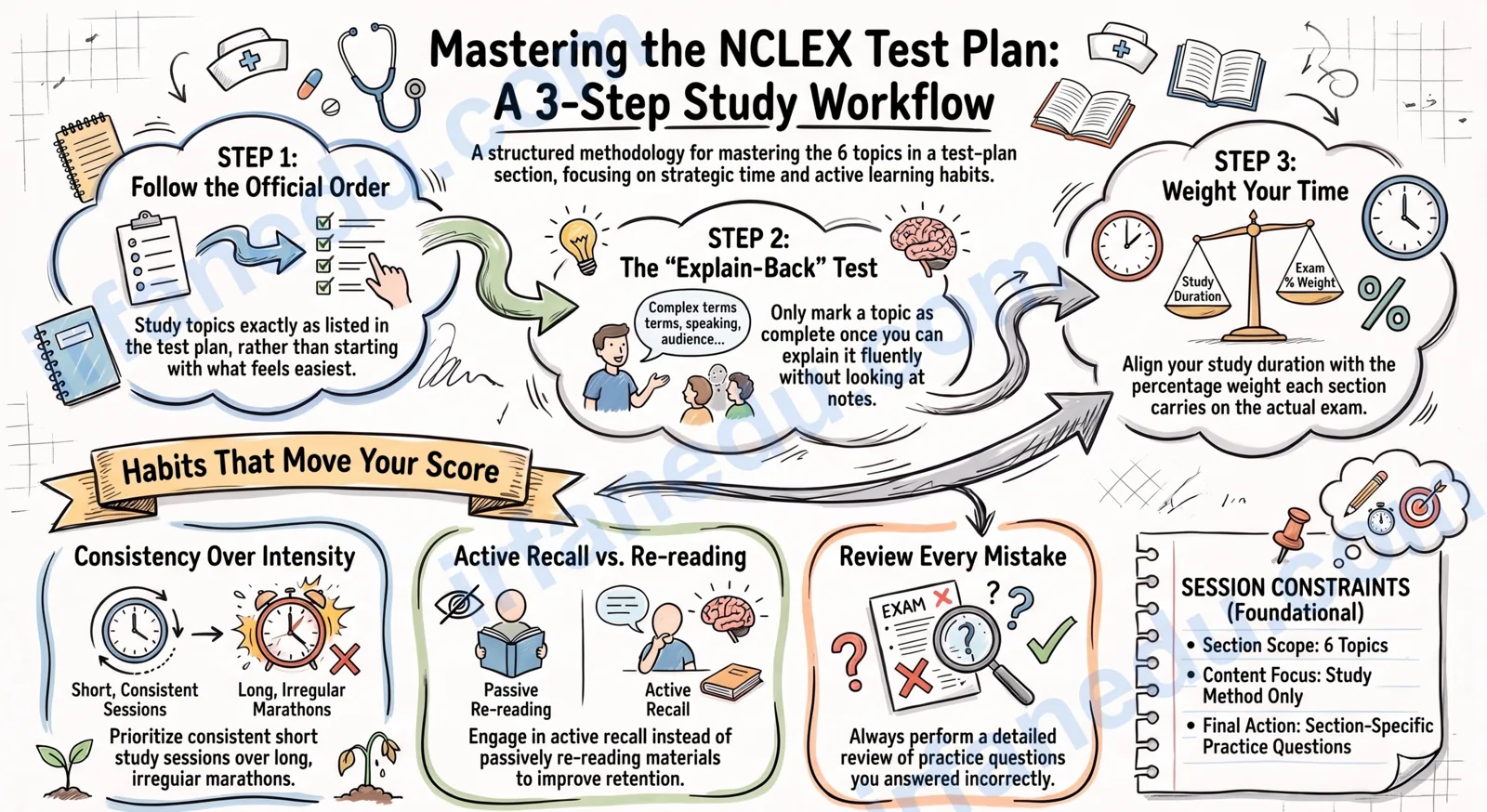
Health Promotion and Maintenance is about 9% of the items you will see. That percentage is worth taking literally when you plan revision time: a category at 9% deserves roughly 9% of your question practice, not equal time with everything else.
| Topic | Focus | Study time |
|---|---|---|
| Growth and Development high yield | Milestones, play and age-appropriate teaching | 14 min |
| Antepartum Care | Prenatal assessment, danger signs and teaching | 14 min |
| Labour and Birth high yield | Stages, fetal monitoring and complications | 15 min |
| Postpartum and Newborn Care high yield | BUBBLE-HE, haemorrhage and newborn transition | 14 min |
| Screening and Disease Prevention | Immunisations, screening intervals and lifestyle teaching | 11 min |
| The Aging Adult | Normal aging versus pathology | 10 min |
Growth and Development
Milestones, play and age-appropriate teaching
Development items ask whether a behaviour is expected for the age, or which approach fits the stage. Anchor a handful of milestones and the psychosocial stage, and most items resolve quickly.
Subtopics: Infant milestones · Toddler and preschool · School age and adolescent · Erikson stages · Age-appropriate play
Motor milestone anchors
Two months social smile, four months rolls front to back and holds the head steady, six months sits with support and transfers objects, nine months crawls and develops a pincer grasp, twelve months pulls to stand and says one to three words.
Erikson stages
Infant: trust versus mistrust. Toddler: autonomy versus shame. Preschool: initiative versus guilt. School age: industry versus inferiority. Adolescent: identity versus role confusion.
Play by stage
Infants use solitary play, toddlers parallel play, preschoolers associative play and school-age children cooperative play with rules.
Fear by stage
Infants fear separation, toddlers fear separation and loss of control, preschoolers fear bodily harm and mutilation, school-age children fear loss of control, adolescents fear altered body image and separation from peers.
High-yield points
- Birth weight doubles by about six months and triples by twelve months.
- The posterior fontanelle closes by two months; the anterior fontanelle closes between twelve and eighteen months.
- Stranger anxiety appears around six to eight months and is a normal, reassuring finding.
- Toddlers say no to assert autonomy. Offer limited choices rather than open questions.
- Preschoolers think magically and take language literally; avoid phrases like ‘we will put you to sleep’.
- Adolescents need privacy, honesty about body image effects and involvement in decisions.
- Allow a toddler to hold a favourite object during a procedure and perform painful procedures in the treatment room, not the bed.
Antepartum Care
Prenatal assessment, danger signs and teaching
Antepartum items separate the normal discomforts of pregnancy from the findings that need immediate reporting. Nearly every stem hinges on that distinction.
Subtopics: Prenatal visits · Danger signs · Nutrition in pregnancy · Common discomforts · Gestational complications
Presumptive, probable, positive signs
Presumptive signs are what the client feels, probable signs are what the examiner observes, and positive signs are attributable only to the fetus: fetal heart tones, visualised fetus and examiner-palpated movement.
Danger signs
Vaginal bleeding, leaking fluid, severe or persistent headache, visual disturbance, epigastric pain, decreased fetal movement, painful urination, persistent vomiting and signs of preterm labour.
Nutrition
Folic acid 400 to 800 micrograms daily before and during early pregnancy prevents neural tube defects. Iron needs rise; take with vitamin C and avoid taking with milk or tea.
Weight and fundal height
After about 20 weeks the fundal height in centimetres approximates the gestational age in weeks. A discrepancy of more than two to three centimetres is investigated.
High-yield points
- Fetal heart rate baseline is 110 to 160 beats per minute.
- Quickening is felt around 16 to 20 weeks in a first pregnancy.
- Supine hypotensive syndrome is relieved by turning the client to the left side.
- Painless bright red bleeding suggests placenta previa; never perform a vaginal examination.
- Painful dark bleeding with a rigid uterus suggests abruption.
- Rh-negative clients receive Rh immune globulin at about 28 weeks and again within 72 hours of birth if the newborn is Rh positive.
- Advise avoidance of raw fish, unpasteurised dairy, deli meats, alcohol and cat litter boxes.
Labour and Birth
Stages, fetal monitoring and complications
Fetal heart rate interpretation drives most intrapartum items. Learn which decelerations are benign and which demand immediate intervention, and the rest of the topic follows.
Subtopics: Stages of labour · Fetal heart rate patterns · Cord prolapse · Pain management in labour
Deceleration patterns
Early decelerations mirror the contraction and reflect head compression – benign. Variable decelerations are abrupt and V-shaped and reflect cord compression – reposition. Late decelerations begin after the peak and reflect uteroplacental insufficiency – act immediately.
Intervention for late decelerations
Stop oxytocin, reposition to the left side, give oxygen by non-rebreather, increase the IV fluid rate and notify the provider.
Stages of labour
First stage runs from onset to full dilation and includes latent, active and transition phases. Second stage is full dilation to birth. Third stage is birth to placental delivery. Fourth stage is the first one to four hours after birth.
Cord prolapse
An obstetric emergency. Relieve pressure on the cord by lifting the presenting part with a gloved hand, place the client in knee-chest or Trendelenburg, give oxygen and call for immediate help. Never push the cord back.
High-yield points
- Variable decelerations: reposition first. Late decelerations: stop oxytocin first.
- Moderate variability of 6 to 25 beats per minute is the most reassuring single finding.
- Assess fetal heart rate immediately after rupture of membranes, whether spontaneous or artificial.
- Amniotic fluid should be clear; green means meconium and yellow-brown may mean infection.
- Stop oxytocin if contractions are closer than every two minutes, last more than 90 seconds, or the fetal heart rate becomes non-reassuring.
- After an epidural, watch for maternal hypotension; treat with a fluid bolus and left lateral position.
- Hyperventilation in labour causes tingling and dizziness; have the client breathe into cupped hands.
Postpartum and Newborn Care
BUBBLE-HE, haemorrhage and newborn transition
Postpartum items live or die on fundal assessment and on separating a normal newborn transition finding from a pathological one.
Subtopics: Postpartum assessment · Postpartum haemorrhage · Newborn transition · Breastfeeding support
Fundal assessment
Firm, midline and at or just below the umbilicus in the first 24 hours, descending about one fingerbreadth per day. Boggy means massage; deviated means empty the bladder.
Postpartum haemorrhage
Blood loss over 500 mL after vaginal birth or 1000 mL after caesarean. Uterine atony is the leading cause, so massage first, then give a uterotonic.
Newborn transition
Respiratory rate 30 to 60, heart rate 110 to 160, temperature 36.5 to 37.5 degrees Celsius axillary. Acrocyanosis of the hands and feet is normal in the first day; central cyanosis is not.
Breastfeeding
Feed 8 to 12 times in 24 hours. Adequate intake shows as six or more wet nappies a day after day four and a return to birth weight by two weeks.
High-yield points
- Jaundice in the first 24 hours is always pathological and is reported.
- A saturated perineal pad in under one hour is excessive bleeding.
- Methylergonovine is contraindicated in hypertension; check blood pressure before every dose.
- Homan sign is unreliable; assess for unilateral calf pain, warmth and swelling instead.
- Postpartum blues resolve within two weeks; persistent symptoms or any thought of harm require immediate referral.
- Newborn vitamin K is given intramuscularly in the vastus lateralis to prevent haemorrhagic disease.
- Place the newborn skin to skin and delay the first bath to support thermoregulation and bonding.
Screening and Disease Prevention
Immunisations, screening intervals and lifestyle teaching
Prevention items usually ask you to classify an activity or to identify the client who needs a screening. Learning the three levels of prevention resolves the classification items instantly.
Subtopics: Levels of prevention · Immunisation schedule · Adult screening · Health teaching
Three levels of prevention
Primary prevents the disease from occurring, such as immunisation and helmet use. Secondary detects it early, such as mammography and colonoscopy. Tertiary limits disability after disease, such as cardiac rehabilitation.
Live vaccine cautions
Live vaccines including measles-mumps-rubella and varicella are avoided in pregnancy and in significant immunosuppression.
Teaching readiness
Teaching is effective only when the client is physically comfortable, not in acute pain or anxiety, and states a reason to learn.
High-yield points
- Immunisation is primary prevention even though it involves an injection.
- A screening colonoscopy is secondary prevention; a colonoscopy for rectal bleeding is diagnostic, not screening.
- Cardiac rehabilitation and stroke rehabilitation are tertiary prevention.
- Egg allergy is no longer an absolute contraindication to influenza vaccination in most guidance, but anaphylaxis to a previous dose is.
- Teach-back is the most reliable way to evaluate teaching: ask the client to explain it in their own words.
- Written materials should be at about a fifth to sixth grade reading level.
The Aging Adult
Normal aging versus pathology
The recurring exam question is whether a finding is normal aging or a problem. Confusion is never normal aging.
Subtopics: Normal age changes · Polypharmacy · Delirium vs dementia · Functional assessment
Expected age changes
Slower reaction time, reduced skin elasticity, decreased near vision, high-frequency hearing loss, reduced renal clearance, decreased thirst sensation and reduced bone density.
Delirium versus dementia
Delirium is acute, fluctuating, often reversible and usually has a cause such as infection, hypoxia, medication or dehydration. Dementia is gradual and progressive.
Polypharmacy
Reduced renal and hepatic clearance means standard doses can become toxic. Review every medication at each visit, including over-the-counter and herbal products.
High-yield points
- New confusion in an older adult is often the first sign of a urinary tract infection or pneumonia, not of dementia.
- Older adults may not mount a fever with infection; a change in behaviour may be the only clue.
- Reduced thirst sensation makes dehydration common; offer fluids on a schedule rather than waiting for a request.
- Anticholinergics, benzodiazepines and sedative hypnotics are high risk for falls and confusion in older adults.
- Assess function with activities of daily living and instrumental activities of daily living, not diagnosis alone.
More NCLEX practice and review
Everything on this site tagged NCLEX lives in the NCLEX category.