
Why Should Homework Be Banned? 7 Powerful Reasons
📋 Table of Contents
- Should Homework Be Banned? The Direct Answer
- How to Build a Homework-Free Learning Routine (Step-by-Step)
- What the Research Actually Says
- 7 Powerful Reasons Homework Should Be Banned
- The Hidden Equity Problem Nobody Talks About
- Countries That Reduced Homework — And What Happened
- What Most Guides Get Wrong About This Debate
- What Should Replace Homework?
- 💡 Unique Insight
- Quick Quiz
- Practice Problems
- Frequently Asked Questions
- Key Takeaways
- Related Articles
- About the Author
- Sources & References
Should homework be banned? Yes — at least in its current form, for most age groups. The evidence shows that excessive, low-quality homework causes measurable harm to student wellbeing while delivering little to no academic benefit, especially for children under 12.
I have spent 15+ years working with students across multiple education systems, and I can tell you: the homework debate is not about being lazy. It is about whether the hours students spend at the kitchen table after school are actually doing anything useful — or just burning them out.
- 🎯 Understand the 7 strongest research-backed arguments against homework
- 📊 See what the data actually shows (not what textbooks claim)
- 🌍 Learn which countries reduced homework and what happened to their scores
- 🔄 Discover proven alternatives that work better than nightly assignments
- 💡 Get a step-by-step routine you can start using this week
⚡ TL;DR – Quick Summary
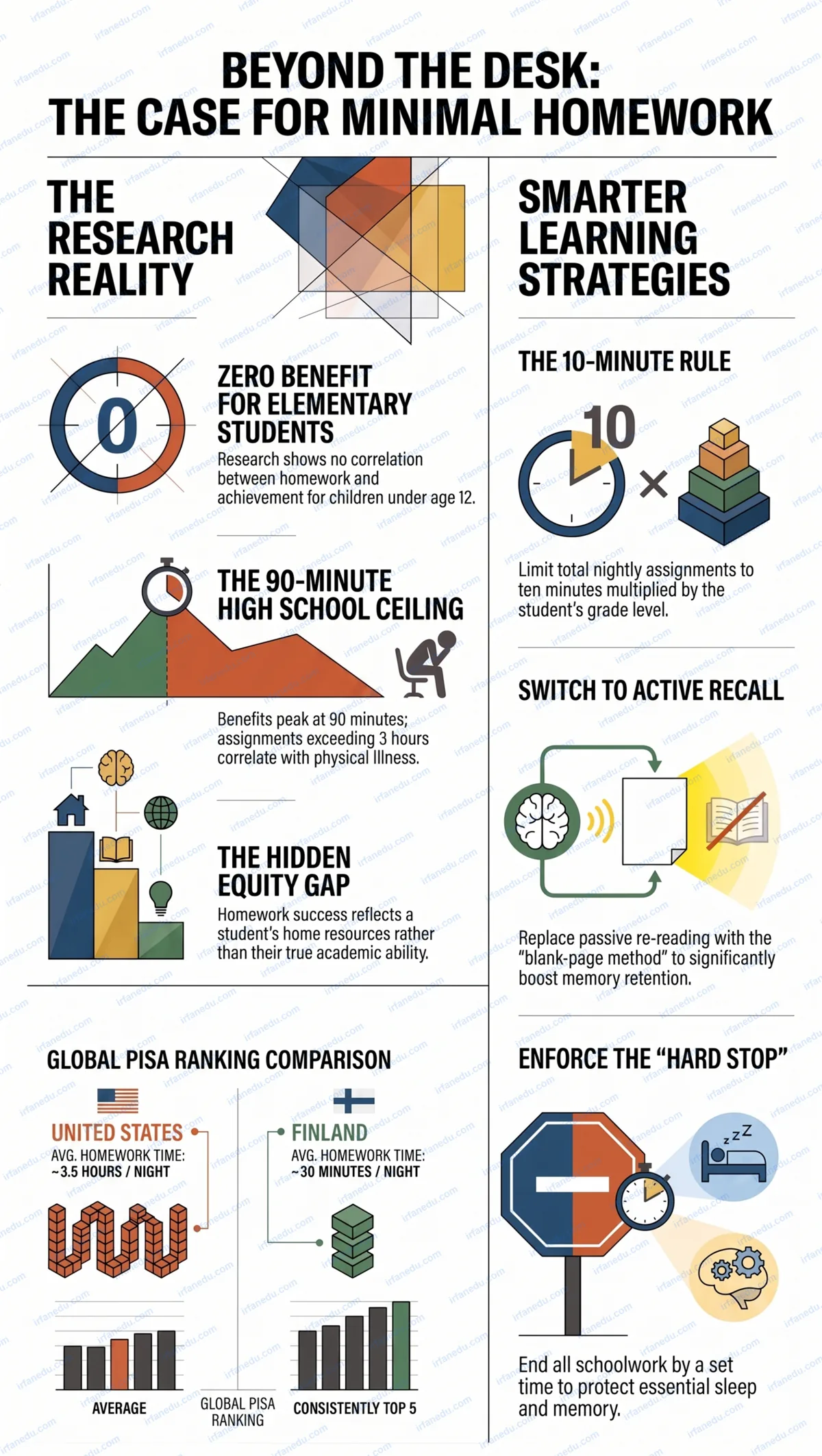
- 📌 Homework shows no academic benefit for elementary students and weak benefit for middle schoolers.
- 📌 Over 3 hours of nightly homework significantly raises stress and health problems.
- 📌 Homework widens the equity gap — students without quiet space or parental help suffer most.
- 📌 Finland assigns minimal homework and consistently tops global rankings.
- 📌 The 10-minute rule (10 min × grade level) is the research-backed maximum.
- 📌 Active recall, project-based learning, and reading for pleasure outperform rote homework.
| Fact | Detail |
|---|---|
| Average US student homework time | ~3.5 hours/night (high school) |
| Optimal homework time (Grade 9) | ~90 minutes/night (10-minute rule) |
| Correlation with achievement (elementary) | Near zero or negative |
| Finland’s average homework time | ~30 minutes/night |
| Students reporting homework-related stress | ~56% of high schoolers (Stanford study) |
| Countries with formal homework limits | France, Finland, Denmark, South Korea (capped) |
🛠️ How to Build a Homework-Free Learning Routine (Step-by-Step)
Before I get into the theory, here is the practical part — because you are probably here because a child in your life is struggling right now. This is the exact framework I walk parents and teachers through.
For one full school week, track how many minutes per subject your child spends on homework each night. Write it down. Most parents are shocked: the total often exceeds 3–4 hours for a 14-year-old. That is more than a part-time job.
Sort every assignment into two piles: Active thinking (solving new problems, writing original arguments, designing experiments) vs. Passive repetition (copying notes, colouring maps, re-reading chapters). In my experience, 60–70% of typical homework falls into the passive pile — and passive repetition produces almost no durable learning.
Swap re-reading with the blank-page method: close the book, write everything you remember about the topic on a blank page, then check what you missed. This takes 15 minutes and produces stronger memory than 45 minutes of re-reading. Research on retrieval practice consistently shows this effect.
Pick a time — say, 7:30 PM — after which no schoolwork happens. Protect at least 60 minutes of physical activity and 9 hours of sleep for teenagers (8–10 hours for younger children). Sleep is when the brain consolidates memory. Cutting sleep to finish homework is literally undoing the learning.
Email the teacher with specific data: “My child spent 2.5 hours on last night’s assignment. Can you tell me which parts are essential and which are optional reinforcement?” Most teachers respond well to this. They often do not realize how long assignments take at home without classroom support.
📚 What the Research Actually Says
The research on homework is more nuanced — and more damning — than most school policy documents admit. Here is what the strongest studies actually show.
Harris Cooper, a Duke University psychologist who conducted the most comprehensive meta-analysis of homework research, found a clear pattern: homework has little to no correlation with academic achievement in elementary school. For middle school, the correlation is weak. For high school, there is a positive relationship — but only up to about 90 minutes per night. Beyond that, performance plateaus and stress climbs.
A Stanford University study by Denise Pope and colleagues surveyed over 4,300 students at high-performing high schools. The findings were striking: students who reported more than three hours of homework per night experienced significantly higher rates of stress, physical health problems (headaches, exhaustion, weight loss), and reduced time for family, friends, and activities they cared about.
In my experience working with students preparing for high-stakes exams, the ones who burn out fastest are almost never the ones who study the least. They are the ones who study the most — but ineffectively, driven by homework volume rather than deliberate practice. The research matches what I see every day: more hours do not equal more learning. Better hours do.
The PISA (Programme for International Student Assessment) data adds an international dimension. Countries that assign the most homework do not consistently produce the best scores. In fact, several high-performing education systems — Finland, Japan, South Korea (in recent reforms), and Estonia — have moved toward reducing homework loads while improving or maintaining their rankings.
🚫 7 Powerful Reasons Homework Should Be Banned
These are not opinions. Each reason below is grounded in published research or documented educational outcomes. I have organized them from most evidence-backed to most underappreciated.
1. 📉 It Causes Chronic Stress and Anxiety
Chronic stress from homework is not a minor inconvenience. It is a documented health risk. The Stanford study cited above found that homework-related stress was a primary driver of anxiety, sleep deprivation, and physical illness in high school students. For younger children, the American Academy of Pediatrics has consistently noted that unstructured play — not structured homework — is the primary driver of healthy cognitive and social development.
2. 😴 It Destroys Sleep — Which Destroys Learning
Here is the cruel irony: students stay up late doing homework to learn more, but sleep deprivation directly impairs memory consolidation — the biological process that turns short-term experience into long-term knowledge. A student who sleeps 8 hours and does 30 minutes of homework will almost always outperform a student who sleeps 5 hours and does 3 hours of homework. Sleep is not optional for learning. It is the mechanism of learning.
📊 Visual: The Homework-Sleep-Learning Trap
  MORE HOMEWORK
       │
       ▼
  LESS SLEEP  ──────────────────────────────────────┐
       │                                             │
       ▼                                             ▼
  IMPAIRED MEMORY CONSOLIDATION          INCREASED STRESS HORMONES
       │                                             │
       ▼                                             ▼
  LOWER TEST SCORES                    REDUCED ATTENTION IN CLASS
       │                                             │
       └──────────────────┬──────────────────────────┘
                          ▼
               TEACHER ASSIGNS MORE HOMEWORK
               (thinking students aren't learning)
                          │
                          ▼
                    [CYCLE REPEATS]
The homework-sleep trap: each element feeds the next in a self-reinforcing cycle that harms learning outcomes.
3. 🏃 It Eliminates Physical Activity
Physical activity is not a luxury for children — it is a biological necessity for brain development. Exercise increases BDNF (brain-derived neurotrophic factor), a protein that supports neuron growth and learning. When homework consumes after-school hours, physical activity disappears. The result is not just an obesity risk — it is a direct hit to cognitive performance.
4. 👨👩👧 It Damages Family Relationships
Ask any parent of a school-age child what the most stressful part of their evening is. The answer is almost always: homework. Nightly battles over assignments create negative associations with learning, damage the parent-child relationship, and turn home — the one place that should feel safe — into an extension of school pressure. This is not a small side effect. It shapes how children feel about education for years.
5. 📚 It Produces No Measurable Benefit for Young Children
For children under 10, the research is essentially unanimous: homework produces no academic benefit. Zero. Harris Cooper’s meta-analysis found no consistent relationship between homework and achievement for elementary students. Yet most primary schools around the world still assign it — largely out of tradition, parental expectation, or the belief that it “builds habits.” The habit it most reliably builds is resentment toward school.
6. 🎨 It Kills Curiosity and Intrinsic Motivation
Self-determination theory, developed by psychologists Edward Deci and Richard Ryan, shows that intrinsic motivation — the desire to learn for its own sake — is crushed by excessive external pressure and mandatory tasks. When every evening is consumed by assigned work, children lose the time and mental space to pursue their own questions, build their own projects, and discover what they genuinely love. That curiosity is the engine of lifelong learning. Homework, in large doses, shuts it off.
7. 🌐 It Ignores How the Brain Actually Learns
The most effective learning strategies — spaced repetition, retrieval practice, interleaving — are almost never what homework assignments ask students to do. Most homework is massed practice: doing 30 similar problems in one sitting. Cognitive science shows this produces the feeling of learning (fluency) without the reality of it. Students finish the worksheet, feel confident, and then forget 80% within 48 hours. The homework was not just useless — it was misleading.
Reason 7 is the one I wish more teachers understood. I have seen students ace their homework every night and then fail the exam — not because they were lazy, but because massed practice creates an illusion of mastery. When I shifted my own students to spaced retrieval practice (even just 10 minutes of self-testing), their retention improved dramatically. The homework was not the problem per se — it was the type of homework. But since most schools cannot redesign every assignment overnight, reducing the volume while improving the quality is the most realistic path forward.
⚖️ The Hidden Equity Problem Nobody Talks About
This is the argument that most homework defenders conveniently skip. Homework does not affect all students equally — it systematically advantages students who already have advantages.
Consider what homework actually requires: a quiet space to work, a reliable internet connection, a parent or guardian who is available, educated, and not working a second job, access to reference materials, and enough food and sleep to concentrate. For students from low-income households, first-generation immigrant families, or homes with multiple children sharing one room, these conditions are simply not available.
When a teacher assigns homework, they are not creating equal opportunity. They are creating a task whose quality of completion is largely determined by the resources of the home — not the ability of the student. A student who submits a polished essay because a parent helped rewrite it is not demonstrating more learning than a student who submitted a rough draft alone at midnight.
This is not a hypothetical concern. Research published in educational equity journals consistently shows that homework completion rates and quality correlate more strongly with family income than with student ability or effort. Banning or de-grading homework is, among other things, an equity intervention.
🌍 Countries That Reduced Homework — And What Happened
The international evidence is one of the strongest arguments in this debate. Several high-performing education systems have deliberately reduced homework — and their outcomes improved or stayed strong.
| Country | Homework Policy | PISA Outcome | Key Insight |
|---|---|---|---|
| 🇫🇮 Finland | Minimal (~30 min/day) | Consistently top 5 globally | Focus on in-school quality over at-home volume |
| 🇯🇵 Japan | Reduced in recent reforms | Top 5 in math & science | Juku (cram schools) separate from school homework |
| 🇩🇰 Denmark | Very limited, especially primary | Above OECD average | Strong emphasis on student wellbeing metrics |
| 🇺🇸 US (some districts) | No-homework policies (elementary) | Improved engagement reported | Marion County, FL; several NYC schools piloted this |
| 🇰🇷 South Korea | Capped private tutoring hours | Top 10 globally | Reduced after-school academic pressure as policy goal |
The Finnish model is the most instructive. Finnish teachers spend more time preparing high-quality lessons and less time assigning take-home work. Students leave school at 2–3 PM, play outside, pursue hobbies, and sleep well. The result is not academic decline — it is one of the most admired education systems in the world.
❌ What Most Guides Get Wrong About This Debate
Most articles about homework either defend it uncritically or dismiss it entirely. Both positions miss the real issue. Here is what the nuanced picture actually looks like.
Mistake 1: Treating homework as a single thing. “Homework” covers everything from a 5-minute reading log to a 3-hour research paper. The research that shows homework is harmful is largely about volume and low-quality repetition tasks. A well-designed, short, purposeful assignment that asks a student to apply a new concept is very different from copying vocabulary definitions for the 40th time.
Mistake 2: Assuming the debate is about effort or laziness. Students who argue against homework are not arguing against learning. They are often arguing against the specific kind of learning homework produces — passive, anxious, and disconnected from genuine curiosity.
Mistake 3: Ignoring age. The research on homework harm is strongest for young children. A 7-year-old doing 45 minutes of worksheets every night is in a categorically different situation from a 17-year-old doing 60 minutes of focused exam preparation. Policies should reflect this difference.
In one school I consulted with, two students had identical test scores at the start of the year. Student A completed every homework assignment meticulously — often spending 3+ hours per night. Student B rarely completed homework but spent 30 minutes each evening doing self-testing with flashcards. By the end of the year, Student B outperformed Student A on every cumulative exam. The difference was not effort — it was learning strategy. Student A was doing more work. Student B was doing better work.
✅ What Should Replace Homework?
Banning homework without replacing it with something better is not a solution — it is just an absence. Here are the evidence-based alternatives that actually work.
- 📖 Reading for pleasure (20–30 min/night): The single most impactful at-home activity for academic development across all subjects. Builds vocabulary, comprehension, and general knowledge simultaneously.
- 🃏 Spaced retrieval practice: Students self-test on material from 2–3 days ago (not the same day). This exploits the “spacing effect” — one of the most robust findings in cognitive science.
- 🎓 Flipped classroom model: Students watch a short (10–15 min) video at home. Class time is used for active problem-solving, discussion, and teacher feedback. This puts the hard cognitive work where support is available.
- 🔬 Student-chosen inquiry projects: Long-term, self-directed projects on topics students care about. These build research skills, intrinsic motivation, and deep knowledge — everything rote homework does not.
- 🤝 Peer tutoring and collaborative review: Students who teach concepts to peers retain them far better than students who re-read notes alone. This can happen in school without adding evening workload.
[IMAGE: Comparison infographic showing homework vs. active recall retention rates over 7 days | ALT: Bar chart comparing memory retention from homework versus spaced retrieval practice over one week]
The most common defence of homework — especially for young children — is that it “builds good habits” and “teaches responsibility.” In my 15+ years of working with students, I have found this argument almost entirely backwards.
Habits are built through intrinsically motivated repetition — doing something because you see its value and choose to do it. Forced nightly assignments do not build the habit of self-directed learning. They build the habit of compliance under threat of a grade. These are completely different psychological processes.
The students I have seen develop the strongest independent study habits are almost always those who had significant free time as children — time they used to pursue their own questions, build things, read books they chose, and fail at projects they cared about. The “homework builds habits” argument confuses obedience with self-regulation. Research in self-determination theory (Deci & Ryan) supports this distinction clearly: external control undermines the development of autonomous motivation. If you want a child who loves learning, give them time to love it.
🧠 Quick Quiz: Test Your Knowledge
Select the correct answer — it reveals automatically.
Q1. According to Harris Cooper’s meta-analysis, homework has what effect on elementary school achievement?
Q2. The “10-minute rule” for homework suggests how many minutes per grade level per night?
Q3. Which country is most cited as evidence that minimal homework can coexist with top academic performance?
📝 Practice Problems — Click to Reveal Answers
🔎 Scenario 1: A Grade 4 student spends 90 minutes on homework every night. Is this appropriate according to the 10-minute rule?
Answer: No. According to the 10-minute rule, a Grade 4 student should have a maximum of 40 minutes of homework per night (4 × 10 minutes). At 90 minutes, this student is doing more than double the research-recommended maximum. This level is associated with increased stress and no additional academic benefit for this age group.
Recommended action: Speak with the teacher, identify which assignments are essential, and protect the remaining time for sleep, play, and family connection.
🔎 Scenario 2: A teacher wants to assign homework but wants it to be genuinely effective. What type of assignment should they choose?
Answer: The teacher should assign a retrieval practice task — for example, asking students to write down everything they remember about today’s lesson without looking at their notes, then check what they missed. This exploits the testing effect (also called the retrieval practice effect), one of the most replicated findings in cognitive psychology. It takes 15–20 minutes and produces stronger long-term retention than re-reading, highlighting, or completing repetitive worksheets.
🔎 Scenario 3: A parent argues “homework teaches responsibility.” How would you respond using evidence?
Answer: Acknowledge the intention, then redirect to the evidence. Self-determination theory (Deci & Ryan) shows that responsibility and self-regulation develop through autonomous motivation — choosing to do something because you value it. Mandatory homework driven by grade penalties builds compliance, not responsibility. True responsibility is better cultivated through student-chosen projects, reading goals, and activities where the student has genuine agency over the process and outcome.
❓ Frequently Asked Questions
Should homework be banned in schools?
Many researchers and educators argue that homework — especially for younger students — causes more harm than benefit. Countries like Finland assign very little homework yet consistently rank among the top in global education assessments. Whether homework should be banned depends on age, workload, and whether it serves a clear learning purpose. A blanket ban may not be necessary; a significant reduction in volume and improvement in quality would address most of the documented harms.
Does homework actually improve academic performance?
Research is mixed. Homework shows weak to no correlation with achievement in elementary school. For high school students, a moderate amount (under 90 minutes) may help reinforce concepts. Beyond that threshold, performance gains plateau while stress and burnout increase significantly. The type of homework matters as much as the amount — retrieval practice outperforms passive re-reading by a wide margin.
What are the main arguments against homework?
The main arguments against homework include: it causes chronic stress and anxiety, it widens the equity gap between students from different socioeconomic backgrounds, it reduces time for physical activity and sleep, it can damage the parent-child relationship, it builds compliance rather than genuine responsibility, and research shows limited academic benefit especially for younger children. The cognitive science case against low-quality massed practice is particularly strong.
Which countries have banned or limited homework?
Finland is the most cited example, assigning minimal homework while achieving top PISA scores. France has periodically debated banning homework. Denmark limits homework significantly at the primary level. Several school districts in the United States and Canada have adopted no-homework or reduced-homework policies, particularly for elementary school students. South Korea has capped private tutoring hours as part of broader academic pressure reform.
What can replace homework?
Effective alternatives include in-class project-based learning, flipped classroom models where students watch short videos at home and do active work in class, reading for pleasure (20–30 minutes per night), spaced retrieval practice (self-testing on material from previous days), independent research projects chosen by students, and peer tutoring. These approaches build deeper understanding without the stress and equity problems of mandatory nightly assignments.
How much homework is too much?
The widely cited “10-minute rule” suggests 10 minutes of homework per grade level per night — so 30 minutes for Grade 3, 90 minutes for Grade 9. Research by Harris Cooper and colleagues supports this guideline. Exceeding these limits is associated with diminishing academic returns and increased student stress. For children under Grade 3, the research-supported recommendation is effectively zero mandatory homework.
Does homework increase stress in students?
Yes. A Stanford University study found that students who reported more than three hours of homework per night experienced significantly higher stress levels, physical health problems, and reduced time for social activities. Chronic homework stress is linked to sleep deprivation and anxiety disorders in adolescents. The American Psychological Association lists academic pressure — of which homework is a primary driver — among the top stressors for teenagers globally.
🎯 Key Takeaways
- ✅ Homework has no proven academic benefit for children under 10 and weak benefit for middle schoolers.
- ✅ The 10-minute rule (10 min × grade level) is the research-backed daily maximum.
- ✅ Homework widens the equity gap — it rewards home resources, not student ability.
- ✅ Sleep deprivation from homework overload directly impairs the memory consolidation that makes learning permanent.
- ✅ Finland’s success shows that less homework does not mean less learning — it often means more.
- ✅ The best replacement for low-quality homework is retrieval practice, reading for pleasure, and student-directed inquiry.
- ✅ The “homework builds responsibility” argument confuses compliance with genuine self-regulation.
About Dr. Irfan Mansuri
Dr. Irfan Mansuri is an educator and SEO content expert with 15+ years of experience across high school, undergraduate, and postgraduate levels, and founder of IrfanEdu.com. I combine deep subject knowledge with proven test-taking strategies to make complex ideas simple and accessible for students and parents worldwide.
📖 Sources & References
- Cooper, H., Robinson, J. C., & Patall, E. A. (2006). Does homework improve academic achievement? A synthesis of research, 1987–2003. Review of Educational Research, 76(1), 1–62. — See overview at Britannica: Homework
- Pope, D., Brown, M., & Miles, S. (2015). Overloaded and Underprepared