
Fraction Story Sums: Solve Any Word Problem in 4 Steps
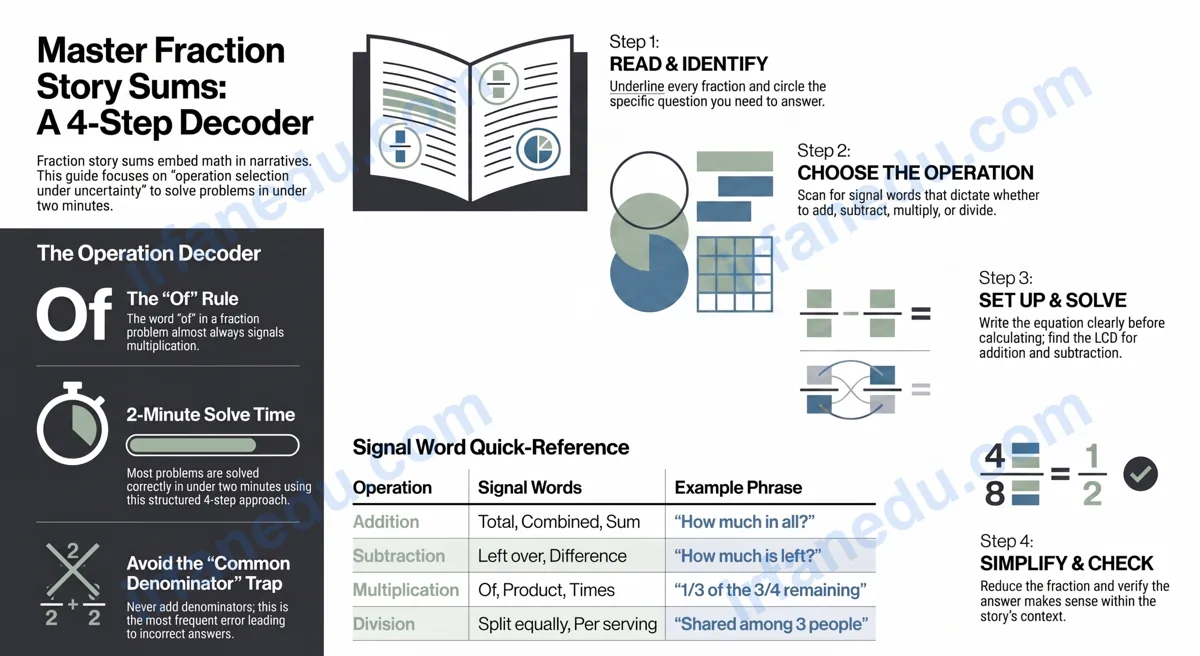
Most students freeze when they see a fraction inside a word problem. The numbers look fine on their own, but wrap them in a story and suddenly the brain stalls. I have seen this happen hundreds of times in my teaching career, and the fix is always the same: start with a concrete, fully solved example before you touch any rule or formula.
A fraction story sum is a word problem that uses fractions to represent real quantities. You solve it by identifying the fractions, choosing the correct operation based on signal words, setting up the equation, and simplifying the answer. The four operations used are addition, subtraction, multiplication, and division.
- You will learn a reliable 4-step method that works for every type of fraction word problem.
- You will see fully worked examples for all four operations, not just addition.
- You will discover the single most common mistake students make (it is not what most teachers think).
- You will get a visual fraction bar diagram, a quiz, and practice problems to test yourself.
TL;DR – Quick Summary
- Fraction story sums are word problems that use fractions in real-life contexts.
- Signal words tell you which operation to use: “of” = multiply, “total” = add.
- Always find a common denominator before adding or subtracting fractions.
- Multiply fractions by multiplying numerators and denominators separately.
- To divide fractions, flip the second fraction and multiply.
- Always simplify your answer and check it makes sense in context.
| Feature | Detail |
|---|---|
| Grade range | Grades 4-7 (ages 9-13) |
| Operations covered | Addition, Subtraction, Multiplication, Division |
| Key skill | Reading signal words to choose the right operation |
| Most common mistake | Adding denominators instead of finding LCD |
| Hardest type | Multi-step problems combining two operations |
| Fastest win | Memorize that “of” = multiply |
Start With a Fully Solved Example
Before I explain any rules, I want you to watch a complete fraction story sum being solved from start to finish. Read through it once, then I will break down every decision made.
Example Problem
Maya had 3/4 of a pizza. She ate 1/3 of what was left. How much of the whole pizza did she eat?
Step 1 – Read and Identify:
The fractions are 3/4 (how much pizza exists) and 1/3 (the fraction of that amount she ate). The question asks how much of the whole pizza she ate.
Step 2 – Choose the Operation:
The phrase “1/3 of what was left” contains the word “of.” In fraction problems, “of” means multiply. So the operation is: 1/3 × 3/4.
Step 3 – Set Up and Solve:
Multiply numerators: 1 × 3 = 3
Multiply denominators: 3 × 4 = 12
Result: 3/12
Step 4 – Simplify and Check:
3/12 simplifies to 1/4 (divide both by 3).
Check: Maya had 3/4 of a pizza. She ate 1/3 of that. 1/3 of 3/4 = 1/4. That is less than 3/4, which makes sense – she did not eat all of it.
Answer: Maya ate 1/4 of the whole pizza.
Notice what happened there. The problem sounded complicated, but it collapsed into a single multiplication once I spotted the word “of.” That is the whole game with fraction story sums: translate the English into math, then let the math do the work.
What Are Fraction Story Sums?
A fraction story sum is a word problem in which one or more quantities are expressed as fractions. The problem places those fractions inside a real-world scenario – sharing food, measuring ingredients, splitting time, calculating distances – and asks you to find a missing value.
They are called “story sums” because the math is embedded inside a short story. Your job is to extract the math from the story and solve it. The story is not decoration; it tells you which operation to use.
Fraction story sums appear in every major math curriculum from Grade 4 onward. They test two skills at once: fraction arithmetic and reading comprehension. Students who struggle with them are usually weak on one of those two skills, not both.
In my experience teaching fractions to hundreds of students, the reading comprehension part causes more errors than the arithmetic. A student who can compute 2/3 × 3/4 perfectly will still get the wrong answer if they misread “of” as a cue to add. I spend more time on signal-word recognition than on fraction rules, and test scores improve faster as a result.
The 4-Step Method for Any Fraction Story Sum
Every fraction story sum, regardless of how complex the story is, can be solved with the same four steps. I developed this sequence after analyzing where students go wrong at each stage.
- Read and Identify: Read the problem twice. Underline every fraction. Circle the question (what are you actually being asked to find?). Write down the fractions separately so they are not buried in the text.
- Choose the Operation: Scan for signal words (see the table in the next section). The words in the problem almost always tell you exactly which operation to use. Do not guess.
- Set Up and Solve: Write the equation. For addition and subtraction, find the least common denominator (LCD) first. For multiplication, multiply straight across. For division, flip the second fraction (take its reciprocal) and then multiply.
- Simplify and Check: Reduce the fraction to its lowest terms. Then re-read the original problem and ask: does this answer make sense? If Maya ate “of” some pizza, the answer should be smaller than what she started with. If it is not, you made an error.
Signal Words: How to Choose the Right Operation
Signal words are the most powerful shortcut in fraction story sums. Each operation has a set of words that almost always signal its use. Learn this table and you will eliminate the most common source of wrong answers.
| Operation | Signal Words / Phrases | Example Phrase |
|---|---|---|
| Addition | total, combined, altogether, sum, in all, both | “How much did they eat in all?” |
| Subtraction | left over, remaining, difference, how much more, less than | “How much pizza is left?” |
| Multiplication | of, times, product, twice as much | “She ate 2/3 of the 3/4 remaining.” |
| Division | split equally, per serving, each portion, how many groups, shared among | “Split 3/4 of a cake equally among 3 people.” |
Worked Examples: All Four Operations
Most guides only show addition examples. Here I work through all four operations so you are prepared for any problem that appears on a test.
Addition Example
Problem: Tom ran 2/5 of a mile before school and 1/3 of a mile after school. How far did he run in total?
Signal word: “in total” = add
Setup: 2/5 + 1/3
LCD of 5 and 3 = 15
2/5 = 6/15 | 1/3 = 5/15
6/15 + 5/15 = 11/15 of a mile
Check: 11/15 is less than 1 mile, which is reasonable for a student running twice in a day.
Subtraction Example
Problem: A bottle was 7/8 full of juice. After breakfast, it was 1/2 full. How much juice was used?
Signal word: “how much was used” = subtract (find the difference)
Setup: 7/8 – 1/2
LCD of 8 and 2 = 8
7/8 – 4/8 = 3/8 of the bottle
Check: 3/8 is less than 7/8, so the answer is a smaller portion than the original. Correct.
Multiplication Example
Problem: A recipe calls for 3/4 cup of sugar. Priya wants to make 2/3 of the recipe. How much sugar does she need?
Signal word: “2/3 of the recipe” = multiply
Setup: 2/3 × 3/4
Numerators: 2 × 3 = 6 | Denominators: 3 × 4 = 12
6/12 = 1/2 cup of sugar
Check: 1/2 is less than 3/4, which makes sense since Priya is making less than the full recipe.
Division Example
Problem: A piece of ribbon is 3/4 of a meter long. It is cut into pieces that are each 1/8 of a meter. How many pieces are there?
Signal word: “cut into pieces each” = divide
Setup: 3/4 ÷ 1/8
Flip the second fraction: 3/4 × 8/1
Numerators: 3 × 8 = 24 | Denominators: 4 × 1 = 4
24/4 = 6 pieces
Check: 6 pieces of 1/8 meter each = 6/8 = 3/4 meter. Correct.
The division example above is the one that trips up the most students in my classes. They know the “flip and multiply” rule mechanically, but they panic when the answer comes out as a whole number. A whole number is a perfectly valid answer to a fraction division problem. Always check by multiplying back: 6 × 1/8 = 6/8 = 3/4. If it matches the original, you are right.
Common Mistakes in Fraction Story Sums (Wrong vs. Right)
These are the five errors I see most often. Each one has a clear fix.
| Mistake | Wrong Approach | Correct Approach |
|---|---|---|
| Adding denominators | 1/3 + 1/4 = 2/7 | 1/3 + 1/4 = 4/12 + 3/12 = 7/12 |
| Treating “of” as addition | 1/2 of 3/4 = 1/2 + 3/4 = 5/4 | 1/2 of 3/4 = 1/2 × 3/4 = 3/8 |
| Forgetting to simplify | Answer: 6/12 | Answer: 1/2 (always reduce) |
| Flipping the wrong fraction | 3/4 ÷ 1/2: flip 3/4 → 4/3 × 1/2 = 4/6 | 3/4 ÷ 1/2: flip 1/2 → 3/4 × 2/1 = 6/4 = 3/2 |
| Not checking the answer | Accepts any number as the answer | Re-reads the problem; confirms the answer is reasonable |
Visual Solution: Fraction Bar Diagram
A fraction bar diagram makes the addition example (2/5 + 1/3) visible. This is the same technique used in Singapore Math and is highly effective for visual learners.
Problem: 2/5 + 1/3 = ?

Step 1 — Draw bars split into 5 and 3 parts:

  2/5:  [##|##|  |  |  ]   (2 out of 5 shaded)
  1/3:  [##|  |  ]         (1 out of 3 shaded)

Step 2 — Convert to LCD = 15:

  2/5 = 6/15:  [##|##|##|##|##|##|  |  |  |  |  |  |  |  |  ]
  1/3 = 5/15:  [##|##|##|##|##|  |  |  |  |  |  |  |  |  |  ]

Step 3 — Add the shaded parts:

  6/15 + 5/15 = 11/15

  Total: [##|##|##|##|##|##|##|##|##|##|##|  |  |  |  ]
          ←————— 11 shaded out of 15 ——————→

Answer: 11/15
Drawing this diagram takes 30 seconds and eliminates the most common error (adding denominators). If you can see that 5-part bars and 3-part bars do not line up, you will never add denominators again.
What Most Guides Get Wrong About Fraction Story Sums
Almost every guide I have reviewed teaches fraction word problems by operation type: “here are addition problems, here are subtraction problems.” That approach trains students to solve problems they have already categorized. It does not train them to categorize a new problem on their own.
The real skill is operation selection under uncertainty. In my experience, students who practice mixed-operation problem sets (where they do not know in advance which operation is needed) outperform students who practice blocked sets by a significant margin on tests. The reason is that tests never label the operation for you.
My recommendation: after you learn each operation type, immediately practice a mixed set where you must identify the operation yourself. This is the drill that actually transfers to exam performance, and it is the one most workbooks skip.
Quick Quiz: Test Your Understanding
Q1. A bag of flour is 5/6 full. You use 1/4 of the bag. How much flour did you use?
Show Answer
Q2. A tank was 7/10 full. After watering the garden, it was 2/5 full. How much water was used?
Show Answer
Q3. A rope is 5/6 of a meter long. It is cut into pieces each 1/12 of a meter. How many pieces?
Show Answer
Practice Problems: Reveal-on-Click Solutions
Try each problem yourself before clicking to reveal the solution.
Problem 1 (Addition): Lena read 3/8 of her book on Saturday and 1/4 on Sunday. What fraction of the book did she read in total?
Setup: 3/8 + 1/4
LCD = 8: 3/8 + 2/8 = 5/8
Check: 5/8 is less than 1 (she has not finished the book). Reasonable.
Problem 2 (Subtraction): A pizza was 5/6 eaten. Then someone ate another 1/3. Wait — how much is left now?
First, find total eaten: 5/6 + 1/3 = 5/6 + 2/6 = 7/6
Hmm — 7/6 is more than 1 whole pizza. This means the problem as stated is impossible (you cannot eat more than 100% of a pizza). This is a great example of why the “check” step matters. A real exam would not set this up, but spotting an impossible answer is a genuine skill.
Revised problem: 5/6 was eaten, then 1/12 more was eaten. How much is left?
5/6 + 1/12 = 10/12 + 1/12 = 11/12 eaten. Left = 1 – 11/12 = 1/12.
Problem 3 (Multiplication): A field is 2/3 of a kilometer wide and 3/5 of a kilometer long. What is its area?
Setup: 2/3 × 3/5 = 6/15 = 2/5 square kilometer
Check: 2/5 is less than both 2/3 and 3/5. An area smaller than either dimension makes sense.
Problem 4 (Multi-step): A jug holds 3/4 liter. You fill 2/3 of the jug, then drink 1/8 of a liter. How much is left in the jug?
Step 2 — Subtract what you drank: 1/2 – 1/8 = 4/8 – 1/8 = 3/8 liter
Check: You filled 1/2 liter and drank 1/8 liter. 1/2 > 1/8, so a positive amount remains. Correct.
Frequently Asked Questions
What is a fraction story sum?
How do I know which operation to use in a fraction word problem?
What is the 4-step method for solving fraction story sums?
Why do students get fraction word problems wrong?
How do you add fractions in a word problem?
How do you multiply fractions in a word problem?
What does “of” mean in fraction story sums?
Key Takeaways
- Fraction story sums are word problems that use fractions in real-life contexts.
- The 4-step method (Read, Choose, Solve, Check) works for every type of fraction word problem.
- Signal words are your most reliable guide to choosing the correct operation.
- “Of” means multiply – this single rule eliminates the most common error.
- Always find a common denominator before adding or subtracting fractions.
- To divide fractions, flip the second fraction and multiply.
- Always simplify your final answer and verify it makes sense in context.
- Practice mixed-operation problem sets (not blocked by type) for the best exam preparation.
Related Articles
Dr. Irfan Mansuri
Dr. Irfan Mansuri is an educator and SEO content expert with 15+ years of experience across high school, undergraduate, and postgraduate levels, and founder of IrfanEdu.com. I combine deep subject knowledge with proven test-taking strategies to make complex ideas simple. Connect on LinkedIn.
Sources &
Sources & References
Reviewed by Dr. Irfan Mansuri. External links open in a new tab and are provided for further reading and verification.