
Area vs Volume: Complete Guide + Free Printable Worksheet
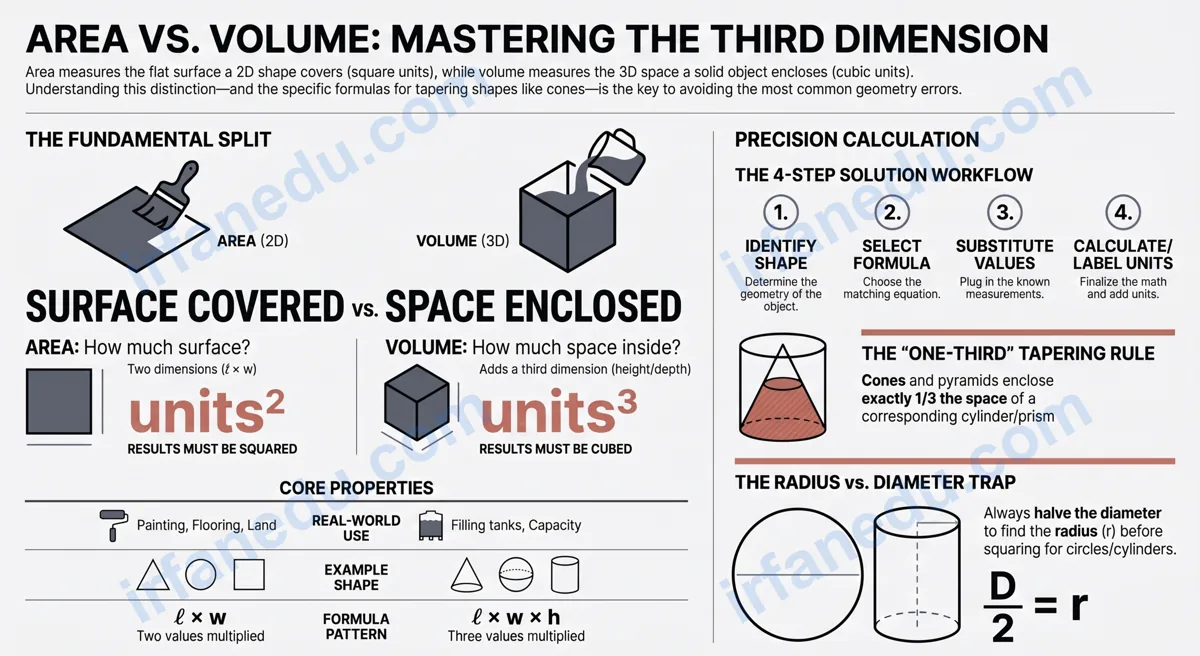
Most students can recite “area is length times width” without truly understanding what that means — or why it breaks down the moment the shape is not a rectangle. In my 15+ years of teaching math, the single most common source of geometry errors is students mixing up area and volume, or applying the right formula to the wrong shape.
Area is the amount of flat surface a 2D shape covers, measured in square units. Volume is the amount of 3D space a solid object encloses, measured in cubic units. Every geometry problem involving measurement starts by correctly identifying which of these two quantities you need.
- Understand the precise definitions of area and volume
- Apply the correct formula for rectangles, triangles, circles, prisms, cylinders, cones, and spheres
- Avoid the five most common mistakes students make
- Practice with 12 graded problems and check your answers instantly
Free Printable Worksheet (with Answer Key): 12 graded problems on area and volume, ready to print or use on screen.
TL;DR — Quick Summary
- Area = surface covered by a 2D shape; units are always squared (cm², m²).
- Volume = space inside a 3D solid; units are always cubed (cm³, m³).
- Rectangle area: A = l x w. Rectangular prism volume: V = l x w x h.
- Circle area: A = πr². Cylinder volume: V = πr²h.
- Triangle area: A = (1/2)bh. Cone volume: V = (1/3)πr²h.
- Surface area and volume are different — surface area is the total outer face area of a 3D solid.
Fact vs Fiction: Common Myths About Area and Volume
Before the lesson, let’s clear the air. These are the most persistent misconceptions I see in student work — and the corrections that fix them permanently.
| FICTION (What students believe) | FACT (What is actually true) |
|---|---|
| MYTH “Area and volume are basically the same thing.” | FACT Area is 2D (flat surface); volume is 3D (space inside). They measure completely different things and use different units. |
| MYTH “Surface area and volume are the same for 3D shapes.” | FACT Surface area is the total of all outer faces (in units²). Volume is the interior space (in units³). A cube with side 4 cm has surface area 96 cm² but volume 64 cm³. |
| MYTH “A bigger area always means bigger volume.” | FACT A flat pancake has large area but tiny volume. A tall narrow cylinder has small area but large volume. Shape and height both matter. |
| MYTH “You always multiply all the numbers given in a problem.” | FACT Each formula is specific. Triangle area = (1/2) x base x height — you must halve the product. Forgetting the 1/2 doubles your answer. |
| MYTH “Units don’t matter as long as the number is right.” | FACT A missing or wrong unit makes the answer wrong in any real-world context. Area without “²” and volume without “³” are incomplete answers. |
What Are Area and Volume?
Area is the measure of the two-dimensional space enclosed within a flat shape’s boundary. Volume is the measure of the three-dimensional space enclosed within a solid object.
Think of it this way: if you pour paint on a floor and it covers a certain region, that region’s size is its area. If you fill a box with water, the amount of water that fits is the box’s volume.
| Property | Area | Volume |
|---|---|---|
| Dimensions | 2D (flat) | 3D (solid) |
| Units | Square units (cm², m², in²) | Cubic units (cm³, m³, in³) |
| What it measures | Surface covered | Space enclosed |
| Example shapes | Square, rectangle, circle, triangle | Cube, cylinder, cone, sphere |
| Real-world use | Flooring, painting, land | Filling tanks, packaging, capacity |
| Key formula pattern | Two measurements multiplied | Three measurements multiplied |
Why Does This Distinction Matter in Real Life?
Confusing area and volume causes real, costly errors outside the classroom. A contractor who calculates volume when they need area will order the wrong amount of flooring tiles. A nurse who confuses surface area and volume when calculating drug dosages based on body surface area risks patient safety.
Here are three concrete real-world scenarios where the distinction is critical:
- Painting a room: You need the area of the walls (in m² or ft²) to know how many cans of paint to buy. Volume is irrelevant here.
- Filling a swimming pool: You need the volume (in m³ or gallons) to know how much water the pool holds. Area alone tells you nothing about depth.
- Buying carpet: Carpet is sold by area (m² or yd²). But if you also need to fill a raised platform under the carpet with foam, you need volume.
In my experience teaching geometry, students who struggle with area and volume almost always have the same root problem: they memorise formulas as disconnected strings of letters rather than understanding what each variable represents physically. Once a student understands that “height” in a volume formula means the third dimension being added to a flat base, the formula stops being arbitrary and starts making sense. I always teach the concept before the formula — never the other way around.
Step-by-Step: How to Calculate Area and Volume
Follow these four steps for any area or volume problem. They work for every shape.
- Identify the shape. Is it 2D (area) or 3D (volume)? Name it precisely: rectangle, triangle, circle, cylinder, cone, sphere.
- Select the correct formula. Use the table below. Match the formula to the exact shape — do not guess.
- Substitute the measurements. Plug in the given values for length, width, height, or radius. Label each variable before you calculate.
- Calculate and label units. Perform the arithmetic carefully. Write the answer with square units (²) for area or cubic units (³) for volume.
| Shape | Type | Formula | Variables |
|---|---|---|---|
| Rectangle | Area | A = l x w | l = length, w = width |
| Square | Area | A = s² | s = side length |
| Triangle | Area | A = (1/2) x b x h | b = base, h = perpendicular height |
| Circle | Area | A = π x r² | r = radius |
| Parallelogram | Area | A = b x h | b = base, h = perpendicular height |
| Rectangular Prism | Volume | V = l x w x h | l, w, h = three dimensions |
| Cube | Volume | V = s³ | s = side length |
| Cylinder | Volume | V = π x r² x h | r = base radius, h = height |
| Cone | Volume | V = (1/3) x π x r² x h | r = base radius, h = height |
| Sphere | Volume | V = (4/3) x π x r³ | r = radius |
  AREA (2D — flat surface)         VOLUME (3D — space inside)

  Rectangle:                        Rectangular Prism:
  +----------+                      +----------+
  |          | h                   /|         /|
  |          |                    / |        / |  h
  +----------+                   +----------+  |
       l                         |          |  +
  A = l x h                      |          | / w
                                  +----------+
                                       l
  Triangle:                       V = l x w x h
     /\
    /  \ h                        Cylinder:
   /    \                            ___
  /______\                          /   \  r
      b                            |     |
  A = (1/2) x b x h                |     |  h
                                    \___/
  Circle:                         V = pi x r^2 x h
     ___
    /   \  r                      Sphere:
   |  .  |                           ___
    \___/                           /   \  r
  A = pi x r^2                     |  .  |
                                    \___/
                                 V = (4/3) x pi x r^3

  Units: cm^2, m^2, in^2          Units: cm^3, m^3, in^3
Worked Examples: Area and Volume Solved Step by Step
These three examples cover the most commonly tested shapes. I solve each one in full so you can see exactly where students lose marks.
Example 1 — Area of a Triangle
Problem: Find the area of a triangle with base 10 cm and perpendicular height 6 cm.
Step 1 — Formula: A = (1/2) x b x h
Step 2 — Substitute: A = (1/2) x 10 x 6
Step 3 — Calculate: A = (1/2) x 60 = 30
Answer: A = 30 cm²
Common error: Forgetting the 1/2 and writing A = 60 cm². The 1/2 is not optional — a triangle is always half a parallelogram with the same base and height.
Example 2 — Volume of a Cylinder
Problem: Find the volume of a cylinder with radius 3 cm and height 10 cm. Use π = 3.14.
Step 1 — Formula: V = π x r² x h
Step 2 — Substitute: V = 3.14 x 3² x 10
Step 3 — Calculate r² first: 3² = 9
Step 4 — Multiply: V = 3.14 x 9 x 10 = 3.14 x 90 = 282.6
Answer: V = 282.6 cm³
Common error: Squaring the diameter instead of the radius. Always halve the diameter to get r before squaring.
Example 3 — Volume of a Cone
Problem: Find the volume of a cone with radius 6 cm and height 12 cm. Use π = 3.14.
Step 1 — Formula: V = (1/3) x π x r² x h
Step 2 — Substitute: V = (1/3) x 3.14 x 36 x 12
Step 3 — Calculate: 3.14 x 36 = 113.04; 113.04 x 12 = 1356.48; 1356.48 / 3 = 452.16
Answer: V = 452.16 cm³
Key insight: A cone holds exactly one-third the volume of a cylinder with the same base and height. This is not a coincidence — it is a geometric truth you can use to check your work.
Common Mistakes Students Make (and How to Fix Them)
These five errors account for the majority of lost marks on area and volume problems. Recognise them and you will avoid them.
Mistake 5 is the one that surprises me most in student work. I have seen high-school students calculate the surface area of a box when asked for its volume, and vice versa, simply because they did not read the question carefully. My advice: circle the word “area” or “volume” in the problem before you write a single number. That one habit eliminates this error completely.
The “volume is just area times height” shortcut is only half the story — and it misleads students on non-prism shapes.
Most textbooks teach V = base area x height as a universal rule. It works perfectly for prisms and cylinders. But students then apply it to cones and pyramids and get answers that are three times too large. The reason: cones and pyramids taper to a point, so they enclose only one-third the space of the corresponding prism. The correct rule is V = (1/3) x base area x height for all tapering solids.
In my experience, the cleanest way to remember this is a physical demonstration: three identical cone-shaped cups filled with water empty exactly into one cylinder of the same base and height. That image sticks in a way no formula alone ever does. If your teacher or textbook skips this demonstration, you are missing the geometric intuition that makes the (1/3) factor feel inevitable rather than arbitrary.
Practice Worksheet: Area and Volume (12 Problems)
Work through these problems in order — they go from straightforward to more challenging. Show your working for full credit. Use π = 3.14 for all circle/cylinder/cone/sphere problems.
How to use this worksheet: Print the PDF (button above or below), solve each problem in the blank space provided, then check your answers using the key below. For best results, attempt all 12 problems before looking at any answers.
- Find the area of a rectangle with length 8 cm and width 5 cm.
- Find the area of a square with side 7 m.
- Find the area of a triangle with base 10 in and height 6 in.
- Find the area of a circle with radius 4 cm. (Use π = 3.14)
- Find the volume of a rectangular prism with length 6 cm, width 4 cm, and height 3 cm.
- Find the volume of a cube with side 5 m.
- Find the volume of a cylinder with radius 3 cm and height 10 cm. (Use π = 3.14)
- A triangle has base 14 in and height 9 in. Find its area.
- Find the volume of a cone with radius 6 cm and height 12 cm. (Use π = 3.14)
- A rectangular room is 5 m long, 4 m wide, and 3 m tall. Find the volume of air in the room.
- Find the area of a parallelogram with base 11 cm and height 7 cm.
- A sphere has radius 5 cm. Find its volume. (Use π = 3.14)
Show Answer Key
- 40 cm²
- 49 m²
- 30 in²
- 50.24 cm²
- 72 cm³
- 125 m³
- 282.6 cm³
- 63 in²
- 452.16 cm³
- 60 m³
- 77 cm²
- 523.33 cm³
Want a printable version? Download the PDF with all 12 problems and a separate answer key section.
Quick Quiz: Test Your Understanding
Q1. A rectangle has length 9 cm and width 4 cm. What is its area?
Reveal answer
Correct: B) 36 cm². A = l x w = 9 x 4 = 36 cm². Option A (26) is the perimeter, not the area — a classic mix-up.
Q2. A cylinder has radius 5 cm and height 8 cm. Using π = 3.14, what is its volume?
Reveal answer
Correct: B) 628 cm³. V = π x r² x h = 3.14 x 25 x 8 = 3.14 x 200 = 628 cm³.
Q3. Which formula gives the volume of a cone?
Reveal answer
Correct: C) V = (1/3) x π x r² x h. A cone holds one-third the volume of a cylinder with the same base and height. Option A is the cylinder formula; option B is incorrect.
Frequently Asked Questions
What is the difference between area and volume?
Area measures the flat surface covered by a 2D shape and is expressed in square units (cm², m²). Volume measures the 3D space enclosed inside a solid and is expressed in cubic units (cm³, m³). Area uses two dimensions; volume uses three. They answer different questions and can never be compared directly.
What are the units for area and volume?
Area is always in square units: cm², m², in², ft², km². Volume is always in cubic units: cm³, m³, in³, ft³. A common mistake is writing area in cubic units or volume in square units. Always match the unit to the number of dimensions: two dimensions = squared, three dimensions = cubed.
How do you find the area of a triangle?
The area of a triangle equals half the base times the perpendicular height: A = (1/2) x base x height. The height must form a 90-degree angle with the base. For example, a triangle with base 10 cm and height 6 cm has area = 0.5 x 10 x 6 = 30 cm². Forgetting the 1/2 is the most common error.
How do you find the volume of a cylinder?
Volume of a cylinder = π x r² x h, where r is the radius of the circular base and h is the height. Using π = 3.14, a cylinder with radius 3 cm and height 10 cm has volume = 3.14 x 9 x 10 = 282.6 cm³. Always square the radius, not the diameter.
Sources & References
Reviewed by Dr. Irfan Mansuri. External links open in a new tab and are provided for further reading and verification.