
Simplifying radicals worksheet: free PDF, worked examples & answer key 🧮
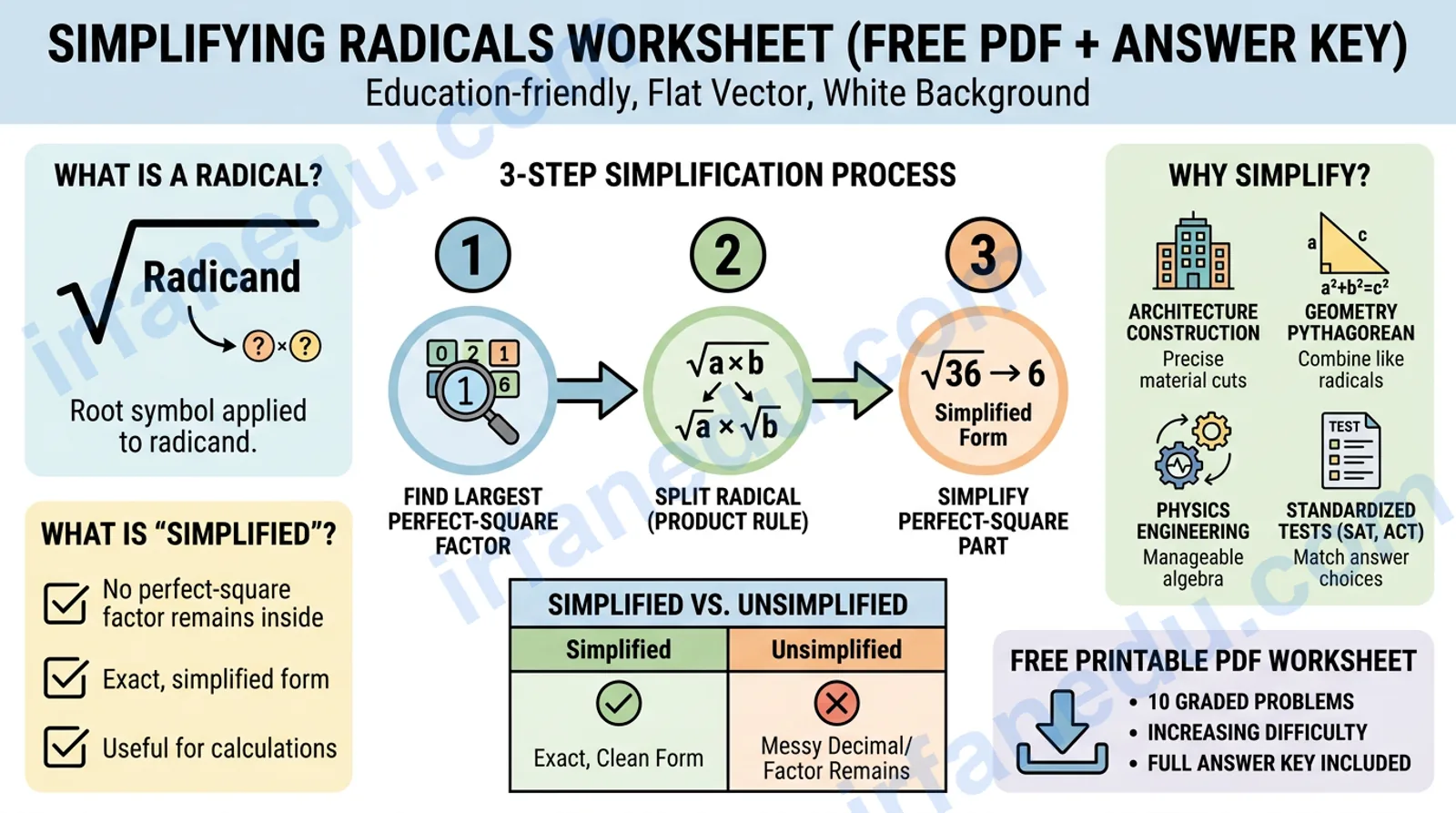
Imagine you’re building a square garden with an area of 72 square feet. 🌿 You need to know the exact side length to buy fencing — and your calculator gives you a messy decimal. But a simplified radical, 6√2 feet, is exact, clean, and actually useful for calculations. That’s the real reason simplifying radicals matters.
Simplifying a radical means rewriting a square root expression so that no perfect-square factor remains under the radical sign. You do this by finding the largest perfect-square factor of the radicand, splitting the radical using the product rule, and reducing the perfect-square part to a whole number. The result is an exact, simplified form — for example, √72 simplifies to 6√2.
In this guide you’ll get a clear lesson, three fully worked examples, a comparison table, a list of the most common mistakes students make, and a free printable worksheet with 10 problems and a complete answer key. By the end, you’ll be able to simplify any square root — including those with variables — without second-guessing yourself.
- ✅ Understand what “simplified radical form” actually means
- ✅ Apply the 3-step method to any square root
- ✅ Avoid the four mistakes that cost students marks
- ✅ Practice with 10 graded problems and check your work
Download free printable PDF worksheet (with answer key)
🌍 Where you actually use simplified radicals
Simplified radicals show up constantly in real math and science — not just on tests. Knowing this context makes the skill feel worth learning.
🏗️ Architecture & construction
The diagonal of a square room with side length 5 m is 5√2 m (about 7.07 m). Builders use this exact form to cut materials precisely. A decimal approximation introduces rounding error that compounds across a large structure.
📐 Geometry & the Pythagorean theorem
Every time you apply the Pythagorean theorem, you get a square root. Leaving it unsimplified makes further algebra — like adding two side lengths — much harder. Simplified form lets you combine like radicals cleanly.
🔬 Physics & engineering
Wave speed, pendulum period, and electrical impedance formulas all produce radical expressions. Engineers simplify them before substituting numbers so the algebra stays manageable.
📊 Standardized tests (SAT, ACT)
Both the SAT and ACT expect answers in simplified radical form. An unsimplified answer like √50 will not match any answer choice — the correct option will be 5√2. Knowing this pattern alone can recover several points on test day.
What is a radical and what does “simplified” mean?
A radical is a root symbol (√) applied to a number or expression called the radicand. A square root radical √n asks: “What number, multiplied by itself, gives n?”
A radical is in simplified form when three conditions are met:
- No perfect-square factor (other than 1) remains under the radical sign.
- No fractions appear under the radical sign.
- No radicals appear in the denominator of a fraction.
This worksheet focuses on condition 1 — the most common type on middle and high school assessments. Conditions 2 and 3 (rationalizing the denominator) are covered in a follow-up lesson.
The key tool you need is the product rule for radicals:
📌 Product rule for square roots
√(a × b) = √a × √b (where a ≥ 0 and b ≥ 0)
This rule works in both directions. You can split a radical into two, or merge two radicals into one.
🔢 Visual: the simplification tree for √72
The diagram below shows exactly how to break √72 apart. Think of it as a factor tree, but for radicals. 🌳
Simplification tree: √72
         √72
          |
    ┌─────┴─────┐
   √36         √2
    |            |
    6          √2  ← cannot simplify further
    |
    └──────────────────────────────
    Result:  6√2
    ─────────────────────────────────────────
    Check:  (6√2)² = 36 × 2 = 72  ✓

    Perfect squares to memorize:
    √4=2  √9=3  √16=4  √25=5  √36=6
    √49=7 √64=8 √81=9  √100=10 √121=11
    √144=12  √169=13  √196=14  √225=15
Step-by-step: how to simplify any radical in 3 steps
Follow these three steps every time and you will never get stuck. The method works for any whole-number radicand.
-
Step 1 — Find the largest perfect-square factor.
Look at the radicand and ask: what is the biggest perfect square that divides into it evenly? Use the list above if needed. Choosing the largest factor means you only have to simplify once — choosing a smaller one forces extra steps. -
Step 2 — Split the radical using the product rule.
Rewrite √n as √(perfect square × remaining factor). For example, √72 = √(36 × 2). -
Step 3 — Simplify the perfect-square radical and write the answer.
Take the square root of the perfect-square factor and place it in front. √36 × √2 = 6√2. Done.
Worked examples (easy → hard) 📝
I’ve chosen these three examples deliberately — they cover the three most common scenarios you’ll meet on a worksheet or test.
Example 1 — Basic: √50
Step 1: Factors of 50 that are perfect squares: 25 (25 × 2 = 50). Largest = 25.
Step 2: √50 = √(25 × 2) = √25 × √2
Step 3: √25 = 5, so the answer is 5√2.
Check: (5√2)² = 25 × 2 = 50 ✓
Example 2 — Coefficient included: 3√75
Step 1: Largest perfect-square factor of 75 is 25 (25 × 3 = 75).
Step 2: 3√75 = 3 × √(25 × 3) = 3 × √25 × √3
Step 3: 3 × 5 × √3 = 15√3.
Check: (15√3)² = 225 × 3 = 675 = 9 × 75 ✓
In my experience teaching algebra, students most often forget to multiply the outside coefficient (3) by the new coefficient (5). Write it out every time until it’s automatic.
Example 3 — Variable radicand: √(50x⁶)
Step 1: Treat the number and variable separately. Largest perfect-square factor of 50 is 25. For x⁶: since 6 is even, x⁶ = (x³)², which is a perfect square.
Step 2: √(50x⁶) = √(25 × 2 × x⁶) = √25 × √(x⁶) × √2
Step 3: 5 × x³ × √2 = 5x³√2.
Check: (5x³√2)² = 25x⁶ × 2 = 50x⁶ ✓
Simplified vs. unsimplified: comparison table
This table shows ten common radicals in both forms. Memorize the simplified column — these appear on virtually every algebra test. 📊
| Unsimplified form | Largest perfect-square factor | Simplified form | Decimal (approx.) |
|---|---|---|---|
| √8 | 4 | 2√2 | 2.828 |
| √12 | 4 | 2√3 | 3.464 |
| √18 | 9 | 3√2 | 4.243 |
| √20 | 4 | 2√5 | 4.472 |
| √27 | 9 | 3√3 | 5.196 |
| √45 | 9 | 3√5 | 6.708 |
| √50 | 25 | 5√2 | 7.071 |
| √75 | 25 | 5√3 | 8.660 |
| √98 | 49 | 7√2 | 9.899 |
| √200 | 100 | 10√2 | 14.142 |
Notice a pattern: many simplified radicals end in √2 or √3. That’s because 2 and 3 are the most common “leftover” factors after removing perfect squares.
Common mistakes — and exactly how to fix them ⚠️
After reviewing hundreds of student worksheets, I’ve found the same four errors appearing over and over. Here they are with corrections.
Wrong: √72 = √(4 × 18) = 2√18 (not fully simplified — 18 still has factor 9)
✅ Fix: Always ask “is there a bigger perfect square?” before stopping. √72 = √(36 × 2) = 6√2.
Wrong: √2 + √3 = √5
✅ Fix: Radicals add only when the radicand is identical. √2 + √2 = 2√2. Otherwise, leave them separate.
Wrong: 3√75 = 3√(25 × 3) = 5√3 (dropped the 3 out front)
✅ Fix: Write every step. 3 × √25 × √3 = 3 × 5 × √3 = 15√3.
Wrong: √(9 + 16) = √9 + √16 = 3 + 4 = 7 (but √25 = 5, not 7)
✅ Fix: The product rule works for multiplication only. Addition inside a radical cannot be split.
❗ Commonly misunderstood: “simplified” doesn’t mean “smaller”
Most students assume that simplifying a radical always produces a smaller-looking number. It doesn’t — it produces an exact number in a standardized form. Here’s the non-obvious part: 6√2 and √72 are exactly equal in value. Simplification is about form, not magnitude.
Why does form matter? Because algebra breaks down when forms aren’t standardized. If one student writes √72 and another writes 6√2, a computer algebra system (and a test’s answer key) treats them as different answers — even though they’re identical. Simplified form is a convention that enables communication, not a mathematical transformation that changes the number. Understanding this distinction is what separates students who truly understand radicals from those who just follow steps.
📝 On-page practice worksheet — 10 problems
Work through these problems in order — they start easy and get progressively harder. Use the 3-step method for every problem. When you’re done, reveal the answer key below to check your work.
How to use this worksheet: Print the PDF (button below) or work directly on this page. Attempt all 10 problems before checking answers. For each problem, write out all three steps — don’t skip straight to the answer. Self-checking with the answer key is the fastest way to identify exactly which step is tripping you up.
- Simplify: √16
- Simplify: √50
- Simplify: √72
- Simplify: √98
- Simplify: √48
- Simplify: √200
- Simplify: √180
- Simplify: 3√75
- Simplify: √(x⁴)
- Simplify: √(50x⁶)
Show Answer Key 🔑
- √16 = 4 (since 16 is a perfect square)
- √50 = 5√2 (50 = 25 × 2; √25 = 5)
- √72 = 6√2 (72 = 36 × 2; √36 = 6)
- √98 = 7√2 (98 = 49 × 2; √49 = 7)
- √48 = 4√3 (48 = 16 × 3; √16 = 4)
- √200 = 10√2 (200 = 100 × 2; √100 = 10)
- √180 = 6√5 (180 = 36 × 5; √36 = 6)
- 3√75 = 15√3 (75 = 25 × 3; √25 = 5; 3 × 5 = 15)
- √(x⁴) = x² (x⁴ is a perfect square: (x²)² = x⁴)
- √(50x⁶) = 5x³√2 (50 = 25 × 2; x⁶ = (x³)²; 5 × x³ × √2)
Download free printable PDF worksheet (with answer key)
🧠 Quick quiz — test yourself
Select the correct answer for each question. The result reveals instantly.
1. What is √48 in simplified form?
2. Which of the following is NOT a correct simplification?
3. Simplify √(50x⁶). What is the correct answer?