
Word Problems with Division of Fractions: Step-by-Step Guide + Free Worksheet
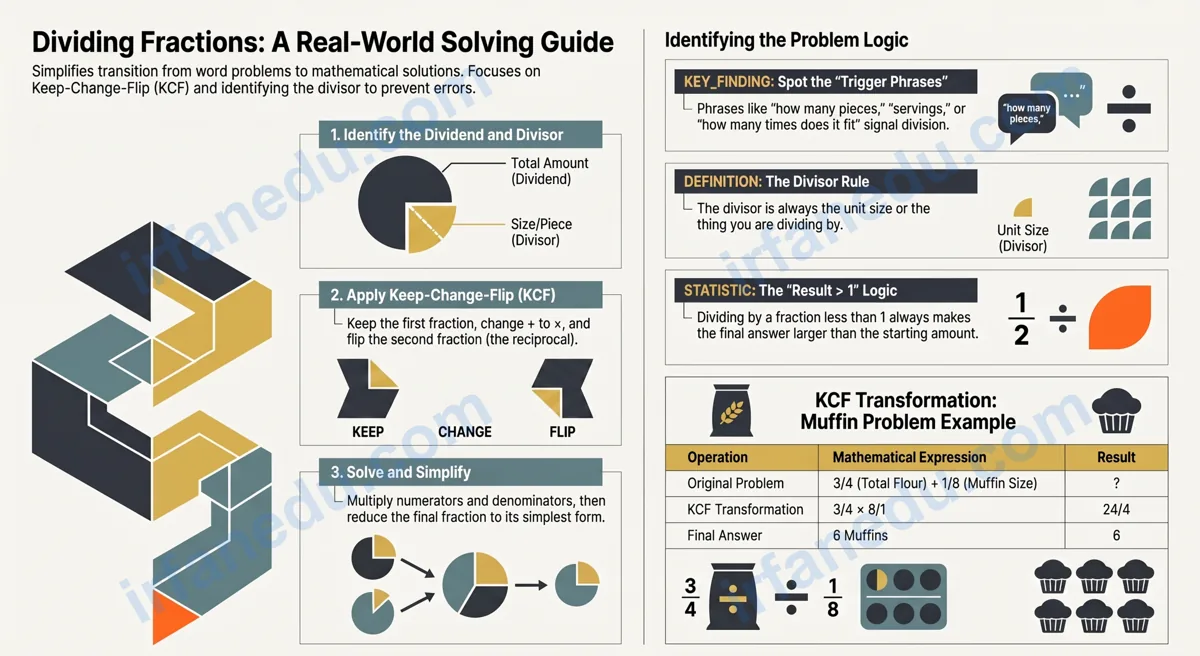
Here is a word problem that trips up thousands of students every year: “A baker has 3/4 of a cup of flour. Each muffin needs 1/8 of a cup. How many muffins can the baker make?” If you have ever stared at a question like that and felt unsure whether to multiply or divide — this guide is exactly what you need.
To solve word problems with division of fractions, you identify the total amount and the size of each group, write a division sentence, and then apply the keep-change-flip rule to convert division into multiplication. The method works for every real-world scenario: cutting ribbon, portioning food, measuring distances, and more.
- Understand what division of fractions actually means in a real-world context.
- Use a reliable 6-step method to set up and solve any fraction division word problem.
- Avoid the three most common errors that cost students marks.
- Practice with 10 graded problems and check your answers instantly.
Identify the total amount (dividend) and the size of each group (divisor). Write the division: total ÷ group size. Apply keep-change-flip — keep the first fraction, change ÷ to ×, flip the second fraction. Multiply across, simplify, and check the answer makes sense. Example: 3/4 ÷ 1/8 = 3/4 × 8/1 = 24/4 = 6 muffins.
Get all 10 problems plus a full answer key in one print-ready sheet.
TL;DR – Quick Summary
- Division of fractions answers “how many groups of this size fit in this total?”
- Keep-change-flip converts any fraction division into multiplication instantly.
- Always write the division sentence before calculating — it prevents setup errors.
- The answer can be greater than 1, a whole number, or a mixed number.
- Trigger words: “how many pieces,” “how many servings,” “how many times does it fit.”
- Check your answer by multiplying back: answer × divisor should equal the dividend.
| Fact | Detail |
|---|---|
| Grade level | Grade 6 (US Common Core 6.NS.A.1); extends to Grade 7 |
| Core method | Keep-Change-Flip (multiply by the reciprocal) |
| Key trigger words | “How many pieces / servings / groups of [fraction]” |
| Answer can be | A whole number, proper fraction, or mixed number |
| Check method | Multiply answer × divisor; result should equal the dividend |
| Common error | Flipping the wrong fraction (flipping the dividend, not the divisor) |
Start Here: A Fully Solved Example
Before I explain any rules, I want you to see the method in action. Work through this example with me — the concept will click faster from a real problem than from a definition.
Example 1 — The Muffin Problem
Problem: A baker has 3/4 of a cup of flour. Each muffin needs 1/8 of a cup. How many muffins can the baker make?
- Identify the dividend: The total flour available = 3/4 cup.
- Identify the divisor: Each muffin uses = 1/8 cup.
- Write the division sentence: 3/4 ÷ 1/8
- Keep-change-flip: Keep 3/4, change ÷ to ×, flip 1/8 to 8/1.
= 3/4 × 8/1 - Multiply across: (3 × 8) / (4 × 1) = 24/4
- Simplify: 24/4 = 6
Answer: The baker can make 6 muffins.
Check: 6 × 1/8 = 6/8 = 3/4. Correct.
Notice what happened: dividing by a small fraction (1/8) gave an answer larger than the original number (3/4). That is not a mistake — it is exactly what should happen. Six eighth-sized scoops fit inside three-quarters of a cup.
In my experience teaching this topic, the single biggest source of confusion is that students expect division to always make a number smaller. That intuition comes from whole-number division. With fractions, dividing by something less than 1 makes the result bigger. Once a student truly accepts that, the rest of the topic becomes straightforward.
  VISUALISING 3/4 ÷ 1/8
  ┌─────────────────────────────────────┐
  │  One whole cup                      │
  │  [  1/8 ][  1/8 ][  1/8 ][  1/8 ]  │
  │  [  1/8 ][  1/8 ][  1/8 ][  1/8 ]  │
  └─────────────────────────────────────┘

  3/4 of the cup is shaded:
  [  1/8 ][  1/8 ][  1/8 ][  1/8 ]
  [  1/8 ][  1/8 ]  ← 6 eighth-sized pieces

  3/4 ÷ 1/8 = 6  ✓
What Is Division of Fractions?
Division of fractions answers one specific question: how many times does one fraction fit inside another? It is the same idea as whole-number division, just applied to parts of a whole.
The formal definition: dividing a/b by c/d means finding how many groups of size c/d are contained in a/b. Mathematically, a/b ÷ c/d = a/b × d/c, because dividing by a number is identical to multiplying by its reciprocal.
The reciprocal of a fraction is simply that fraction flipped upside down. The reciprocal of 1/8 is 8/1 (= 8). The reciprocal of 3/5 is 5/3.
How to Solve Word Problems with Division of Fractions: The 6-Step Method
Every fraction division word problem — no matter how it is worded — can be solved with these six steps. I use this exact sequence with my students, and it eliminates almost all setup errors.
- Read the problem twice. Underline the numbers and the question being asked.
- Identify the dividend. This is the total amount you are starting with.
- Identify the divisor. This is the size of each group or piece.
- Write the division sentence: dividend ÷ divisor.
- Apply keep-change-flip: keep the dividend fraction, change ÷ to ×, flip the divisor fraction.
- Multiply and simplify. Multiply numerators, multiply denominators, then reduce. Check your answer in context.
The step most students skip is Step 4 — writing the division sentence before calculating. That one habit prevents the most common error: setting up the problem backwards.
Three More Worked Examples (Easy to Hard)
Example 2 — Ribbon Cutting (Easy)
Problem: A piece of ribbon is 5/6 of a metre long. Each bow needs 1/6 of a metre of ribbon. How many bows can be made?
- Dividend: 5/6 m. Divisor: 1/6 m.
- Division sentence: 5/6 ÷ 1/6
- Keep-change-flip: 5/6 × 6/1 = 30/6
- Simplify: 30/6 = 5
Answer: 5 bows. Check: 5 × 1/6 = 5/6. Correct.
Example 3 — Road Paving (Medium)
Problem: A road crew needs to pave 7/8 of a kilometre of road. They can pave 1/4 of a kilometre per day. How many days will the job take?
- Dividend: 7/8 km. Divisor: 1/4 km per day.
- Division sentence: 7/8 ÷ 1/4
- Keep-change-flip: 7/8 × 4/1 = 28/8
- Simplify: 28/8 = 7/2 = 3 and 1/2 days
Answer: 3 and 1/2 days. This means the crew finishes halfway through the fourth day — a perfectly sensible real-world answer.
Example 4 — Whole Number Divided by a Fraction (Harder)
Problem: A teacher has 3 metres of craft paper. Each student project needs 3/4 of a metre. How many complete projects can be made?
- Dividend: 3 (write as 3/1). Divisor: 3/4.
- Division sentence: 3/1 ÷ 3/4
- Keep-change-flip: 3/1 × 4/3 = 12/3
- Simplify: 12/3 = 4
Answer: 4 complete projects. Check: 4 × 3/4 = 12/4 = 3. Correct.
Example 4 is the type that surprises students most. Dividing 3 by 3/4 gives 4 — a larger number than you started with. I always ask students to pause and reason it out: “How many three-quarter-sized pieces fit in 3 whole metres?” Four pieces. Once you visualise it that way, the arithmetic confirms what common sense already told you.
Common Mistakes: Wrong vs. Right
These three errors account for the vast majority of wrong answers on fraction division word problems. Recognising them is half the battle.
| Wrong (common error) | Right (correct approach) |
|---|---|
| Flipping the dividend instead of the divisor. 3/4 ÷ 1/8 → 4/3 × 1/8 = 4/24 = 1/6 |
Always flip the second fraction (the divisor). 3/4 ÷ 1/8 → 3/4 × 8/1 = 24/4 = 6 |
| Multiplying instead of dividing. Reading “how many pieces” and multiplying: 3/4 × 1/8 = 3/32 |
Identify the trigger phrase “how many pieces of size ___” and set up division. |
| Forgetting to simplify. Leaving the answer as 24/4 instead of 6. |
Always reduce the final fraction. Divide numerator and denominator by their GCF. |
Most fraction division guides teach keep-change-flip as a memory trick and move on. What they miss: the method fails students in word problems because students never learn to identify which fraction is the divisor. The divisor is always the “group size” or “unit size” — the thing you are dividing by. In the muffin problem, 1/8 is the divisor because it is the size of one muffin’s portion. In a problem like “how many 2/3-cup servings are in 4 cups?”, 2/3 is the divisor. If you can reliably identify the divisor before calculating, you will never set up a fraction division problem backwards again. I have never seen another worksheet site make this distinction explicit — and it is the one thing that separates students who get these right consistently from those who guess.
Practice Worksheet: 10 Word Problems (Easy to Hard)
These 10 problems follow the same method as the worked examples above. Try each one on paper using the 6-step method. When you are done, reveal the answer key below — or download the full PDF to print and use offline.
How to use this worksheet: Print the PDF (or copy the problems into your notebook), solve each one showing all working, then self-check with the answer key. If you get a problem wrong, go back to the 6-step method and identify which step went wrong.
- A piece of rope is 3/4 of a metre long. You cut it into pieces that are each 1/4 of a metre. How many pieces do you get?
- A baker has 2/3 of a cup of sugar. Each batch of cookies needs 1/6 of a cup. How many batches can the baker make?
- A road is 5/6 of a kilometre long. Workers pave 1/3 of a kilometre per day. How many days will it take to pave the whole road?
- A jug holds 7/8 of a litre of juice. Each glass holds 1/4 of a litre. How many glasses can be filled?
- A spool has 4/5 of a metre of ribbon. Each bow needs 2/5 of a metre. How many bows can be made?
- A recipe calls for 3/8 of a cup of butter. If you want to make 1/2 of the recipe, how much butter do you need?
- A tank is 5/6 full of water. If each bucket holds 1/9 of the full tank, how many buckets of water are in the tank?
- A plank of wood is 7/10 of a metre long. Each shelf needs 7/20 of a metre. How many shelves can be cut?
- A cyclist rode 9/10 of a kilometre. If each lap of a track is 3/10 of a kilometre, how many laps did the cyclist complete?
- A container holds 11/12 of a litre of paint. Each small tin holds 1/6 of a litre. How many small tins can be filled?
Show Answer Key
- 3 pieces
- 4 batches
- 2 and 1/2 days
- 3 and 1/2 glasses
- 2 bows
- 3/16 of a cup
- 7 and 1/2 buckets
- 2 shelves
- 3 laps
- 5 and 1/2 tins
Want a clean print-ready version? Download the free PDF — includes all 10 problems and a separate answer key page.
Worked Practice: Check Your Method
Stuck on a problem? Expand each one below to see the full working.
Problem 3 — Full Working (Road Paving)
Problem: A road is 5/6 km long. Workers pave 1/3 km per day. How many days?
Division sentence: 5/6 ÷ 1/3
Keep-change-flip: 5/6 × 3/1 = 15/6
Simplify: 15/6 = 5/2 = 2 and 1/2 days
Check: 2.5 × 1/3 = 2.5/3 = 5/6. Correct.
Problem 7 — Full Working (Water Tank)
Problem: A tank is 5/6 full. Each bucket holds 1/9 of the full tank. How many buckets?
Division sentence: 5/6 ÷ 1/9
Keep-change-flip: 5/6 × 9/1 = 45/6
Simplify: 45/6 = 15/2 = 7 and 1/2 buckets
Check: 7.5 × 1/9 = 7.5/9 = 5/6. Correct.
Problem 6 — Full Working (Recipe Halving)
Problem: A recipe needs 3/8 cup of butter. You make 1/2 of the recipe. How much butter?
Note: This is a multiplication problem (a fraction OF a recipe), not division.
Sentence: 3/8 × 1/2 = 3/16
Answer: 3/16 of a cup.
This problem tests whether you recognise “of” as multiplication. It is intentionally placed among division problems to sharpen your ability to choose the right operation.
Quick Quiz: Test Your Understanding
1. A plank is 3/4 m long. Each piece must be 1/8 m. How many pieces can be cut?
Show answer
B) 6. 3/4 ÷ 1/8 = 3/4 × 8/1 = 24/4 = 6.
2. Which fraction do you flip when applying keep-change-flip to 2/3 ÷ 4/5?
Show answer
B) Flip 4/5 to get 5/4. You always flip the divisor (the second fraction). 2/3 × 5/4 = 10/12 = 5/6.
3. A jug holds 5/6 L. Each glass holds 1/3 L. How many glasses?
Show answer
C) 2 and 1/2. 5/6 ÷ 1/3 = 5/6 × 3/1 = 15/6 = 5/2 = 2 and 1/2 glasses.
Frequently Asked Questions
How do you solve word problems with division of fractions?
Identify which quantity is being divided (the dividend) and what size each group is (the divisor). Write the division sentence, then apply keep-change-flip: keep the first fraction, change division to multiplication, flip the second fraction. Multiply across and simplify. Finally, check that the answer makes sense in the real-world context of the problem.
What is the keep-change-flip method for dividing fractions?
Keep-change-flip (KCF) means: keep the first fraction exactly as it is, change the division sign to multiplication, and flip (take the reciprocal of) the second fraction. So a/b ÷ c/d becomes a/b × d/c. This works because dividing by a number is mathematically identical to multiplying by its reciprocal.
When do you divide fractions in a word problem?
You divide fractions when a problem asks how many equal-sized fractional pieces fit into a total, or how many groups of a given fraction are contained in another amount. Trigger phrases include “how many pieces,” “how many servings,” “how many times does it fit,” and “split equally into groups of.” The word “of” by itself usually signals multiplication, not division.
Can the answer to a fraction division word problem be greater than 1?
Yes — and it often is. When you divide a fraction by a smaller fraction, the result is greater than 1. For example, 3/4 ÷ 1/4 = 3, because three quarter-sized pieces fit into three-quarters of a whole. This surprises students who expect division to always reduce a number, but that rule only applies to dividing by numbers greater than 1.
What is the difference between multiplying and dividing fractions in word problems?
Multiplying fractions finds a fraction of a quantity (e.g., 1/2 of 3/4 cup). Dividing fractions finds how many times one fraction fits into another (e.g
Sources & References
Reviewed by Dr. Irfan Mansuri. External links open in a new tab and are provided for further reading and verification.