
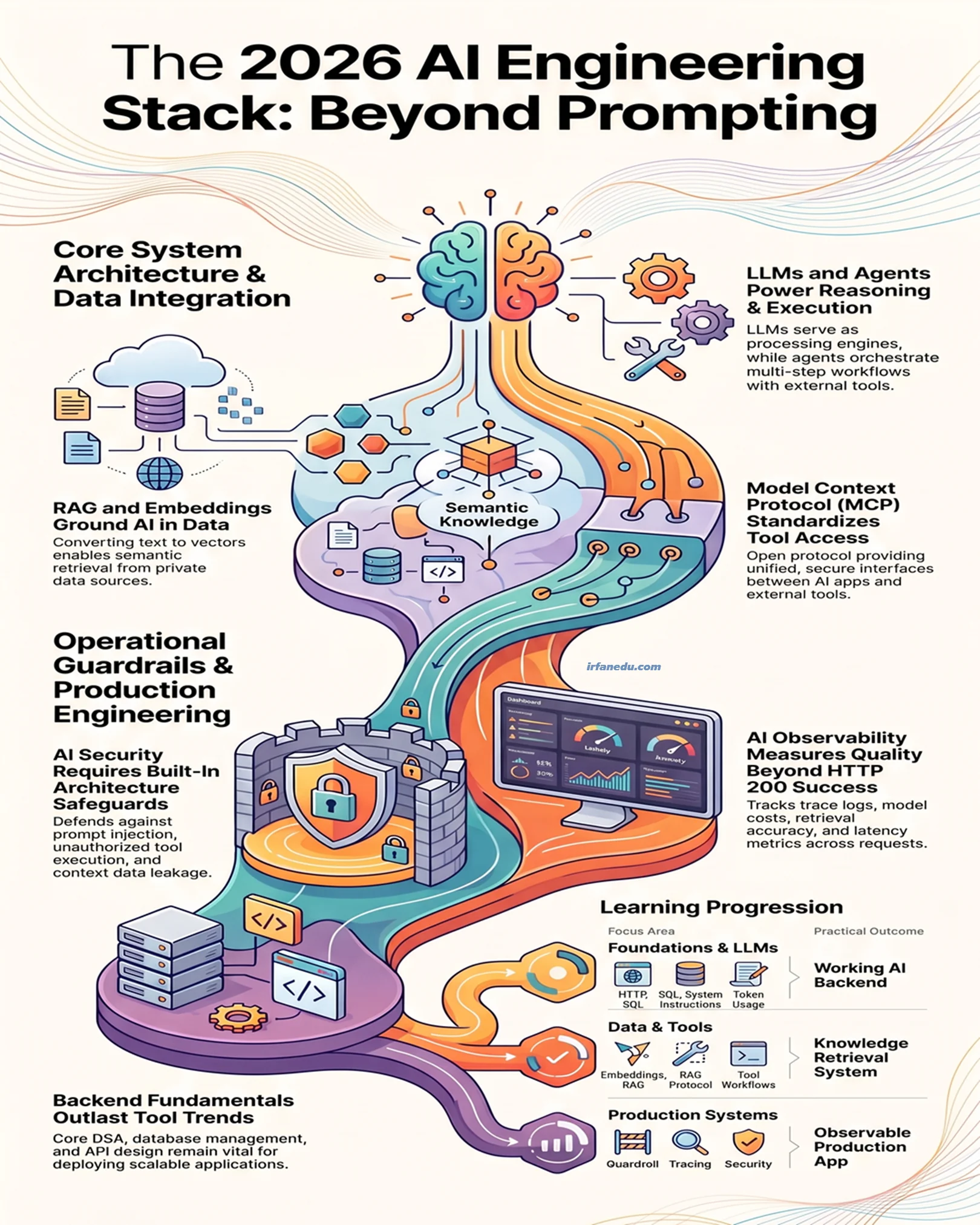
AI engineering in 2026 is about much more than writing effective prompts. Developers are increasingly building complete AI-powered applications that connect language models with data, APIs, tools, security controls and monitoring systems.
Learning to communicate with an AI model is a useful starting point. However, turning a model into a reliable product requires a broader set of engineering skills. You need to understand how the model receives information, retrieves relevant knowledge, performs actions, manages context and handles failures.
This guide explains the eight essential layers of the AI engineering stack, the tools associated with each layer, and a practical learning roadmap for developers who want to build production-ready AI applications.
1. Large Language Models (LLMs): The Reasoning Engine
Large Language Models, commonly known as LLMs, are the foundation of many modern AI applications. They process text and other supported inputs, generate responses, summarize information, classify content and assist with reasoning and coding tasks.
Popular model families include OpenAI models, Claude, Gemini, Llama and Mistral. Their capabilities, costs, context windows, deployment options and performance vary by model and version.
What does an AI engineer need to learn?
- How to call model APIs from Python, JavaScript or another backend language.
- System instructions, user messages and structured outputs.
- Context windows, token usage, latency and API costs.
- Streaming responses and handling API errors, timeouts and rate limits.
- Model selection, testing and output validation.
For example, a customer-support application may use an LLM to draft a response. The backend must still verify the user’s account, retrieve the correct order information, enforce permissions and decide whether the response can safely be sent.
2. Agentic AI: Turning Instructions into Actions
A conventional chatbot primarily responds to a prompt. An AI agent can follow a workflow, select tools, inspect their results and continue through multiple steps toward a defined goal. The degree of autonomy depends on the application’s design.
Consider a travel-planning assistant. It might collect travel preferences, search available flights, compare hotel options and prepare an itinerary. Each step may involve a different tool or service.
Popular frameworks and tools
- LangGraph — graph-based orchestration for stateful agent workflows.
- CrewAI — tools for orchestrating collaborative AI agents.
- AutoGen — a framework for building multi-agent AI applications.
Essential agent engineering concepts
- Tool calling and validating tool arguments.
- Workflow state and task planning.
- Retries, timeouts and recovery from failed actions.
- Human approval for sensitive or irreversible operations.
- Stopping conditions, execution limits and prevention of endless loops.
Agents introduce additional complexity. Every tool call creates a possible failure point, and an incorrect decision can have consequences beyond generating a poor answer. Start with a predictable workflow and introduce greater autonomy only when it provides a measurable benefit.
3. Retrieval-Augmented Generation (RAG): Connecting AI to Real Data
A language model’s built-in knowledge may be incomplete, outdated or unrelated to a particular organization’s private information. Retrieval-Augmented Generation (RAG) addresses this problem by retrieving relevant information from an external source before generating an answer.
RAG is useful for institutional knowledge bases, technical documentation, product manuals, educational resources, policy documents and customer support systems.
How a RAG pipeline works
- Collect: Load relevant documents, database records or other approved sources.
- Prepare: Clean the content and divide it into useful chunks.
- Index: Generate embeddings and store searchable representations and metadata.
- Retrieve: Search for information relevant to the user’s question.
- Generate: Supply the retrieved context to the model with clear instructions.
- Evaluate: Check relevance, factual support, citations and answer quality.
Tools to explore
- LangChain — components for building LLM and retrieval applications.
- LlamaIndex — tools for connecting language models with data.
- RAGFlow — an open-source RAG-oriented application platform.
- Neo4j — a graph database that can support knowledge-graph approaches.
A more advanced approach, GraphRAG, uses relationships between entities and graph-based retrieval techniques to help answer questions that require connecting information across multiple documents. It is useful for some workloads, but it is not necessary for every RAG application.
4. Embedding Models: The Foundation of Semantic Search
Embedding models convert text or other supported inputs into numerical vectors. These vectors represent patterns of meaning and can be compared to identify related content, even when two passages use different words.
For example, a search for “how to change my account password” may retrieve a document titled “Resetting your login credentials.” Keyword matching alone might miss this relationship, while semantic retrieval can identify it.
Embedding tools and model families
- OpenAI Embeddings — embedding models accessible through an API.
- Cohere Embed — embedding models designed for search and retrieval tasks.
- BGE models — embedding and retrieval models available through the BAAI ecosystem.
What should developers understand?
- Vector dimensions and similarity measures.
- Chunk size, chunk overlap and document preprocessing.
- Vector indexes and approximate nearest-neighbor search.
- Metadata filtering and hybrid search.
- Retrieval quality, relevance testing and model-specific limitations.
Embeddings are only one part of a search system. Good results also depend on document quality, appropriate chunking, indexing, query formulation and ranking. Evaluate the complete retrieval pipeline rather than assuming that changing the embedding model will solve every problem.
5. Model Context Protocol (MCP): Connecting AI to Tools and Data
The Model Context Protocol (MCP) is an open protocol for connecting AI applications with external tools, resources and data sources through a standardized interface.
Instead of building every integration around a different custom interface, developers can use MCP-compatible clients and servers where supported. Depending on the server and its permissions, integrations may expose database queries, repository information, files, internal services or other capabilities.
Common MCP use cases
- Accessing approved GitHub repository information.
- Connecting assistants to selected database operations.
- Integrating with workplace tools and internal services.
- Providing controlled access to files, documentation and APIs.
Start with the official MCP documentation to understand clients, servers, tools, resources, transports and authorization considerations.
What MCP does not automatically solve
A standard protocol does not guarantee that an integration is secure, compatible or reliable. Individual servers still need correct authentication, authorization, input validation, network controls and operational monitoring. A connection should expose only the capabilities that the application actually requires.
6. AI Security: Protecting Models, Data and Tool Access
AI applications face security risks that extend beyond traditional application vulnerabilities. An agent might encounter malicious instructions inside a retrieved document, disclose sensitive context, misuse an available tool or produce an unsafe output.
AI security must therefore be built into the architecture rather than added as a final filter.
Important security risks
- Prompt injection: Untrusted content attempts to override the intended instructions.
- Data leakage: Private information appears in outputs, logs or external requests.
- Excessive permissions: An agent can access or modify more resources than necessary.
- Unsafe tool execution: Invalid or manipulated arguments trigger unintended actions.
- Insecure retrieval: Search results expose documents the current user is not authorized to see.
- Unvalidated outputs: Model-generated content is trusted without appropriate checks.
Tools and resources
- NVIDIA NeMo Guardrails — tools for defining and enforcing conversational controls.
- Microsoft Presidio — tools for detecting and handling sensitive information.
- OWASP LLM security guidance — a resource for understanding major LLM application risks.
Security platforms and guardrails can help, but no single product prevents every attack. Apply least-privilege access, server-side authorization, secret management, input validation, audit logging and explicit approval for high-impact operations.
7. AI Observability: Measure More Than Whether It Runs
An AI application can return an HTTP 200 response and still deliver a completely incorrect answer. Traditional infrastructure monitoring is important, but it does not fully measure the quality of an AI system.
AI observability combines application traces, model interactions, retrieval information, operational metrics and quality evaluations to help developers identify failures and improve performance.
Useful observability tools
- LangSmith — tracing, debugging and evaluation workflows for AI applications.
- Langfuse — an open-source-oriented platform for LLM observability and evaluation.
- TruLens — tools for evaluating and monitoring AI application quality.
Metrics worth tracking
- Latency: How long the application takes to respond.
- Cost: Model usage and total cost per request or completed task.
- Answer quality: Accuracy, relevance and adherence to requirements.
- Retrieval quality: Whether the correct evidence was found.
- Reliability: Error rates, failed tool calls and timeout frequency.
- Safety: Policy violations, unauthorized access attempts and unsafe outputs.
Build evaluation datasets from realistic user questions and expected outcomes. Use repeatable tests before releases and monitor production performance over time. Protect sensitive information in traces, and avoid treating automated evaluation scores as a substitute for human review where the consequences of errors are significant.
8. AI Memory: Maintaining Useful Context Across Interactions
Many language models process each request using the context provided for that request. Without an application-managed memory mechanism, information from earlier conversations may not be available when a later request arrives.
Memory systems can store selected user preferences, conversation summaries, project details or other useful information. The application can then retrieve relevant information when needed.
Types of AI memory
- Working memory: Information needed during the current task or conversation.
- Conversation history: Previous messages or compact summaries of earlier exchanges.
- Long-term memory: Selected information retained across sessions.
- Structured memory: Facts and relationships stored in databases or knowledge graphs.
Tools and infrastructure
- Mem0 — a memory layer for AI applications.
- Redis — infrastructure that can support fast context and state storage.
- Neo4j — a graph database for representing entities and relationships.
These technologies serve different purposes. A database, cache, graph store or dedicated memory framework may be appropriate depending on the application’s requirements. Persistent memory is not automatically intelligent: developers must decide what to store, when to retrieve it, how to update it and when to delete it.
How the Eight Layers of the AI Engineering Stack Work Together
These layers are not eight independent products that every project must install. They are engineering capabilities that can be combined according to the problem being solved.
| Layer | Main responsibility | Example implementation |
|---|---|---|
| LLMs | Understand input and generate output | Model API or self-hosted model |
| Agentic AI | Coordinate multi-step tasks and tool use | LangGraph |
| RAG | Retrieve relevant external knowledge | LangChain or LlamaIndex |
| Embeddings | Represent content for semantic retrieval | Embedding model and vector index |
| MCP | Standardize connections to supported tools and data | MCP client and server |
| Security | Protect data, actions and permissions | Authorization, validation and guardrails |
| Observability | Trace behavior and evaluate quality | LangSmith or Langfuse |
| Memory | Maintain selected context over time | Database, Redis or memory framework |
Example: Building an AI university assistant
Imagine an assistant that answers students’ questions about university regulations, course materials and examination schedules.
- A student submits a question through a web interface.
- The backend authenticates the user and checks access permissions.
- The retrieval system searches approved university documents using embeddings.
- The LLM generates an answer using the retrieved evidence.
- An agent or workflow calls an authorized tool if a live lookup is required.
- Memory may supply relevant conversation context when appropriate.
- Validation and security controls check the response and any requested action.
- Observability tools record suitable metrics and traces for later evaluation.
Not every question needs every layer. A straightforward factual question may require only retrieval and generation. An operation that changes a student’s official record would require stronger authorization, validation and explicit safeguards.
AI Engineering Roadmap for Beginners in 2026
Developers do not need to master every framework before building their first AI application. A structured progression helps establish fundamentals before introducing more complex architectures.
| Stage | What to learn | Suggested outcome |
|---|---|---|
| 1. Programming foundations | Python or JavaScript, Git, APIs, HTTP, SQL and data structures | A working backend application |
| 2. LLM integration | Model APIs, structured outputs, token usage and error handling | An AI-powered application |
| 3. Retrieval and embeddings | Document processing, vector search and RAG evaluation | A document question-answering system |
| 4. Tool use and agents | Function calling, workflows, state and MCP basics | An assistant that uses approved tools |
| 5. Security and testing | Authentication, permissions, prompt injection and validation | A safer application with repeatable tests |
| 6. Production engineering | Deployment, logging, monitoring, evaluation and cost control | A deployed and observable application |
A practical 12-week study plan
- Weeks 1–2: Strengthen Python or JavaScript, HTTP APIs, Git and SQL.
- Weeks 3–4: Build an application using an LLM API and structured outputs.
- Weeks 5–6: Create a document-search application using embeddings and RAG.
- Weeks 7–8: Add tool calling, workflow orchestration and a small MCP integration.
- Weeks 9–10: Implement authorization, validation, testing and security controls.
- Weeks 11–12: Deploy the project and add tracing, evaluation and cost monitoring.
This is an illustrative plan, not a guarantee of job readiness. Your pace will depend on your existing programming experience, available study time and the complexity of your projects.
Three Practical AI Engineering Projects for Your Portfolio
1. AI document assistant
Build a system that answers questions from PDFs or technical documents. Add document upload, chunking, semantic search, source references and an evaluation dataset. Test whether the system correctly identifies questions that the documents cannot answer.
2. AI research assistant with tools
Create an assistant that searches approved sources, summarizes findings and produces a report. Add a tool-calling workflow, request limits, human approval for external actions and traceable execution logs.
3. AI support assistant with persistent memory
Develop a support application that retains selected preferences and relevant conversation summaries. Implement user-specific access controls, memory editing and deletion, and tests to ensure one user’s information cannot appear in another user’s conversation.
Why Backend Fundamentals and DSA Still Matter
The rapid growth of AI tools can make it tempting to skip conventional software engineering and focus entirely on model APIs and frameworks. That is a risky strategy.
Data structures and algorithms (DSA), databases, networking, operating systems, API design, testing and debugging remain important because production AI applications still run on software infrastructure.
- Data structures and algorithms: Help with problem-solving, efficient search and technical interviews.
- Backend development: Provides the APIs, business logic and orchestration around AI models.
- Databases: Store application records, document metadata, user preferences and workflow state.
- Security: Ensures that users and AI tools can access only authorized resources.
- Testing and debugging: Help identify errors in application logic, retrieval and model outputs.
- Deployment and operations: Keep applications available, scalable and maintainable.
AI engineering is best approached as an extension of software engineering, not a replacement for it. The strongest learning strategy is to build conventional programming skills alongside practical experience with AI systems.
Frequently Asked Questions About AI Engineering
1. What is an AI engineering stack?
An AI engineering stack is the collection of models, data retrieval systems, tools, application logic, security controls, memory mechanisms and monitoring capabilities used to build and operate AI-powered applications.
2. Is prompt engineering enough to become an AI engineer?
Prompt engineering is useful, but it is not sufficient for most production engineering tasks. Developers also need programming, API integration, data handling, testing, security and deployment skills. The exact requirements depend on the role.
3. What is the difference between an LLM and an AI agent?
An LLM processes input and generates output. An AI agent uses a model within a workflow that may select tools, execute steps, inspect results and continue toward a goal. Not every agent needs multiple models or unrestricted autonomy.
4. What is RAG, and why is it important?
Retrieval-Augmented Generation retrieves relevant external information and provides it to a language model when generating an answer. It is useful when applications need to work with current documents, private knowledge bases or domain-specific information.
5. Do I need to learn MCP before learning RAG?
No. RAG and MCP address different needs. RAG focuses on retrieving relevant information for generation, while MCP standardizes connections between AI applications and supported external capabilities. Learn whichever is relevant to your first project.
6. Which programming language should beginners learn for AI engineering?
Python is a strong starting point because of its broad ecosystem for machine learning, data processing and AI application development. JavaScript or TypeScript is also valuable for web-based AI products. The best choice depends on your existing skills and target role.
7. How long does it take to learn AI engineering?
The timeline depends on prior experience, study time and project complexity. A beginner might use a 12-week plan to build an initial portfolio, but becoming proficient in production AI engineering generally requires continued practice, testing and real-world projects.
8. Can I become an AI engineer without a machine learning degree?
Yes, many AI application engineering tasks can be learned through programming, documentation, courses and projects. A strong foundation in software engineering is important. Specialized ML research or model training roles may require deeper mathematics and machine learning knowledge.
Final Thoughts: Learn to Build Complete AI Systems
The future of AI application development is not simply about choosing the newest language model. It is about connecting models to reliable data, building useful workflows, controlling tool access, evaluating outputs and maintaining systems after deployment.
Start with programming and backend fundamentals. Learn to integrate an LLM, build a small RAG application, add a controlled tool-calling workflow and measure the quality of your results. Expand your stack only when your project needs another capability.
Frameworks and model capabilities will continue to change. The underlying engineering principles—clear interfaces, reliable data, security, testing, observability and thoughtful system design—will remain valuable.
Keep Learning with IrfanEdu
Explore practical educational resources, technology guides and programming topics to strengthen your skills.
Visit IrfanEdu.com and continue building your knowledge step by step.
Editorial note: AI tools, APIs and frameworks evolve frequently. Check their official documentation for current capabilities, compatibility, licensing and security recommendations before using them in a production application.