
Block wall calculator: blocks, mortar & fill estimator
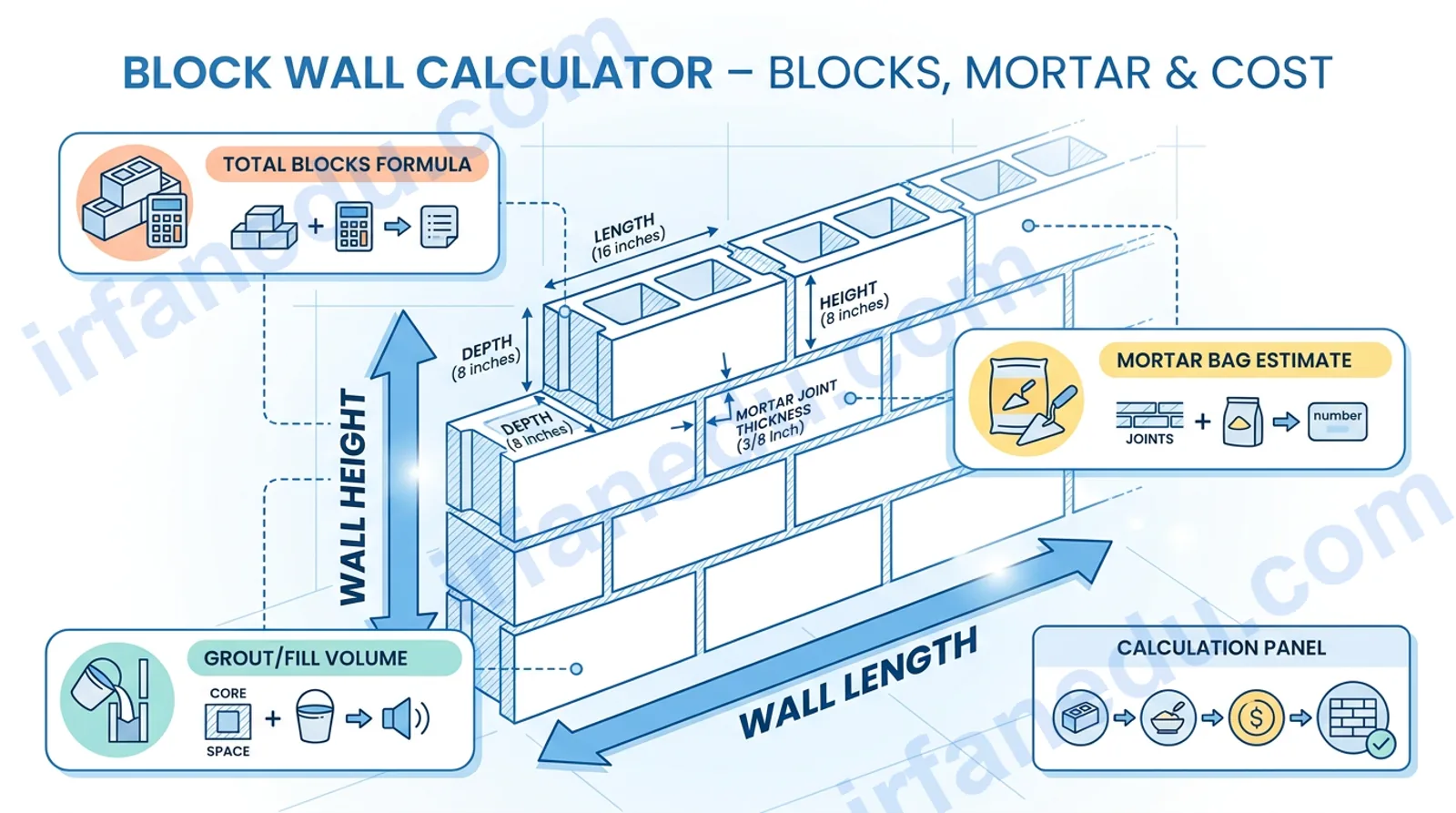
Most tutorials jump straight to “multiply length by height.” That step-zero they skip? Accounting for the mortar joint in the block’s face area. Miss it and your block count is off by about 12% — enough to send you back to the hardware store mid-project. This calculator handles it correctly, and the explanation below shows you exactly why.
A block wall calculator estimates CMU count by dividing total wall area by the face area of one block including its mortar joint. For a standard 8×8×16-inch block with a 3/8-inch mortar joint, each block covers 0.889 sq ft. Divide your wall’s square footage by 0.889, then add 5–10% for waste. Mortar: roughly 1 bag per 35 blocks. Fill: cores × block volume.
- 🧱 Standard CMU face area (with mortar joint) = 0.889 sq ft per block.
- 📐 Blocks needed = Wall area ÷ 0.889, then add your waste %.
- 🪣 Mortar bags ≈ total blocks ÷ 35 (standard 70–80 lb bag).
- 💧 Core fill volume = number of cores × core dimensions (if grouting).
- 🏗 Always add 5–10% waste; 10% for complex layouts or cuts.
- ⚠️ Subtract door/window openings before calculating blocks.
| Fact | Value |
|---|---|
| Nominal block size (most common) | 8 × 8 × 16 inches |
| Actual block size | 7⅝ × 7⅝ × 15⅝ inches |
| Standard mortar joint | 3/8 inch (0.375 in) |
| Face area per block (with joint) | 0.889 sq ft |
| Blocks per 100 sq ft (no waste) | ≈ 113 |
| Mortar bags per 100 blocks | ≈ 3 bags (70–80 lb each) |
| Recommended waste factor | 5% simple / 10% complex |
| Weight per standard CMU | ~28–35 lb (hollow) |
Block wall calculator
CMU blocks · mortar bags · core fill volume
feet (ft)
feet (ft)
inches (in) — default 16
inches (in) — default 8
inches (in) — default 0.375
% — default 5
How to use this block wall calculator
- Enter wall length and height in feet. For a wall with openings (doors, windows), subtract those areas first.
- Set block size. Default is 16 × 8 inches (nominal), the most common CMU in North America. Change this for 4-inch or 12-inch blocks.
- Set mortar joint thickness. Standard is 3/8 inch. Decorative or precision work sometimes uses 1/4 inch.
- Set waste factor. Use 5% for a straight wall, 10% for walls with many corners or cuts.
- Click Calculate. The result card shows total blocks, mortar bags, and core fill volume with a full step-by-step breakdown.
- Core fill: Only fill cores with grout if your design or local code requires it (structural or retaining walls). For garden walls, leave cores empty.
What is a CMU (concrete masonry unit)?
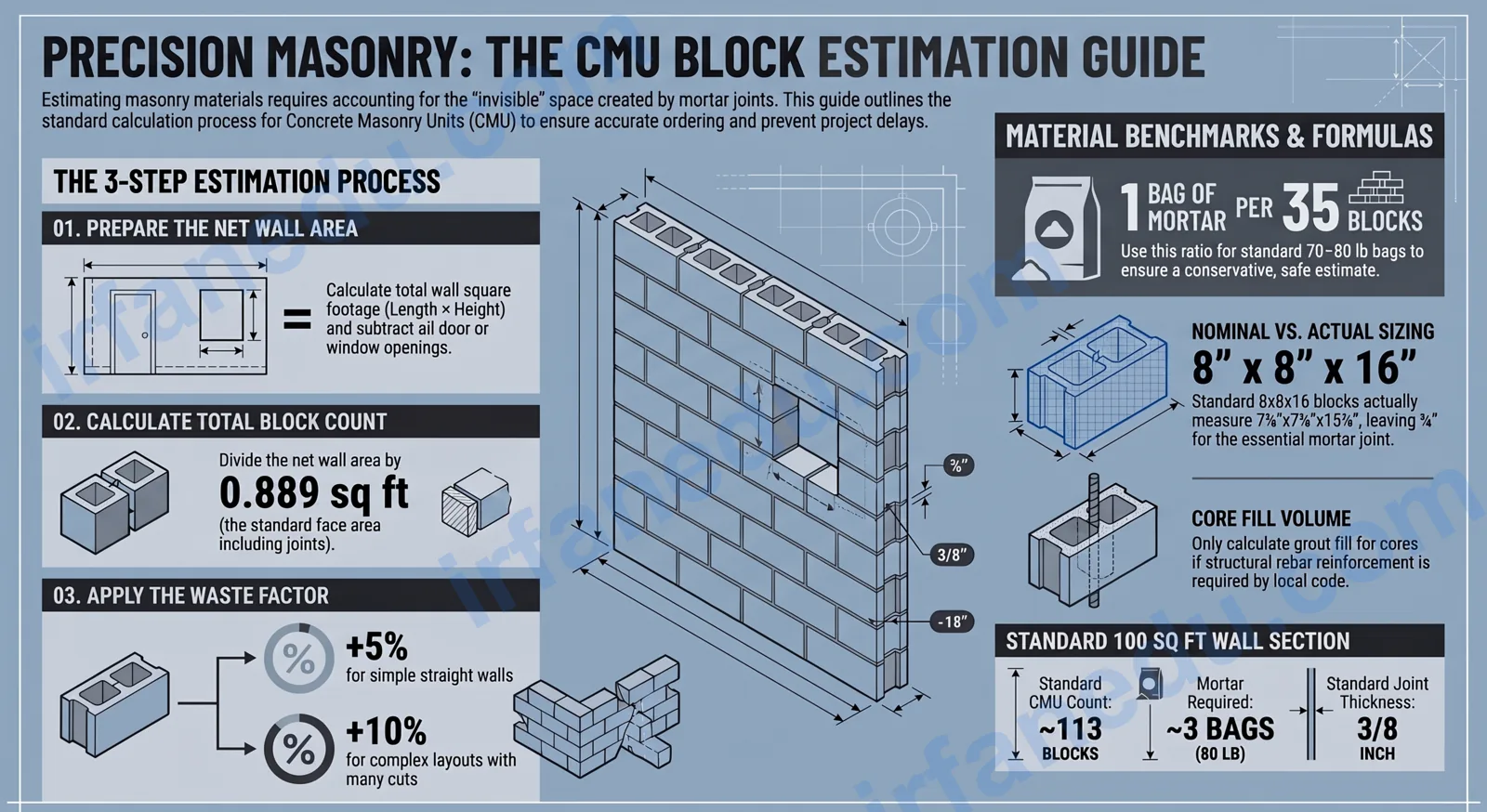
A concrete masonry unit (CMU) is a precast block made from Portland cement, water, and aggregate — the correct technical term for what most people call a “cinder block” or “concrete block.” The nominal 8×8×16-inch CMU is the industry standard in the United States, but actual dimensions are 7⅝×7⅝×15⅝ inches, leaving exactly 3/8 inch for a mortar joint on all four exposed faces.
CMUs are hollow by design: the two or three internal cores reduce weight, improve thermal performance, and allow vertical rebar + grout reinforcement when structural strength is needed.
In my experience helping students and DIYers understand construction math, the single most common error is treating the nominal block size as the actual face area. A 16×8-inch block does NOT cover 0.889 sq ft — it covers only 0.827 sq ft. The mortar joint adds the rest. Using the nominal dimension (which includes the joint) is the correct shortcut, and this calculator does exactly that.
The formula explained
Core formula:
Blocks needed = (Wall Area ÷ Block Face Area) × (1 + Waste %)Block face area (sq ft):
Face Area = [(Block Length + Joint) × (Block Height + Joint)] ÷ 144Mortar bags:
Mortar Bags = ceil(Total Blocks ÷ 35)Core fill volume (cu ft):
Fill = Total Blocks × Cores per Block × Core Volume| Symbol / Input | Meaning | Unit |
|---|---|---|
| Lw | Wall length | feet (ft) |
| Hw | Wall height | feet (ft) |
| Lb | Nominal block length | inches (in) |
| Hb | Nominal block height | inches (in) |
| j | Mortar joint thickness | inches (in) |
| W% | Waste factor | percent (%) |
| Aface | Block face area (with joint) | sq ft |
| N | Total blocks needed (with waste) | count |
| M | Mortar bags needed | bags |
| Vfill | Core fill volume | cu ft / cu yd |
SI units note: The calculator uses US customary units (feet, inches). To convert: 1 ft = 0.3048 m; 1 cu ft = 0.0283 m³. Standard metric CMU is 200×200×400 mm nominal (with 10 mm joint), giving a face area of 0.084 m².
Worked examples (matching the calculator’s steps)
Given: Wall 20 ft long × 4 ft high, standard 8×16 block, 3/8-inch joint, 5% waste.
- Wall area = 20 × 4 = 80 sq ft
- Face area = (16 + 0.375) × (8 + 0.375) ÷ 144 = 16.375 × 8.375 ÷ 144 = 137.14 ÷ 144 = 0.9524 sq ft
- Blocks (no waste) = 80 ÷ 0.9524 = 83.98 → 84
- With 5% waste = 84 × 1.05 = 88.2 → 89 blocks
- Mortar bags = ceil(89 ÷ 35) = 3 bags
Given: Wall 30 ft long × 8 ft high, 8×16 block, 3/8-inch joint, 10% waste.
- Wall area = 30 × 8 = 240 sq ft
- Face area = (16.375 × 8.375) ÷ 144 = 0.9524 sq ft
- Blocks (no waste) = 240 ÷ 0.9524 = 251.9 → 252
- With 10% waste = 252 × 1.10 = 277.2 → 278 blocks
- Mortar bags = ceil(278 ÷ 35) = 8 bags
- Core fill = 278 × 2 × (3.5/12) × (5/12) × (7.625/12) = 278 × 0.0513 ≈ 14.3 cu ft (0.53 cu yd)
Given: Wall 15 ft × 9 ft, 4×16 block, 3/8-inch joint, 5% waste.
- Wall area = 15 × 9 = 135 sq ft
- Face area = (16.375 × 8.375) ÷ 144 = 0.9524 sq ft (same face area — only depth changes)
- Blocks (no waste) = 135 ÷ 0.9524 = 141.7 → 142
- With 5% waste = 142 × 1.05 = 149.1 → 150 blocks
- Mortar bags = ceil(150 ÷ 35) = 5 bags
Note: a 4-inch block has the same face dimensions as an 8-inch block — only the depth (wall thickness) differs. The calculator handles this correctly because depth is not part of the face-area formula.
  ┌─────────────────────────────────────────────┐
  │         CMU BLOCK FACE AREA DIAGRAM          │
  │                                              │
  │  ←────── Nominal 16 in ──────→               │
  │  ←── Actual 15⅝ in ──→←3/8 in→              │
  │  ┌─────────────────────┐ │  ↑                │
  │  │                     │ │  │ Nominal 8 in   │
  │  │   BLOCK FACE        │ │  │ (Actual 7⅝ in) │
  │  │   (hollow cores     │ │  │ + 3/8 in joint │
  │  │    inside)          │ │  ↓                │
  │  └─────────────────────┘─┘                   │
  │                                              │
  │  Face area = (16 + 0.375) × (8 + 0.375) in  │
  │            = 16.375 × 8.375 = 137.14 sq in  │
  │            = 137.14 ÷ 144 = 0.9524 sq ft    │
  │                                              │
  │  Blocks per 100 sq ft = 100 ÷ 0.9524 ≈ 105  │
  └─────────────────────────────────────────────┘
Common mistakes when estimating block walls
| ❌ Wrong approach | ✅ Correct approach |
|---|---|
| Using actual block size (15⅝ × 7⅝ in) for face area | Use nominal size (16 × 8 in) which includes the mortar joint |
| Forgetting to subtract door/window openings | Calculate opening area and subtract before dividing |
| Ordering exactly the number calculated (no waste) | Always add 5–10% for cuts, breakage, and mismatches |
| Assuming all cores need grout fill | Only fill cores where rebar reinforcement is required by design or code |
| Using 1 bag of mortar per 100 blocks (too little) | Use 1 bag per 35 blocks for a safe conservative estimate |
The mortar bag estimate is where I see the most variation between guides. Some say 1 bag per 40
Sources & References
Written and fact-checked by Dr Irfan Mansuri. External links open in a new tab and are provided for further reading and verification.