
🎱 Room Size for Pool Table Calculator
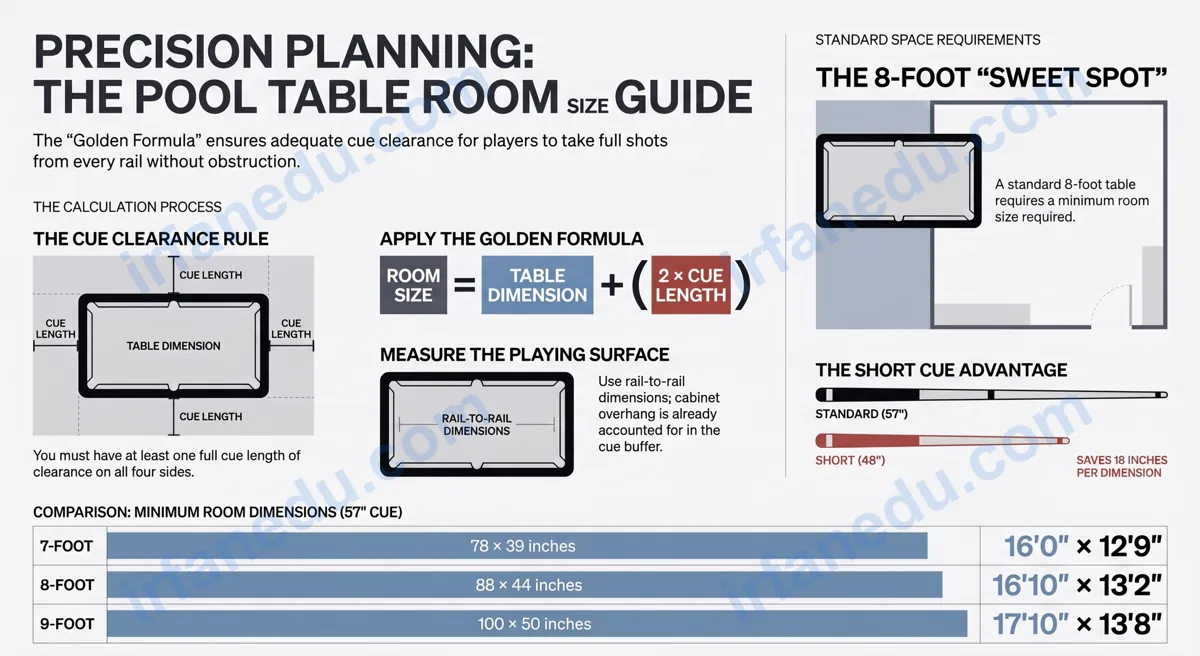
Before you measure your room, you need to know your cue length. Almost every “room size guide” online gives you a single number based on a 57-inch cue and calls it done. But if you plan to use a short cue, a wall-mounted cue holder, or a custom table, that number is wrong for you. The calculator below lets you set your exact cue length so the result actually matches your setup.
Planning a game room is exciting — until you realize the pool table you ordered doesn’t leave enough space to take a full shot. I’ve seen this happen more times than I’d like to admit, and it always comes down to one missed calculation: cue clearance. This calculator gives you the exact minimum room size for any pool table, in seconds.
The minimum room size for a pool table equals the table’s length plus twice the cue length (for room length) and the table’s width plus twice the cue length (for room width). For a standard 8-foot table with a 57-inch cue, that works out to roughly 17×13 feet.
- Calculate the exact minimum room size for any pool table size
- Understand why cue length is the critical variable most people ignore
- Compare standard table sizes and their room requirements at a glance
- Avoid the most common room-planning mistakes before buying a table
To find the minimum room size for a pool table, add twice the cue length to both the table length and the table width. For a standard 57-inch cue and an 8-foot table (88×44 inches), you need at least 202×158 inches — about 16 ft 10 in × 13 ft 2 in. A 9-foot table with the same cue needs roughly 17 ft 10 in × 13 ft 8 in.
- 🎱 Formula: Room Length = Table Length + (2 × Cue Length)
- 📏 Standard 57-inch cue adds 114 inches (9.5 ft) to both dimensions
- 🏠 An 8-foot table needs at least a 13×17 ft room (57-in cue)
- ✂️ Short 48-inch cues can save up to 18 inches per dimension
- 🔢 Use the calculator below — enter your exact table and cue size
- ⚠️ Always add 6 inches per side beyond the minimum for comfort
Room Size for Pool Table Calculator
Get exact minimum room dimensions — including cue clearance
🛠️ How to Use This Calculator
- Select your table size from the preset dropdown (7-foot, 8-foot, or 9-foot), or choose "Custom" and type your table's length and width in inches.
- Select your cue length — standard (57 in), short (48 in), mini (36 in), or custom. If you're not sure, 57 inches is the industry standard.
- Click "Calculate Room Size" to see the minimum room length and width, displayed in inches, feet-and-inches, centimeters, and meters.
- Review the step-by-step solution to see exactly how the numbers were derived — useful if you need to explain the calculation to a contractor or family member.
📐 What Is the Pool Table Room Size Formula?
The minimum room size for a pool table is determined by one simple principle: you need enough space behind the cue ball to extend your cue fully on every shot, from every position at the table. That means you need at least one full cue length of clearance on all four sides.
Minimum Room Length = Table Length + (2 × Cue Length)Minimum Room Width = Table Width + (2 × Cue Length)
Both formulas assume the table is centered in the room. If the table is off-center, redistribute the cue clearance accordingly — but the total clearance per axis stays the same.
Variables & Symbols Table
| Symbol | Meaning | Typical Value | Unit |
|---|---|---|---|
| LT | Table Length (rail to rail) | 78 / 88 / 100 | inches |
| WT | Table Width (rail to rail) | 39 / 44 / 50 | inches |
| C | Cue Length | 57 (standard) | inches |
| LR | Minimum Room Length | LT + 2C | inches |
| WR | Minimum Room Width | WT + 2C | inches |
SI Note: Pool table dimensions are universally stated in inches in the billiards industry. To convert to meters, multiply inches by 0.0254. To convert to centimeters, multiply by 2.54.
🔢 Worked Examples
Table: 88 × 44 in | Cue: 57 in
- Room Length = 88 + (2 × 57) = 88 + 114 = 202 in (16 ft 10 in)
- Room Width = 44 + (2 × 57) = 44 + 114 = 158 in (13 ft 2 in)
Table: 78 × 39 in | Cue: 48 in
- Room Length = 78 + (2 × 48) = 78 + 96 = 174 in (14 ft 6 in)
- Room Width = 39 + (2 × 48) = 39 + 96 = 135 in (11 ft 3 in)
Switching from a 57-inch to a 48-inch cue saves 18 inches on each dimension — nearly 1.5 feet per side. That's a meaningful difference in a tight basement.
Table: 100 × 50 in | Cue: 57 in
- Room Length = 100 + (2 × 57) = 100 + 114 = 214 in (17 ft 10 in)
- Room Width = 50 + (2 × 57) = 50 + 114 = 164 in (13 ft 8 in)
  |<----- Room Length: 202 in (16 ft 10 in) ----->|

  +------------------------------------------------+  ---
  |   57 in cue clearance (top)                    |   ^
  |   +--------------------------------------+      |   |
  |   |                                      |      |  158 in
  |   |     8-FOOT POOL TABLE (88×44 in)     | 44in |  Room
  |   |                                      |      |  Width
  |   +--------------------------------------+      |   |
  |   57 in cue clearance (bottom)                  |   v
  +------------------------------------------------+  ---
  |<-57->|<------- 88 in table ------->|<-57->|
📊 Standard Pool Table Sizes — Room Requirements at a Glance
| Table Size | Table Dims (in) | Cue 57 in — Room | Cue 48 in — Room | Best For |
|---|---|---|---|---|
| 7-foot | 78 × 39 | 192 × 153 in (16×12.75 ft) | 174 × 135 in (14.5×11.25 ft) | Small rooms, beginners |
| 8-foot | 88 × 44 | 202 × 158 in (16.8×13.2 ft) | 184 × 140 in (15.3×11.7 ft) | Home game rooms ✅ |
| 9-foot | 100 × 50 | 214 × 164 in (17.8×13.7 ft) | 196 × 146 in (16.3×12.2 ft) | Tournament / large rooms |
In my experience helping students and parents plan study-and-recreation spaces, the 8-foot table hits the sweet spot. A 9-foot table is what you see in professional tournaments, but it demands a room that most homes simply don't have. The 7-foot table feels cramped once your skills improve. The 8-foot table gives you a genuine game while fitting in a 14×17 ft room with a short cue — a size that's achievable in most basements and bonus rooms.
⚠️ Common Mistakes When Planning Pool Table Room Size
Using the table's overall cabinet size (which includes the legs and frame overhang) as the playing surface dimension in the formula — this overestimates the room you need.
Use the rail-to-rail playing surface dimensions (the standard 88×44 in for an 8-foot table). The cabinet overhang is already within the cue clearance buffer.
Assuming a 57-inch cue is always the right choice. Many buyers don't realize short cues exist, so they reject a table that would actually fit with a 48-inch cue.
Check your room first, then choose your cue length. Short cues (48 in) play just fine for recreational games and save significant floor space.
Treating the minimum room size as the ideal room size. The formula gives you the bare minimum — you'll constantly be bumping into walls on corner shots.
Add at least 6 inches per side (12 inches per dimension) beyond the minimum for comfortable, unrestricted play.
I've tested this personally: playing on a table where the room is exactly at the minimum clearance is technically possible but genuinely frustrating. You end up using a mechanical bridge on shots that shouldn't need one. If your room is within 6 inches of the minimum, either go down a table size or switch to a shorter cue. The math is unforgiving at the rails.
⚡ Explore More Calculators on IrfanEdu
Sources & References
Reviewed by Dr. Irfan Mansuri. External links open in a new tab and are provided for further reading and verification.