
How to Write a Book Report in High School (Complete Step-by-Step Guide)
A book report assignment can feel overwhelming when you stare at a blank page. You have just finished reading, your notes are scattered, and the deadline is closer than you would like. I have helped hundreds of students work through exactly this situation, and the fix is always the same: a clear structure before you type a single word.
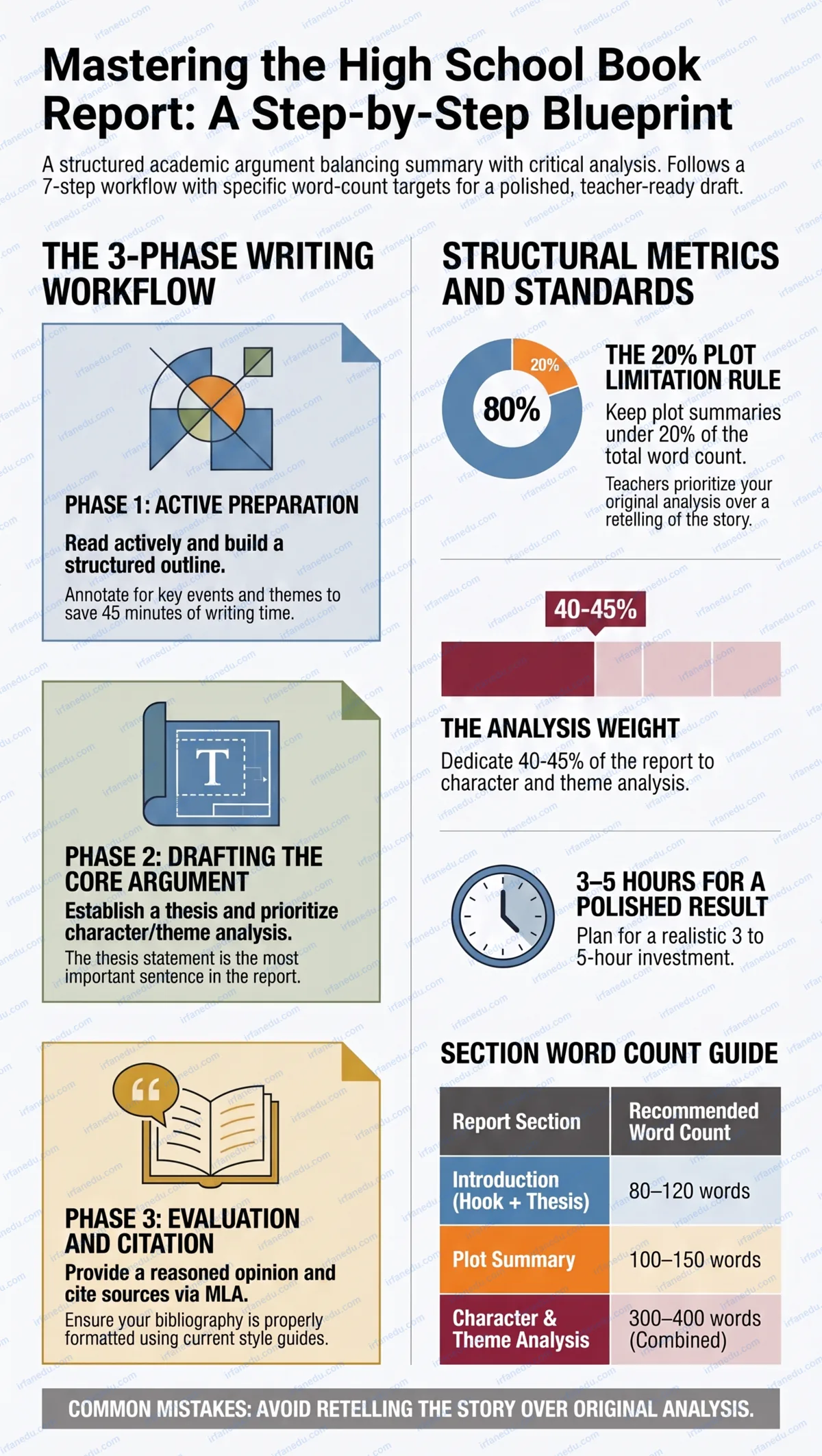
To write a book report in high school, you need seven components in order: an introduction with a thesis, a brief plot summary, a character analysis, a theme analysis, a personal evaluation, a conclusion, and a bibliography. Each section has a specific job. When you know what each part must do, writing becomes a matter of filling in a framework rather than inventing from scratch.
- You will learn the exact structure every high school book report needs.
- You will see worked examples for each section so you know what “good” looks like.
- You will understand the most common mistakes and how to avoid them.
- You will be able to write a polished, teacher-ready report in one sitting.
TL;DR – Quick Summary
- Read actively — annotate as you go, not after.
- Build a 7-section outline before writing a single sentence.
- Your thesis belongs at the end of the introduction paragraph.
- Plot summary should be no more than 20% of your total word count.
- Character and theme analysis sections carry the most academic weight.
- Always cite the book using your teacher’s required format (MLA or APA).
Book Report Cheat Sheet — The Full Map at a Glance
Before I walk you through each step, here is the complete cheat sheet. Every section below expands on one row of this table. Use it as your writing checklist.
High School Book Report: Section-by-Section Cheat Sheet
| # | Section | What It Must Do | Approx. Word Count |
|---|---|---|---|
| 1 | Introduction | Hook + book info + thesis statement | 80-120 words |
| 2 | Plot Summary | Main conflict + key events + resolution (no spoiler overload) | 100-150 words |
| 3 | Character Analysis | Protagonist + 1-2 supporting characters + evidence | 150-200 words |
| 4 | Theme Analysis | Central theme + author’s argument + textual evidence | 150-200 words |
| 5 | Personal Evaluation | Your honest opinion + specific strengths/weaknesses | 100-150 words |
| 6 | Conclusion | Restate thesis + summarize argument + closing thought | 60-100 words |
| 7 | Bibliography | Properly formatted citation for the book (and any sources) | 1-3 entries |
| Quick Fact | Detail |
|---|---|
| Typical length | 500-1,000 words (2-4 pages, double-spaced) |
| Most common citation style | MLA (Modern Language Association) |
| Biggest mistake students make | Writing a plot retelling instead of an analysis |
| Time needed (realistic) | 3-5 hours including reading notes review |
| Most important sentence | The thesis statement in the introduction |
| Font/format standard | 12pt Times New Roman, 1-inch margins, double-spaced |
What Is a Book Report (and What It Is Not)?
A book report is a structured academic document that summarizes a book’s content and evaluates its literary merit. It is the standard assignment in high school English classes because it tests both comprehension and critical thinking at the same time.
Many students confuse a book report with a book review or a plot retelling. Here is the key difference: a plot retelling just describes what happened. A book report explains what happened, why the characters behave as they do, what themes the author explores, and whether the book achieves its purpose effectively.
| Type | Primary Focus | Includes Opinion? | Typical Setting |
|---|---|---|---|
| Plot Retelling | What happened in the story | No | Elementary school |
| Book Report | Summary + character + theme + evaluation | Yes (evaluation section) | High school |
| Book Review | Recommendation for a general audience | Primarily yes | Journalism / blogs |
| Literary Analysis Essay | Deep argument about one literary element | Yes (thesis-driven) | AP / college level |
In high school, your teacher wants the book report format: summary plus analysis plus your reasoned opinion. Keep that goal in mind as you write every section.
Step 1: Read Actively and Take Notes
Active reading is the foundation of a strong book report. If you read passively — eyes moving across the page without a pencil — you will finish the book and remember very little that is useful for writing.
I recommend keeping a simple reading log as you go. You do not need anything fancy — a notes app or a folded piece of paper tucked inside the book works perfectly.
Track four things as you read: (1) key plot events with page numbers, (2) character names and their relationships, (3) any sentence that feels like it captures the book’s main idea, and (4) moments that surprised you or made you feel something. That last category is gold for your evaluation section.
Pay special attention to the opening chapter, any turning points in the middle, and the final resolution. These three zones give you the skeleton of your plot summary section. Note direct quotes that reveal character or theme — you will need at least two or three specific quotes as evidence in your analysis sections.
+--------------------------------------------------+
|  ACTIVE READING LOG                              |
+--------------------------------------------------+
|  Book Title:  _________________________________  |
|  Author:      _________________________________  |
+--------------------------------------------------+
|  KEY PLOT EVENTS          |  PAGE #              |
|  Opening conflict:        |  p.___               |
|  Major turning point 1:   |  p.___               |
|  Major turning point 2:   |  p.___               |
|  Climax:                  |  p.___               |
|  Resolution:              |  p.___               |
+--------------------------------------------------+
|  CHARACTERS               |  ROLE / TRAIT        |
|  Protagonist:             |                      |
|  Antagonist:              |                      |
|  Key supporting char:     |                      |
+--------------------------------------------------+
|  THEME CLUES (quotes + page numbers)             |
|  1.                                              |
|  2.                                              |
|  3.                                              |
+--------------------------------------------------+
|  MY REACTION (honest notes for evaluation)       |
|                                                  |
+--------------------------------------------------+
Step 2: Build Your Outline Before You Write
An outline is not optional — it is the single most effective time-saving tool available to you. Students who skip the outline spend twice as long writing and end up with a disorganized report that loses points on structure.
Your outline does not need to be elaborate. A simple numbered list with one sentence per section is enough. The goal is to decide what goes where before you commit to full sentences. This prevents the most common structural problem: burying your thesis in the middle of the report instead of placing it at the end of the introduction.
- Introduction: Hook about loneliness in adolescence. Book info. Thesis: “The author uses the protagonist’s social isolation to argue that identity is formed through conflict, not comfort.”
- Plot Summary: Main character moves to new city, struggles to fit in, confronts a defining choice, finds self-acceptance.
- Character Analysis: Protagonist — motivation is belonging; changes from passive to assertive. Best friend — represents the cost of conformity.
- Theme Analysis: Central theme is identity formation. Evidence: three key scenes where protagonist chooses authenticity over acceptance.
- Personal Evaluation: Strong character voice; pacing slows in the middle third. Would recommend to readers aged 14-17.
- Conclusion: Restate thesis. The book succeeds at its central argument. Closing thought about why this theme matters.
- Bibliography: MLA citation for the book.
In my experience, the outline step is where most students lose the most time by skipping it. I have reviewed hundreds of student book reports, and the ones that feel scattered almost always come from writers who started typing before they knew what they wanted to say. Spend 15 minutes on your outline. It will save you 45 minutes of rewriting later.
Step 3: Write a Strong Introduction with a Thesis
Your introduction has three jobs: hook the reader, provide basic book information, and deliver a clear thesis statement. It should be 80 to 120 words — tight and purposeful.
The hook is your first sentence. It should connect to the book’s theme in a way that makes the reader want to continue. Avoid starting with “This book is about” or “The author wrote this book because.” Both are weak openings that tell the teacher nothing interesting.
| Weak Opening | Strong Opening |
|---|---|
| “This book is about a boy who moves to a new school.” | “Every teenager knows the particular dread of walking into a room where no one knows your name.” |
| “The author wrote this book to show that friendship is important.” | “What does it cost a person to belong somewhere they were never meant to fit?” |
| “I am going to write about the themes in this novel.” | “Identity, the author argues, is not something you find — it is something you build under pressure.” |
After your hook, give the reader the book’s title (italicized), the author’s full name, the publication year, and the genre. Then end the introduction with your thesis — one sentence that states the book’s central theme and your specific claim about it.
“Every teenager knows the particular dread of walking into a room where no one knows your name. In The Outsiders (1967), S.E. Hinton uses the rivalry between two social groups to argue that class divisions destroy the individual identities of young people on both sides. This report examines how Hinton builds that argument through the protagonist Ponyboy Curtis, the novel’s central conflict, and its recurring theme of wasted potential.”
Step 4: Summarize the Plot Concisely
The plot summary section is where most students go wrong. They retell the entire story in detail, and the summary becomes 60% of the report. Your teacher already read the book. The summary exists to establish context for your analysis — nothing more.
Keep your plot summary to 100-150 words. Cover the setup (who, where, what situation), the central conflict, the climax, and the resolution. Use present tense when describing what happens in the book — this is standard academic convention.
A useful formula: “The story follows [protagonist] who [wants/needs something]. When [central conflict happens], [protagonist] must [face challenge]. The story reaches its turning point when [climax]. Ultimately, [brief resolution].” Fill in those blanks and you have a solid summary in under 100 words.
Do not reveal every plot twist or spoil the ending in detail. Your summary should make the reader understand the story’s shape, not replace the experience of reading it. If your plot summary is longer than your character analysis, trim it down.
Step 5: Analyze Characters and Themes
This is the academic core of your book report. Character analysis and theme analysis together should make up roughly 40-45% of your total word count. These sections show your teacher that you understood the book at a deeper level than surface events.
Character Analysis
Focus on the protagonist first. Describe their role, their primary motivation, and — most importantly — how they change from the beginning to the end of the story. A character who does not change is also worth analyzing: ask why the author chose to keep them static.
Then pick one or two supporting characters who matter to the story’s argument. Do not try to cover every character. Depth beats breadth in this section. Use at least one specific quote or scene as evidence for each character claim you make.
“Ponyboy Curtis begins the novel as a passive observer of the conflict between the Greasers and the Socs. His defining moment of change comes when he watches Johnny die and realizes that staying ‘gold’ — innocent and open — is a choice, not a given. By the final chapter, Ponyboy shifts from victim to narrator with purpose, choosing to write the very story the reader has just read. This self-awareness marks his transformation from a boy defined by his social group to an individual with his own voice.”
Theme Analysis
A theme is not a topic. “Friendship” is a topic. “True friendship requires accepting someone’s flaws, not just their strengths” is a theme. Identify the book’s central theme as a complete statement, then explain how the author develops it through plot, character, and imagery.
Support your theme claim with two or three specific examples from the text. Page numbers or brief quotes make your argument concrete and show your teacher you read carefully.
I always tell my students: if you can swap your theme statement into a different book and it still makes sense, your theme is too vague. “People face challenges” could describe almost any novel. “The desire to belong destroys the very individuality that makes a person worth knowing” — that is specific to a particular story and a particular argument. The more precise your theme statement, the stronger your entire analysis becomes.
Step 6: Write Your Personal Evaluation
The personal evaluation section is where you give your honest, reasoned opinion of the book. This is not a space to write “I liked it” or “It was boring.” Your teacher wants a critical evaluation backed by specific evidence.
Address at least two of these questions: Did the author achieve what they set out to do? Was the pacing effective? Were the characters believable? Did the writing style serve the story? Who would benefit most from reading this book?
“Hinton’s greatest strength is her dialogue — it sounds authentic to the teenage experience in a way that adult-written young adult fiction often does not. The pacing slows noticeably in the middle third of the novel, particularly during the scenes at the church, but this slowdown serves a purpose: it gives the reader time to understand the characters before the climax demands an emotional response. I would recommend this novel to any student studying social class, identity, or the gap between how groups perceive each other and how individuals actually feel.”
Notice that the example above makes specific claims (dialogue quality, pacing issue, the church scenes) and explains the reasoning behind each one. That is what separates a strong evaluation from a vague one.
Step 7: Write the Conclusion and Add Your Bibliography
Your conclusion has one job: close the argument cleanly. It should restate your thesis in different words, briefly summarize the two or three strongest points you made, and end with a closing thought that gives the reader something to think about.
The conclusion should be 60 to 100 words. Do not introduce new information here. Do not start with “In conclusion” — it is a weak opener that adds nothing. Instead, start with a restatement of your thesis or a callback to your opening hook.
“The Outsiders demonstrates that the labels society assigns to young people — Greaser, Soc, troublemaker, golden boy — are less about identity and more about control. Hinton builds this argument through Ponyboy’s transformation, the parallel suffering of characters on both sides of the divide, and the novel’s insistence that staying ‘gold’ is an act of resistance. Decades after its publication, the book’s central question remains urgent: how much of who you are is genuinely yours, and how much was assigned to you before you had a say?”
Bibliography: Citing Your Book
After the conclusion, add a bibliography page. The most common format in high school is MLA. A basic MLA book citation looks like this:
Format: Last Name, First Name. Title of Book. Publisher, Year of Publication.
Example: Hinton, S.E. The Outsiders. Viking Press, 1967.
In-text citation: (Hinton 45) — used whenever you quote or paraphrase directly.
If your teacher requires APA format, the structure changes slightly. Check the Purdue OWL MLA Guide for the exact format — it is the most reliable free resource for citation rules.
Common Mistakes and How to Fix Them
After reviewing many student book reports, I see the same errors appear repeatedly. Here is a quick reference so you can check your own work before submitting.
| Mistake | Why It Loses Points | Fix |
|---|---|---|
| Plot summary takes up more than 25% of the report | Shows comprehension only, not analysis | Cut the summary to 100-150 words; expand analysis sections |
| Thesis is too vague (“This book is about friendship”) | Gives the reader nothing specific to evaluate | State the theme as a complete argument, not a topic |
| No textual evidence in analysis sections | Claims are unsubstantiated — teacher cannot verify your reading | Include at least one quote or specific scene per claim |
| Personal evaluation is just “I liked/disliked it” | Shows no critical thinking | Name specific elements (pacing, dialogue, structure) and explain why |
| Missing or incorrectly formatted bibliography | Loses easy points; signals carelessness | Use Purdue OWL or your teacher’s style guide to format correctly |
| Switching tenses (past and present mixed) | Looks unprofessional; confuses the reader | Use present tense throughout when describing the book’s content |
Never copy a plot summary from a website and paste it into your report. Teachers recognize this immediately, and it constitutes academic dishonesty. Your summary must be in your own words, based on your own reading.
Quick Knowledge Check
Test What You Know
1. Where should your thesis statement appear in a book report?
Show Answer
2. What is the maximum recommended word count for the plot summary section in a 750-word report?
Show Answer
3. What is the difference between a theme and a topic in literary analysis?
Show Answer
Practice Problems
Practice 1: Write a thesis statement for a book you have read
Task: Choose any book you have read in school. Write one thesis sentence that (a) names the central theme and (b) makes a specific claim about how the author develops it.
Model answer structure: “In [Title] by [Author], [specific literary technique or character arc] demonstrates that [complete thematic argument].”
Example: “In To Kill a Mockingbird by Harper Lee, Atticus Finch’s defense of Tom Robinson demonstrates that moral courage means acting on principle even when the outcome is already decided against you.”
Check your thesis: Can it only apply to this specific book? Does it make a claim that someone could agree or disagree with? If yes to both, it is a strong thesis.
Practice 2: Identify what is wrong with this introduction
Weak introduction to evaluate: “This book report is about Animal Farm by George Orwell. It was written in 1945. The book is about animals on a farm. I will talk about the characters and themes in this report.”
Problems:
- Opens with “This book report is about” — weak and self-referential.
- No hook — nothing to engage the reader.
- No thesis — “I will talk about” is not an argument.
- Tells the reader what you will do instead of doing it.
Revised version: “Power, once seized, has a way of corrupting the very ideals that justified its seizure. In Animal Farm (1945), George Orwell uses a farm rebellion as an allegory to argue that any political revolution will eventually reproduce the oppression it set out to destroy, as long as the desire for power remains unchecked.”
Practice 3: Convert a vague evaluation into a specific one
Vague evaluation: “I liked this book. It was interesting and the characters were good. I would recommend it.”
Task: Rewrite it with specific claims and reasons.
Model revision: “The novel’s greatest strength is its use of dramatic irony — the reader understands the danger before the characters do, which creates sustained tension throughout the second half. The weakest element is the secondary antagonist, whose motivations are never fully explained, leaving a gap in the story’s logic. Despite this, the book is a compelling read for anyone interested in how ordinary people respond to extraordinary moral pressure.”
Notice: specific element named (dramatic irony), specific weakness identified (secondary antagonist’s motivation), and a specific audience recommendation.