
How Much Income Tax Do You Pay in Florida?
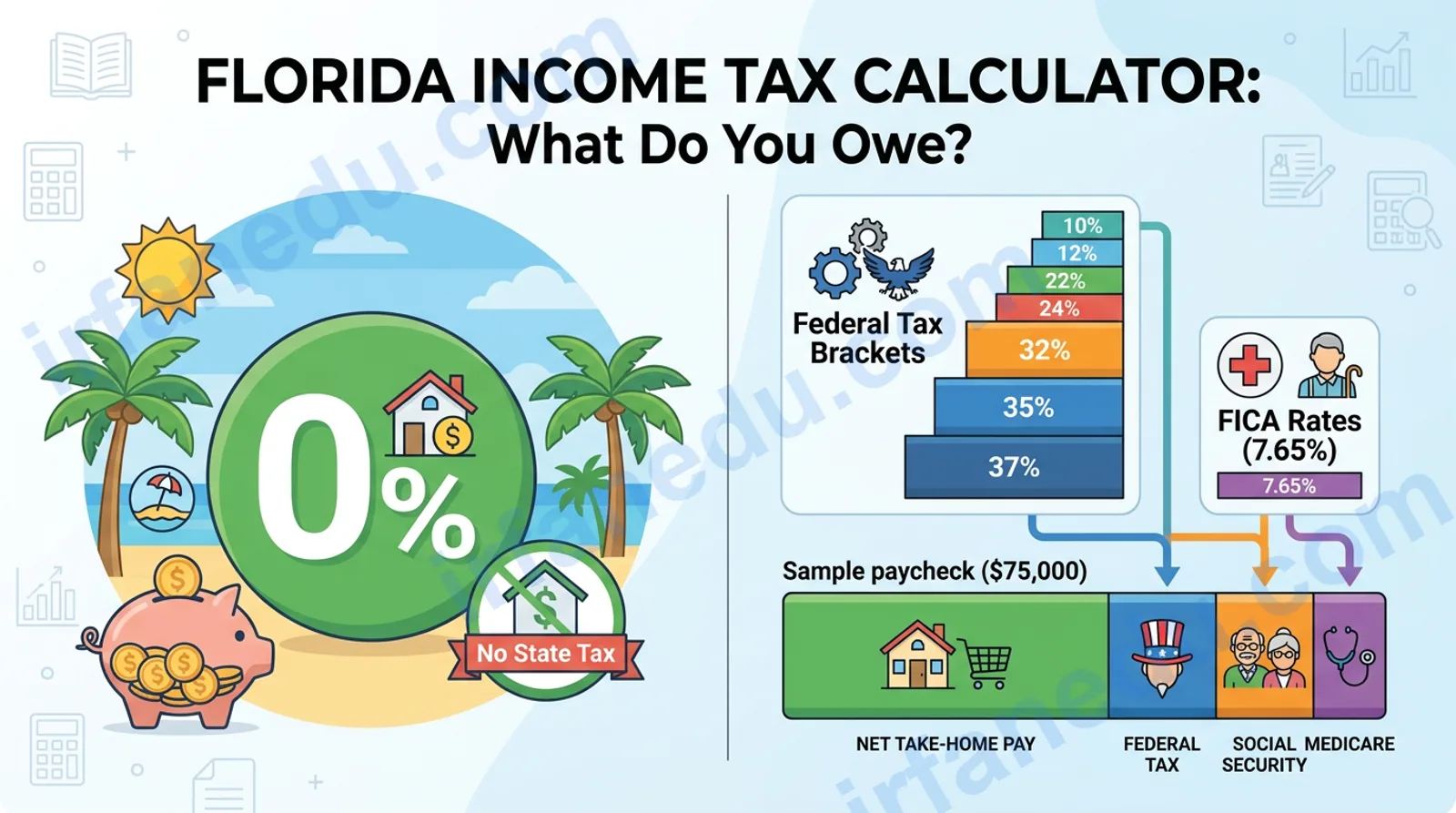
Most guides about Florida income tax bury the most important fact three paragraphs in. Here it is upfront: Florida charges zero state income tax. But that does not mean Florida workers pay nothing. Federal income tax, Social Security, and Medicare still come out of every paycheck — and those add up fast.
This calculator gives you a real, step-by-step breakdown of what you actually owe in 2026, using current IRS brackets and FICA rates.
Florida has no state income tax. Florida residents pay only federal income tax (10%–37%) and FICA — Social Security at 6.2% and Medicare at 1.45%. For a single filer earning $75,000 in 2026, estimated federal tax is about $10,294 and FICA is $5,738, leaving take-home pay of roughly $58,968. Use the calculator below for your exact numbers.
⚡ In Short
- Florida = $0 state income tax, ever.
- You still owe federal tax: 10%–37% by bracket.
- FICA = 6.2% Social Security + 1.45% Medicare on every paycheck.
- 2026 standard deduction: $14,600 (single) / $29,200 (MFJ).
- Social Security wage base cap: $176,100 in 2026.
- Pre-tax 401(k) and HSA contributions reduce your taxable income.
In my experience helping students and families understand their paychecks, the single biggest misconception I see is people assuming “no state income tax” means a dramatically smaller tax bill overall. It helps — but federal taxes are the heavy hitter. A Florida resident earning $80,000 still sends roughly $12,000+ to the IRS. Knowing that number before you budget is what this calculator is for.
| Quick Fact | Value (2026) |
|---|---|
| Florida State Income Tax Rate | 0% (no state income tax) |
| Federal Tax Brackets | 10%, 12%, 22%, 24%, 32%, 35%, 37% |
| Standard Deduction (Single) | $14,600 |
| Standard Deduction (MFJ) | $29,200 |
| Social Security Rate | 6.2% (wage base: $176,100) |
| Medicare Rate | 1.45% (+ 0.9% above $200K single) |
| Florida Sales Tax | 6% (state) + local surtax |
| Governing Authority | IRS (federal); Florida DOR (state) |
Florida Income Tax Calculator (2026)
Florida Income Tax Calculator
Estimate your 2026 federal tax, FICA & take-home pay
USD / year
USD / year
How to Use This Calculator
- Enter your gross annual salary — your total pay before any deductions, in US dollars.
- Select your filing status — Single, Married Filing Jointly, or Head of Household. This determines your standard deduction and bracket thresholds.
- Add pre-tax deductions — enter your annual 401(k), 403(b), HSA, or employer health insurance contributions. These reduce your taxable income before the IRS sees it.
- Click Calculate — the result card shows your estimated federal tax, Social Security, Medicare, and take-home pay with a numbered step-by-step breakdown.
What Is Florida Income Tax?
Florida income tax is, technically, nothing — the state levies zero personal income tax on wages, salaries, or investment income for individuals. Florida’s constitution has prohibited a personal income tax since 1924, and a 2018 constitutional amendment made it even harder to introduce one in the future.
Florida is one of nine US states with no state income tax, alongside Texas, Nevada, Washington, Wyoming, South Dakota, Alaska, Tennessee, and New Hampshire. According to the IRS Tax Withholding Estimator, Florida residents’ entire income tax burden flows through the federal system — which is what this calculator focuses on.
Florida funds its state budget primarily through a 6% state sales tax, documentary stamp taxes, and property taxes — not income taxes. That is an important distinction when comparing your total tax burden to residents of other states.
The Formula: How Your Florida Tax Bill Is Calculated
Take-Home Pay = Gross Salary − Federal Income Tax − Social Security Tax − Medicare Tax − Pre-Tax Deductions
Here is how each piece works in 2026:
| Taxable Income (Single) | Rate | Tax on This Bracket |
|---|---|---|
| $0 – $11,600 | 10% | Up to $1,160 |
| $11,601 – $47,150 | 12% | Up to $4,266 |
| $47,151 – $100,525 | 22% | Up to $11,743 |
| $100,526 – $191,950 | 24% | Up to $21,962 |
| $191,951 – $243,725 | 32% | Up to $16,568 |
| $243,726 – $609,350 | 35% | Up to $127,962 |
| Over $609,350 | 37% | On the excess |
The US uses a marginal tax system — only the income inside each bracket is taxed at that bracket’s rate. Earning $50,000 does not mean all $50,000 is taxed at 22%. Only the slice from $47,151 to $50,000 hits 22%; the rest is taxed at lower rates.
Worked Examples: What You Actually Keep
Example 1: Single Filer, $55,000 Salary
- Gross: $55,000
- Standard deduction (single): $14,600 → Taxable income: $40,400
- Federal tax: 10% on $11,600 ($1,160) + 12% on $28,800 ($3,456) = $4,616
- Social Security: $55,000 × 6.2% = $3,410
- Medicare: $55,000 × 1.45% = $797.50
- Total taxes: $8,823.50 → Take-home: $46,176.50
Example 2: Married Filing Jointly, $120,000 Combined Salary
- Gross: $120,000
- Standard deduction (MFJ): $29,200 → Taxable income: $90,800
- Federal tax: 10% on $23,200 ($2,320) + 12% on $67,600 ($8,112) = $10,432
- Social Security: $120,000 × 6.2% = $7,440
- Medicare: $120,000 × 1.45% = $1,740
- Total taxes: $19,612 → Take-home: $100,388
  FLORIDA PAYCHECK BREAKDOWN — $75,000 Gross (Single, 2026)
  ============================================================
  Gross Salary            $75,000  ████████████████████ 100%
  ─ Standard Deduction   -$14,600
  = Taxable Income        $60,400

  Federal Income Tax      -$8,686  ████ 11.6%
  Social Security         -$4,650  ██   6.2%
  Medicare                -$1,088  █    1.45%
  Florida State Tax           $0   ·    0%
  ─────────────────────────────────────────────
  TOTAL TAXES            -$14,424  ██████ 19.2%
  NET TAKE-HOME           $60,576  ██████████████ 80.8%
  ============================================================
Most Florida tax guides stop at “no state income tax” and call it a day. Here is what they miss: your effective federal tax rate on gross income is almost always lower than your marginal bracket — sometimes by 8–12 percentage points. A single Floridian earning $75,000 is technically in the 22% bracket, but their effective federal rate is only about 11.6%. That gap exists because the standard deduction and the lower brackets absorb most of the income first. Knowing this distinction prevents the very common mistake of budgeting as if your entire salary is taxed at your top bracket rate.
Florida vs. High-Tax States: The Real Difference
| State | State Income Tax Rate | Extra Annual Tax on $75K Salary | Notes |
|---|---|---|---|
| Florida | 0% | $0 | No state income tax |
| California | 1%–13.3% | ~$4,900 | High earners pay 13.3% |
| New York | 4%–10.9% | ~$3,800 | NYC adds city tax on top |
| Illinois | 4.95% flat | ~$3,713 | Flat rate, no brackets |
| Texas | 0% | $0 | No state income tax |
| Oregon | 4.75%–9.9% | ~$4,200 | High marginal rate |
The savings are real — but remember that Florida’s 6% sales tax and property taxes partially offset the income tax advantage. If you own a home or spend heavily, factor those in.
I have seen people relocate from New York to Florida purely for the tax savings, then discover their property taxes and homeowner’s insurance costs are higher than expected. The income tax saving is genuine and significant — especially above $100,000 — but do the full math on your total cost of living before making a major move based on tax alone.
Common Mistakes When Calculating Florida Take-Home Pay
- Mistake: Taxing all income at your top bracket rate. Your marginal rate applies only to the last slice of income. The effective rate is always lower.
- Mistake: Forgetting FICA. Social Security (6.2%) and Medicare (1.45%) together take 7.65% off the top of every dollar of wages, regardless of deductions.
- Mistake: Ignoring pre-tax deductions. A $10,000 401(k) contribution does not just save you $10,000 in take-home — it also reduces your federal taxable income, cutting your tax bill by $1,200–$3,700 depending on your bracket.
- Mistake: Assuming Florida has no taxes at all. Florida has a 6% state sales tax and counties add local surtaxes (typically 0.5%–1.5%). Property taxes average around 0.83% of assessed value statewide.
- Mistake: Using last year’s brackets. The IRS adjusts brackets for inflation each year. Always use current-year numbers — this calculator uses 2026 figures.
The pre-tax deduction mistake is the one I see most often with younger workers. If your employer offers a 401(k) match and you are not contributing enough to capture it, you are leaving free money on the table AND paying more federal tax than you need to. Maximizing pre-tax contributions is the single highest-leverage tax move available to most Florida employees.
Explore More Calculators on IrfanEdu
Quick Quiz: Test Your Florida Tax Knowledge
3-Question Florida Tax Quiz
1. What is Florida’s state income tax rate for individuals?
2. What is the combined FICA rate an employee pays in 2026?
3. In 2026, what is the standard deduction for a single filer?
Frequently Asked Questions
Does Florida have a state income tax?
What taxes do Florida workers actually pay?
How do I calculate my take-home pay in Florida?
Is Florida really tax-friendly compared to other states?
Key Takeaways
- Florida charges zero state income tax on personal income — permanently.
- Federal income tax (10%–37%) and FICA (7.65%) still apply to all Florida workers.
- Your effective federal rate is always lower than your marginal bracket rate.
- Pre-tax 401(k) and HSA contributions reduce your taxable income and your tax bill.
- Florida’s 2026 standard deduction follows IRS rules: $14,600 (single), $29,200 (MFJ).
- Use the calculator above to get a personalized, step-by-step breakdown.