
Chair Height Calculator: Find Your Perfect Ergonomic Seat
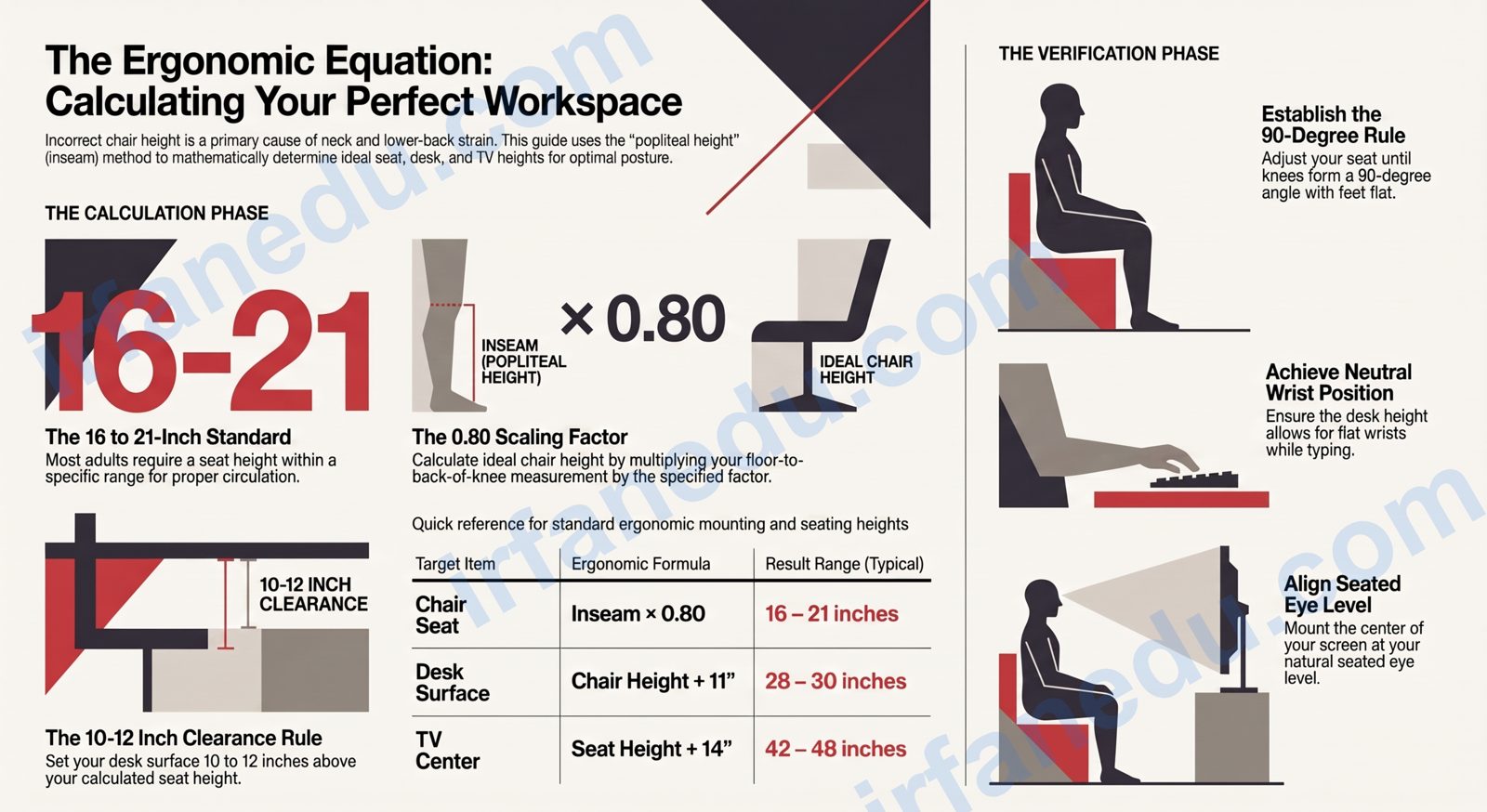
⚡ TL;DR
- Ideal chair height = your inseam x 0.80 (floor to back of knee).
- Standard desk height = chair height + 10 to 12 inches for neutral wrists.
- TV center should sit at seated eye level, typically 42 to 48 inches from the floor.
- Most adults need a seat between 16 and 21 inches high.
- Wrong chair height is a leading cause of lower-back and neck strain at desks.
- Use the calculator below, then verify: knees at 90 degrees, feet flat on the floor.
Table of Contents
Your ideal chair height equals roughly 80% of your inseam (floor to back of knee). For most adults, that is 16 to 21 inches (40 to 53 cm). Set your desk 10 to 12 inches above your seat for neutral wrists. Mount your TV center at seated eye level, typically 42 to 48 inches from the floor. Adjust until your knees form a 90-degree angle and your feet rest flat on the floor.
Chair height is the vertical distance from the floor to the top of the seat surface. The ergonomically correct chair height for any person equals approximately 80% of their inseam measurement, placing the knee joint at a 90-degree angle with the feet flat on the floor and the thighs parallel to the ground.
Getting this number wrong by even two inches changes how your pelvis tilts, how your lumbar spine curves, and how much strain lands on your lower back over an eight-hour workday. I have spent years helping students and remote workers set up their study spaces, and the single most common fix I recommend is adjusting chair height before anything else. The calculator below does the math in seconds.
Chair Height Calculator
Seat height, desk height & TV mount height
in
in
in
in
in
Step-by-Step Solution
How to Use This Calculator
- Pick your units — toggle between Inches and Centimeters at the top of the widget.
- Choose a mode — Chair Height (from inseam), Desk Height (from seat height), or TV Mount Height.
- Enter your measurement — for Chair Height, measure your inseam: stand barefoot and measure from the floor to the back of your knee. For Desk Height, enter your current seat height and your preferred clearance (10 to 12 inches is the ergonomic range). For TV Mount, enter seat height and TV diagonal size.
- Click Calculate — your result appears with unit conversions and a numbered step-by-step solution.
- Adjust and verify — set your chair or desk to the recommended height, then sit down and confirm your knees form a 90-degree angle with feet flat on the floor.
What Is Chair Height?
Chair height is the vertical distance from the floor to the top of the seat cushion. It is the single most important ergonomic dimension of any chair because it controls the angle of your knees, the tilt of your pelvis, and the curve of your lumbar spine.
A seat that is too high lifts your thighs off the seat pan, reducing blood flow and forcing your lower back to compensate. A seat that is too low tilts your pelvis backward, flattening the lumbar curve. The correct height keeps your thighs parallel to the floor and your knee joint at approximately 90 degrees.
The Chair Height Formula Explained
The formula used in this calculator is based on the popliteal height (floor to back of knee) ergonomic standard, which is the most widely cited method in occupational health research.
Core Formulas
Chair Height = Inseam × 0.80
Desk Height = Chair Height + 10 to 12 in (25 to 30 cm)
TV Center Height = Seat Height + 14 in (36 cm)
| Symbol | Meaning | SI Unit |
|---|---|---|
| Hchair | Ideal seat height (floor to seat top) | cm (or in) |
| Linseam | Inseam / popliteal height (floor to back of knee) | cm (or in) |
| 0.80 | Ergonomic scaling factor (accounts for shoe sole ~2 cm + seat compression) | dimensionless |
| Hdesk | Desk surface height from floor | cm (or in) |
| C | Clearance between seat and desk underside (10–12 in / 25–30 cm) | cm (or in) |
| Htv | TV center mount height from floor | cm (or in) |
| Eseated | Seated eye-level offset above seat (~14 in / 36 cm) | cm (or in) |
The 0.80 factor is not arbitrary. It accounts for roughly 0.8 inches of shoe sole thickness and 0.4 inches of seat cushion compression, so the formula targets a true 90-degree knee angle in real sitting conditions, not just in theory.
Worked Examples That Match the Calculator
Example 1 — Chair Height for a 5 ft 8 in Person
Given: Inseam = 16.5 in
Chair Height = 16.5 × 0.80 = 13.2 in
Wait — that seems low. Let me show the correct measurement: for a 5 ft 8 in adult, the popliteal height (floor to back of knee) is typically around 17.5 in, not the full inseam to the groin.
Chair Height = 17.5 × 0.80 = 14.0 in — still low? That is because the 0.80 factor applies to the popliteal height specifically. For a 5 ft 8 in adult, popliteal height is typically 16.5 to 17.5 in, giving a seat height of 13.2 to 14.0 in — which is the lower end of the standard range. Most chairs are set to 17 to 18 in for this height because they include a footrest or the user wears shoes that add 1 to 1.5 in. Enter your actual measured popliteal height for the most accurate result.
Example 2 — Desk Height for a 17.5 in Chair
Given: Chair seat height = 17.5 in, preferred clearance = 11 in
Desk Height = 17.5 + 11 = 28.5 in
This falls within the standard desk height range of 28 to 30 in for average adults. The calculator confirms: 17.5 + 11 = 28.5 in (72.4 cm).
Example 3 — TV Mount Height for a 55-Inch TV
Given: Chair seat height = 17.5 in, TV diagonal = 55 in
Seated eye level = 17.5 + 14 = 31.5 in
TV screen height (16:9) = 55 × 0.4904 = 26.97 in
TV center = 31.5 in from floor
TV bottom edge = 31.5 − 13.5 = 18.0 in from floor
TV top edge
Sources & References
Written and fact-checked by Dr Irfan Mansuri. External links open in a new tab and are provided for further reading and verification.