
AI vs AGI vs ASI: Key Differences
| Feature | 🤖 AI Artificial Intelligence |
🧠 AGI Artificial General Intelligence |
🚀 ASI Artificial Superintelligence |
|---|---|---|---|
| 1. Meaning | Designed for specific tasks and problems. | General-purpose intelligence with human-like capabilities. | Intelligence that could potentially exceed human abilities. |
| 2. Current Status | ✅ Exists today | 🔬 Hypothetical | 🔮 Hypothetical |
| 3. Intelligence Level | Narrow or specialized intelligence. | Broad, general-purpose intelligence. | Potentially superhuman intelligence. |
| 4. Learning Ability | Learns patterns from data for defined tasks. | Could learn new skills and tasks across different domains. | Could potentially learn and improve at an extremely advanced level. |
| 5. Adaptability | Limited to its designed or trained capabilities. | Could adapt to new situations and unfamiliar tasks. | Could potentially adapt to highly complex and unfamiliar problems. |
| 6. Knowledge Transfer | Usually limited to specific domains or capabilities. | Could transfer knowledge from one domain to another. | Could potentially apply knowledge across domains beyond human capability. |
| 7. Problem-Solving | Solves specific or well-defined problems. | Could solve a wide range of problems at a human-like level. | Could potentially solve highly complex problems beyond human ability. |
| 8. Examples / Applications | Chatbots, recommendation systems, image recognition, fraud detection and voice assistants. | Potentially general-purpose teachers, scientists, engineers, researchers and personal assistants. | Potentially advanced scientific discovery, complex problem-solving and beyond-human reasoning. |
🔑 The Simplest Difference
AI is designed to perform specific tasks. AGI would aim to learn and perform a broad range of intellectual tasks like a human. ASI refers to a hypothetical form of intelligence that could surpass humans across many or most intellectual tasks.
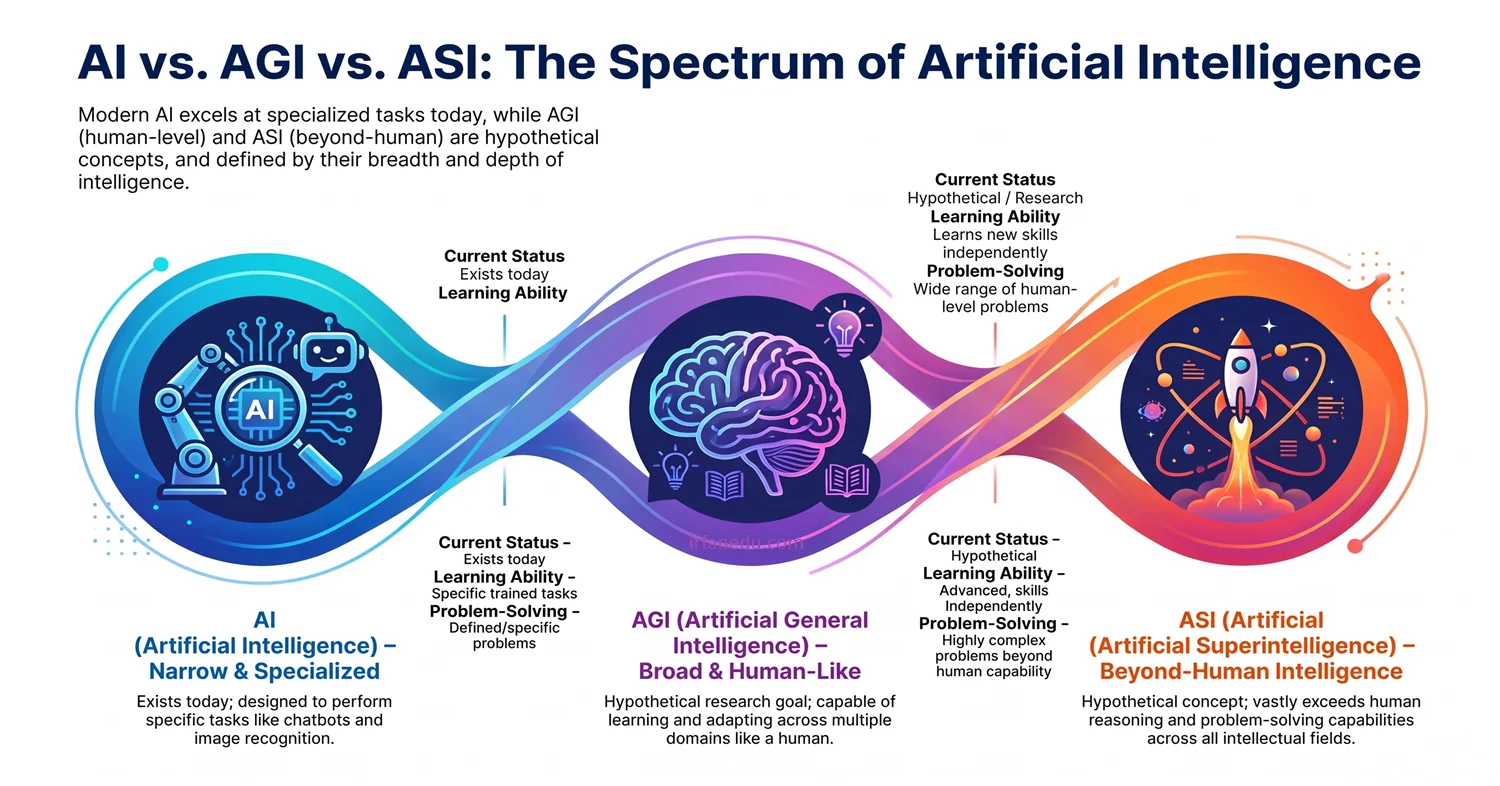
Artificial Intelligence is developing rapidly, but not every AI system has the same level of intelligence, flexibility or ability to handle different types of problems.
The terms AI, AGI and ASI are often used together, but they represent different concepts. Understanding these differences is important for students, teachers, researchers and technology professionals.
This article explains Artificial Intelligence (AI), Artificial General Intelligence (AGI) and Artificial Superintelligence (ASI) using simple definitions, examples, comparison tables and practical applications.
AI → AGI → ASI
A conceptual progression from specialized intelligence to general-purpose intelligence and, theoretically, superhuman intelligence.
Specialized → General → Superhuman
What Is Artificial Intelligence (AI)?
Artificial Intelligence (AI) is the broad field of creating computer-based systems that can perform tasks associated with capabilities such as learning, prediction, perception, reasoning, communication and decision-making.
Many AI systems are designed for specific tasks. A system may recognize objects in images, detect fraud, recommend products, translate languages, generate content or assist with customer service.
Examples of AI Applications
- Chatbots and virtual assistants
- Image recognition
- Recommendation systems
- Fraud detection
- Speech recognition
- Machine translation
- Medical image analysis
- Autonomous driving technologies
- Generative AI for text, images, audio and video
What Is Artificial General Intelligence (AGI)?
Artificial General Intelligence (AGI) refers to a hypothetical form of AI designed to demonstrate broad intellectual capabilities across many different tasks rather than being limited to a particular domain.
When researchers discuss AGI, commonly discussed characteristics include learning new tasks, reasoning, adaptation, generalization and transferring knowledge between different domains.
Potential Characteristics of AGI
- Broad problem-solving ability
- Learning new tasks
- Transfer of knowledge between domains
- Adaptation to unfamiliar situations
- Flexible reasoning
- Broad cognitive capability
What Is Artificial Superintelligence (ASI)?
Artificial Superintelligence (ASI) refers to a hypothetical AI system whose general intellectual capabilities substantially exceed those of humans across a broad range of cognitive tasks.
The concept is generally discussed in relation to areas such as scientific reasoning, mathematical problem-solving, strategic planning, programming and other intellectual activities.
Potential Characteristics of ASI
- Very advanced reasoning
- Broad problem-solving capability
- Advanced scientific and mathematical reasoning
- Ability to work across many domains
- Potentially very advanced learning and adaptation
- Potentially superior performance across many intellectual tasks
AI vs AGI vs ASI: Key Differences
| Feature | AI | AGI | ASI |
|---|---|---|---|
| Full form | Artificial Intelligence | Artificial General Intelligence | Artificial Superintelligence |
| Main idea | Intelligent task performance | General-purpose intelligence | Superhuman general intelligence |
| Scope | Often specialized or task-oriented | Broad across domains | Broad and potentially superhuman |
| Learning | Depends on system and training | Expected to learn new tasks | Theoretically highly advanced |
| Knowledge transfer | Can vary by system | Expected to transfer knowledge across domains | Expected to be highly capable across domains |
| Human-level generality | Not necessarily | Central concept | Expected to exceed human capability |
| Status | Widely deployed | Hypothetical / debated | Hypothetical |
The Evolution of Intelligence: AI → AGI → ASI
AI — Specialized Intelligence
AI systems can be designed to solve particular problems such as image classification, language generation, recommendation, prediction or fraud detection.
High performance in a particular task does not automatically mean that a system has general intelligence.
AGI — General Intelligence
AGI represents a theoretical transition toward systems capable of handling a much broader range of intellectual tasks and adapting to unfamiliar situations.
Generalization, learning, reasoning and knowledge transfer are important ideas in discussions about AGI.
ASI — Superhuman Intelligence
ASI represents a theoretical stage in which an AI system could substantially exceed human intellectual performance across a broad range of cognitive tasks.
Because ASI does not currently exist as an established technology, discussions about it remain theoretical.
Is Today’s AI Already AGI?
Modern AI systems can perform a wide variety of tasks. Some systems can process language, images, audio, code and other forms of information.
However, broad capability alone does not provide a universally accepted answer to whether a system qualifies as AGI.
Different researchers use different criteria involving generality, performance, learning, autonomy and adaptation.
Why Is AGI Difficult to Define?
Human intelligence involves many capabilities, including learning, reasoning, communication, problem-solving, adaptation and knowledge transfer.
Because intelligence is multidimensional, researchers have proposed different approaches to defining AGI.
- Human-level performance across cognitive tasks
- Ability to learn new tasks
- Flexible problem-solving
- Knowledge transfer between domains
- Adaptability to unfamiliar environments
- Broad practical usefulness
- General reasoning ability
AI vs AGI vs ASI: Simple Real-World Examples
| Situation | AI | AGI | ASI |
|---|---|---|---|
| Physics | Can solve supported problem types | Could potentially learn unfamiliar physics problems | Could theoretically exceed human experts broadly |
| Programming | Can generate and assist with code | Could potentially learn new programming environments | Could theoretically exceed human software engineering capabilities |
| Learning | Depends on model and training | Expected to adapt to new tasks | Potentially extremely advanced |
| Scientific research | Can assist researchers | Could potentially perform broader research tasks | Could theoretically discover solutions beyond current human capability |
Potential Applications of AGI
If AGI becomes technically feasible, its potential applications could extend across many sectors.
- Education: adaptive personal learning assistants
- Healthcare: assistance with research and analysis
- Science: hypothesis generation and data analysis
- Engineering: design optimization and simulation
- Programming: broader software development assistance
- Business: planning and analytical support
- Robotics: flexible task learning
- Research: cross-disciplinary knowledge synthesis
Potential Impact of ASI
ASI discussions involve the possibility of AI systems that substantially exceed human capabilities across many intellectual activities.
Potential benefits discussed in the field include faster scientific discovery, advanced engineering, improved optimization and assistance with difficult technical problems.
At the same time, advanced AI raises questions involving safety, alignment, cybersecurity, governance, economic disruption and human oversight.
What Should Students Learn in the AI Era?
Regardless of when or whether AGI or ASI becomes possible, students can benefit from developing strong technical foundations and human-centered problem-solving skills.
AI vs AGI vs ASI: What Should You Remember?
The most important distinction is that these terms describe different concepts of machine capability.
AI is the broad field of artificial intelligence. AGI refers to a hypothetical form of broadly capable general intelligence. ASI refers to a hypothetical form of intelligence that substantially exceeds humans across a broad range of intellectual tasks.
Frequently Asked Questions About AI, AGI and ASI
What is the difference between AI and AGI?
AI is the broad field of artificial intelligence and includes systems designed for particular tasks. AGI refers to a hypothetical system with broad, general-purpose intellectual capabilities across many domains.
Does AGI exist today?
There is no universally accepted definition or benchmark that establishes that AGI has been achieved. Claims about AGI depend on the criteria and evaluation framework being used.
What does ASI mean?
ASI stands for Artificial Superintelligence. It refers to a hypothetical AI system whose general intellectual capabilities substantially exceed those of humans across a broad range of cognitive tasks.
Is ChatGPT AGI?
Whether a current AI system qualifies as AGI depends on the definition and benchmark used. There is no universally accepted AGI standard, and broad capability alone does not settle the question.
Will AGI replace all human jobs?
The employment impact of future AGI is uncertain. Different occupations involve different combinations of physical work, judgment, communication, creativity and responsibility. The effect would depend on the actual capabilities and deployment of future systems.
Is ASI more powerful than AGI?
Conceptually, AGI refers to broad general intelligence, while ASI refers to hypothetical intelligence that substantially exceeds humans across a broad range of intellectual tasks.
What should students learn for the future of AI?
Students can build a strong foundation through mathematics, programming, machine learning, data science, generative AI, critical thinking, communication and domain expertise.
Conclusion
The journey from AI to AGI to ASI provides a useful conceptual framework for understanding discussions about increasingly capable artificial intelligence.
Today’s AI already provides powerful capabilities across many specialized and increasingly broad tasks. AGI represents a debated and hypothetical threshold of general machine intelligence, while ASI represents a further hypothetical stage involving intelligence that could exceed humans across a broad range of cognitive activities.
For students and professionals, the practical approach is to understand AI fundamentals, learn how modern AI systems work and develop the ability to use AI responsibly to solve real-world problems.
The future of technology will increasingly require people who understand both intelligent systems and the real-world problems those systems are designed to solve.